The Hanged Man tarot card meaning is a pause that lets you see things from a different perspective. Upright, it often points to acceptance, patience, and a willing change of approach. Reversed, it can describe resistance, a delay that has lost its purpose, or readiness to stop waiting. The useful question is whether your pause is helping you understand something or keeping you stuck.
You might have sent an application and be waiting for a reply, reached an impasse with a friend, or realised that working harder is not solving the problem. The Hanged Man card invites a new perspective before another push. Surrender here means releasing the need to control every outcome. It does not mean surrendering your safety, consent, or ability to make choices.
The Hanged Man Tarot Card Meaning at a Glance
- Hanged Man keywords: pause, surrender, patience, perspective
- Upright meaning: waiting, letting go, and finding a new point of view
- Reversed meaning: feeling stuck, resisting the lesson, or pausing for too long
- Yes or no: Not right now. Wait and look at the situation from another angle.
- Best question to ask: What would I notice if I stopped forcing this particular answer?
The upright Hanged Man meaning: a useful pause
The upright Hanged Man encourages you to pause long enough to notice what your usual approach misses. Perhaps every discussion has become an argument about who is right. Listening for what the other person needs may give you more to work with than another perfectly prepared defence.
Acceptance can be practical. If a decision depends on information you do not yet have, making any decisions just to escape uncertainty can leave you with a problem you could have avoided. Check what you can check, set a time to follow up, then let yourself do something else. A purposeful wait has a reason and a review point.
Many modern readings describe this as voluntary surrender. You may let go of something such as an outdated plan or the need to win an argument. That differs from giving up a value that matters to you. A changed approach should leave you more able to choose, not less.
The Hanged Man in a tarot reading: context matters
The meaning of the Hanged Man depends on the question and the position of the Hanged Man in the spread. In an advice position, it may suggest observation before action. In an obstacle position, it could describe a situation that is on hold or your own reluctance to decide. Neither reading tells you to wait indefinitely.
In a past-present-next-step tarot spread, a past Hanged Man can invite reflection on an earlier delay. In the present, ask what is suspended now. As a next step, try a different approach rather than treating the card as a fixed prediction. The card reflects a possible way to understand the situation; check it against what is happening.
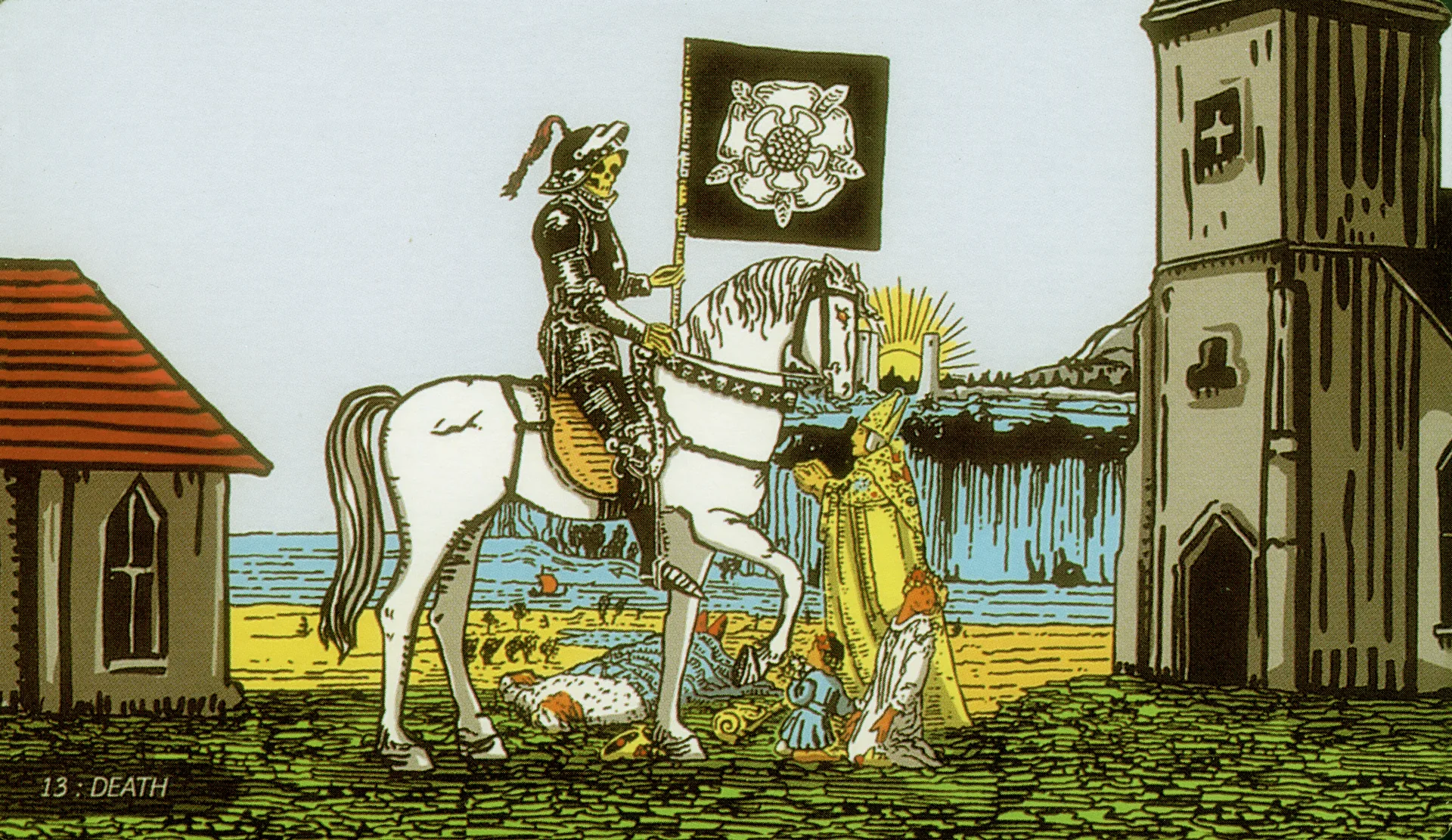
Surrounding cards add detail. Beside the Chariot, consider whether determination has become forcing an outcome. Beside Justice, use the pause to check facts and responsibilities. Beside Death, the question may be whether an old arrangement needs to end rather than receive another extension. These are reading examples, not promises about what will happen.
The Hanged Man in love and relationships
In a love tarot reading, the Hanged Man can indicate a need to stop repeating the same conversation in the same way. If you are partnered, agree on a short break from an argument and a time to return to it. You might discover that the disagreement concerns feeling heard, not just the weekend plans you were discussing.
If you are single, a pause from chasing an unavailable person may leave room to notice who makes an effort with you. You do not need to hurry a relationship to the next stage to prove it matters. Notice whether the pace works for both people, and talk about that openly.
Reversed, the Hanged Man may suggest that waiting for change has become one-sided. Reassess an arrangement in which you keep giving up your needs while the other person makes no effort. The card cannot establish someone's private feelings or guarantee a reunion. Patience is not an obligation to stay in an abusive or unsafe relationship.
The Hanged Man in career, money, and school
At work, the Hanged Man suggests looking at a stalled task from another angle. If a project keeps returning for revisions, ask for a concrete example of the expected result before doing it again. You may need a clearer brief rather than another late night. Things may not be going as planned because the goal is unclear. Ask what a useful result would look like before spending more hours on it.
When a job application or promotion is on hold, make a follow-up plan and continue exploring your options. A delay outside your control does not require you to put the rest of your life on pause. Reversed, this card can prompt you to stop extending a deadline that nobody is taking seriously.
With money, wait before an optional purchase if you need time to understand its full cost. Compare fees, repayment terms, and your budget using reliable information. A card is not evidence that an investment will pay off, and waiting should not mean ignoring a bill or a real deadline.
For school or study, try explaining the difficult idea aloud, drawing it, or asking a different question. New ways of thinking can help when rereading the same page has stopped working. A short rest can be useful; repeatedly avoiding the assignment usually makes the next attempt harder.
The Hanged Man reversed: resistance or release
The Hanged Man reversed can point to feeling stuck, impatience, or a sacrifice that no longer makes sense. You might be waiting for perfect conditions before starting, or holding on to a plan because you have already given it so much time. Ask what further waiting would realistically change.
There is another possible reading: the pause has done its job and you are ready to move again. Turning a reversed tarot card upright is not always the goal. If you have gathered the information, heard the other viewpoint, and considered the consequences, it may be time to take the next step rather than begin another round of reflection.
Watch for the habit of becoming a martyr: doing everything yourself, saying nothing about what you need, then feeling resentful that nobody noticed. A direct request and a fair boundary give people something they can respond to. You do not have to earn support by exhausting yourself.
Choose the interpretation that fits the evidence. Are you refusing a necessary pause, trapped in a delay, or ready to leave it? For example, if you feel stuck because you are waiting for a promised reply, set a follow-up date. If you already have the answer but dislike it, consider what you need in order to move forward. The answer can change the advice completely. This card is not a verdict that you have failed a spiritual lesson.
The Hanged Man yes or no meaning
For a yes or no question about immediate action, this card often leans toward "not yet." It favours understanding the situation before committing. For a question about taking a planned break or reconsidering an approach, it can lean toward yes.
Reversed, ask whether you have enough information to act or whether frustration is making you rush. There is no universal yes or no answer for every question. If safety, medical care, a payment deadline, or legal responsibilities are involved, use appropriate real-world support rather than delaying because of a reading.
The Hanged Man advice: give the pause a purpose
Pick one issue and name what you are waiting for. It might be a reply, a quieter conversation, or time to compare two options. Decide when you will review it. This turns vague waiting into a choice you can revisit.
Try a small perspective exercise: write down your preferred outcome, then describe the situation as someone else might see it. You do not have to agree with that view. The point is to notice information your own frustration may have pushed aside.
Leave room for curiosity, too. A walk, sketch, or enjoyable afternoon away from the problem can make an ordinary new insight easier to notice. Think of the Hanged Man as a prompt to change your approach rather than punish yourself for a delay. Reflection can be worthwhile without becoming a solemn test. End by choosing something manageable you can do now.
One archetype, four perspectives
The Hanged Man Across Four Tarot Decks
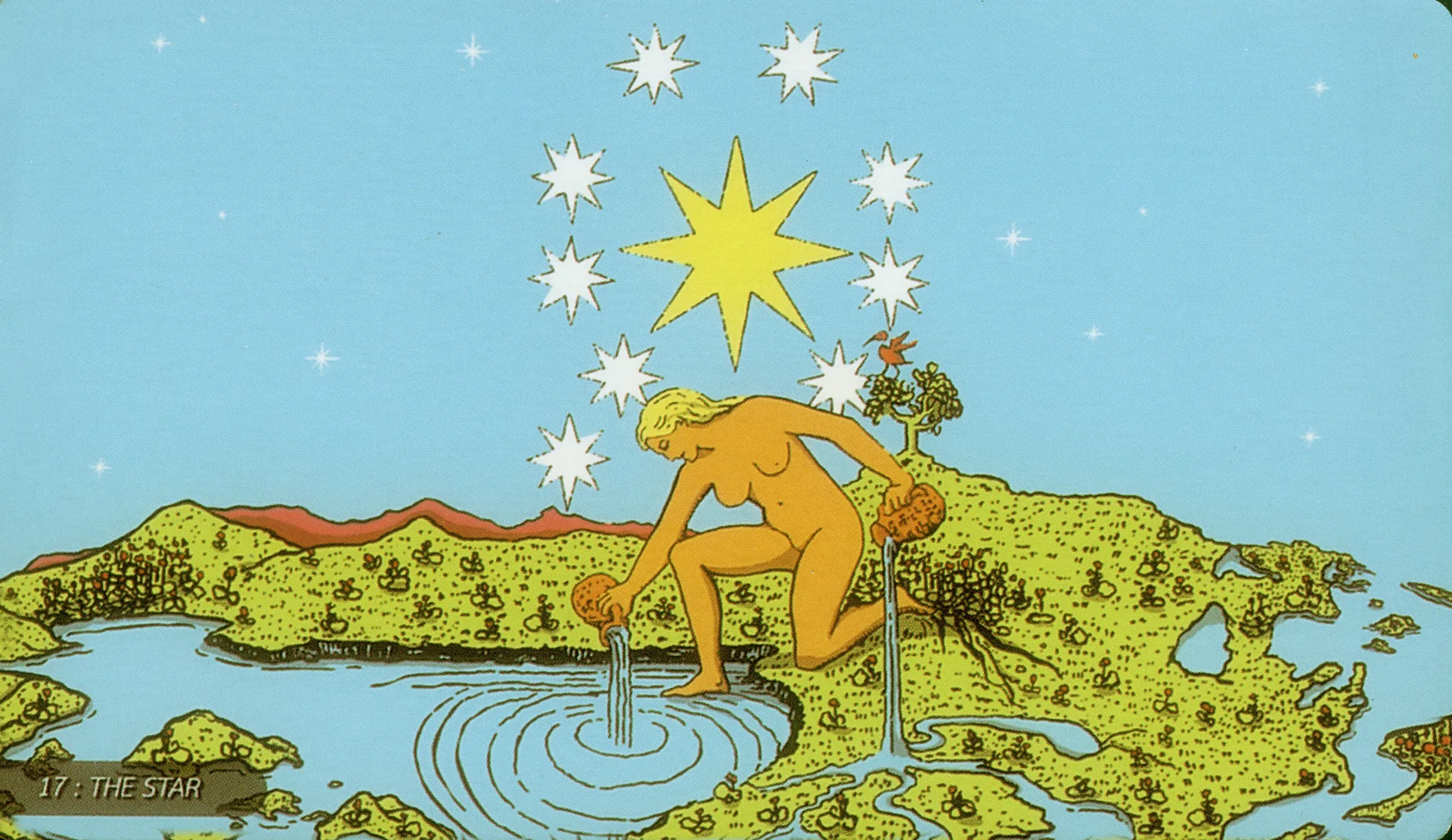
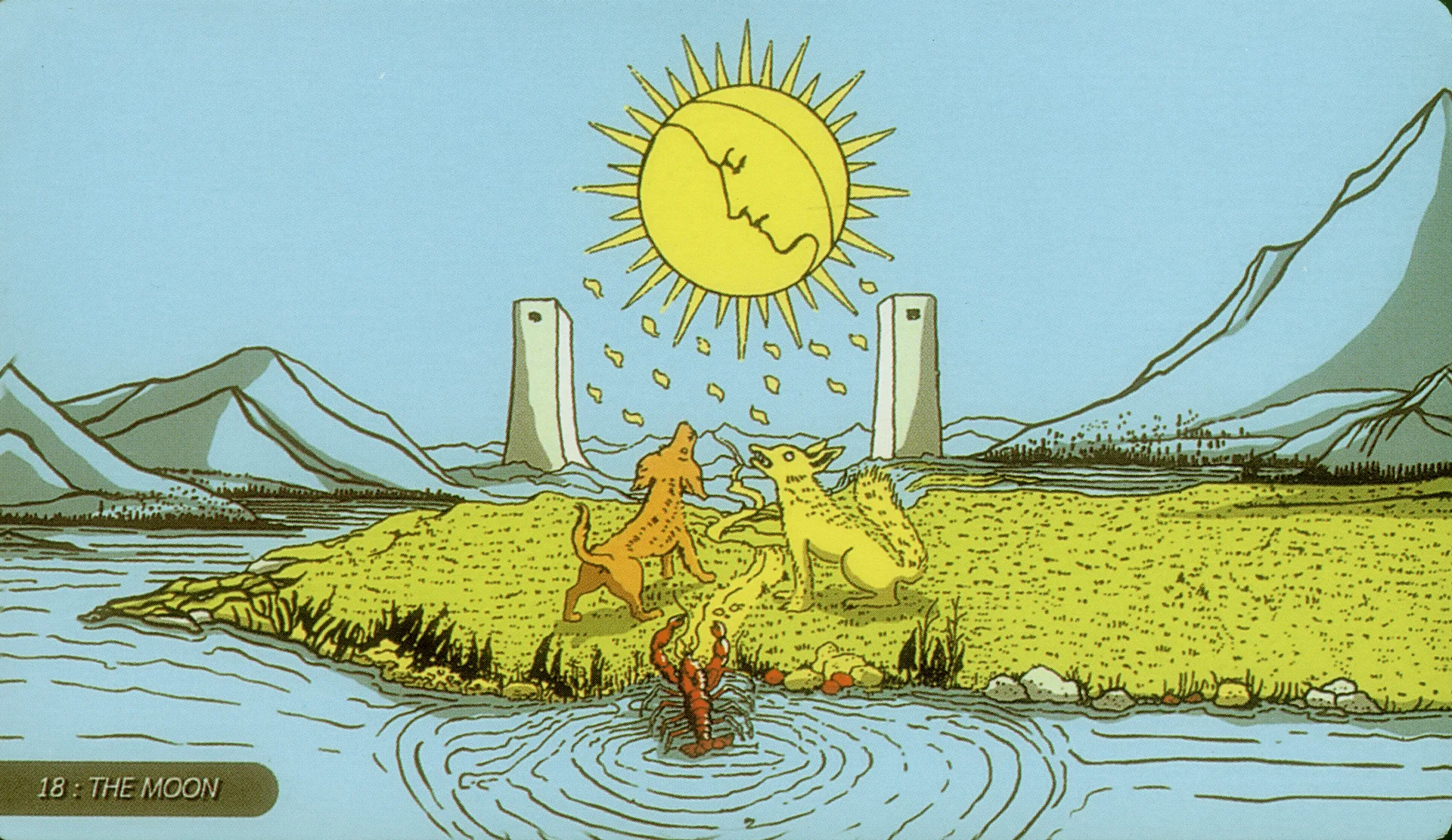
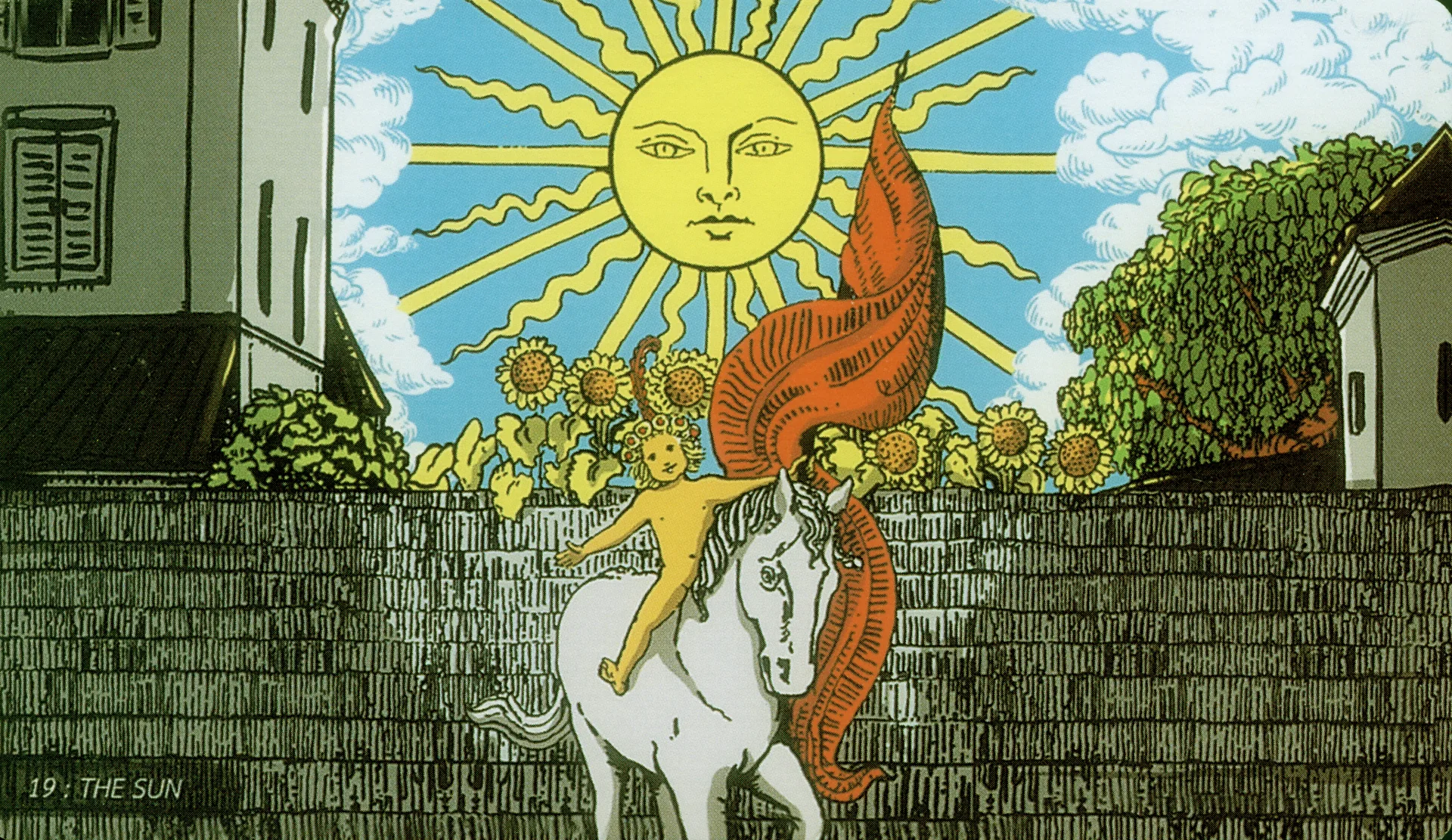
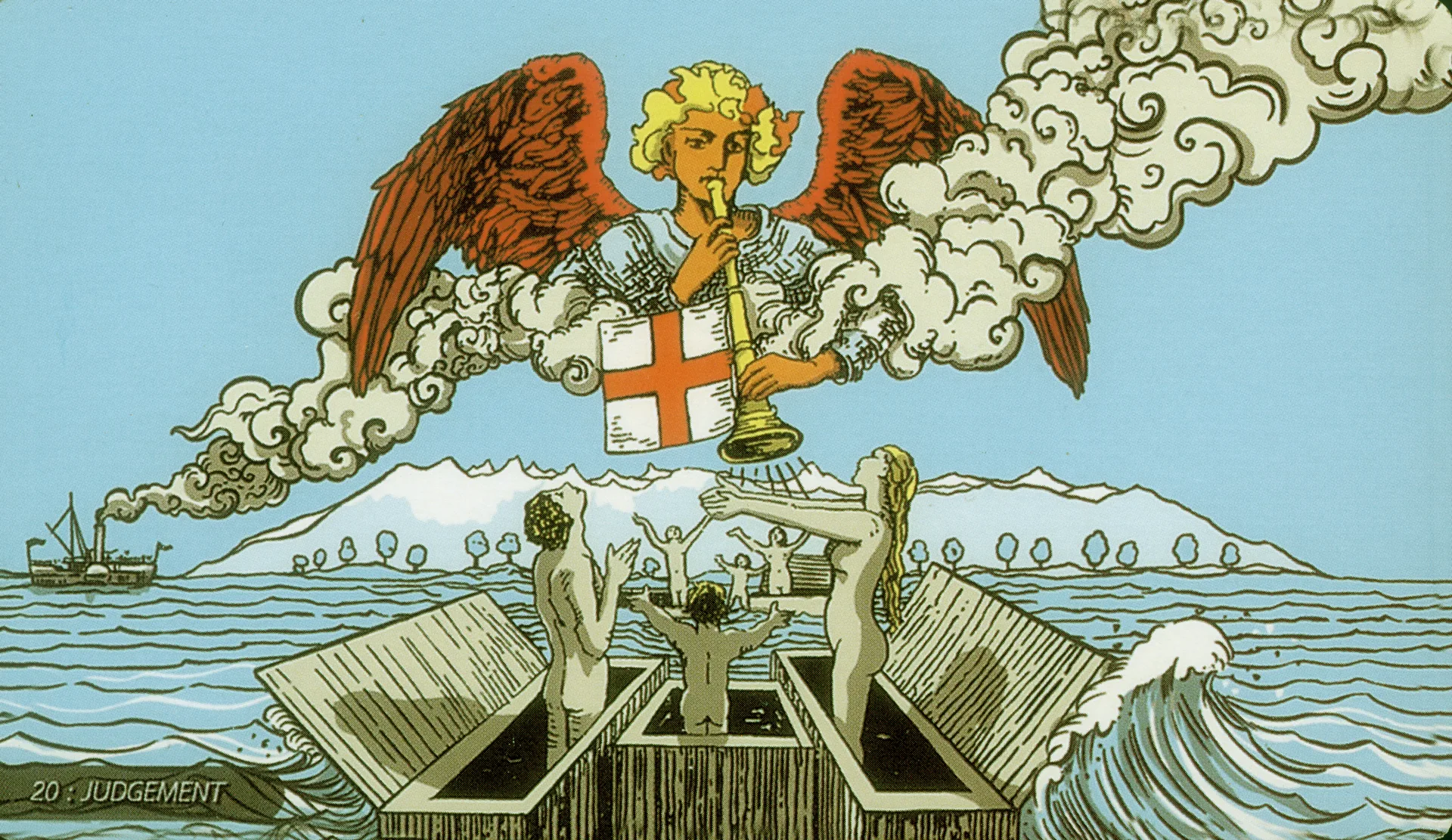
Compare the familiar Rider-Waite-Smith card with the moments before, behind and after the classic scene in three Lo Scarabeo decks.
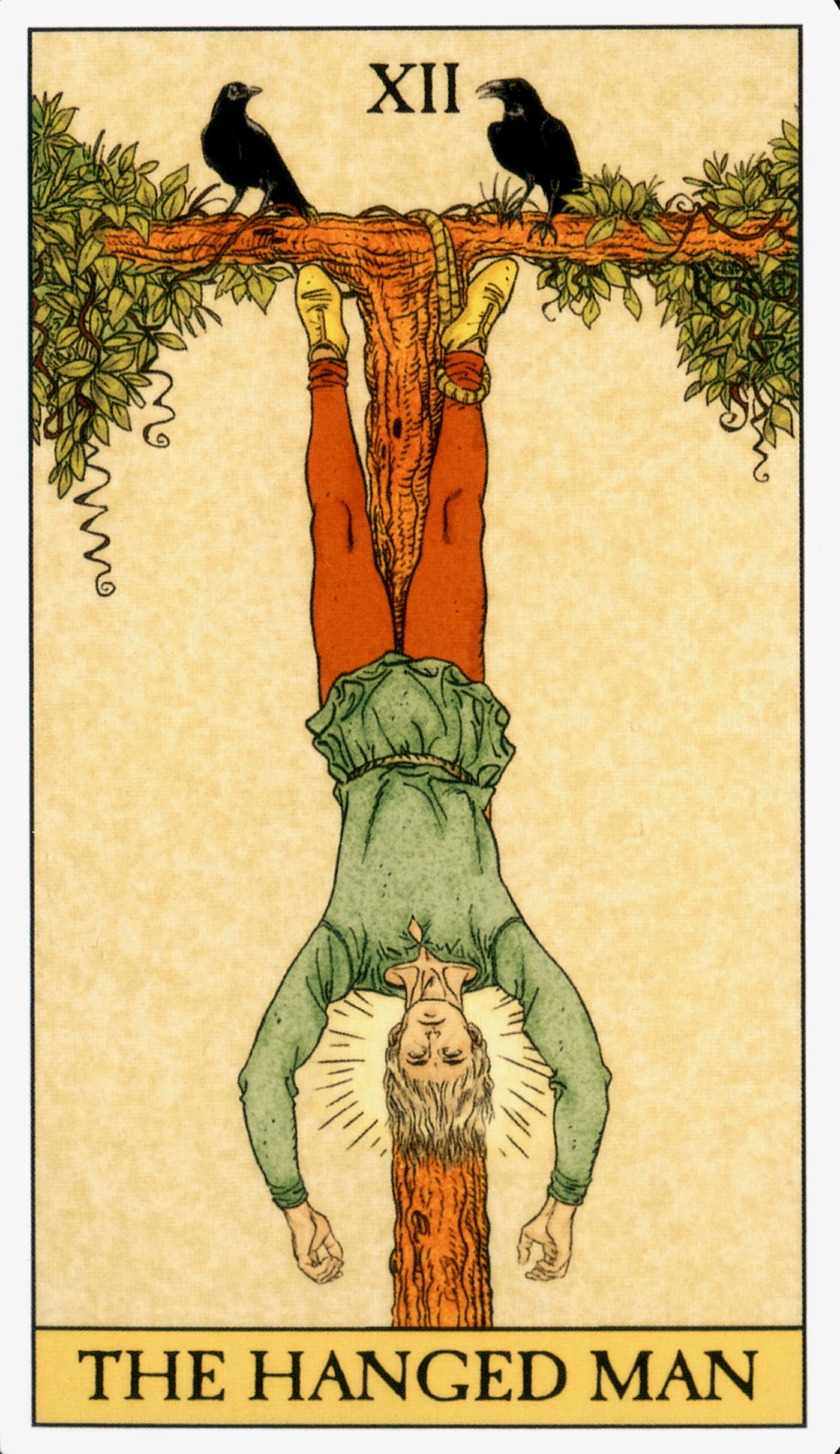
What apparently happens just before
What actually happened
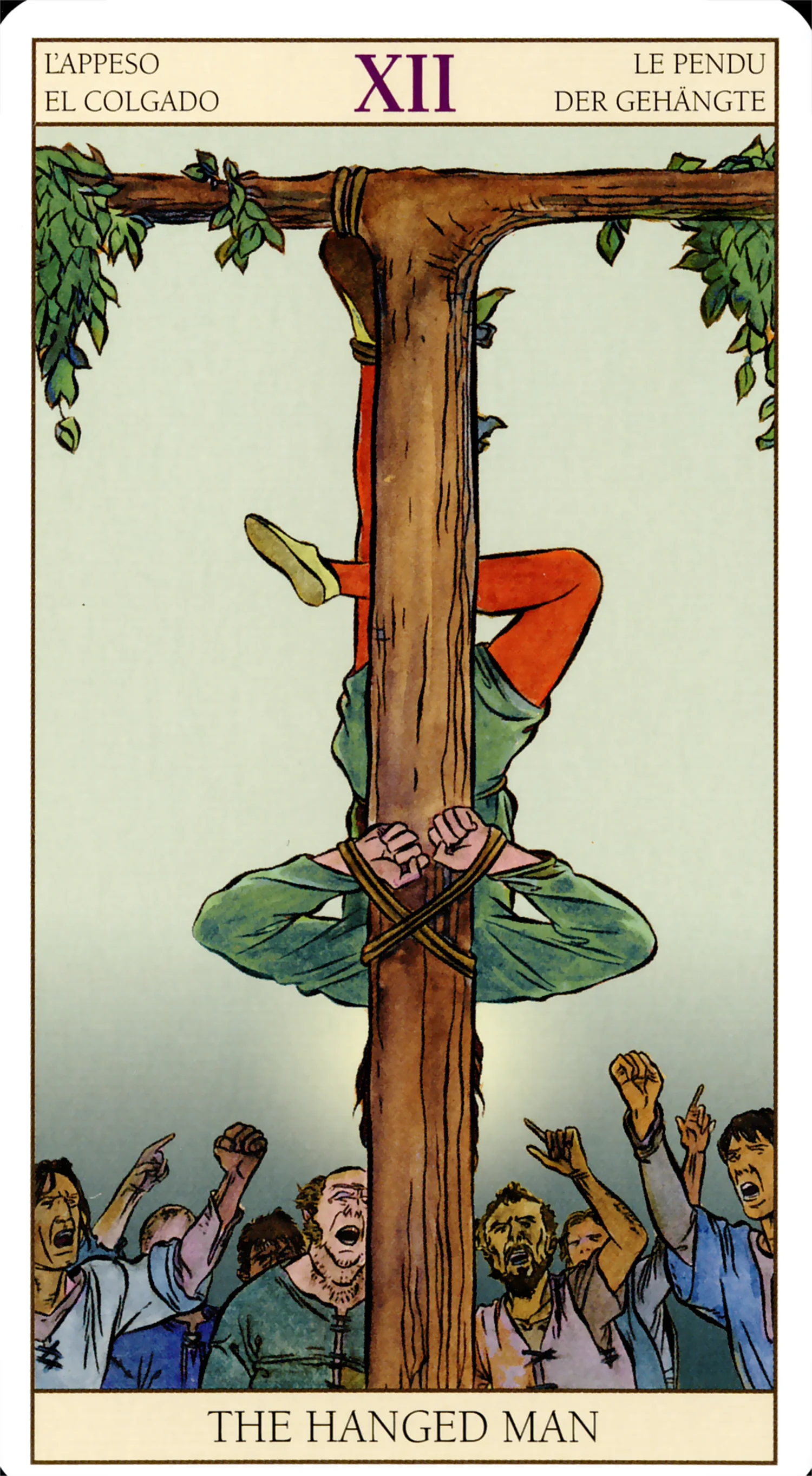
What happened on the opposite side
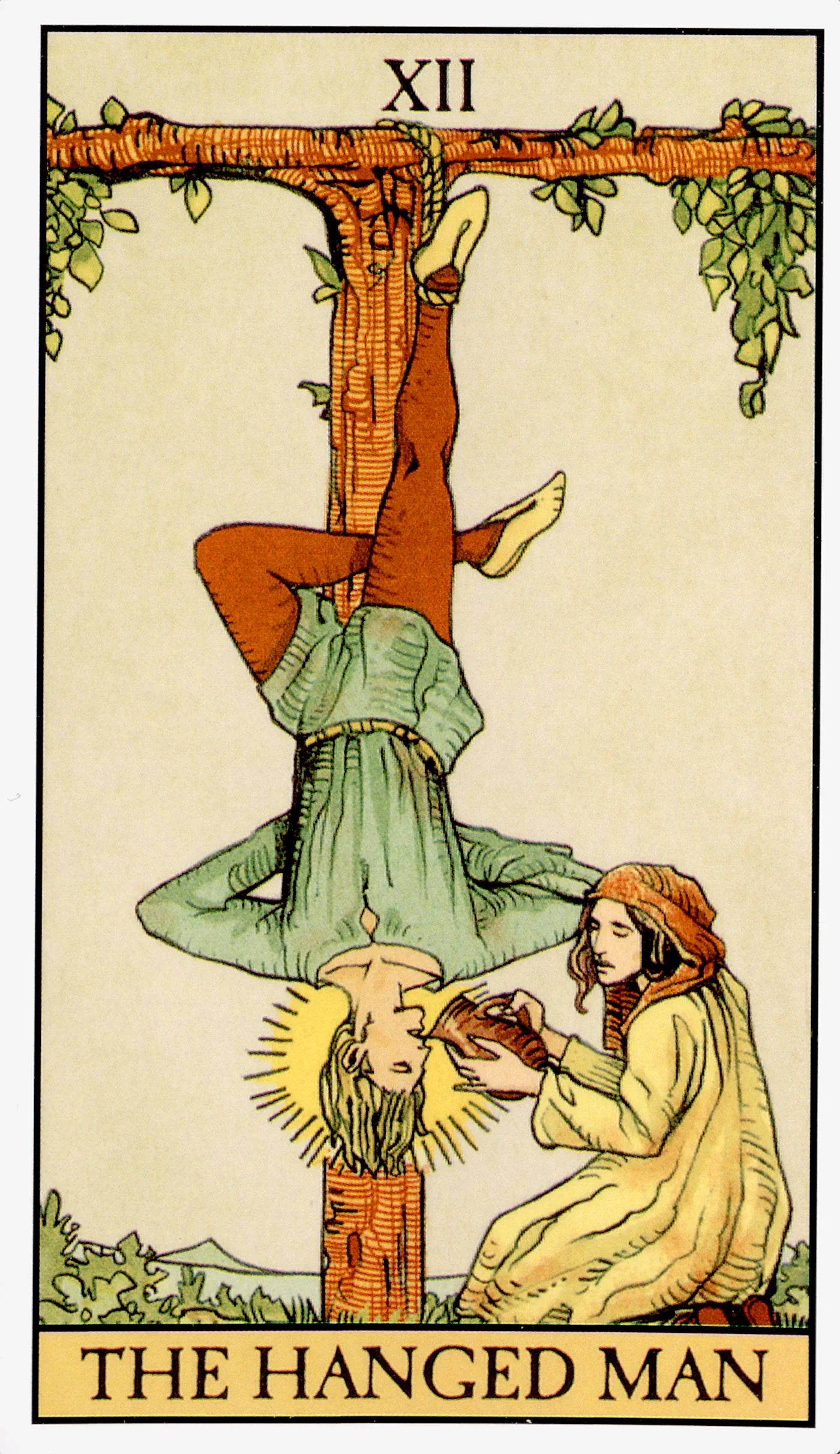
What apparently happened afterwards
The Hanged Man card description and symbols
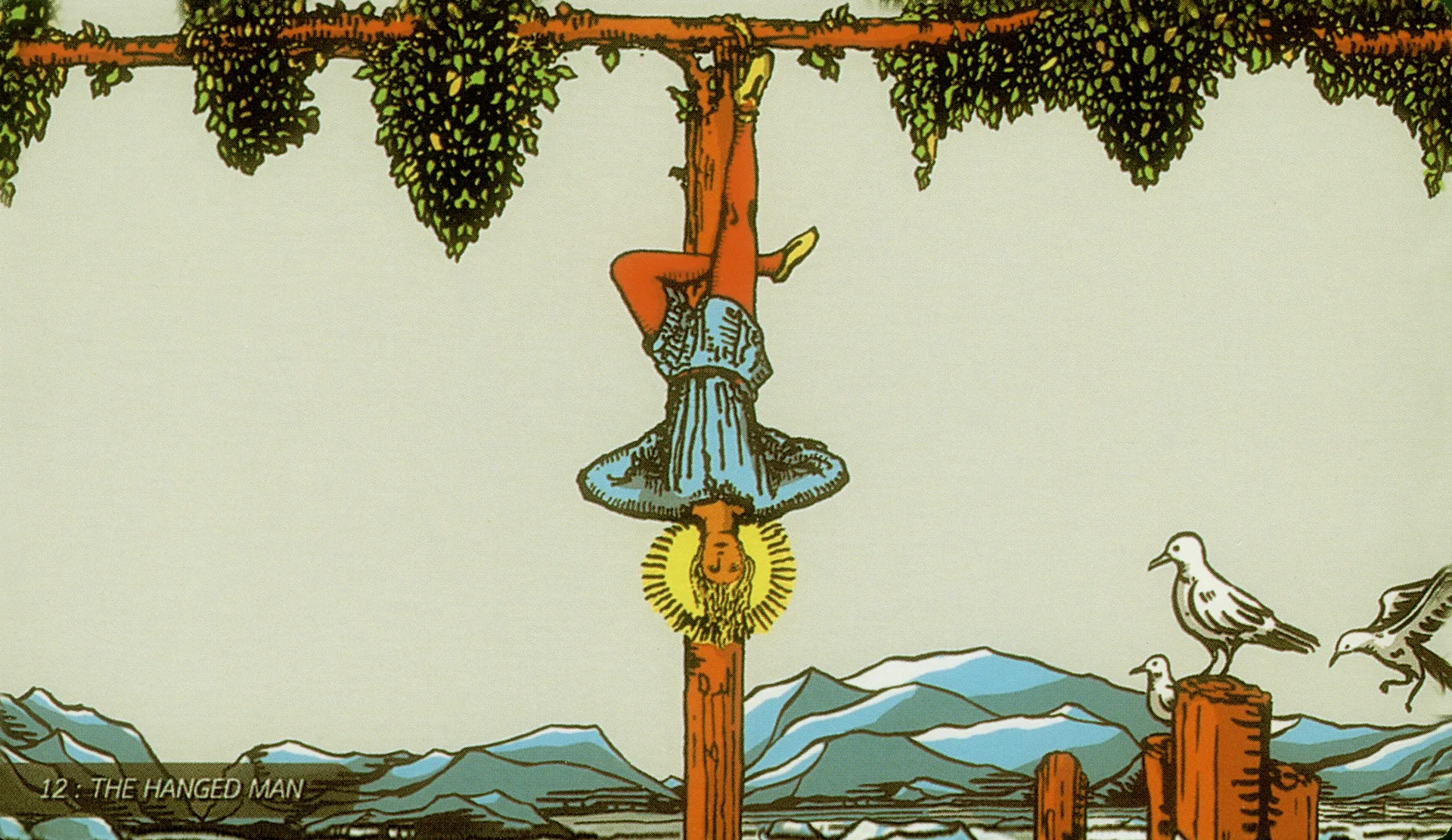
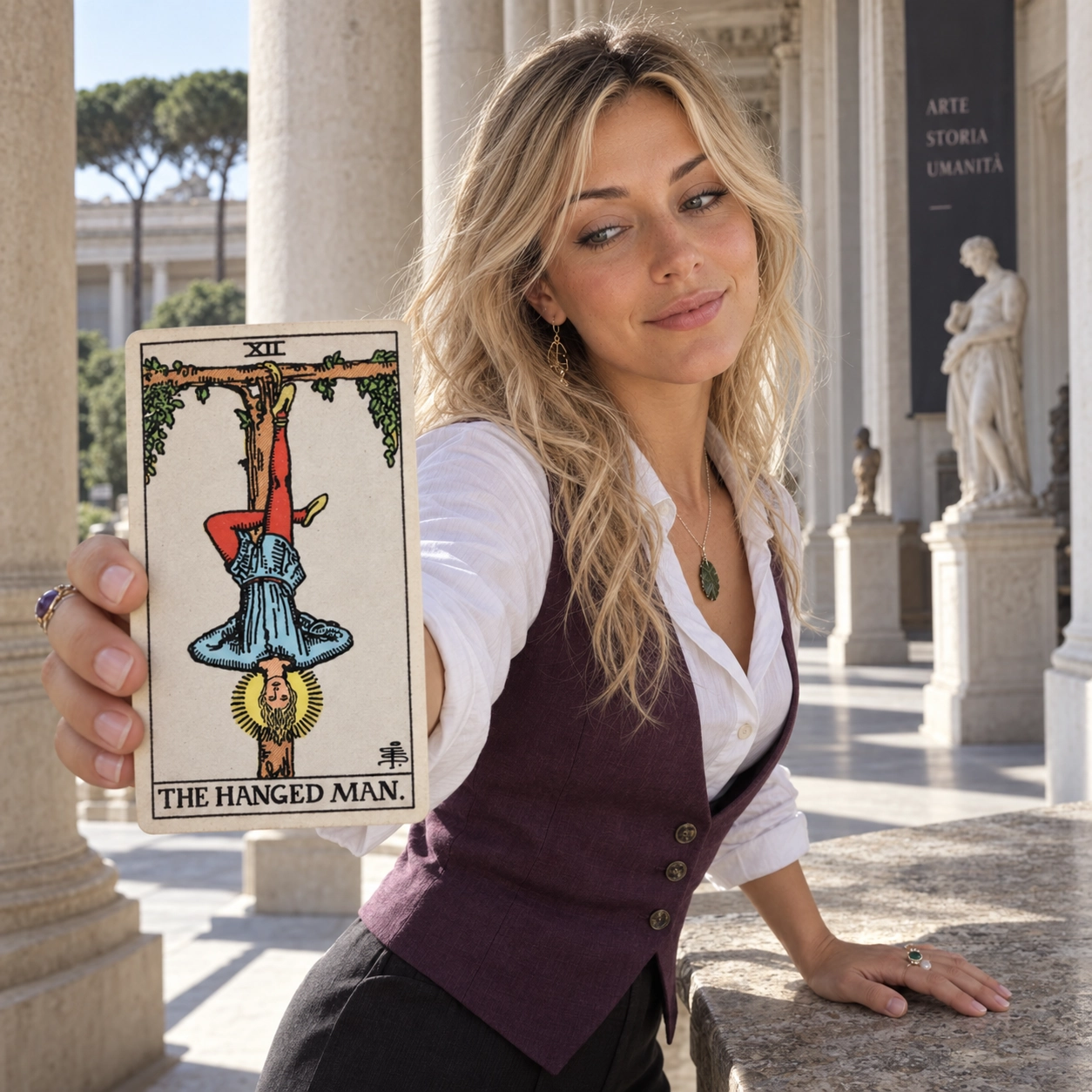
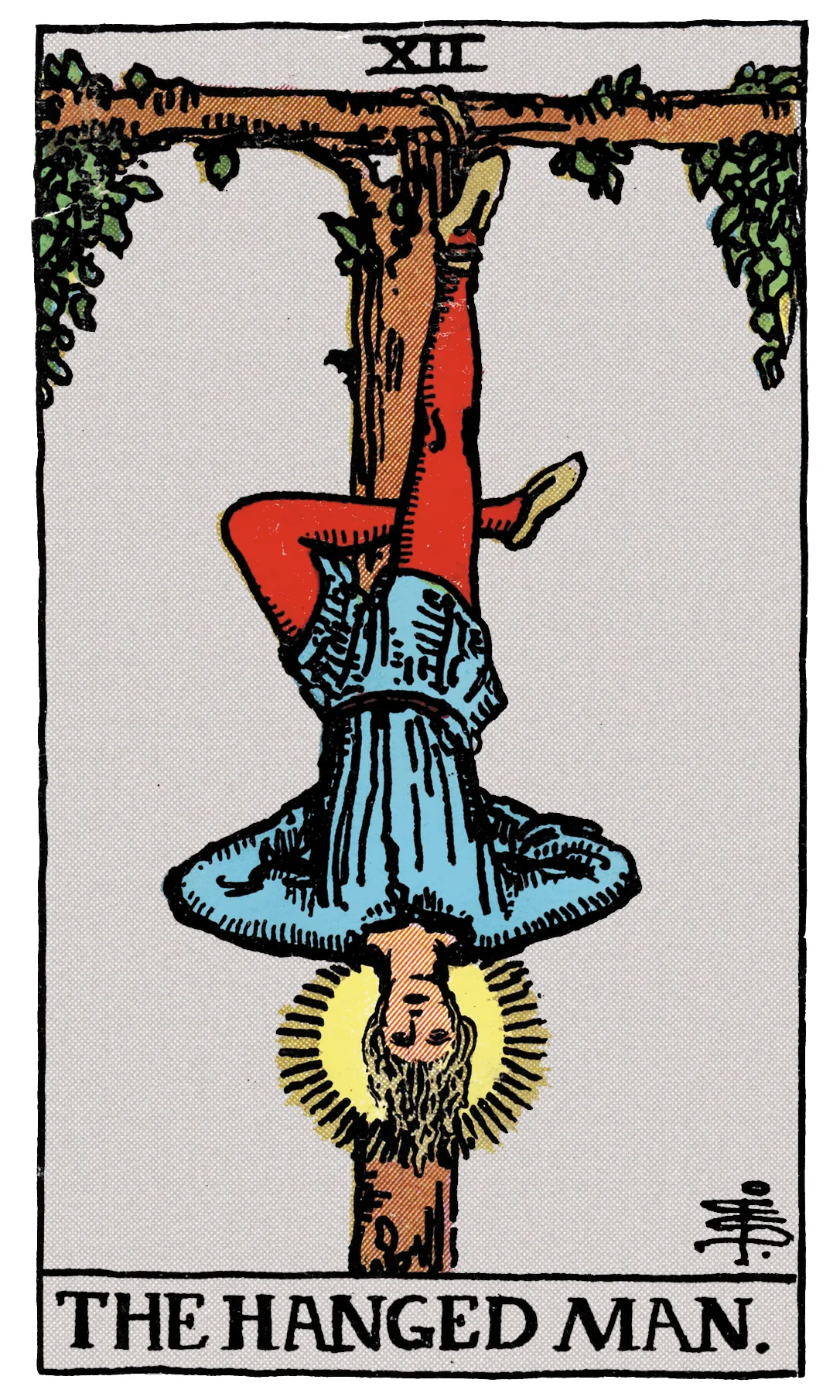
The Rider-Waite-Smith image shows a man hanging upside-down by one foot from a leafy, T-shaped wooden structure. His right foot is bound at the ankle; his left foot remains free, with that leg bent across the other. He wears red leggings, a blue garment, and pale yellow shoes. His other leg bends across the straight leg, his arms are behind his body, and a yellow halo surrounds his head. The numeral XII appears above him.
The Hanged Man is upside-down even when the card itself is upright. When you invert the card for a reversed reading, the figure looks head-up. That visual change does not automatically turn waiting into action; read it with the question and surrounding cards.
The light around the Hanged Man’s head is often interpreted as enlightenment or a change in perspective. His calm face supports a reading of contemplation rather than panic. In The Pictorial Key to the Tarot, A. E. Waite describes the tree as living wood and the figure as life in suspension, not death. He also rejects a simple equation of the image with martyrdom.
This is symbolic artwork, not an instruction to reproduce the pose or harm yourself. The RWS figure is suspended by an ankle, not hanged by the neck. A useful modern reading focuses on seeing differently and choosing what to release, without treating suffering as a requirement for wisdom.
The Hanged Man tarot card meanings and correspondences
This Major Arcana tarot card is numbered twelve in the Rider-Waite-Smith sequence. Traditional tarot decks also have a history of game playing; divination is not their only use. Different versions of the tarot change the image and the language used to interpret it, so inspect your own deck before applying every RWS detail.
In Golden Dawn-derived correspondences, the Hanged Man is linked with the element of Water and the Hebrew letter Mem. Some modern tarot readers associate it with Neptune. These are different layers of interpretation, not an original planetary assignment shared by every tradition. The connection between the Hanged Man and surrender can help explain why water imagery appeals to readers, but an association is not a prediction.
Some readers also compare the hanging figure with Odin's ordeal on the world tree in Norse myth. That comparison can explore knowledge gained through a changed viewpoint; it does not establish the card's historical origin. You need not adopt a mythology or spiritual belief to use the image as a prompt for reflection.
Helpful questions for reading the Hanged Man
As you learn to read tarot, keep the observation separate from the conclusion. "I see a man suspended with a calm expression" is an observation. "I need to stop forcing this conversation" is an interpretation to test against your circumstances.
- What part of this situation can I influence, and what is outside my control?
- What information would make this wait useful?
- Whose viewpoint have I not considered yet?
- What would tell me it is time to stop waiting?
A tarot journal can help you compare the first reading with what you notice later. Look at the Hanged Man before reaching for a tarot guide: what is the calm figure doing that your current approach leaves no room for? Write down the question, the position of the Hanged Man, and one practical action. Look for what you learned rather than turning every outcome into proof that the card was right.
One card, many perspectives
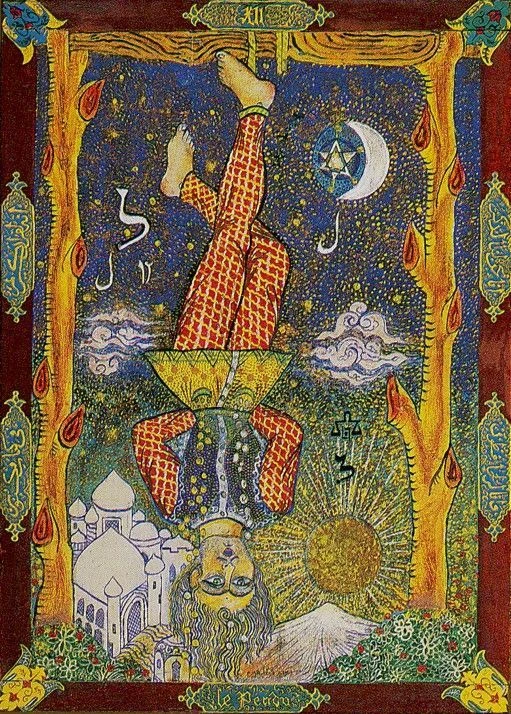
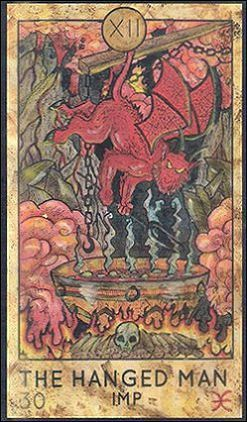
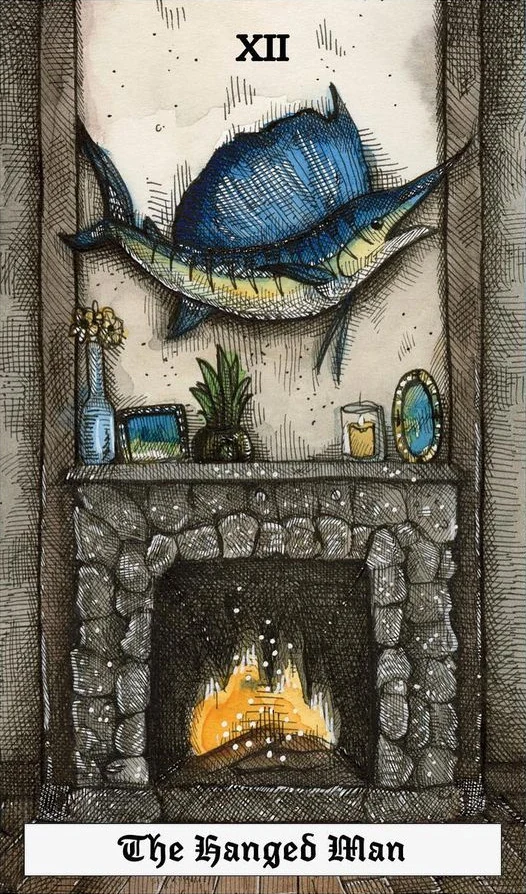
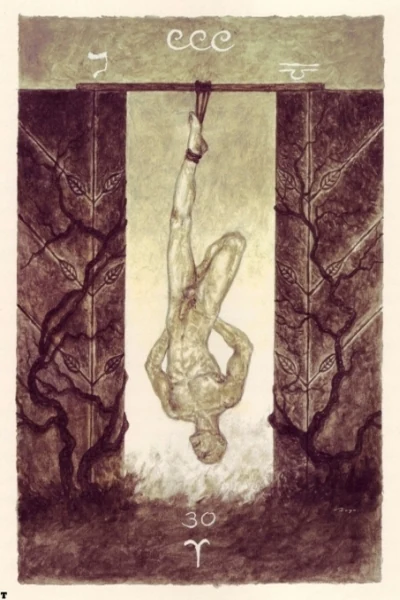
See The Hanged Man Card from Other Decks
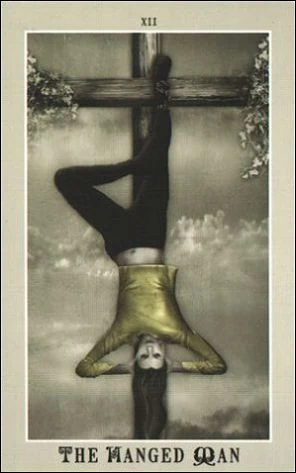
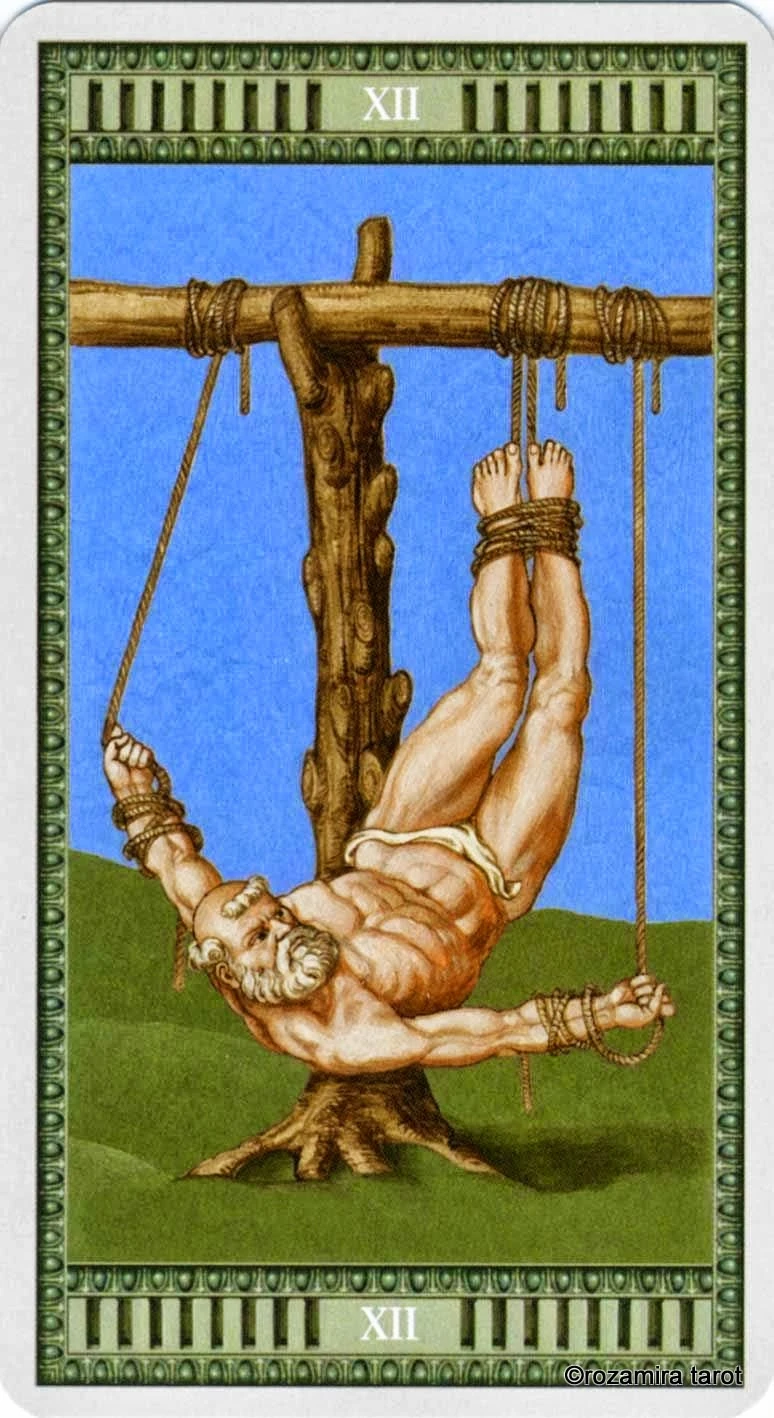
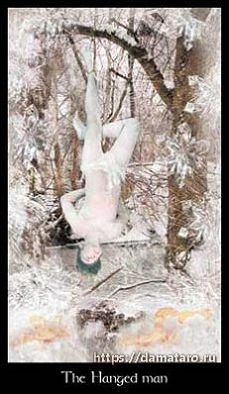
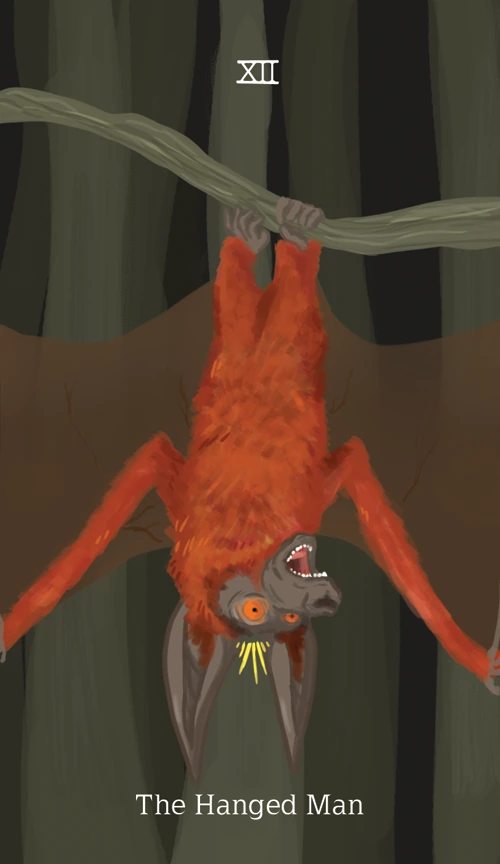
Discover how other tarot decks interpret this card. Select a deck to explore its full review and gallery.







The Hanged Man FAQ
What does the Hanged Man mean upright and reversed?
Upright, it often suggests a purposeful pause, acceptance, and a new perspective. Reversed, it can indicate resistance, unhelpful waiting, or readiness to move on. Your question and the facts help distinguish those possibilities.
Does the Hanged Man mean something bad will happen?
No. The image is commonly read as suspension and reflection, not a prediction of harm or death. It does not ask you to hurt yourself or endure an unsafe situation. Use it to consider your choices, not to forecast a disaster.
Is the Hanged Man a yes or no card?
It often leans toward not yet for immediate action, especially when you need more information. For a planned pause or a change of approach, it can lean toward yes. That is a contextual interpretation, not a guaranteed answer.
What should I do after pulling the Hanged Man?
Name what you are waiting for and set a time to review it. Try another viewpoint or ask a clearer question. If the pause has stopped helping, choose a manageable next step rather than extending it indefinitely.