Explore the Original Madam Clara Tarot Cards
Browse the verified Tarot cards in deck order. Filter by section, or open any card in the larger carousel to study the artwork and fortune ribbons closely.
Showing the selected card group.


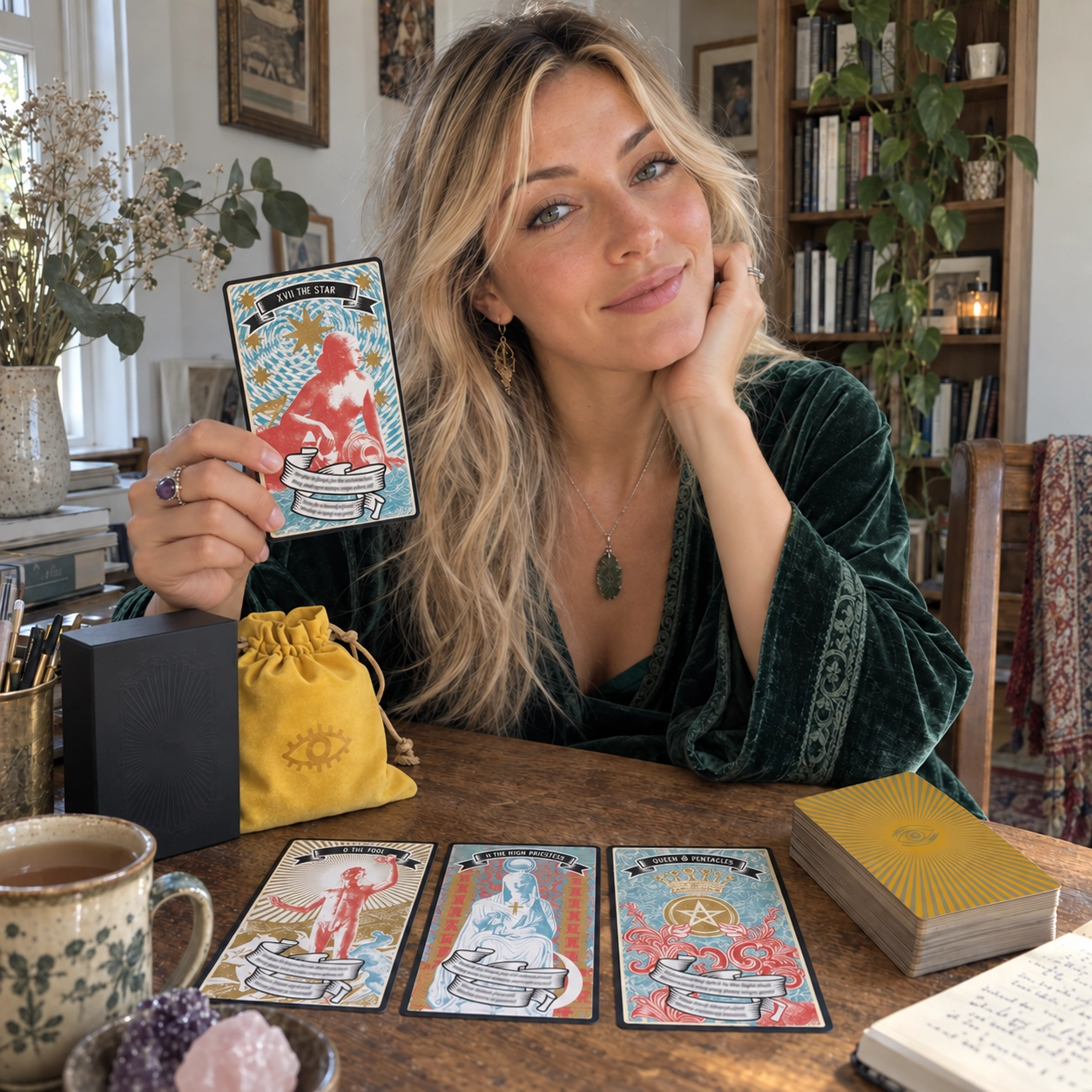
Aurica’s Quick Take
I love how Madam Clara Sees All! feels like a cabinet of old carnival posters flung open at midnight. Coral red, turquoise, mustard gold, and curious vintage figures give every card a little theatrical spark.
In a reading, my eye goes first to the strongest gesture—a raised hand, a turning wheel, or a cup held close. Then I let the fortune ribbon arrive like a second voice, checking whether its words agree with the picture or gently challenge it.
This is not a shy deck, and that is exactly its charm. Give its lively images room to speak, and they can help you meet a difficult question with curiosity, courage, and a brighter sense of possibility.
What makes the Original Madam Clara Tarot different?
Most collage decks ask you to decode the assembled source material. Madam Clara’s Original Deck does something more immediate: it stages each card like a fortune-teller’s poster. A central figure or emblem meets a burst of rays, a black title banner, and a white ribbon carrying two directional prompts. The result feels part carnival broadside, part mid-century screen print, and part practical reading cue.
The palette changes from card to card but keeps returning to turquoise, coral red, mustard gold, cream, and black. Those colors create continuity even when the source imagery shifts from sculpture to engraving, flora, animals, tools, or abstract rays. The border system is strong enough that a mixed spread still reads as one visual sentence.
The Fool — a fresh start with one foot already moving
A bare figure steps between gold sunbursts, an uplifted red flower, and a pale animal at the edge of the frame. The image is unusually exposed and kinetic. Its visible fortune text points toward following the heart and looking before the leap, letting openness and caution occupy the same card.
In practice, this Fool works well as a permission card—but not as permission to ignore the terrain. Ask what deserves a wholehearted beginning, then name the one practical check that keeps enthusiasm from becoming carelessness.
How the Original Madam Clara Tarot reads in practice
Start with the loudest element: posture, object, direction, or burst of color. Then read the fortune ribbon as a second voice—not a fixed definition. Because each ribbon presents upright and reversed wording, it can help a hesitant reader begin, but the picture should still be allowed to contradict or complicate the printed cue.
The deck is particularly good at questions that need movement: What is changing? Who has leverage? Where is energy gathering? Courts are assertive, suit emblems are easy to spot, and even quiet cards keep a poster-like sense of momentum.
The fortune window
A compact decision spread that moves from personal agency to hidden knowledge, changing conditions, and directed action.
Read the first two cards as inner resources and the last two as movement. The synthesis question is: What can I direct without pretending I control the whole cycle?
Is the Original Madam Clara Tarot beginner-friendly?
It is friendlier than many art decks because the card names, suit structure, and courts remain familiar. The fortune ribbons also offer an immediate sentence when a beginner feels stuck. The risk is over-reliance: reading only the ribbon can flatten a rich image into a slogan.
A useful learning method is to cover the ribbon for the first minute. Name three visible details, describe the emotional temperature, and decide where the figure or object seems to be moving. Then reveal the ribbon and ask whether it confirms, narrows, or challenges your first impression.
Easy reading
What energy is most available today? Pull one card and name its clearest action before reading the ribbon.
Medium reading
What is changing beneath the surface? Read three cards as appearance, hidden pressure, and next move.
Deep reading
Whose story is shaping this choice? Compare the figures’ poses, directions, and repeated colors before adding traditional meanings.
Wheel of Fortune — the cycle has handles
The card centers a red wheel, entwined forms, a raised hand, and pale creatures beneath turquoise and gold rays. Its message about fortune returning is visually reinforced by circular motion, but the hand makes the turn feel participatory rather than purely accidental.
Read it as timing plus response. What is circling back? What can be grasped, released, or redirected now? The design is especially useful when a reading risks becoming vague about “fate,” because it returns attention to the part of the cycle you can touch.
Love, intimacy, and emotional truth
The Cups and relationship Majors do not whisper. Figures, vessels, tears, flowers, and red-white contrasts create an emotional register that is easy to feel at a glance. That directness can be useful when a reading needs honesty about attraction, disappointment, boundaries, or care.
For love readings, resist turning every dramatic color into drama in the relationship. Use the fortune ribbon as one layer, then ask what the bodies and objects are actually doing. Exchange is not the same as desire; grief is not the same as failure; compassion is not the same as self-erasure.
The heart beneath the banner
A relationship spread for separating attraction, exchange, grief, and emotional stewardship.
Do not force a happy or unhappy ending. Let the four positions distinguish chemistry from reciprocity, mourning, and the capacity to care wisely.
Work, money, and creative momentum
Pentacles are concrete and visually legible, while Wands bring strong posture and forward drive. Together they make the deck useful for career questions, launches, pricing, study, and the difference between inspiration and repeatable craft.
The Original Deck tends to make decisions look active. If a spread feels blocked, look for crossed forms, downward gazes, repeated tools, or a figure holding a single staff. Those details can show whether the real need is patience, skill-building, commitment, or leadership.
The practical crossroads
A work and money spread that tests whether an opening can survive effort, indecision, and leadership.
Follow the visual shift from offered coin to repeated work, crossed blades, and an upright staff. Opportunity becomes useful only after practice and a clear choice.
Rick Pomer’s art and fortune-telling voice
Rick “Madam Clara” Pomer is the creator, writer, and illustrator behind the independent deck and its MotelGiftShop project. That public persona matters to the design: this is not anonymous “vintage-style” decoration. The all-seeing eye, theatrical lettering, fortune language, and recurring rays build a complete parlor-world around the cards.
At the same time, the deck stays usable because its system is orderly. It follows a Rider–Waite-derived structure with Cups, Wands, Swords, and Pentacles; courts run Page, Knight, Queen, and King; Strength is VIII and Justice XI. The two extra Fate / Destiny / Fortune designs deliberately sit outside that standard sequence.
Fate, Destiny, Fortune — a deliberate interruption
The palmistry-hand card abandons the deck’s usual figurative scene for a near-black field, radiating gold lines, a labeled hand, and oversized lettering. Together with the skull version, it sits outside the familiar tarot sequence and announces the deck’s fortune-teller identity without disguise.
Use either special card as an oracle-like hinge: a sign that the reading’s next move is to synthesize rather than pull another conventional tarot card. The palm asks what is being shaped; the skull asks what must be accepted as finite.
When the usual sequence needs a pause
I find these extra Fate images most useful after the familiar cards have had their say. Rather than reaching for another neat definition, return to the question itself: what is within your reach, and what are you trying to hurry into an answer? The interruption can make room for a more honest conversation with the spread.
The following four-card study brings those two perspectives together with Death and The Sun. Let the images suggest what has run its course and what deserves fresh attention. There is no need to make their voices agree immediately; sometimes the useful insight is the tension between accepting a limit and choosing a generous next step.
Fate speaks in two voices
A deck-specific spread that lets the two special cards frame transformation and renewal.
Treat destiny as a conversation between limit and agency. Death clears the completed cycle; The Sun asks what becomes generous, visible, and alive afterward.
Buying and edition guidance
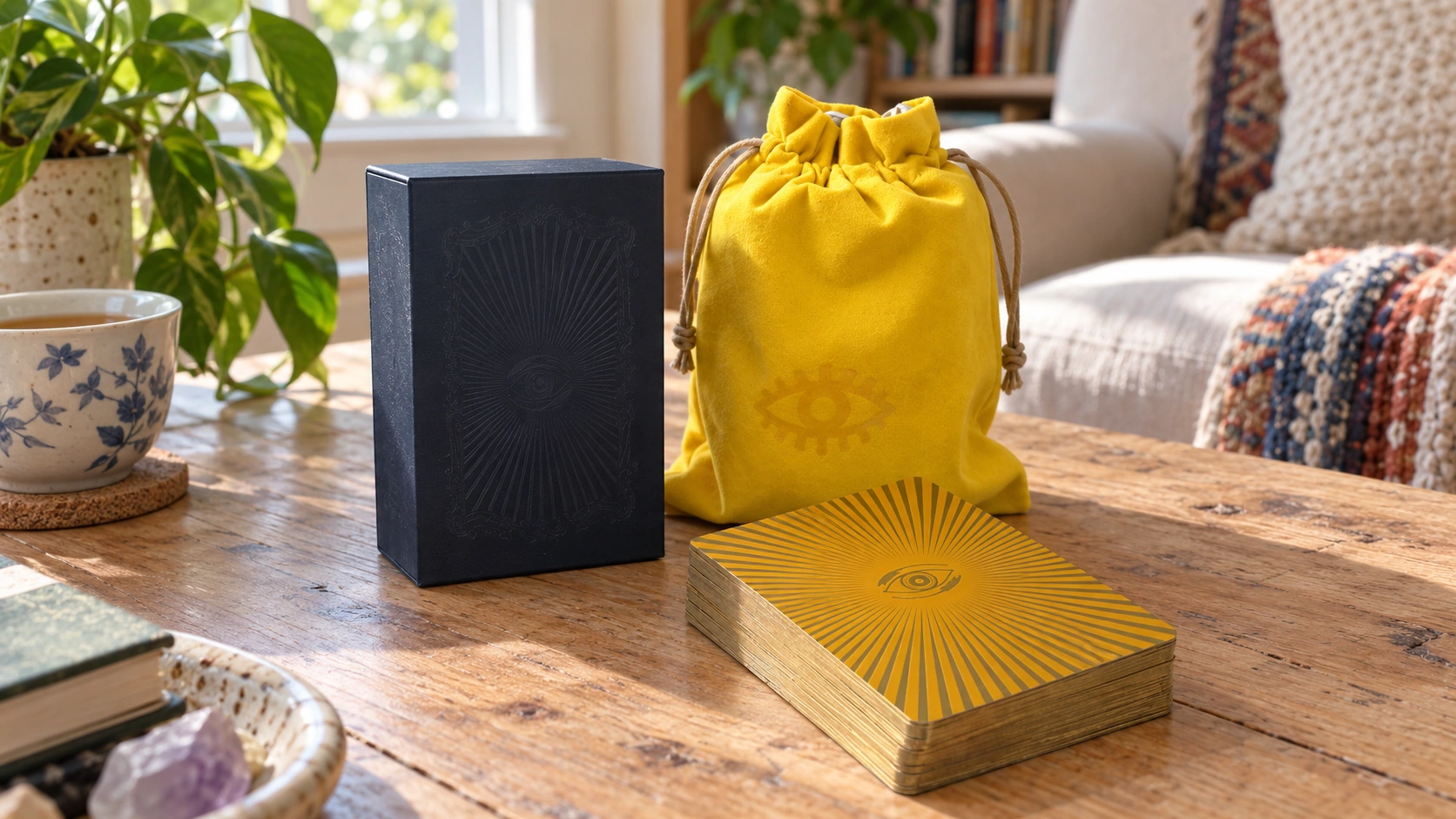
The original deck is commercially documented from June 2016. A second-edition Kickstarter ran in 2017, a third edition was documented as sold out in 2020, and an archived first-party listing identifies a fourth edition in 2022. Packaging, backs, and named extras can therefore vary; do not treat every Madam Clara listing as the same printing.
The verified gallery contains 80 fronts: the standard 78 plus two creator-supplied extras. The standard cards visually align with the later redesign, while the two supplied extras retain the visible Fate / Destiny / Fortune designs associated with the original listing. Because the available evidence does not tie every image to one photographed package, verify resale listings from their own clear photographs. No ISBN, GTIN, or Amazon identifier has been verified for this deck.
Final Thoughts
The Original Madam Clara Tarot succeeds because it commits to a voice. Its cards are bold, funny, dramatic, and unexpectedly practical. The collage sources may be vintage, but the reading experience is fast and contemporary: look, feel the movement, read the ribbon, and answer back.
Its strongest audience is a reader who enjoys visual theatre and wants a deck that can animate a spread quickly. Its weakness is the same quality turned up too far: the printed fortunes can dominate unless you deliberately return to the image. Used with that discipline, the deck becomes more than a novelty—it becomes a lively, coherent tool for story, choice, and reflection.
Original Madam Clara Tarot FAQ
Who created the Original Madam Clara Tarot?
Rick “Madam Clara” Pomer created, wrote, and illustrated the independently published deck. It was sold through MotelGiftShop, now TheParlourKeyport; no separate writer or illustrator is credited.
How many cards are in the Original Deck?
First-party listings describe 78 standard tarot cards plus two extras, for 80 physical cards. The supplied extra designs visibly read Fate / Destiny / Fortune; the Skull and Palmistry Hand labels used here are descriptive rather than verified official titles.
What makes the artwork distinctive?
It combines vintage engraved figures, reduced screen-print-like color, strong radial backgrounds, black banner titles, and fortune ribbons. The cards retain standard tarot names while giving each draw a direct fortune-telling voice.
Does it follow Rider–Waite–Smith structure?
Yes. The Major Arcana and four suits follow the familiar tarot sequence and court ranks, while the compositions are independent collage interpretations rather than copies of Rider–Waite–Smith scenes.
Is the Original Madam Clara Tarot beginner-friendly?
It can be. Familiar card names make navigation easy, and the fortune ribbons provide immediate prompts. Beginners should still compare the image with a trusted tarot reference instead of treating the printed sentence as the only possible meaning.
Is the Original Deck still available?
Availability varies by edition. The original is commercially documented from 2016; later second, third, and fourth editions followed. Use the archived first-party listing as an edition reference and verify any current or second-hand offer from its own photographs.


