
Explore the Kazanlar Tarot Cards
Browse the verified Kazanlar Tarot card fronts in deck order. Each recovered image opens in the native TarotFans lightbox.
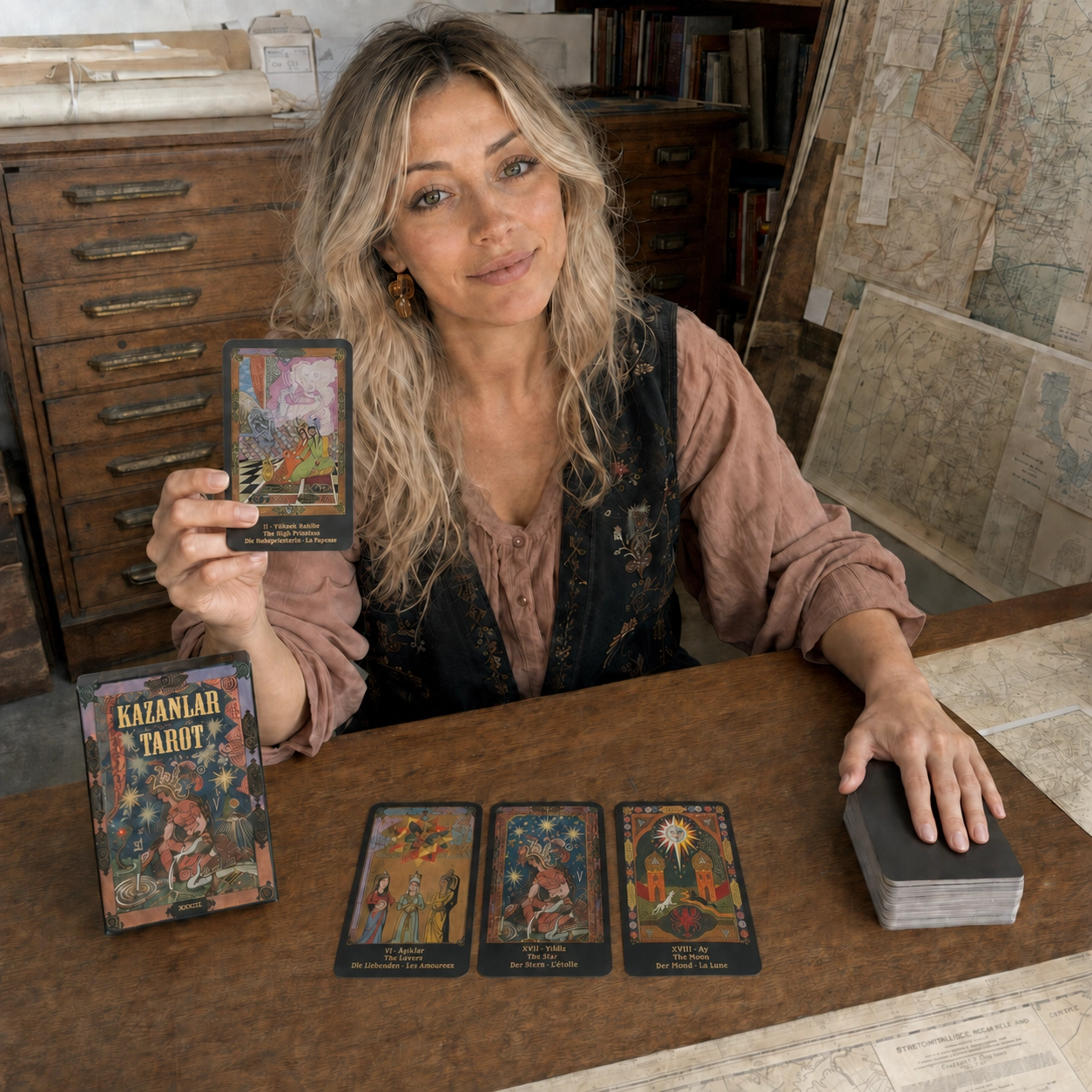
Aurica’s Quick Take
The Kazanlar Tarot feels like opening an illuminated cabinet of curiosities. Costumes, scripts, sacred geometry and astrological signs crowd close, yet the cards become intimate when I stop trying to decode everything at once. I begin with the figure’s gaze, the strongest colour, or the object a hand is guarding, then let that detail answer the question in front of me.
Its 80-card structure adds two portrait cards to the familiar arcana, while trumps such as Arcanum Without a Name and Innocence give old pathways a distinctive voice. I would choose it for reflective readings and slow study rather than a hurried yes or no. One carefully noticed symbol is often more revealing than a catalogue of correspondences.
Aurica’s verdict: Kazanlar rewards the reader who brings curiosity without demanding instant certainty. Follow one bright thread through its richly layered pictures, and this unusual deck can help you meet a complicated story with confidence, wonder and an open heart.
What Makes the Kazanlar Tarot Different?
The first difference is structural. Published as an 80-card deck, the Kazanlar Tarot keeps the 22 Major Arcana and 56 Minor Arcana while adding two portrait cards outside the conventional sequence. Those extra images are not an invitation to pretend the deck has a new suit or two new trumps; they are distinctive supplementary portraits that extend its cultural frame.
The second difference is density. Standard tarot cues sit beside Hebrew letters, Arabic and Persian calligraphy, astrological emblems, Kabbalistic terms, courtly dress and sacred architecture. In the Swords sequence, for example, Tree of Life names appear where many readers expect only a pip number. That makes the deck feel less like a single symbolic dictionary and more like a comparative map.
Most importantly, the deck does not use cultural detail as a light decorative layer. The imagery repeatedly stages encounters between traditions. That makes respectful observation essential: begin with what is visibly present, then consult the deck’s own system before flattening every figure into a familiar Rider–Waite–Smith keyword.
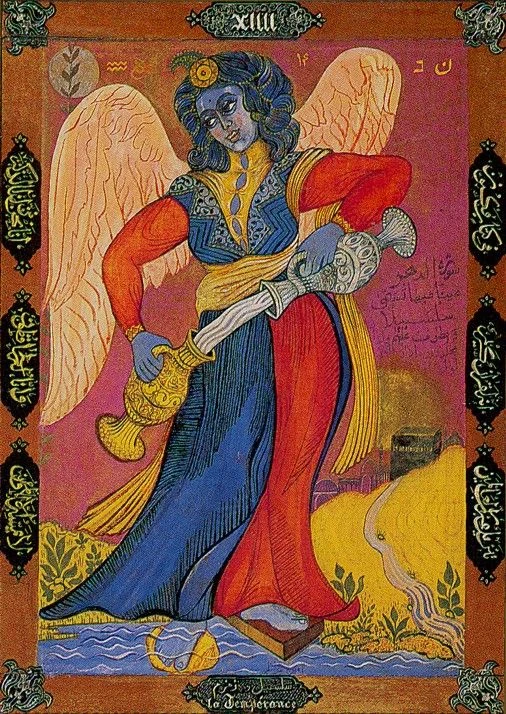
CARD STUDY • XIII
Arcanum Without a Name: Transformation Without the Skeleton
Kazanlar’s XIII replaces the familiar skeletal reaper with a winged, blue-skinned figure. The figure carries a curved blade in one hand and an ornate vessel in the other, standing between water, cultivated ground and a winding road that leads toward a distant dark structure. Arabic-script cartouches frame the image, while red, blue, gold and rose make the card feel vivid rather than funereal.
The card still speaks naturally to severance and irreversible change, but its visual emphasis is ceremonial. The blade can cut; the vessel can contain or pour. Read together, those objects suggest that transformation is not only an ending but also a transfer: something is released, something is preserved, and the path continues beyond the moment of rupture.
Reading prompt: What must be cut away, and what deserves to be carried forward?
How to Read a Symbol-Dense Kazanlar Spread
Do not begin by trying to decode every inscription. Start with the card’s dominant relationship: who faces whom, which object is being held, what direction the body moves, and whether the scene opens outward or closes in. Then notice repeated colors, celestial signs and architectural motifs across the spread. Only after that first visual pass should you add traditional card meanings or research a specific script or correspondence.
- Name the scene. Describe the image in one neutral sentence before interpreting it.
- Find the tension. Identify the strongest contrast—movement and stillness, water and desert, intimacy and distance, concealment and revelation.
- Trace one symbol. Follow a single repeated motif across the spread instead of decoding everything at once.
- Return to the question. Translate the symbolism into one practical choice, boundary or next action.
This method keeps the cards from becoming an esoteric scavenger hunt. The research remains available, but the reading stays connected to the person and question in front of you.
FOUR-CARD FEATURE
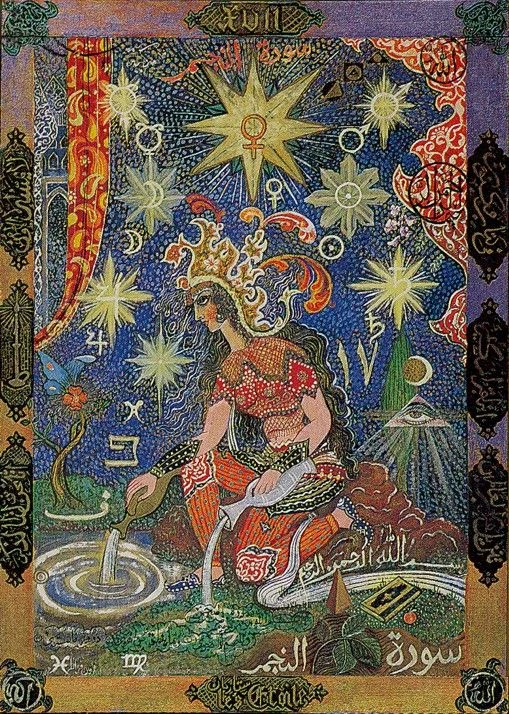
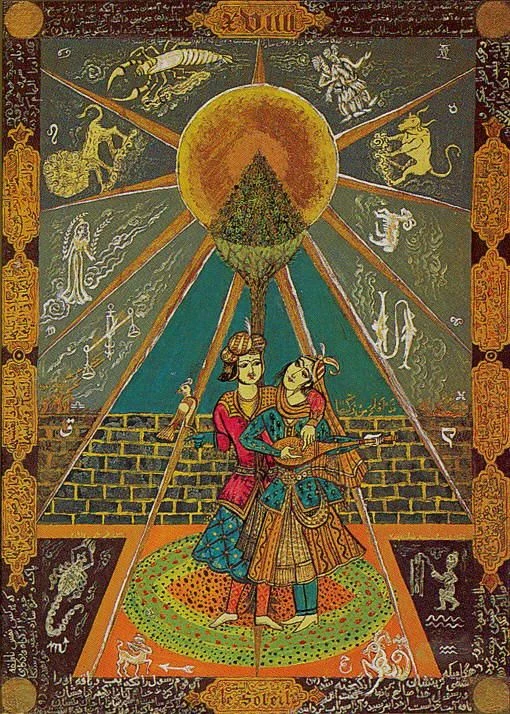
The Celestial Passage
The Fool, Star, Moon and Sun show how the deck layers movement, orientation and revelation. Read as a sequence, they move from openness, through guidance and ambiguity, toward exposed vitality.


Is the Kazanlar Tarot Beginner-Friendly?
It can be a first deck, but it is not an effortless one. Beginners who enjoy art history, comparative religion or symbolic research may love having so much to investigate. Beginners who need instant recognition, uncluttered scenes and close Rider–Waite–Smith correspondence are likely to progress faster with a simpler deck beside it.
A productive approach is to pull one Kazanlar card alongside its equivalent from a familiar deck. Compare only three things: the central figure, the emotional temperature and the action implied by the scene. Over time, the Kazanlar image stops feeling like an illustration to decode and starts becoming a visual voice you recognize.
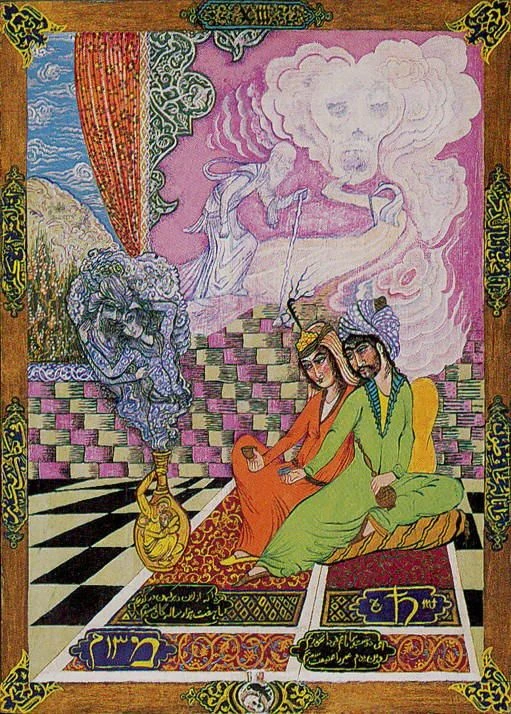
CARD STUDY • II
The High Priestess: Knowledge Behind the Visible Scene
This High Priestess does not present a solitary enthroned guardian. A seated pair occupies the foreground on a patterned carpet, with a black-and-white floor, tiled wall, ornate vessel and fountain-like form around them. Above, a large pale face and gesturing figure emerge in a rose-colored field like a vision suspended over ordinary space.
The card’s power lies in that layered reality. The seated figures inhabit the material scene while the pale presence hovers beyond it, suggesting information that is sensed before it is fully understood. In a reading, the image favors patient attention over dramatic disclosure: watch what repeats, what remains half-seen and what cannot yet be forced into certainty.
Reading prompt: What do you already sense, even though you cannot yet prove it?
Questions That Unlock the Deck
- Which tradition or symbol am I treating as decorative when it may be central?
- What changes when I read the figures’ relationship before reading the card title?
- Where is the image asking me to hold two truths without collapsing either one?
- Which detail becomes meaningful only when another card repeats it?
These prompts are especially useful when the imagery feels crowded. Instead of demanding a complete explanation, they help you choose one interpretive doorway and remain honest about what the image actually shows.
FOUR-CARD FEATURE
Four Suits, Four Ways of Knowing
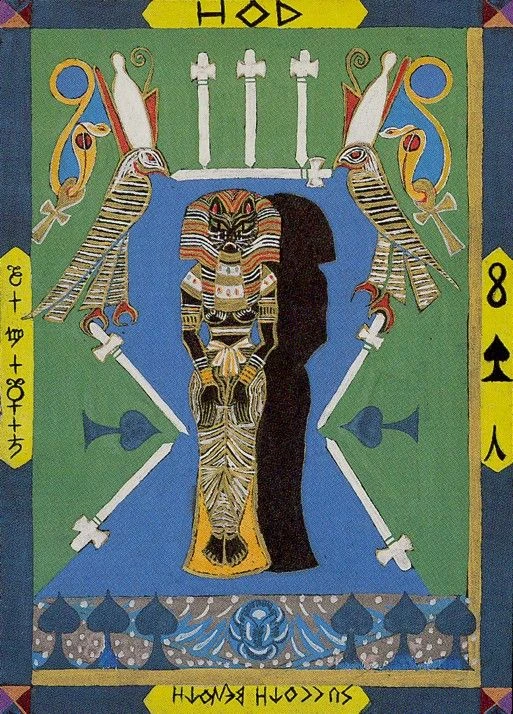
An Ace of Wands, Six of Cups, Eight of Swords and Ten of Pentacles create a compact tour through will, feeling, thought and material consequence. The visual styles vary, but the deck’s inscriptions and ornamental frames keep the sequence in one shared symbolic world.



Who Will Connect With the Kazanlar Tarot?
- You may love it if… You enjoy decks that reveal themselves over months rather than days; you are comfortable researching unfamiliar symbols; or you want tarot art that puts several sacred and cultural vocabularies into active dialogue.
- You may struggle if… You prefer clean contemporary minimalism, read mainly from instant facial expression, or want every card to mirror the Rider–Waite–Smith composition closely.
The deck’s strongest readers are not necessarily experts. They are patient observers. Curiosity matters more than arriving with a complete command of Kabbalah, astrology or comparative religion.

CARD STUDY • VI
Innocence: Choice in a Field of Relationships
Kazanlar’s card VI places three richly dressed figures between purple columns. The central figure stands with hands crossed at the chest while the figures on either side reach toward or turn around that center. Above them, a winged being appears within a geometric emblem; a smaller scene in the upper corner adds another pair beneath a luminous presence.
The composition makes relationship visible as a field of influence rather than a simple romantic pair. Attention moves between invitation, self-possession and the pressure of what watches from above. The deck-specific title Innocence asks whether a choice can remain sincere when desire, expectation and competing loyalties are all present.
Reading prompt: Which choice protects your integrity without denying your desire?
Availability and Buying Guidance
The original Urania/AG Müller edition is a sought-after collectible, but the creator’s official webshop now lists a 2021 revival. The current edition contains 80 cards measuring 70 × 110 mm on varnished matte stock, with options shown for the deck alone or with Hungarian- or English-language book material. Price and availability can change, so confirm the selected option at checkout.
- For the current revival, use the creator’s official product listing rather than assuming a sold-out vintage listing represents present availability.
- For a used 1996 copy, confirm all 80 cards, including the two supplementary portraits.
- Check which edition, language and guidebook are included before comparing prices.
- Compare the box, card backs and borders with verified edition-specific photographs.
See the official 2021 Kazanlar Tarot product listing. For historical context, the Aeclectic Tarot deck record documents the earlier edition.
Final Thoughts
The Kazanlar Tarot is memorable because it refuses a single visual authority. Its cards ask the reader to move among languages, religions, artistic traditions and esoteric systems without pretending those differences vanish. That can make the deck slower to learn, but it also gives repeated readings a rare sense of discovery.
If you approach it with patience, the density becomes its gift. A detail that seemed ornamental in one reading may become the hinge of another. A card that initially felt foreign can become intimate through repetition. This is not the easiest tarot to summarize—and that is precisely why collectors and symbol-minded readers continue to seek it out.

Kazanlar Tarot FAQ
How many cards are in the Kazanlar Tarot?
The complete Kazanlar Tarot contains 80 cards: the conventional 78-card tarot structure plus two additional portrait cards.
What does the Kazanlar Tarot Gallery include?
The Gallery presents the verified Kazanlar Tarot card images currently available to TarotFans. It stays deliberately nonnumeric and does not substitute lower-quality or unrelated artwork to imply complete coverage.
Who created the Kazanlar Tarot?
The deck was created and illustrated by Dr Emil Kazanlar. Its imagery reflects an intentionally broad esoteric and cross-cultural symbolic framework.
Is the Kazanlar Tarot based on Rider–Waite–Smith?
It retains the familiar Major and Minor Arcana structure, but many scenes, titles and correspondences are substantially reinterpreted. Readers can use Rider–Waite–Smith knowledge as a starting point, not as a complete translation.
Is the Kazanlar Tarot suitable for beginners?
Yes, if the beginner enjoys research and complex symbolism. Readers who want immediate scene recognition may find it easier to study the Kazanlar alongside a simpler Rider–Waite–Smith-based deck.
Why is card XIII called Arcanum Without a Name?
The deck follows the tradition of leaving XIII unnamed rather than printing “Death.” Kazanlar’s image also replaces the familiar skeleton with a winged figure carrying a blade and ornate vessel, which shifts attention toward transition and transformation.
Is the Kazanlar Tarot still available?
Yes. The creator’s official webshop lists a 2021, 80-card revival with deck-only and book options. The original 1996 Urania/AG Müller edition remains a separate collectible, so verify the edition and included language material before purchasing.


