Explore the Money Tarot Cards
Browse the individually verified Money Tarot card fronts recovered from the supplied sources. Unavailable cards are omitted rather than guessed. Choose an official group to filter the continuous gallery, or select a card for the full-size Lightbox.
Aurica’s Quick Take
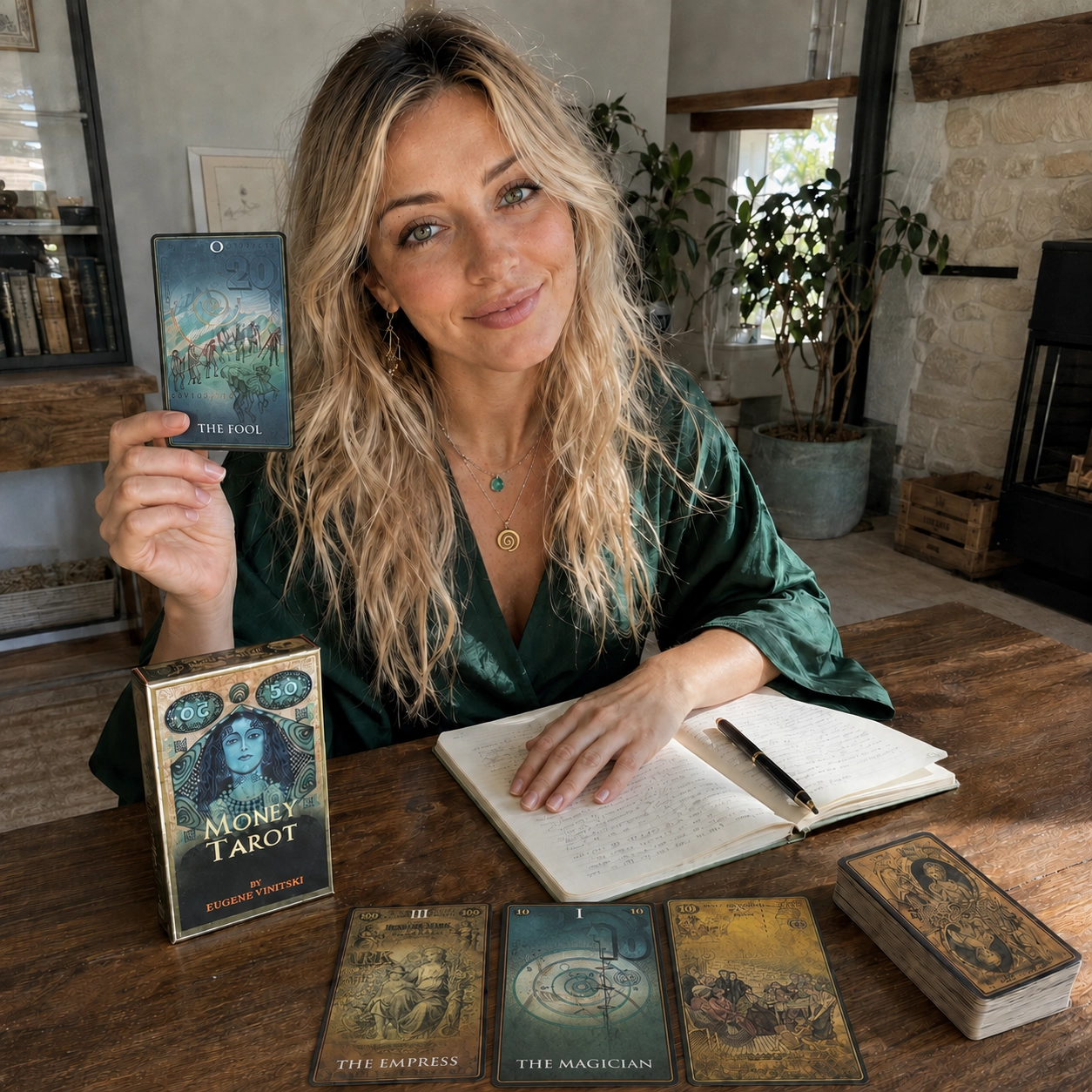
I keep coming back to the way Money Tarot turns old banknotes and portraits into emotional scenery. The Fool feels like value in motion: money can open a road, but it can also distract us. I notice who is holding, offering, guarding, or chasing something, then return to the card’s traditional meaning.
For work and money questions, I use it to explore confidence, timing, exchange, and the stories we attach to success. A golden card can feel generous in one spread and overly tempting in another, so I always look at its neighbors before deciding.
This deck feels less like a cold ledger and more like finding human hopes between the lines. I would choose it for reflective journaling and practical next-step readings. Let the old paper, repeated portraits and bright seals remind you that value is a story people make together—and that your next wise step can be both grounded and hopeful.
What is Money Tarot?
Money Tarot is Eugene Vinitski’s financial-themed tarot, built from banknotes, engraved portraits, seals, numbers and architectural fragments. The familiar tarot structure remains, but every scene asks you to notice how value is displayed, exchanged, protected or pursued.
The gallery contains 75 individually verified card fronts from the available source material. Three unavailable cards remain omitted rather than guessed, so the page stays honest while still showing the deck’s visual language in depth.

CARD STUDY
The Fool: value becomes a winding road
The card is washed in blue-green currency textures, with a large translucent “20” and a loose procession of tiny people crossing the lower half. A curled line loops above them and a bright orange path zigzags through the composition. The human figures feel small beside the printed denomination.
In a reading, start with the route rather than the number. Ask where resources are opening movement, where the group is following an inherited path, and whether the next step is being chosen for curiosity or simply because everyone else is moving.
FOUR-CARD STUDY
Four cards for handling resources
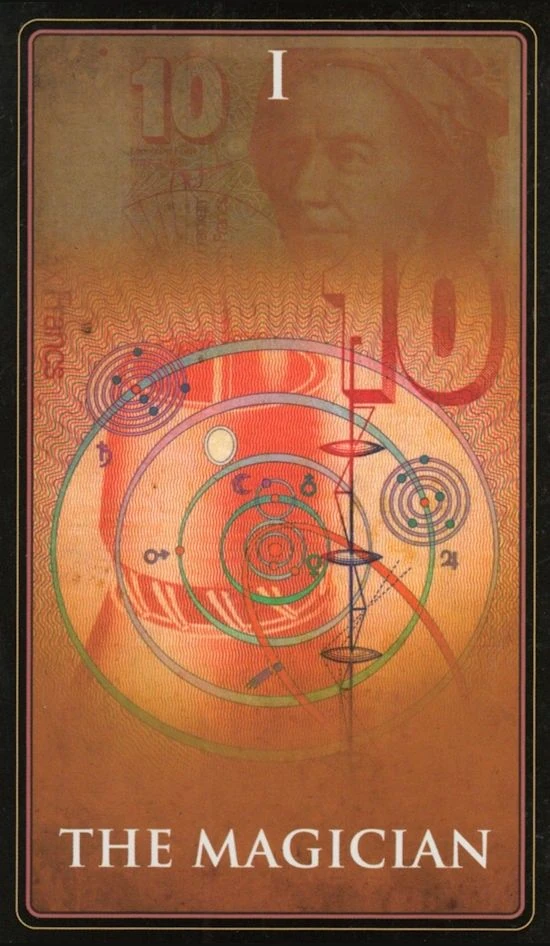
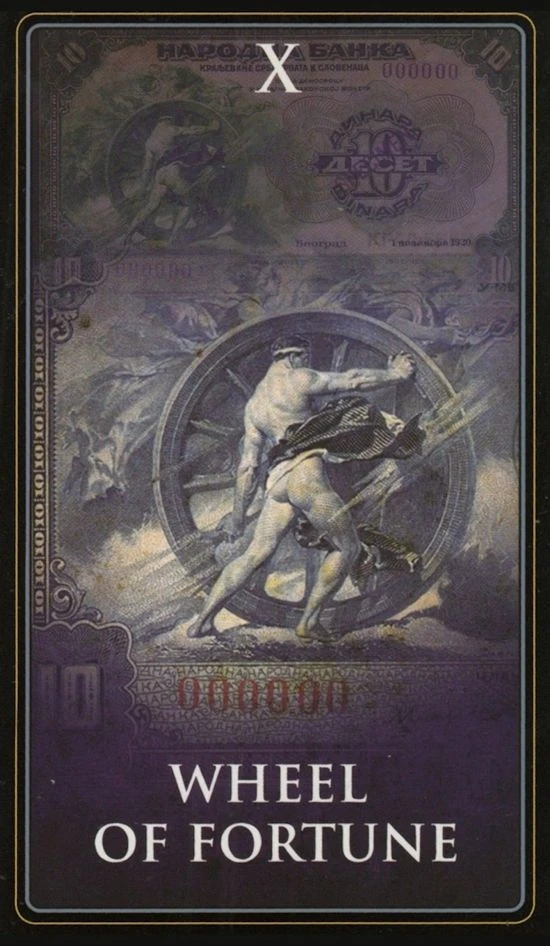
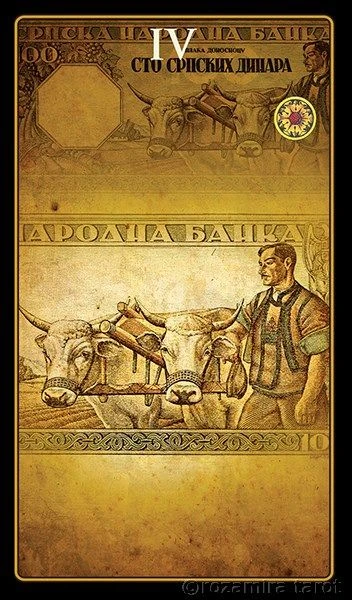
The Magician’s orange diagrams, the Wheel’s layered engraving, the Two’s banknote scenes and the Four’s livestock image make this a useful sequence for planning, adapting, balancing and holding.

How the currency collage reads
These cards do not treat money as a plain pile of coins. Faces, official seals, handwritten marks and old printing techniques turn finance into a record of human choices. A card can feel authoritative, fragile, generous or enclosed depending on whose portrait dominates and how much open space remains.
Begin with three visible facts: the denomination or number, the strongest portrait or figure, and the direction of any exchange. Then compare those details with neighbouring cards. This keeps practical readings specific without reducing every question to profit or loss.
CARD STUDY
Justice: many faces inside one blue-grey record
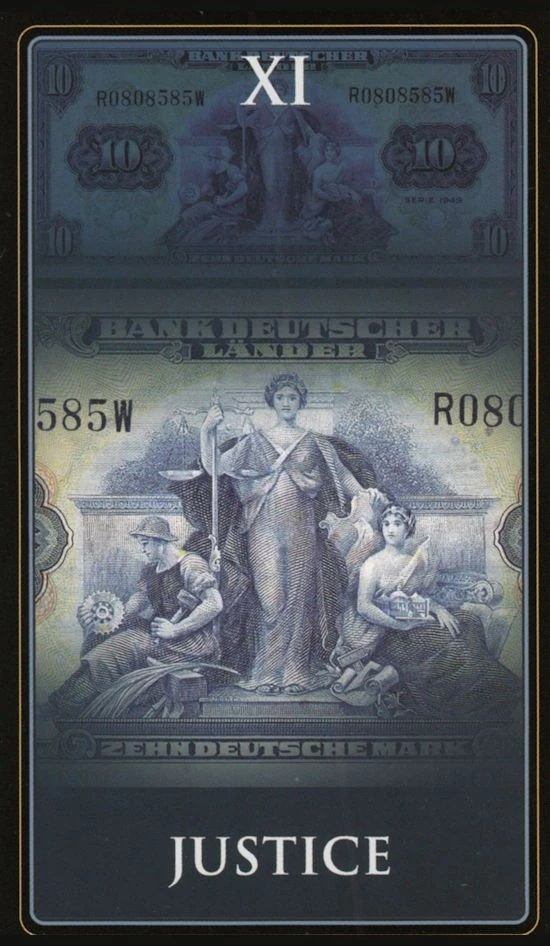
A German banknote forms the card’s cool blue-grey field. Several seated figures appear in the central engraving, with smaller portraits and printed serial marks surrounding them. The Roman numeral XI stands above the banknote composition, while the word JUSTICE anchors the dark lower border.
The image invites a careful look at who is represented and what has been formally recorded. In a spread, it can focus attention on terms, evidence, shared standards or the gap between an official-looking arrangement and the people living inside it.
FOUR-CARD STUDY
Four cards for strain, support and recovery
A pyramid seal, glowing windows, an exchange between figures and a richly framed portrait create four different pictures of scarcity and sufficiency. Use the row to locate pressure, available help and the resource that can be cultivated next.


Reading work, relationships and long-term plans
For career or business questions, the deck is direct without being purely predictive. Its documents and denominations can point toward contracts, perceived worth, hierarchy and the emotional weight attached to success. In relationship readings, notice whether the card shows a solitary portrait, a pair, a family scene or an impersonal institution.
For long-term plans, trace repeated architectural details and circular seals across the spread. They can show what is being formalised, what still depends on trust, and where a plan needs a human conversation rather than another calculation.

CARD STUDY
King of Pentacles: authority printed twice
A Hungarian 200-forint note fills the card with olive, gold and russet. The same bearded crowned head appears as a smaller sculpted profile above and a larger portrait below, surrounded by ornate printing, a serial number and security patterns. The repeated face gives the card a strong, formal presence.
Ask what kind of stewardship this authority supports. The image can help distinguish visible status from practical care, especially when nearby cards show exchange, family or strain. What is being managed, and who actually benefits from that management?
FOUR-CARD STUDY
Four cards for bonds and shared value
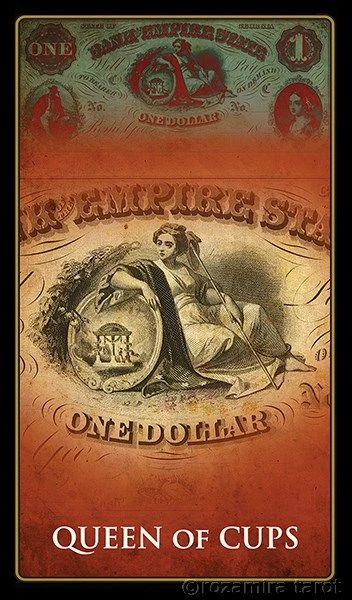
The Lovers presents a seated pair, the Two of Cups layers a couple over architecture, the Queen of Cups reclines inside an American note, and the Ten of Pentacles gathers a large social scene. Together they ask how affection, contribution and security are being shared.



Who will enjoy Money Tarot?
This deck suits readers interested in work, confidence, exchange and the stories societies print onto wealth. It can also be compelling for collectors who enjoy vintage engraving and collage. Readers wanting soft fantasy scenes or instantly literal illustrations may need more time with its layered banknote imagery.
Let the printed details slow you down. Notice who is centred, what is repeated, and whether the image feels open, guarded or crowded. Traditional meanings become more useful after the visible financial story has had a chance to speak.
 See Money Tarot on Etsy
Money Tarot FAQ
Is Money Tarot good for beginners?
It can be beginner-friendly if the artwork feels clear to you. New readers should keep a simple tarot keyword list nearby while learning.
What kind of readings is Money Tarot best for?
It is best for daily pulls, journaling, emotional check-ins, creative questions, and readings where image and mood matter.
Does Money Tarot follow traditional tarot meanings?
It uses tarot structure, but the deck theme gives those meanings its own flavor. Read both the card title and the picture.
Who should skip Money Tarot?
Skip it if you want a completely neutral deck, plain keyword cards, or artwork that does not shape the reading.
How do I compare Money Tarot with other tarot decks?
Look at several major arcana, minor arcana, and court cards. The minor cards are especially important because they show how the deck handles everyday life.
Can Money Tarot be used for serious readings?
Yes. A themed or unusual tarot deck can still give serious guidance when the question is clear and the interpretation is grounded.