The Ten of Swords tarot card meaning centres on a painful ending, exhaustion, or recognising that something cannot continue as it is. Upright, it often asks you to acknowledge the end of a cycle. Reversed, it may invite recovery and letting go, or draw attention to difficulty accepting what has changed.
The picture is stark. If it leaves you unsettled, you can put the deck down and return later. This card does not predict death, prove betrayal, or tell you that suffering is deserved. Its useful question is what needs care now, rather than what further disaster might happen.
You may know it as the 10 of Swords. In an ordinary situation, it could help you name the end of something you kept trying to rescue: a cancelled project, a broken agreement, or a plan that has cost more energy than you have available. You do not have to find a positive lesson immediately.

10 of Swords Tarot Card Meaning at a Glance
- Main keywords: ending, burnout, rock bottom, final truth
- Upright meaning: a cycle is reaching its peak and showing what it has created. In the Swords suit, this connects to thoughts, words, truth, stress, and decisions
- Reversed meaning: release, overwhelm easing, or a family/group pattern that needs repair. The reversed meaning asks you to check how you are handling thoughts, words, truth, stress, and decisions
- Yes or no: no for continuing as-is; yes for ending a painful cycle
- Best question to ask: What is this card trying to help me understand right now?
The quick-reference panel above keeps the site's original wording. More specifically, this Ten concerns painful finality rather than a successful peak; reversed, it can suggest recovery or resistance to an ending. A family or group repair theme is not inherent to this card. The yes-or-no line is a reading convention, not an instruction to end a relationship or a promise that ending it will be safe.
Upright Ten of Swords meaning: recognising an ending
The upright Ten of Swords often points to a limit being reached. A painful situation may have run its course, or you may be facing a fact you hoped would change. Finality can hurt even when the decision makes sense.
For example, a team has spent months trying to save a project whose funding has been withdrawn. Another late night will not restore the budget. A useful response is to confirm what has ended, protect unfinished work, and discuss what happens to the people involved.
Some readers connect this image with betrayal, backstabbing, or feeling stabbed in the back. Those are possible themes for reflection, not evidence that anyone has deceived you. If an agreement was broken, attend to the actual behaviour and its consequences rather than using the card to establish a motive.
Hitting rock bottom is a common phrase for this card, but you do not need to reach your lowest point before asking for support. You can pause because you are hurting or overwhelmed. The Ten of Swords encourages an honest assessment of what you can manage, without demanding that you endure more.
If you feel on the brink of giving up on a task, separate the task from your worth. A plan can fail without making you a failure, and you can decide what to stop without declaring your whole future finished.
The Ten of Swords in a tarot reading
Start with the question, position, and surrounding cards. In a past position, this card may help you reflect on an ending you have already experienced. In the present, ask what is no longer sustainable. In a future position, consider how to respond if a plan fails; do not turn a symbolic possibility into an inevitable ending.
In a standard tarot deck of 78 cards, this is the last numbered card in the Swords sequence. It is not the final card in the Swords suit, which also has Page, Knight, Queen, and King court cards. The Ten of Swords marks a culmination in that numbered sequence, not the end of every possibility in your life.
The Nine of Swords often invites reflection on worry or sleepless distress, while this Ten more often concerns an ending or the experience of defeat. Neither card diagnoses a condition. Beside the Death card, an ending may be a useful shared theme; neither card predicts physical death. With the Star, explore what support could make recovery more manageable. With Justice, check agreements and practical accountability.
Ten of Swords in love and relationships
In love, the card can invite you to come to terms with hurt, a broken agreement, or a relationship pattern that cannot continue unchanged. It does not automatically indicate a relationship will end. You might need a clearer boundary, a serious conversation, time apart, or help deciding what you want.
If a breakup has already happened, a reading can give you space to name the loss. Consider an ordinary need: who can keep you company this evening, which belongings need returning, or whether a temporary pause in contact would help. Take the time you need to decide what helps.
If you are single, old disappointment may make dating feel tiring. A fresh start can mean taking a break rather than meeting someone immediately. Choose a pace that leaves room for your preferences and boundaries.
The image cannot establish infidelity or another person's private feelings. If you suspect dishonesty, separate what you know from what you fear and seek a conversation where safe. If there are threats, coercion, or violence, seek appropriate local support and prioritise a safety plan. You are not responsible for another person's harmful choices.
Career, money, and school: respond to the facts
At work, this card may help you acknowledge a cancelled role, an unworkable workload, or a project that has reached a complete ending. Confirm what is actually decided before assuming the worst case. If a manager says the team will change, ask which duties, dates, and options are affected.
Exhaustion may call for a smaller workload, rest, or a conversation about support. If you keep compensating for an unrealistic deadline, record what remains and propose a manageable handover. Stopping one task can protect the others that still matter.
For a difficult financial situation, list immediate bills, available funds, and who you can contact before a deadline. A tarot reading cannot forecast losses or tell you which investment to choose. Qualified financial or legal advice is more useful than drawing again to see whether your finances will crumble.
At school, an unsuccessful exam or missed opportunity can feel like the end of everything. Check the actual appeal, resit, or alternative route. You can be disappointed and still gather the information you need.
Ten of Swords reversed meaning: recovery or resistance
The reversed Ten of Swords can suggest the first room to breathe after a tough time. The acute pressure may be easing, or you may be ready to stop returning to a painful situation. Recovery is one possible reading, not a guaranteed future.
Other readers see resistance to an ending in the reverse. Perhaps a project has closed, yet you still spend each evening checking whether someone will restart it. Ask what the facts allow and what you are hoping a repeated reading will change.
A new beginning may be quiet. You might cook a meal, ask a friend to help with paperwork, or finish one part of a handover. To move forward, you do not have to feel hopeful about everything at once.
If an old habit returns, avoid treating the card as proof of a relapse or predicting one. Talk with the appropriate professional or support person about what is happening. If something has become harder again, ask what support is available now instead of blaming yourself.
The Ten of Swords reversed may also invite you to accept help you have been declining. Specify what would make the day easier: someone accompanying you to an appointment, checking a letter, or listening without giving advice. Letting go can mean loosening one demand on yourself, not forgiving harm or restoring access to someone who hurt you.
Ten of Swords yes or no meaning
Many readers lean toward no for continuing with the same approach. Reversed, they may see a cautious opening for recovery or a revised plan. Neither orientation supplies a reliable yes or no about someone else's intentions, an urgent health concern, or a risky decision.
Ask what would need to change before proceeding. If a plan depends on you ignoring pain or a clear refusal, the practical information already matters more than the card.
Advice: find a manageable path forward
Write two short lists: what has ended, and what remains available. Be precise. "This contract ended" is different from "I will never find work again." The first tells you what needs attention. The second assumes a future you cannot know.
Choose one action that reduces today's burden. You could ask about a deadline extension, arrange transport to an appointment, or stop rereading a message that leaves you distressed. You can learn from the experience later without making personal growth a duty while the hurt is fresh.
A friend might describe hope as light at the end of the tunnel. If that feels too distant, focus on the next hour. A meal, some company, or help with one awkward call may matter more today than imagining your whole future.
Wellbeing and spiritual reflection
The dramatic image can bring pain or despair to mind. It cannot diagnose illness, predict an accident, confirm pregnancy, or promise a cure. For persistent symptoms or distress, seek qualified care. If you feel at immediate risk of harming yourself or are in immediate danger, contact local emergency or crisis support rather than relying on a reading.
For spiritual reflection, notice whether you are treating a difficult experience as punishment. The card does not assign blame or say the suffering was necessary. You may find meaning later, but you are allowed to seek comfort and practical help now. An oracle or free tarot reading can be a reflective exercise; it is not a substitute for care.
One archetype, four perspectives
Ten of Swords Across Four Tarot Decks
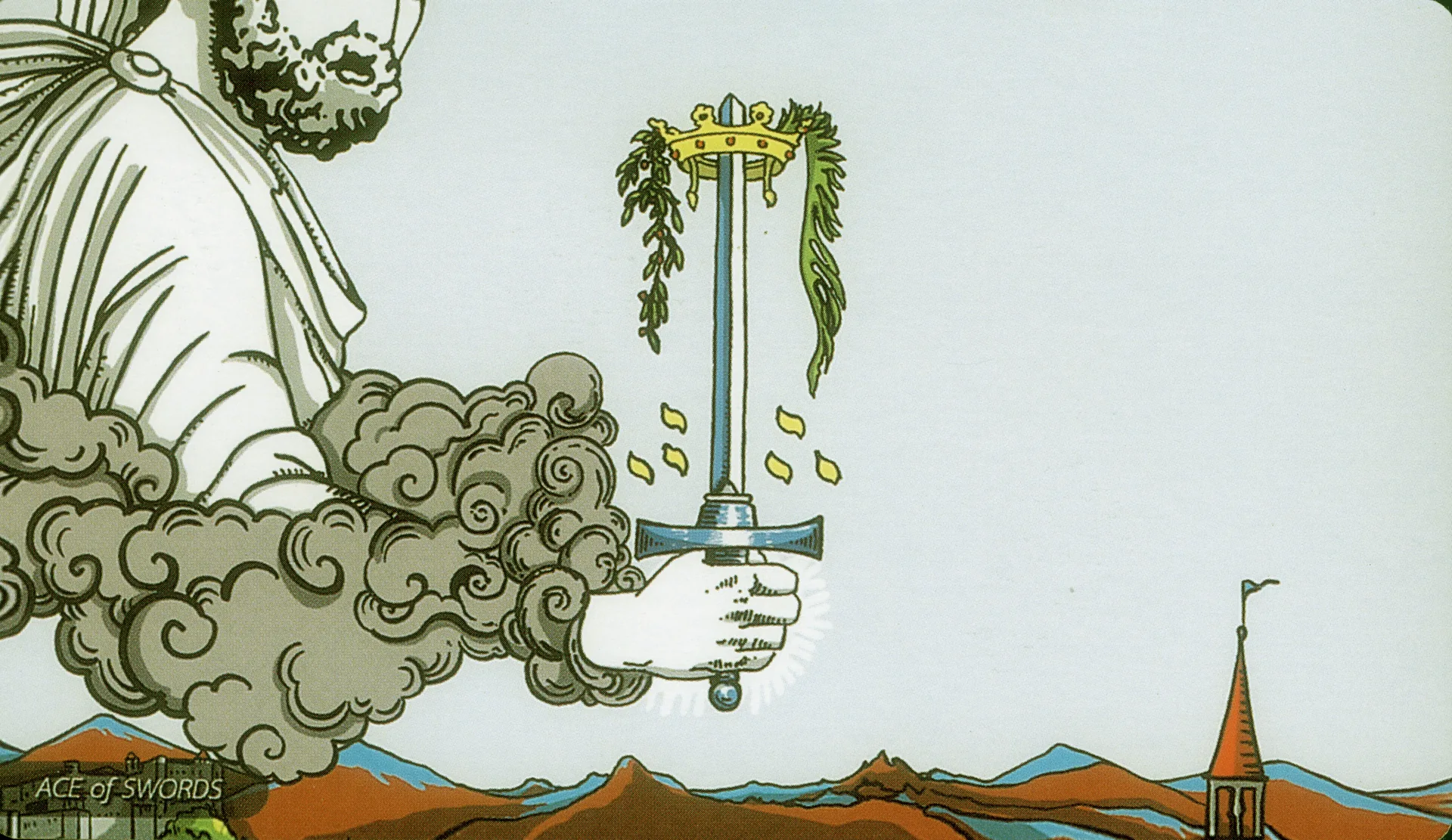
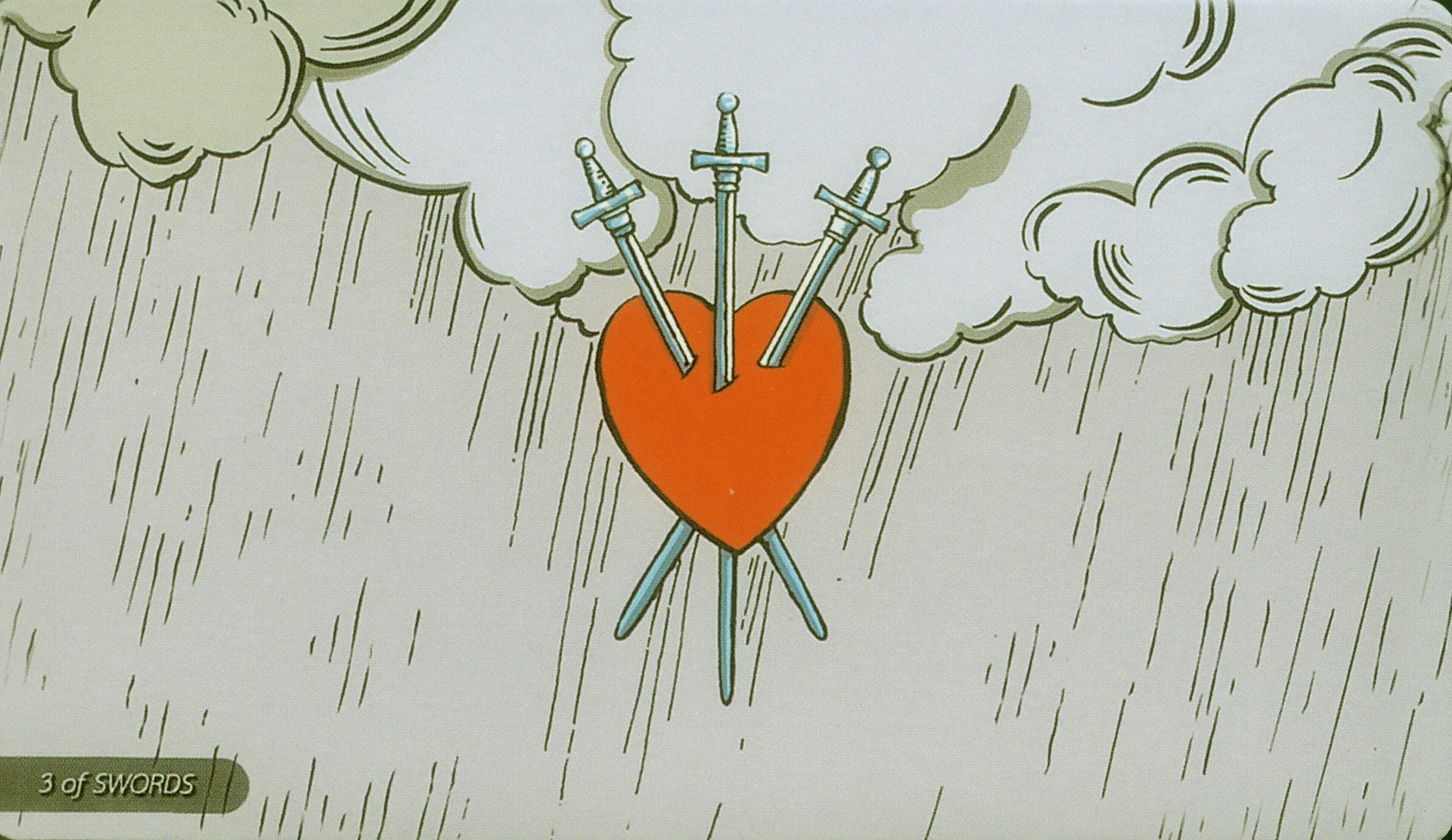
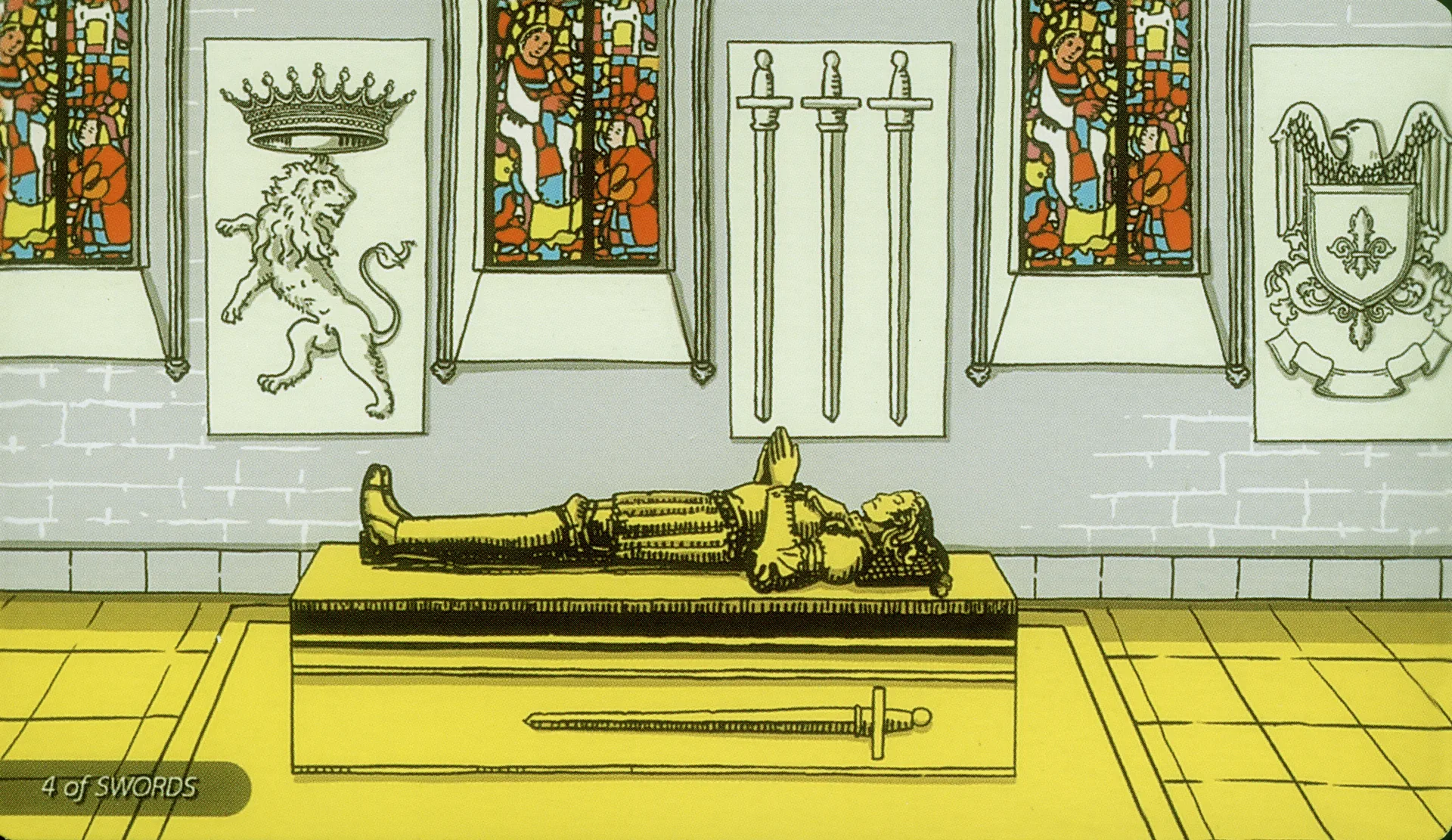
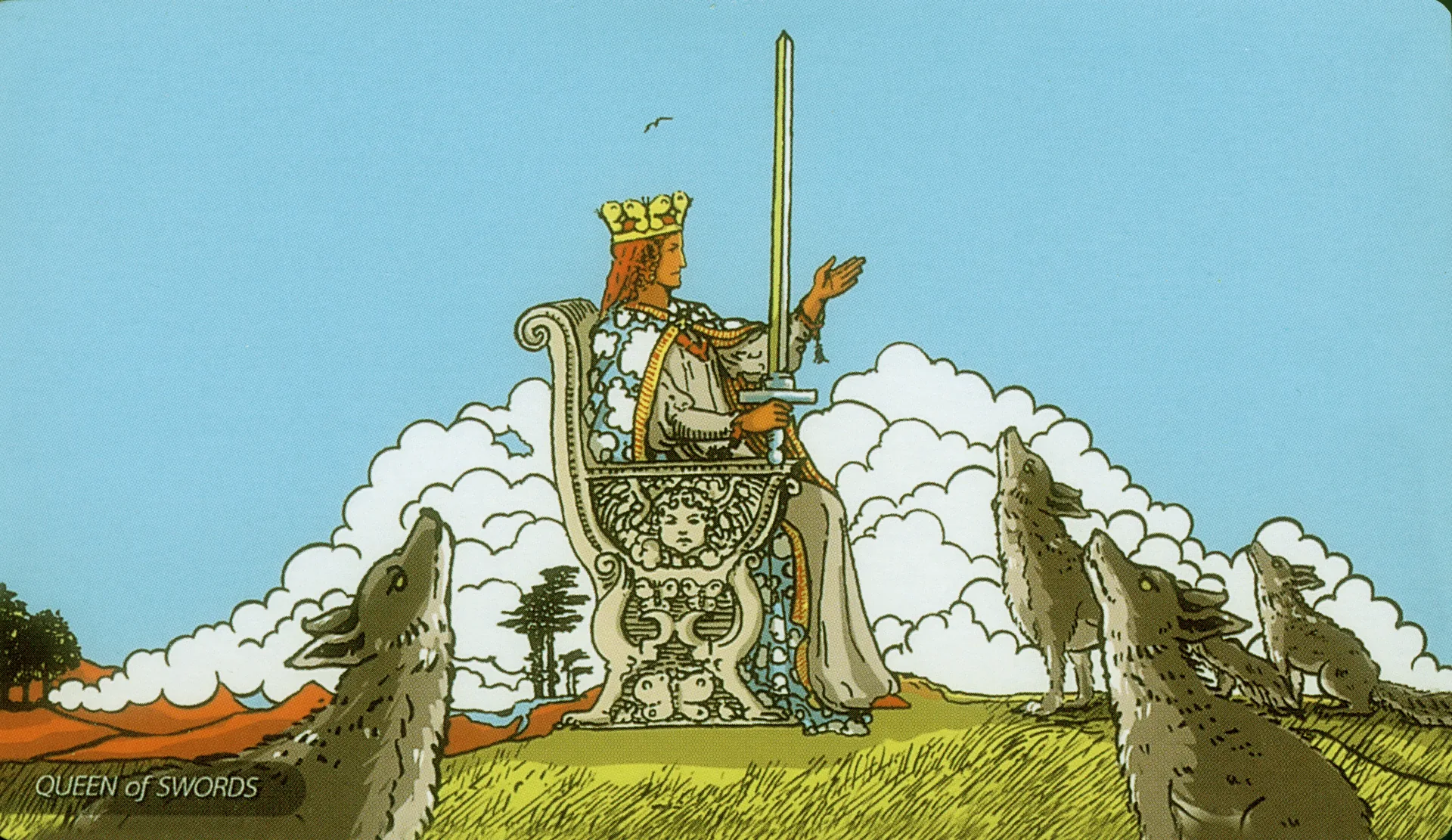
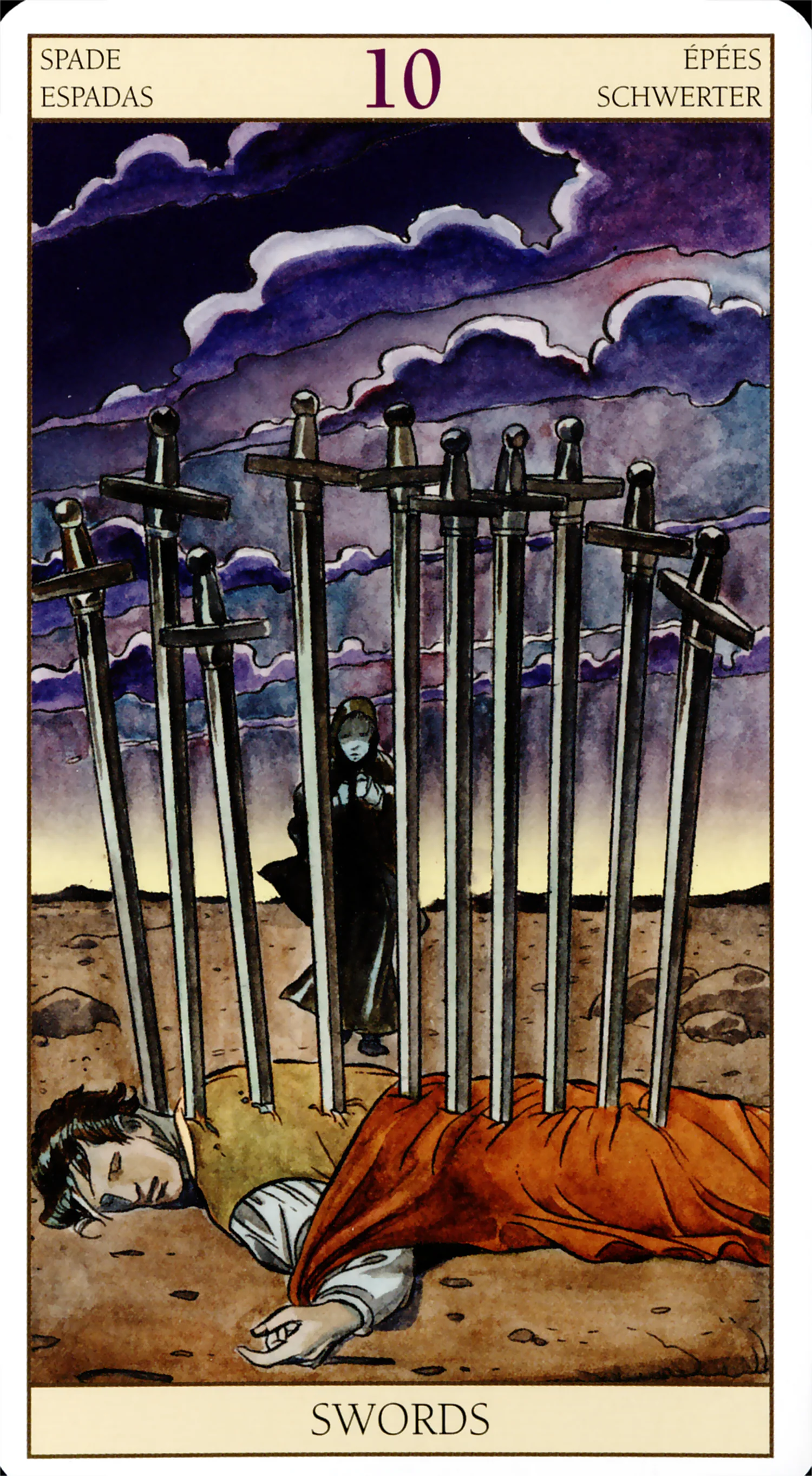
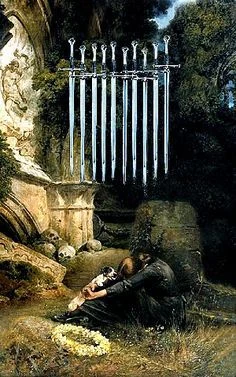
Compare the familiar Rider-Waite-Smith card with the moments before, behind and after the classic scene in three Lo Scarabeo decks.
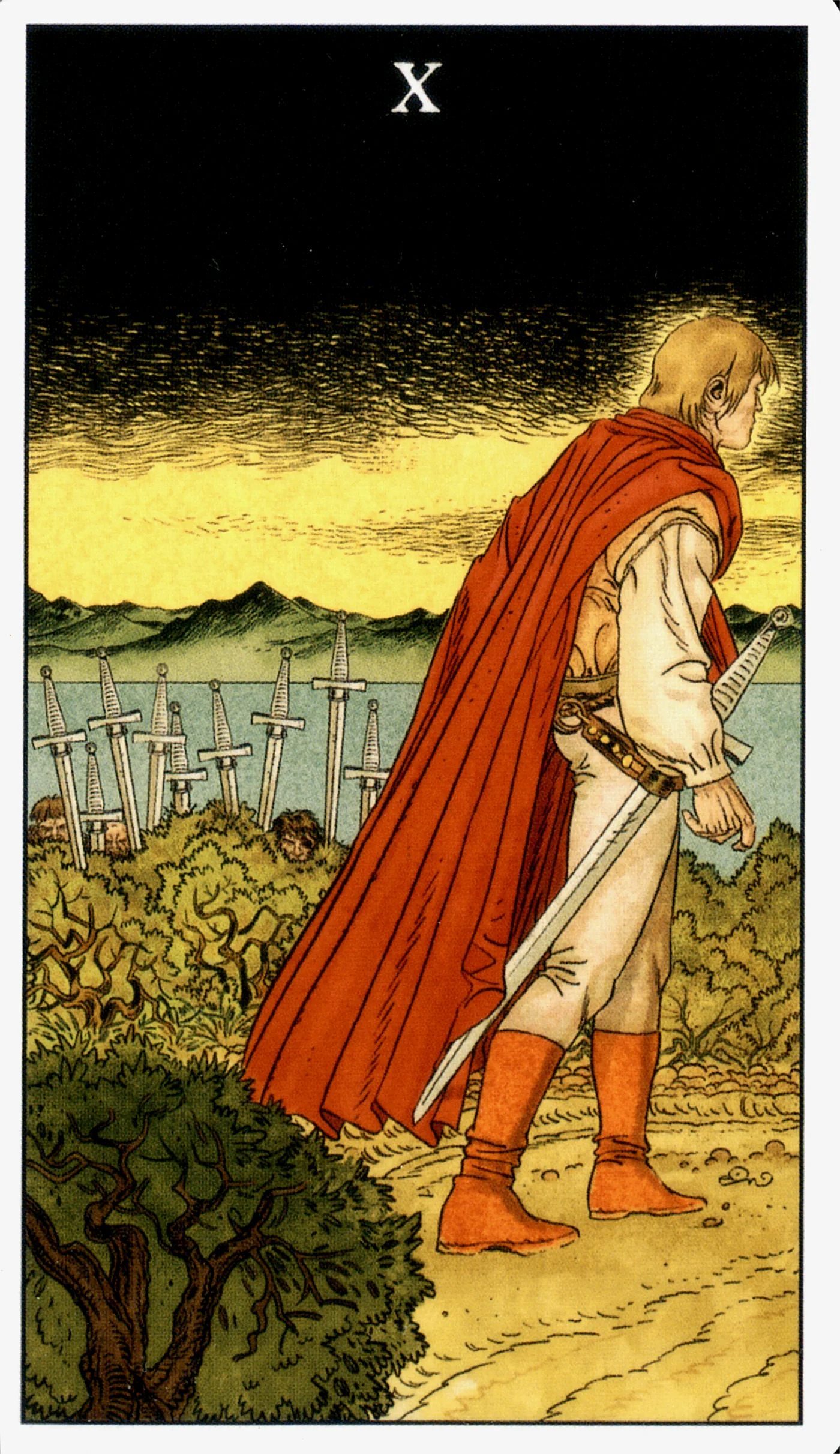
What apparently happens just before
What actually happened
What happened on the opposite side
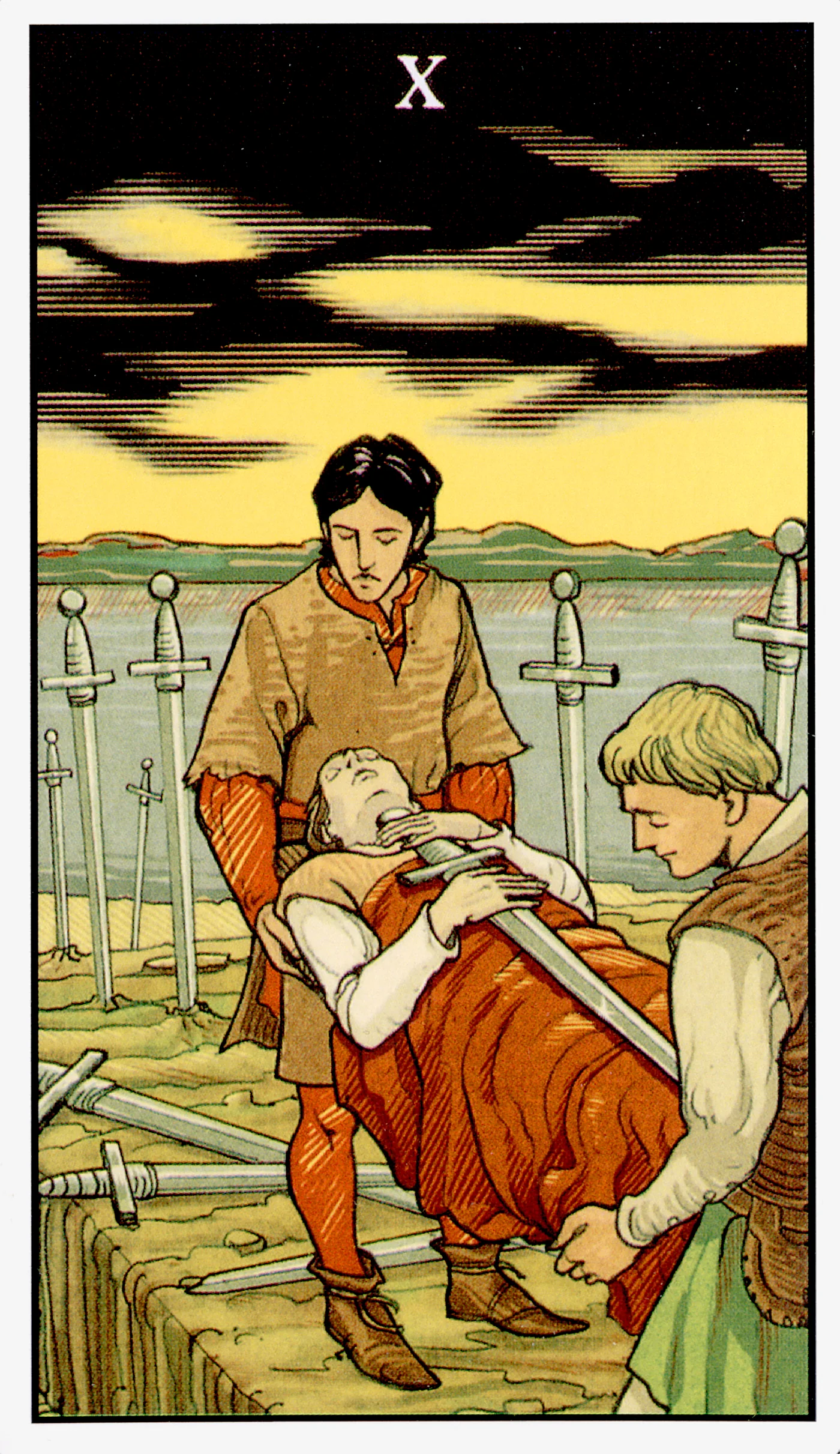
What apparently happened afterwards
Ten of Swords card description and symbolism
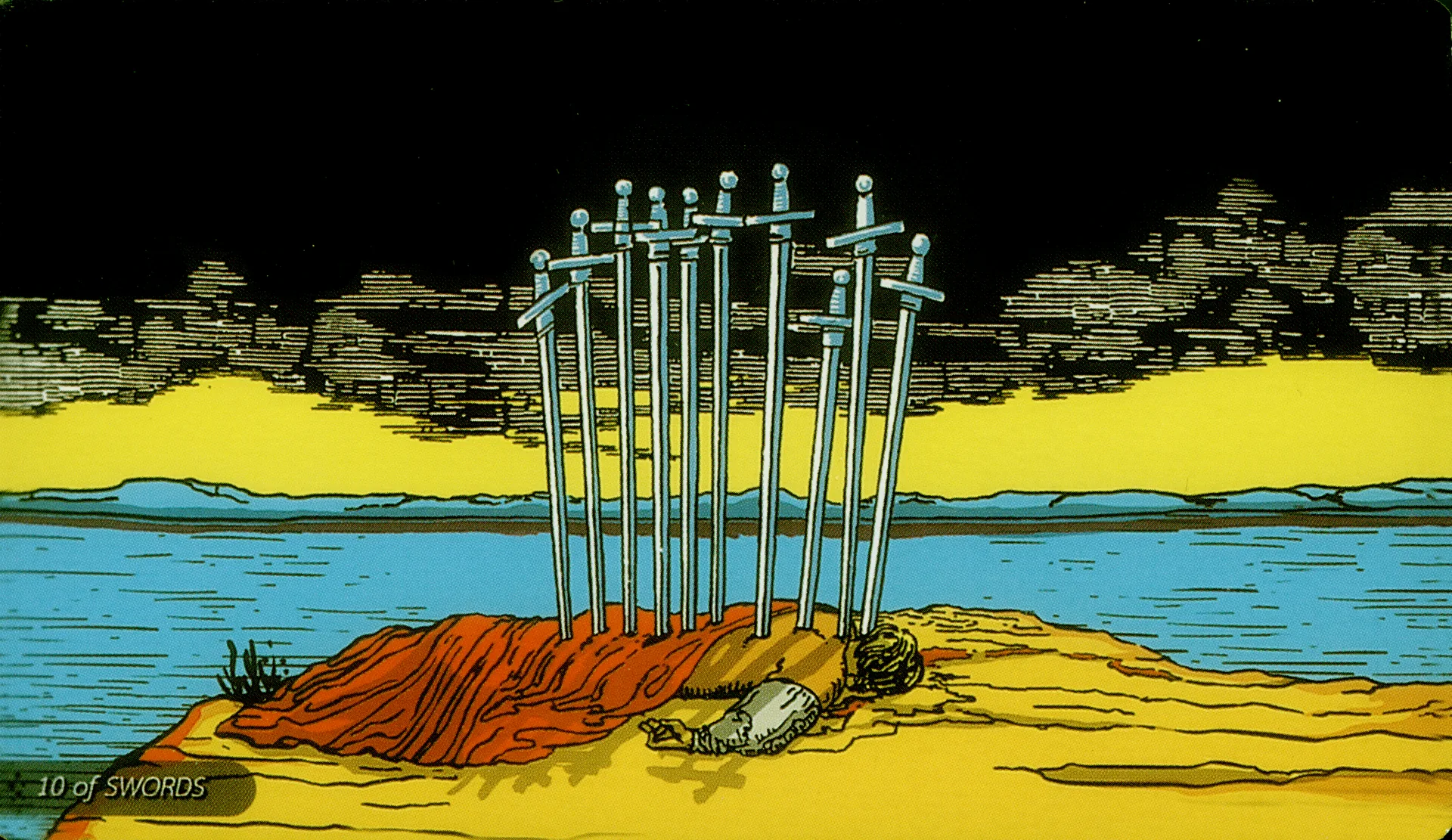
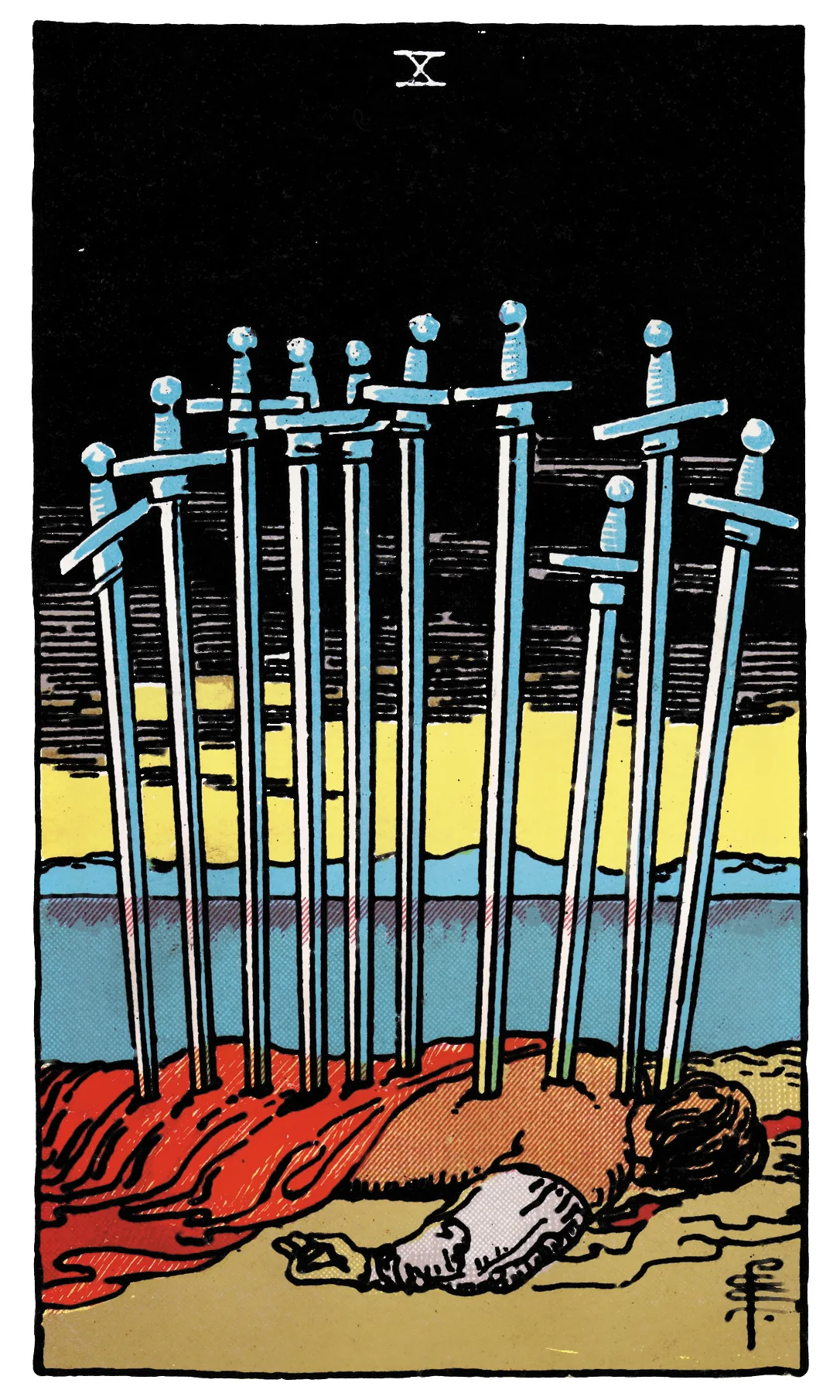
The separate Rider-Waite-Smith portrait bears the Roman numeral X and no printed card-title words. The Ten of Swords depicts a figure lying face down with ten swords entering the back. A red cloth covers much of the lower body. Behind the figure are water, distant land, a black sky, and a yellow band at the horizon.
A common description says the Ten of Swords shows a man lying with ten swords in his back. The visible figure and blades support the physical description; the image does not tell us the person's thoughts, life history, or what will happen to a reader.
Readers often interpret the bright horizon as dawn or sunrise, the dawn of a new day after the darkest part of the scene. Saying "the sun is rising" describes that interpretation; a distinct sun disc is not visible in this retained portrait. The stillness can suggest pause after a crisis, while the contrast in the sky can symbolize a possibility of change.
The wide hero is an expanded panorama, not the best source for claims about Pamela Colman Smith's original composition. The four-deck comparison and gallery preserve other artistic perspectives. Read each actual image rather than assuming every version contains the same objects or printed labels.
The Swords suit, Ten rank, and historical meanings
In many modern traditions, the suit of Swords relates to thought, communication, conflict, and the element Air. Golden Dawn-influenced correspondences associate this Ten with the Sun in Gemini. These are symbolic traditions, not causes of events or universal agreements among readers.
In The Pictorial Key to the Tarot, A. E. Waite describes a prostrate figure pierced by the swords and gives upright meanings including pain, tears, sadness, and desolation. He explicitly writes that it is "not especially a card of violent death." His reversed meanings include advantage, profit, success, and favour that are not permanent, as well as power and authority. Those historical meanings differ from the modern emphasis on recovery.
A frightening picture is not a forecast. Phrases such as "things can only get better" or "inevitable change" should not become guarantees. The card can help you acknowledge an ending and consider support without promising when the situation will improve.
Ten of Swords keywords and tarot cheat sheet
For a brief reminder of these tarot card meanings, think of upright as painful finality, a limit, or acknowledging what no longer works. Reversed can suggest recovery, accepting help, or difficulty releasing an ended situation. The useful distinction is whether you need to recognise the loss or find a gentler response to it.
For journaling, try: What fact am I struggling to accept? What would help today? Which responsibility can I put down? If it is time to let a plan go, name the plan rather than making a judgment about yourself. You do not have to sever every connection to make one necessary change.
One card, many perspectives
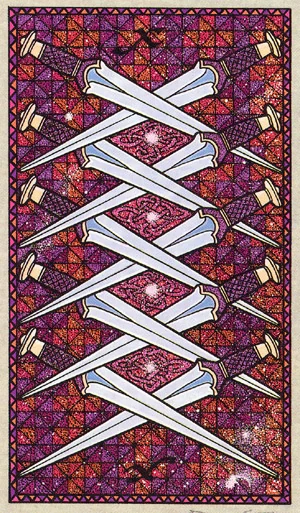
See Ten of Swords Card from Other Decks
Discover how other tarot decks interpret this card. Select a deck to explore its full review and gallery.

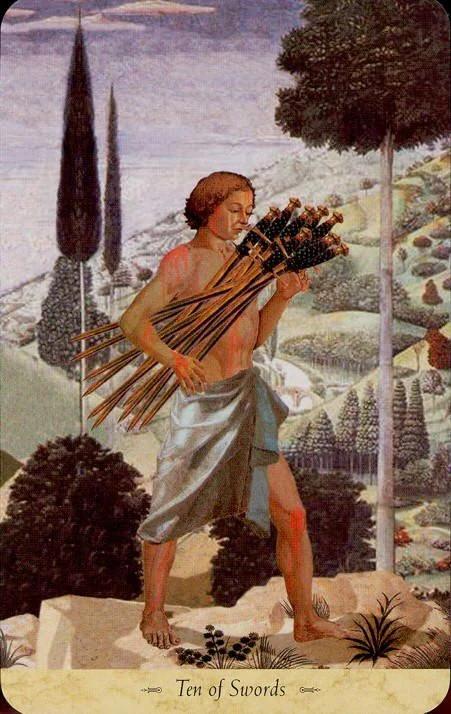


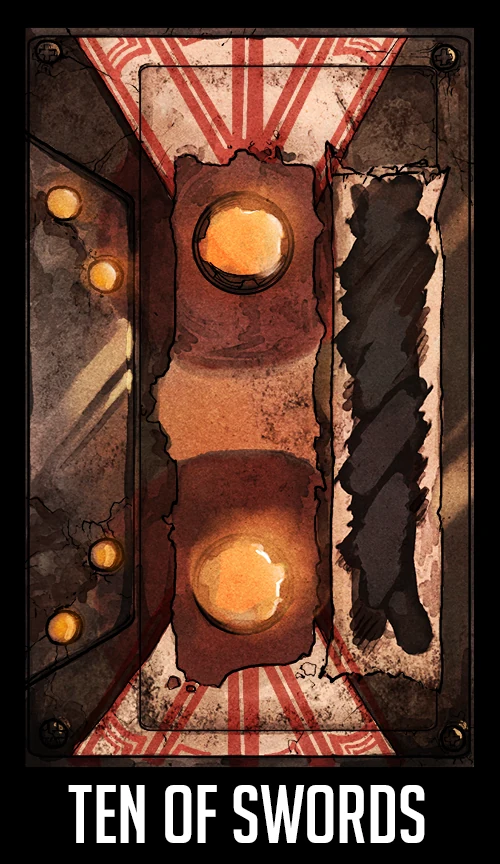


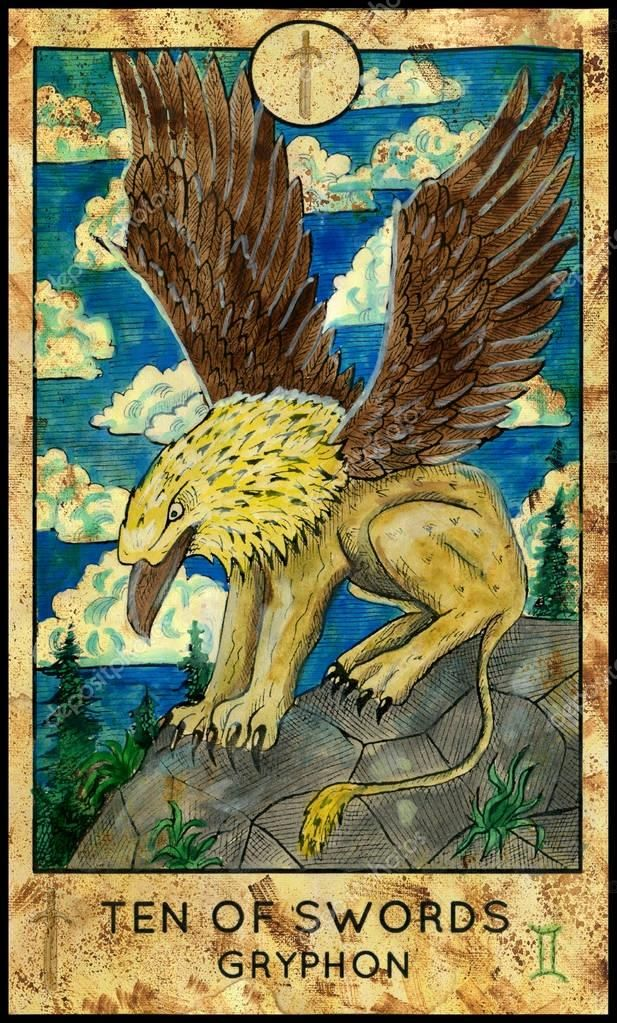

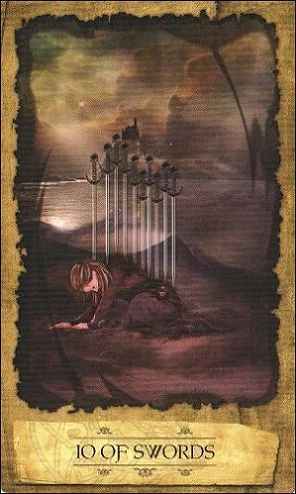


Ten of Swords FAQ
What does the Ten of Swords mean upright and reversed?
Upright, it often concerns a painful ending, exhaustion, or a limit being reached. Reversed, it may suggest recovery, accepting help, or resistance to an ending. The question and surrounding cards help you choose a relevant interpretation.
Does the Ten of Swords predict death or betrayal?
No. Its dramatic picture does not predict physical death or prove betrayal. Interpret it as a prompt for reflection, and rely on evidence and appropriate support for real concerns.
Is the Ten of Swords a yes or no card?
Many readers lean toward no for continuing as before. Reversed may suggest reconsidering the approach or allowing recovery. Neither orientation guarantees an outcome or replaces consent and practical information.
What should I do after pulling the Ten of Swords?
Name what is no longer working, identify one source of support, and choose a manageable next step. You can put the deck down if the image feels upsetting; you do not need another draw to earn rest or care.