Card gallery
Explore The Celtic Tarot cards
Browse the verified card images recovered from the supplied collection. Select a suit to narrow the gallery, or open any card for a larger view.

The Celtic Tarot review — Aurica’s quick take
These cards feel like pages lifted from a firelit storybook. Jewel colours and knotted borders make even the quiet pips hum with old songs.
I reach for them when a question needs patience rather than a quick answer. They speak most clearly when neighboring cards can answer one another.
The guidebook adds depth, though some language feels firmly of 1990. I keep what is alive in its symbols, question what feels fixed or severe, and let neighbouring cards bring nuance back into the reading.
Read it slowly, follow the knotwork, and trust the first honest feeling it stirs; this old deck can still open a brave, hopeful path forward.

The Fool — a path woven from instinct
The Fool steps through a blue interlaced landscape while pale hounds curl through the pattern around him. He looks less careless than enchanted, as though the road is being woven beneath his feet while he walks.
In a reading, I see trust here, but not blindness. The hounds give instinct a visible shape: something loyal and alert travels beside the new beginning. In shadow, all that beautiful pattern can become distraction—following the feeling of a path without asking where it leads.
Deck facts
What comes with The Celtic Tarot
- Author
- Helena Paterson
- Illustrator
- Courtney Davis
- Original publication
- The Aquarian Press / Thorsons, 1990
- Structure
- 78 cards: 22 Major Arcana and 56 Minor Arcana
- Minor suits
- Wands, Cups, Swords and Coins
- Guidebook
- 158-page paperback in the original edition
- ISBN
- 0-85030-919-0 / 978-0-85030-919-5
- Reversals
- The book favors dignified and ill-dignified readings based on neighboring cards
The deck is now out of print, and the second-hand market can be confusing. The book was sold alongside more than one edition of the cards, and some current listings offer only the paperback. If you are buying a used copy, ask the seller to confirm that all 78 cards are present and that the book is included.
Four ways of knowing
These four Major Arcana move from outward skill into guarded intuition, inherited teaching and solitary wisdom.

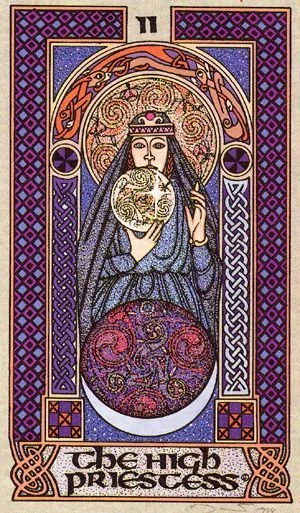
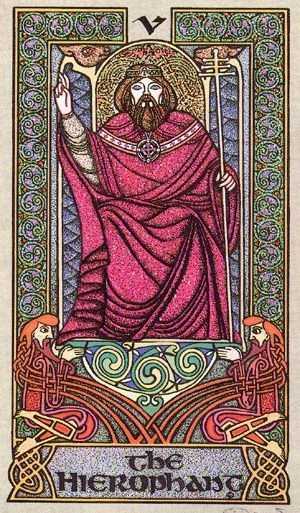

Read them as a sequence: What can I shape, what must I listen for, which tradition supports me, and what can only be learned in quiet?
Artwork and symbolism
Celtic ornament with a clear tarot backbone
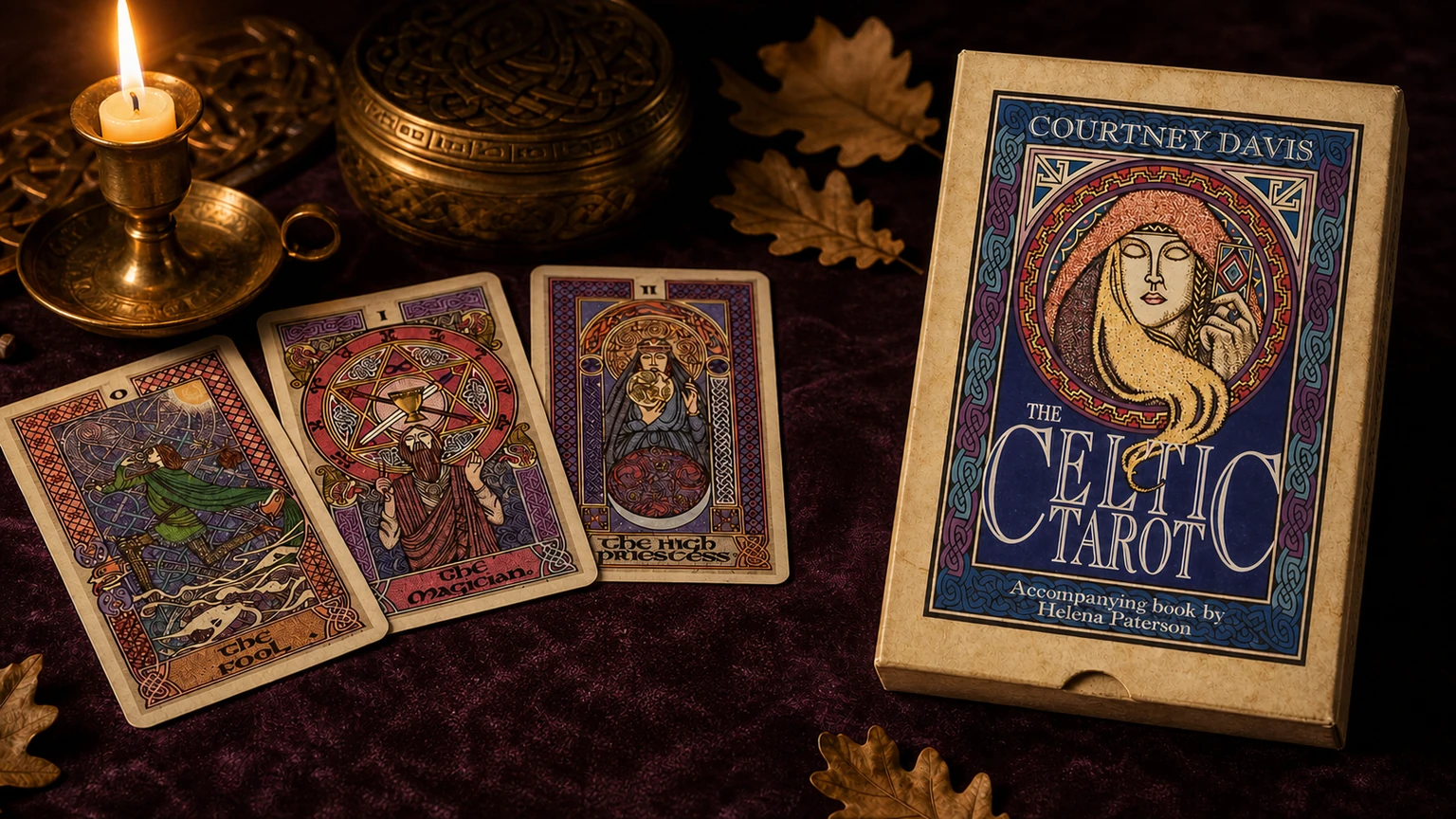
Davis gives almost every card the feeling of a page framed by carved stone or woven thread. The borders change colour by suit, but the visual family is unmistakable: loops, diamonds, spirals and repeating knots hold the pictures in place. Reds, violets, ocean blues and mossy greens sit against cream-colored card stock. The printing has the softly mottled texture of its era rather than the polished gloss of a new digital deck.
The Major Arcana are the most immediately readable. The Fool strides through an interlaced blue landscape with hounds twisting around his path. The Magician stands beneath a large circular emblem that gathers a cup, blades and a star into one commanding design. The High Priestess is symmetrical and still, seated between curling creatures with a crescent below her. These cards keep their traditional titles and numbers, so a reader who knows tarot has something firm to hold while learning the Celtic associations.
Some reinterpretations are gentle; others alter the emotional temperature. Death is not a mounted skeleton charging through a crowd. The card shows a dark-robed figure beside mourners and an open grave, quiet and unmistakably human. The Sun is ecstatic rather than orderly: a pale figure reaches upward inside a mass of reddish light while another figure rests below. The World places a seated figure within a circular enclosure watched by four animal heads. Each image makes you pause, which is exactly the point of this deck.
“The imagery is rich and flamboyant, and spiritually powerful,” Paterson writes in the original book. That description still fits the cards.
The Minor Arcana are more emblematic than scenic
The numbered Minors often concentrate on suit emblems instead of showing people acting out a situation. The Ace of Cups sets a chalice into a cross-like arrangement of blue and purple knotwork. The Three of Swords places three blades over a dense red lattice, with no pierced heart and no rain. The Ten of Coins becomes a formal field of ten round emblems in a green and blue frame.
This makes the deck less conversational than a Rider-Waite-Smith clone, but not empty. Number, colour, symmetry and direction carry the reading. The court cards offer more figurative detail. The Queen of Wands turns toward a tall flowering wand; the Queen of Coins raises a patterned coin beside her face. Their clothing, posture and suit colours make them easier to distinguish than the pips.
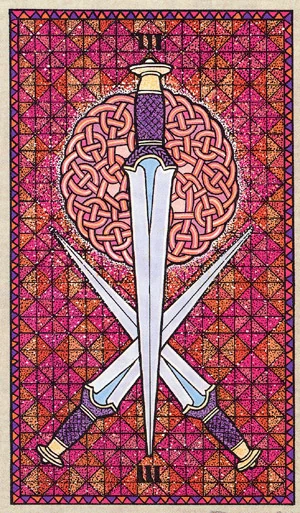
Three of Swords — pain held inside a pattern
Three bright blades stand over a dense red lattice. There is no pierced heart, storm cloud or theatrical rain; the hurt is contained inside repetition, pressure and sharp geometry.
This card can name the thought that keeps returning after the first wound has passed. Its symmetry asks where pain has become a habit of mind. Beside gentler cards, the swords may cut a clean opening; beside rigid ones, they can show a story rehearsed until it feels permanent.
Reading experience
How The Celtic Tarot reads
My first instinct with these cards is to slow down. A quick three-card pull works, but the deck becomes more articulate when the positions have a relationship to one another. Paterson's own method supports that feeling. Instead of depending on reversed cards, she asks the reader to decide whether a card is dignified or ill-dignified by studying the cards around it.
That approach creates useful friction. The Three of Swords does not become “bad” simply because it appears; its sharpness may be a necessary correction beside a card of avoidance. A warm card can be checked by a difficult neighbor without losing its central nature. Readers who already read combinations will recognize the method. Beginners may need the book open for a while, especially because the Minor Arcana do not narrate their meanings through little scenes.
Where it works beautifully
Seasonal reflection, ancestry, creative work, spiritual study and questions about long patterns. The mythic Majors give large spreads a sense of scale without turning every answer into a prediction.
Where it needs care
Fast yes-or-no readings and highly practical daily pulls can feel heavier than necessary. The book also uses firm language about fate, character and “ill-dignified” influences that many contemporary readers will want to soften.
Spreads included in the book
The guidebook teaches the Celtic Cross and an Alchemist's Spread, then introduces the Druid's Star specifically for this deck. The eight positions of the Druid's Star are tied to solar and lunar expressions of the four elements. It is described as a counselling spread for character and present circumstances rather than a device for forecasting the future. That distinction makes it one of the book's most usable ideas.
The four elemental gates
Each Ace presents one suit as a concentrated emblem, surrounded by the deck’s knotted borders and jewel-toned fields.
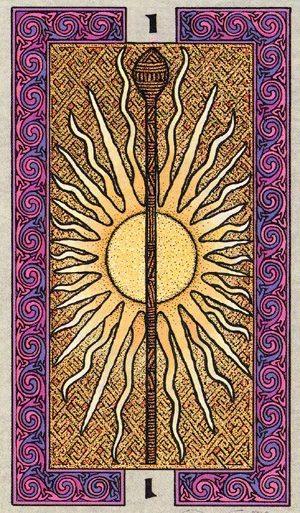
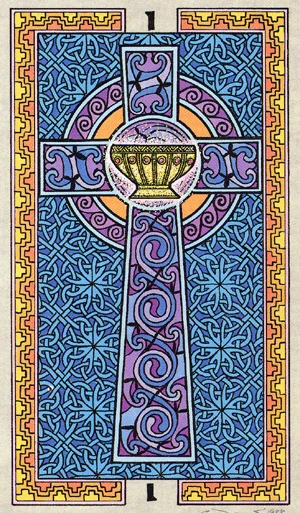
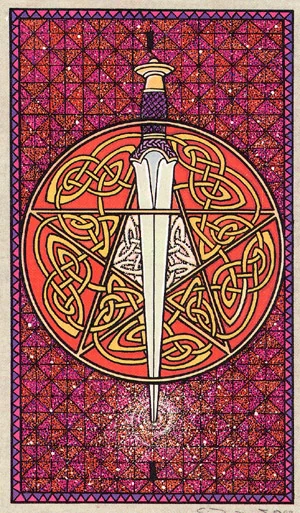

Use them as a simple check-in: Where is energy waking, where are feelings gathering, what truth needs a clean edge, and what is ready to become tangible?
The accompanying book
A substantial guide, with the voice of a 1990 occult text
The paperback is not a thin instruction leaflet. It opens with Paterson's account of tarot history and a broad Celtic profile, explains significators and card dignity, presents spreads, then gives individual entries for every Major and Minor card. The Major Arcana chapters connect each tarot archetype with a named Celtic figure, sacred tree or legend. The Fool becomes Dalua, the High Priestess is linked with Ceridwen, the Emperor with King Arthur, the Hermit with Merlin, and the Wheel with the Morrigan.
The book's confidence is part of its atmosphere, but it should be read in context. Some historical claims about tarot origins and ancient cultures reflect occult writing of the period rather than present-day academic consensus. I find the book strongest when it stays close to the cards: describing a symbol, tracing a mythic connection, or showing how neighboring cards change the tone of a spread.
Each card entry separates dignified and ill-dignified expressions. You do not have to adopt every prediction or moral judgment to use the system. I would treat the entries as a record of the deck's intended grammar, then bring your own ethical reading style to the table.

Death — grief without disguise
A dark-robed figure stands beside mourners and an open grave. Davis removes the charging skeleton of familiar tarot imagery and gives transformation a quieter, more human weight.
The card does not rush toward renewal. It lets an ending be felt before it is explained. Upright, that honesty can make space for release; in shadow, it may show grief held so tightly that the next season cannot yet enter.
What I like
- The deck has a consistent artistic identity from the borders to the court cards.
- Traditional titles and numbering make the Celtic reinterpretations easier to learn.
- The guidebook gives the mythology and reading method enough room to breathe.
- The dignified and ill-dignified system encourages genuine card combinations.
- The Druid's Star spread feels designed for this deck rather than added as filler.
What may not suit you
- Several numbered Minors are decorative pips rather than illustrated situations.
- The dense ornament and muted vintage printing may feel visually busy.
- Some guidebook language about fate and negative influences feels dated.
- Complete copies can be difficult to identify on the second-hand market.
Four queens, four kinds of care
The four Queens hold authority through different suit emblems, colours and gestures rather than through identical poses.
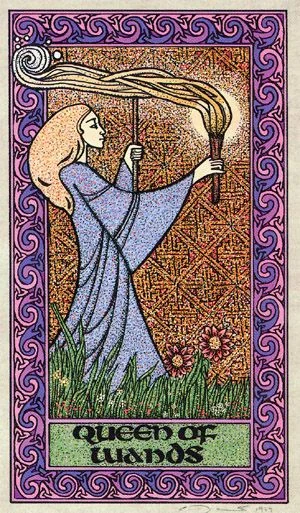
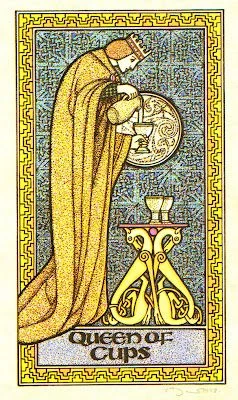
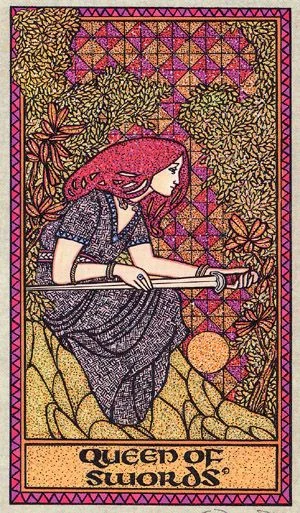

Together they ask what care requires now: encouragement, emotional presence, honest boundaries or steady practical protection.
Who it is for
Choose this deck if the book matters as much as the cards
The Celtic Tarot suits a reader who enjoys research and returns to the same deck over months or years. It is a particularly good match for people interested in Celtic revival art, Arthurian material, sacred trees and the way older tarot books built complete symbolic systems around a deck.
A new reader can learn with it, but patience helps. If you want every numbered card to show an obvious emotional scene, start with a more fully illustrated deck and come back to this one. If you enjoy Marseille-style number reading, elemental dignities or studying symbols in layers, the Minors will make sense much sooner.
Final verdict
Old-fashioned in places, but never anonymous
The Celtic Tarot has a point of view. The artwork is formal, busy and immediately recognizable; the book is earnest, detailed and occasionally severe. I do not agree with every historical claim or every predictive phrase in the text, yet I would rather wrestle with a deck that has convictions than use one assembled from generic symbolism.
For slow readings, mythic study and questions that need more than a keyword, it remains absorbing. Courtney Davis's cards hold their own as objects of art, and Paterson's book explains why each knot, creature and legendary name belongs there. Keep the guidebook nearby, give the deck room on the table, and let the cards speak to each other.
Questions answered
The Celtic Tarot FAQ
Who created The Celtic Tarot?
Helena Paterson wrote the accompanying book and Courtney Davis created the card artwork. The original book-and-deck edition appeared through The Aquarian Press in 1990.
How many cards are in The Celtic Tarot?
The complete deck contains 78 cards: 22 Major Arcana and 56 Minor Arcana in Wands, Cups, Swords and Coins.
Is The Celtic Tarot beginner-friendly?
A patient beginner can learn with it, especially with the guidebook nearby. Its emblematic numbered cards ask for more study than fully scenic Rider–Waite–Smith-style decks.
Does the guidebook use reversed cards?
Paterson emphasizes dignified and ill-dignified meanings shaped by neighboring cards rather than relying only on upside-down reversals.
What should I check before buying a used copy?
Confirm the listing is the 1990 book-and-deck edition, not the paperback alone, and ask the seller to verify that all 78 cards and the accompanying book are present.