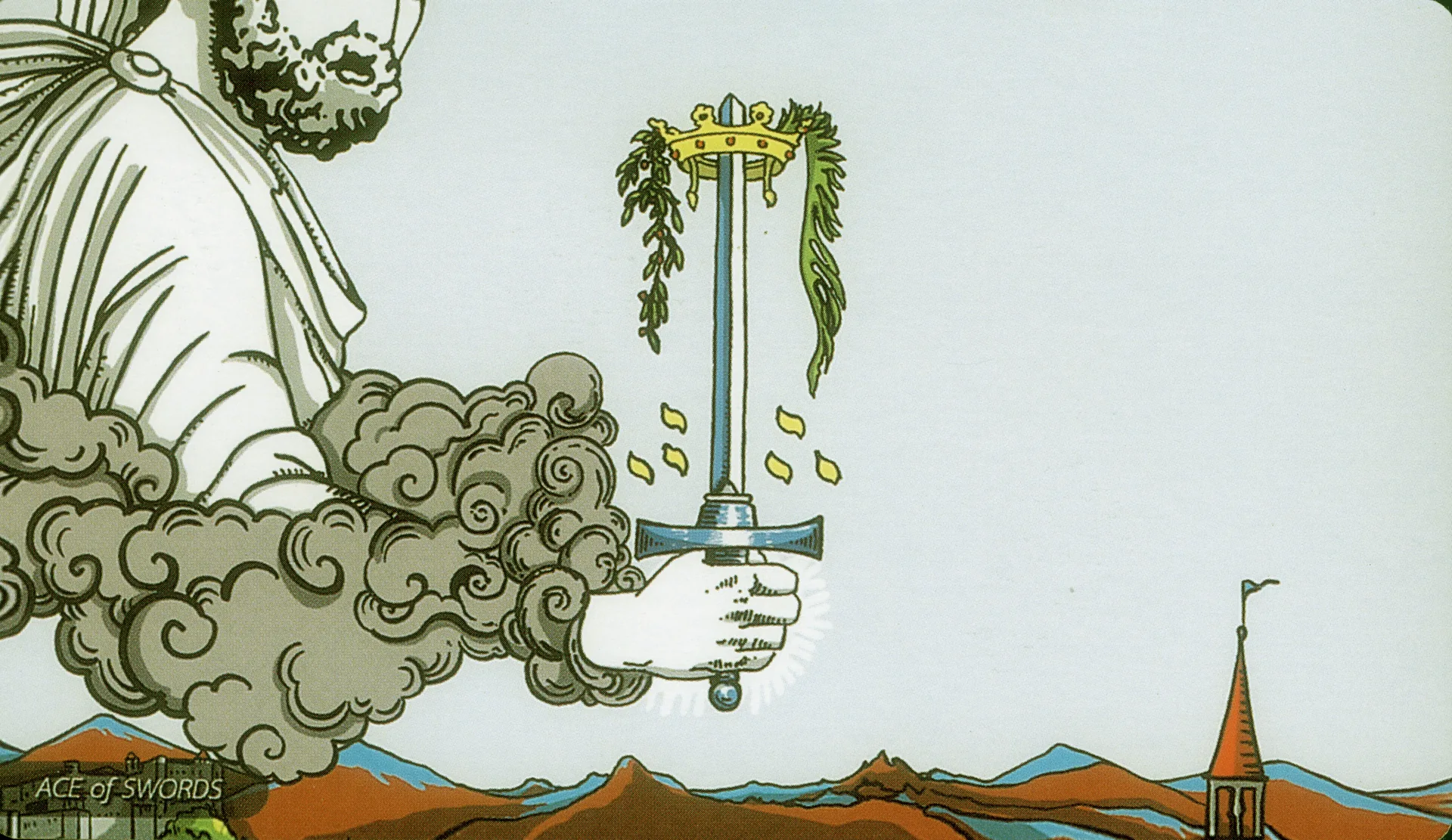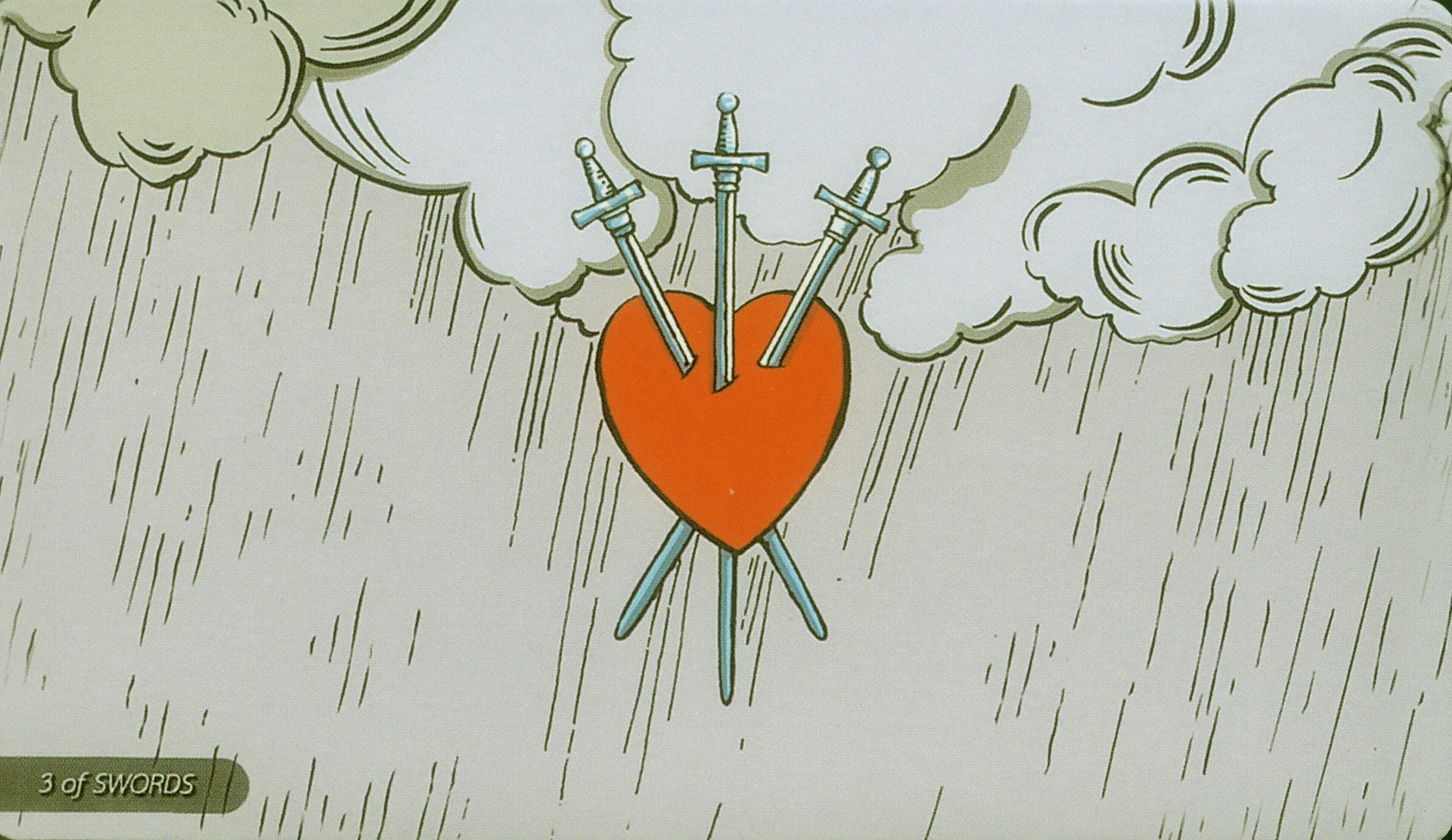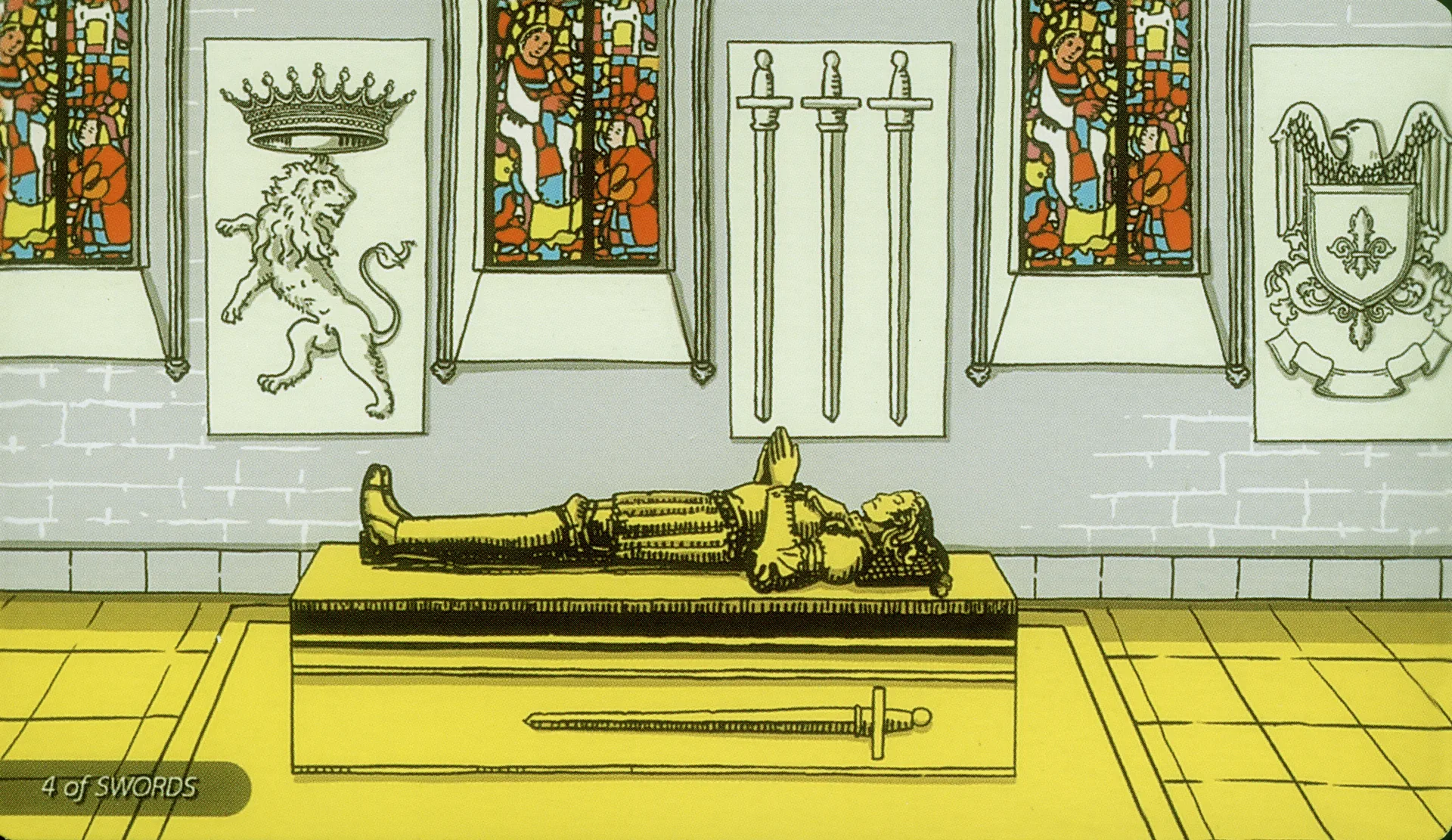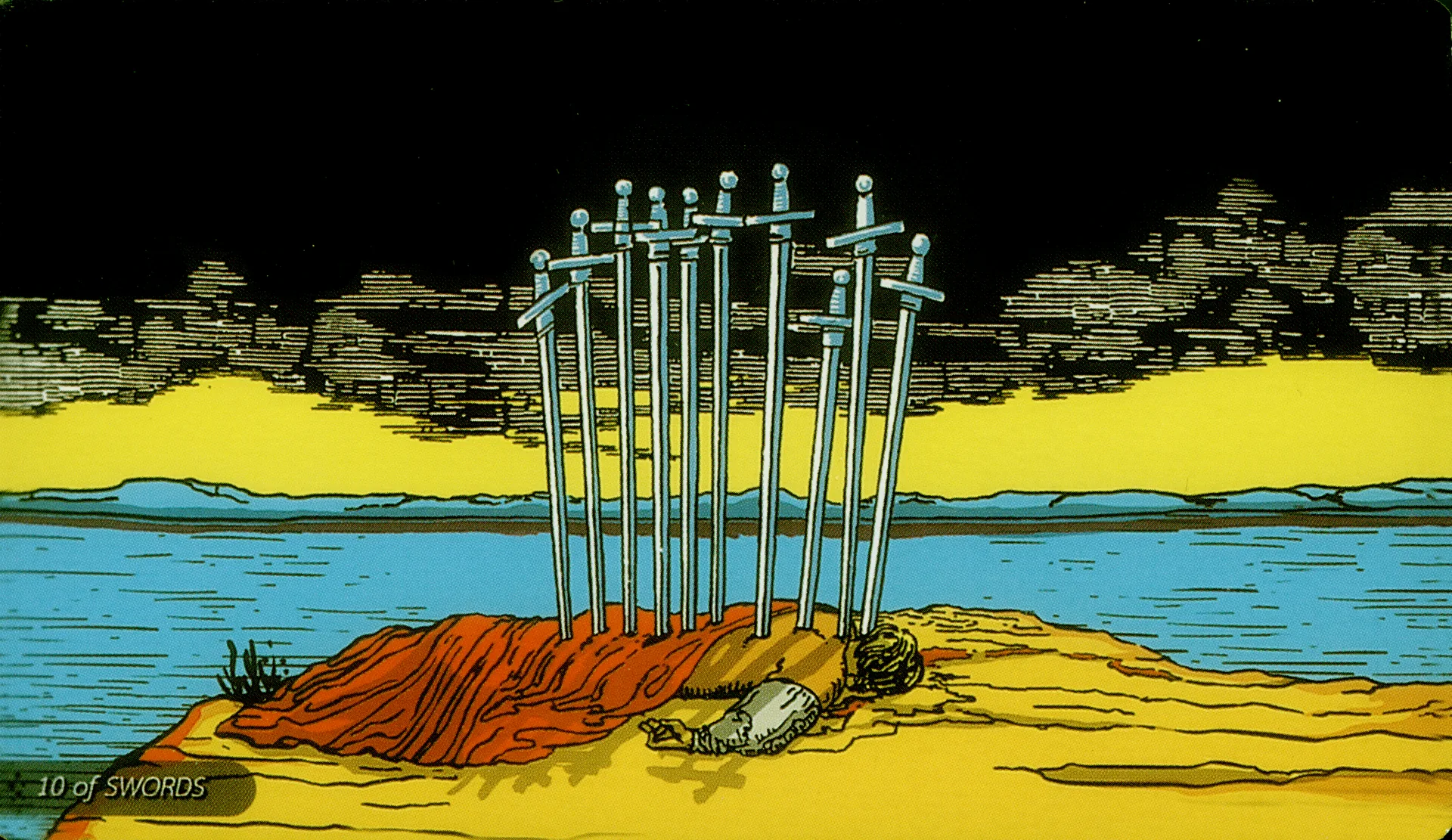

The Five of Swords tarot card meaning often concerns conflict, defeat, or a victory that costs more than it gives. Upright, it asks you to examine how a disagreement is being handled. Reversed, it may invite repair, remorse, or a decision to stop repeating the same battle. It can also prompt you to notice resentment that has not been addressed.
Perhaps you made a good point in a meeting, but the way you delivered it embarrassed a colleague. You can have the figures right and still wish you had spoken differently. This card gives you room to protect a valid concern while changing your approach.
You may also know the card as the 5 of Swords. Its message need not be frightening: it offers a chance to recognise an unhelpful pattern before you give it another afternoon, another friendship, or more of your attention.
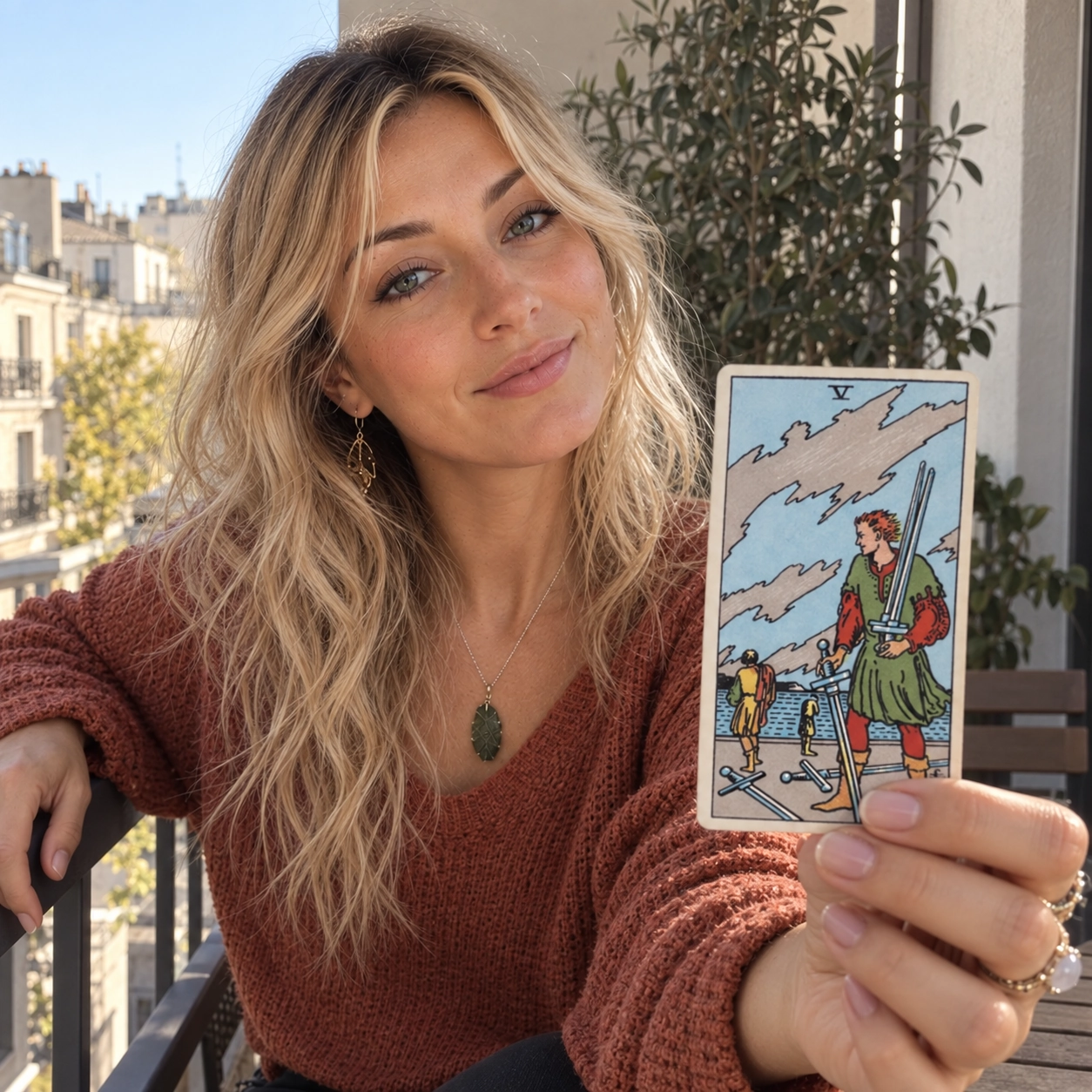
5 of Swords Tarot Card Meaning at a Glance
- Main keywords: conflict, ego battles, winning at a cost
- Upright meaning: a problem is asking for courage, honesty, and a better response. In the Swords suit, this connects to thoughts, words, truth, stress, and decisions
- Reversed meaning: recovery, letting go of conflict, or learning from a hard moment. The reversed meaning asks you to check how you are handling thoughts, words, truth, stress, and decisions
- Yes or no: usually no, because the situation may cost more than it gives
- Best question to ask: What is this card trying to help me understand right now?
Upright Five of Swords meaning: what does winning cost?
The upright Five of Swords often brings a tense exchange into focus. Someone may be determined to win at all costs, even if that means an unfair remark, a misleading claim, or public humiliation. The card suggests looking at what happened before assigning blame.
A hollow victory is sometimes called a pyrrhic victory: you get the result you wanted, but the cost makes it hard to enjoy. You might conquer the discussion and lose the willingness of others to work with you. Ask whether the outcome serves your actual purpose.
If you feel defeated, separate a disappointing result from a judgment about yourself. Losing one argument does not make you a loser. You can acknowledge what happened, seek support, and decide what is worth trying again.
Walking away can be sensible when a conversation has become circular or hostile. That is different from abandoning an essential responsibility. Before you leave, consider what needs recording, who may need help, and whether there is a safer or more useful route to resolution.
Fear of being criticised can make you quiet; recklessness can make you strike back without checking the facts. Neither has to choose your next sentence. Take a breath, identify the issue, and express it without an insult.
Five of Swords in a tarot reading
Read the card alongside the question and position. In the past, reflect on the aftermath of a disagreement. In the present, examine the methods people are using. In a future position, plan how you would respond to pressure; the image does not establish that trouble will happen.
Neighbouring cards offer another angle. With Justice, consider evidence and ethical conduct. Beside the Five of Wands, distinguish lively competition from a personal attack. With the Six of Swords, explore a calmer arrangement. Pentacles cards may direct attention to practical resources, while a cup card may invite you to consider emotional repair. These are interpretive examples, not fixed outcomes.
Love and relationships: disagree without trying to conquer
In a relationship reading, notice whether each conversation has become a contest. If you argue about housework, a list of last week's mistakes may win the moment without making tonight any easier. Choose one specific change you can both discuss, such as who handles dinner on late-working days.
The Five of Swords can invite reflection on defensive communication, but it cannot reveal someone's private feelings or prove betrayal. Ask directly, listen to the answer, and consider their actions. An ex returning or a partner wanting to leave needs real evidence, not an interpretation of this image.
If you are single, consider whether a recent unpleasant experience is shaping how you approach new people. You can keep sensible boundaries without assuming every disagreement signals rejection. Connect at a pace that lets you notice how someone handles an ordinary difference of opinion.
Repeated intimidation is different from a mutual misunderstanding. If someone threatens you or behaves like a bully, you do not owe them another debate to demonstrate fairness. Prioritise your safety and seek appropriate support; the card cannot diagnose a person or relationship.
Career, money, and school: protect the issue, not the feud
At work, separate the problem from the desire to have the last word. If a colleague takes credit for your work, keep dated records and explain the contribution through an appropriate channel. An angry group message may create a second problem without resolving the first.
For money questions, check the terms before accepting a competitive pitch. Pressure to decide immediately is a reason to slow down and verify the information. Tarot cannot predict returns or replace qualified financial advice.
At school, disagreeing about a group project's direction need not turn into a judgment about someone's ability. Compare the requirements, divide the work clearly, and agree on how to review it. You may discover that the idea is fine; nobody has agreed on who does the work.
Use logic to check what actually happened, while leaving room for how people experienced it. Accurate facts and considerate communication can coexist. The card's insight is often in that distinction.
Five of Swords reversed meaning: repair or unresolved resentment
The reversed Five of Swords may suggest a readiness to end a feud, acknowledge regret, or reconsider a win that did not feel good. Some readers also interpret it as lingering bitterness: the exchange has ended, but its effects remain.
Remorse is more useful when it leads to a specific action. Instead of saying, "Sorry you were upset," name what you did: "I interrupted you and made that personal. I will let you finish next time." The other person still chooses whether to accept the apology.
A wish for reconciliation does not guarantee it. Repair needs willingness from the people involved and a change in behaviour. You can offer a fair conversation without demanding immediate forgiveness or renewed closeness.
If the same unhealthy exchange keeps returning, look at what has stayed unchanged. You might need a firmer boundary, a neutral mediator, or a different way to communicate. Avoid treating the reverse orientation as proof that everything is now settled.
In some readings, this card invites you to release attachment to being vindicated. You can learn from the experience even when the other person sees it differently. Choose a next step that you could respect even if nobody applauds it.
Five of Swords yes or no meaning
Many readers lean toward no, or "not by this method," for the upright card. The concern is the cost of pursuing the result. Reversed, the emphasis may shift toward repair or withdrawal, but neither orientation guarantees an answer.
For a useful follow-up, ask whether your proposed action helps resolve the issue or merely scores a point. Consent, legal obligations, and urgent medical decisions cannot be replaced by a yes-or-no reading.
Advice: change one part of the argument
Choose a response you can control. State the problem plainly, leave out the personal attack, and suggest a concrete change. If the conversation is too heated, agree on a time to return to it rather than continuing until someone gives in.
You do not need to overcome every objection before acting responsibly. You might correct an error privately, decline a hostile exchange, or ask for help with a disagreement that has become too difficult to handle alone.
Notice your inner rehearsal of the argument. Replaying a clever reply can feel satisfying, but it may keep the dispute active long after it has ended. Write down the one unresolved issue and decide whether there is anything useful you can do about it today.
Wellbeing: notice what tension is taking from you
Constant arguments can leave you deeply tired or distracted. Use the image as a prompt to notice your need for rest, companionship, or professional support. The Five of Swords cannot diagnose an illness, confirm pregnancy, or promise a cure.
Feeling unhappy after a disagreement does not mean every part of your life is going badly. Pessimism and negativity can make one painful exchange seem like a complete verdict. Return to specific facts and the support available to you; seek qualified care for symptoms or persistent distress.
One archetype, four perspectives
Five of Swords Across Four Tarot Decks
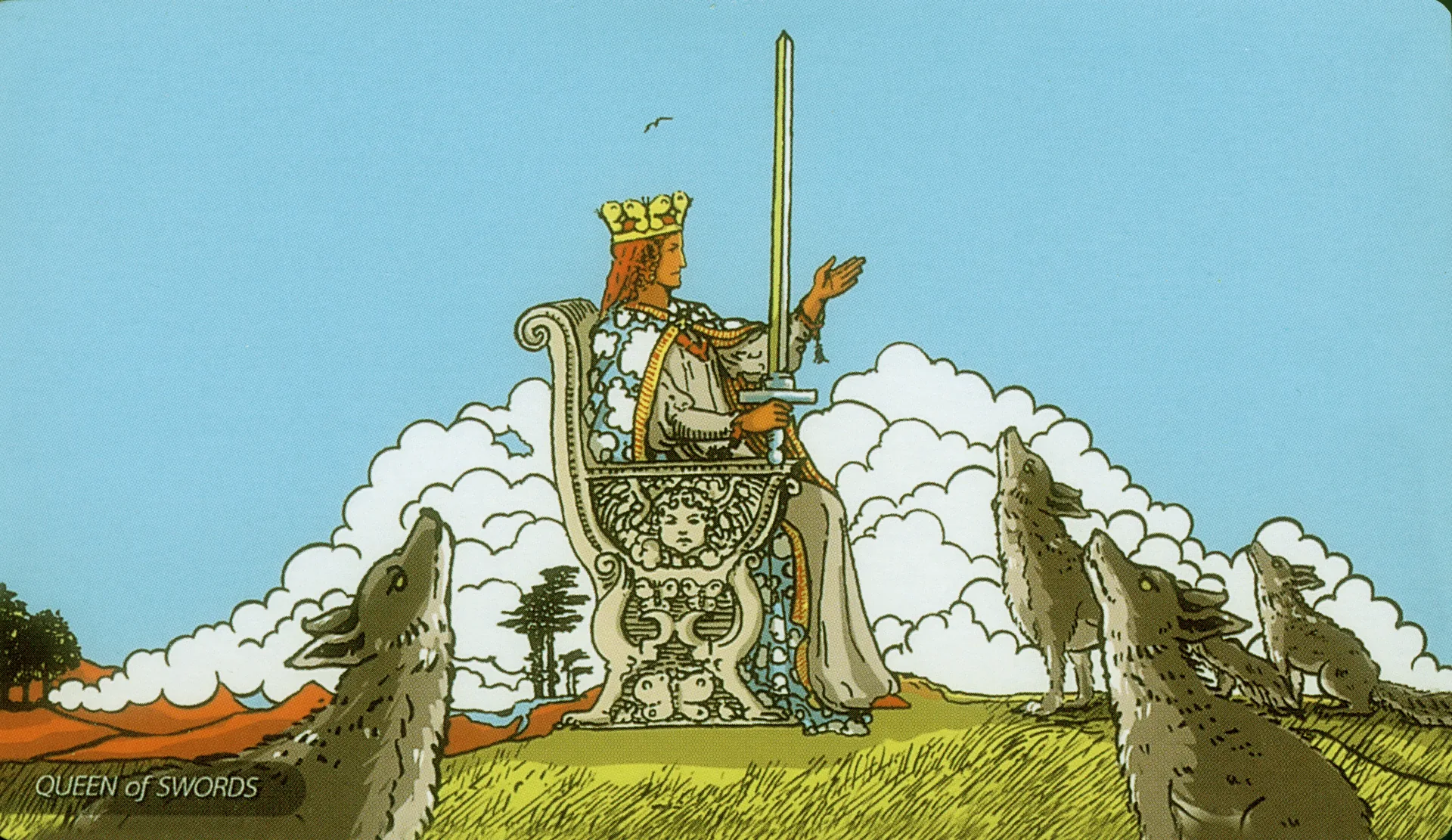
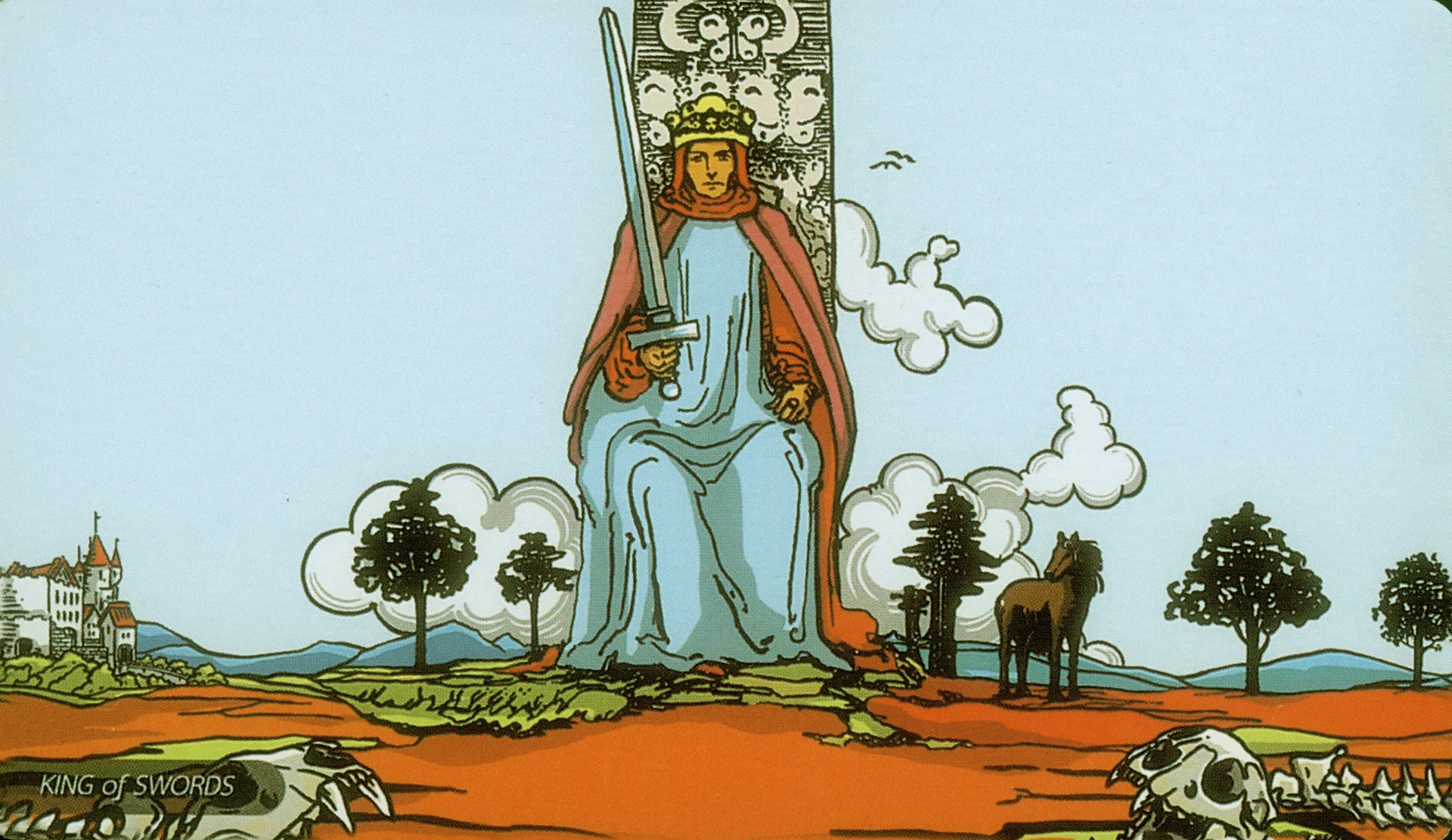
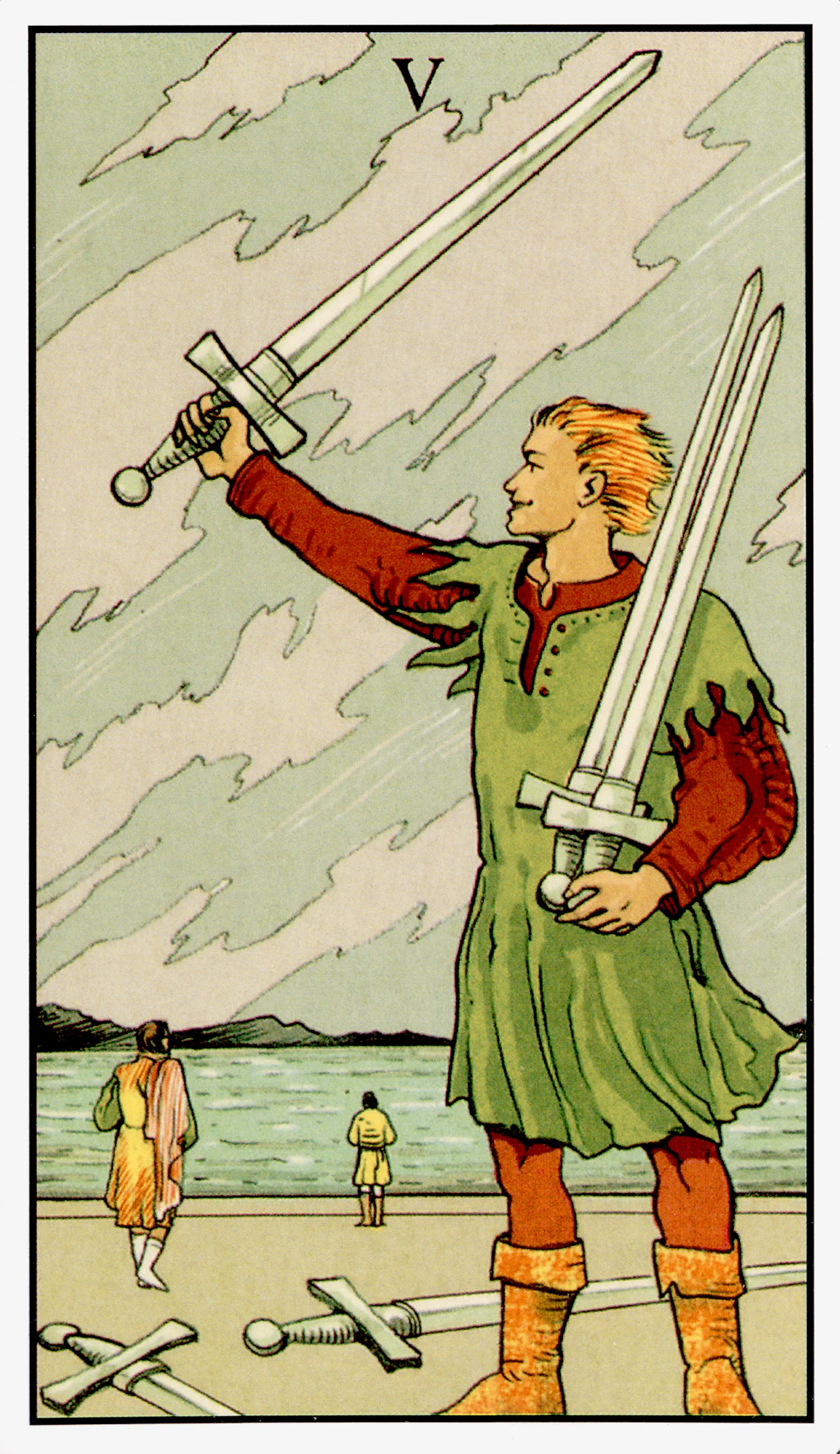
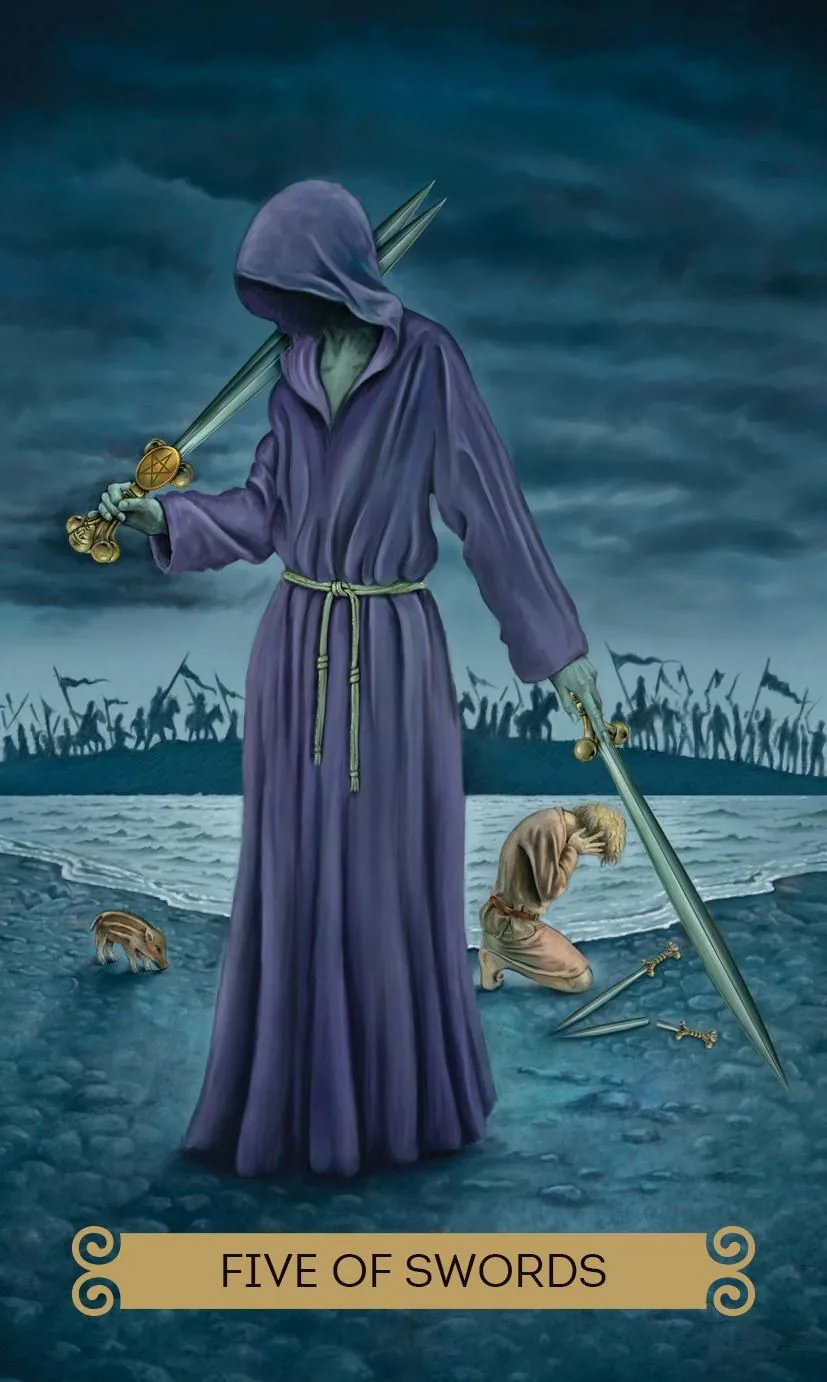
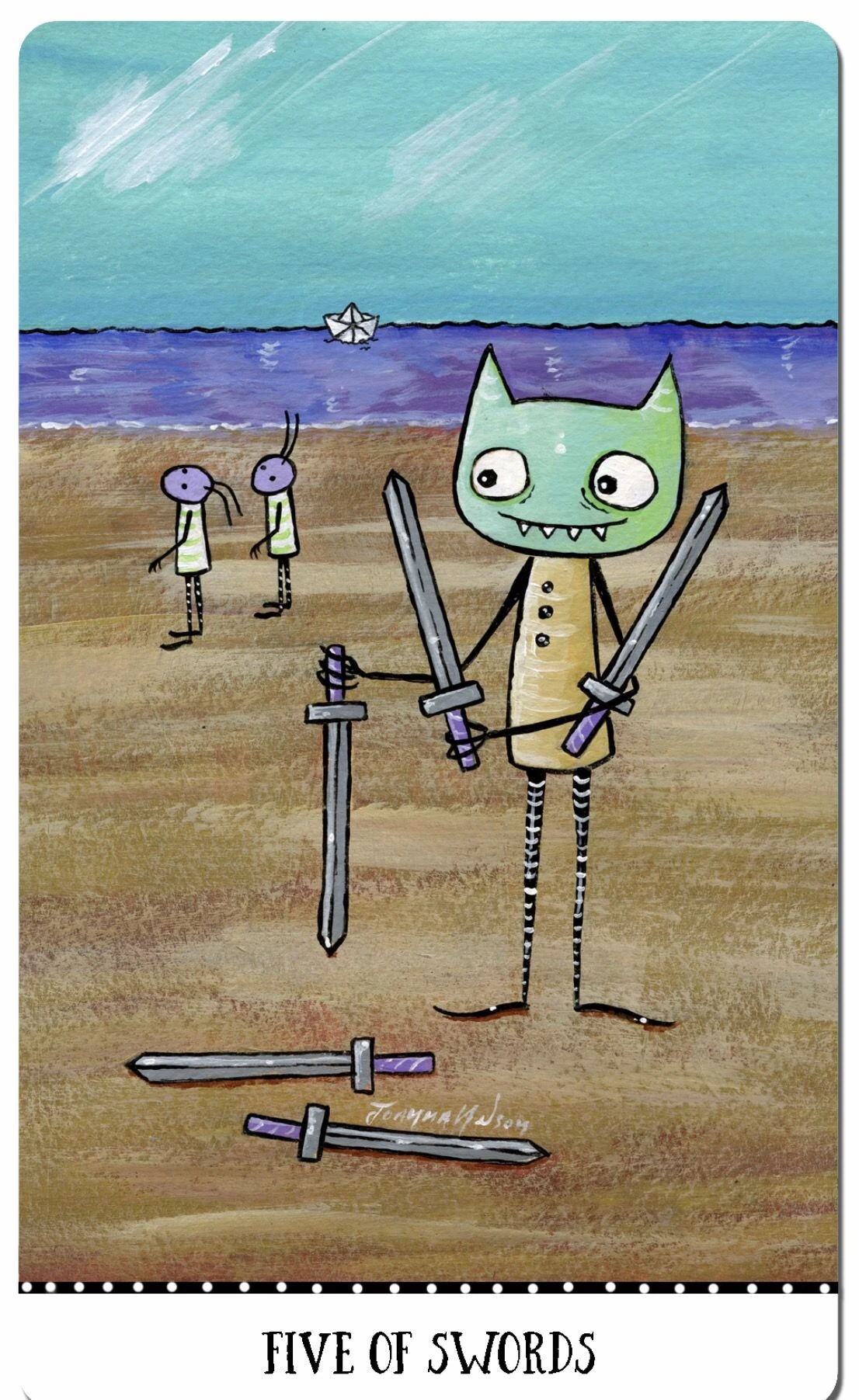
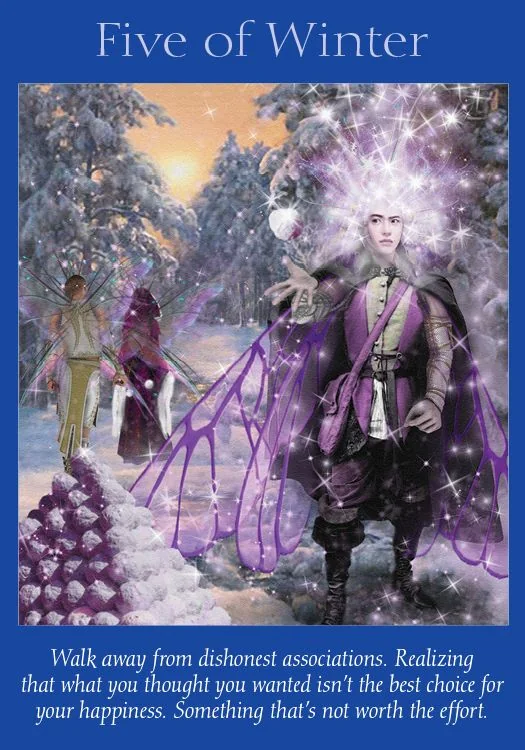
Compare the familiar Rider-Waite-Smith card with the moments before, behind and after the classic scene in three Lo Scarabeo decks.
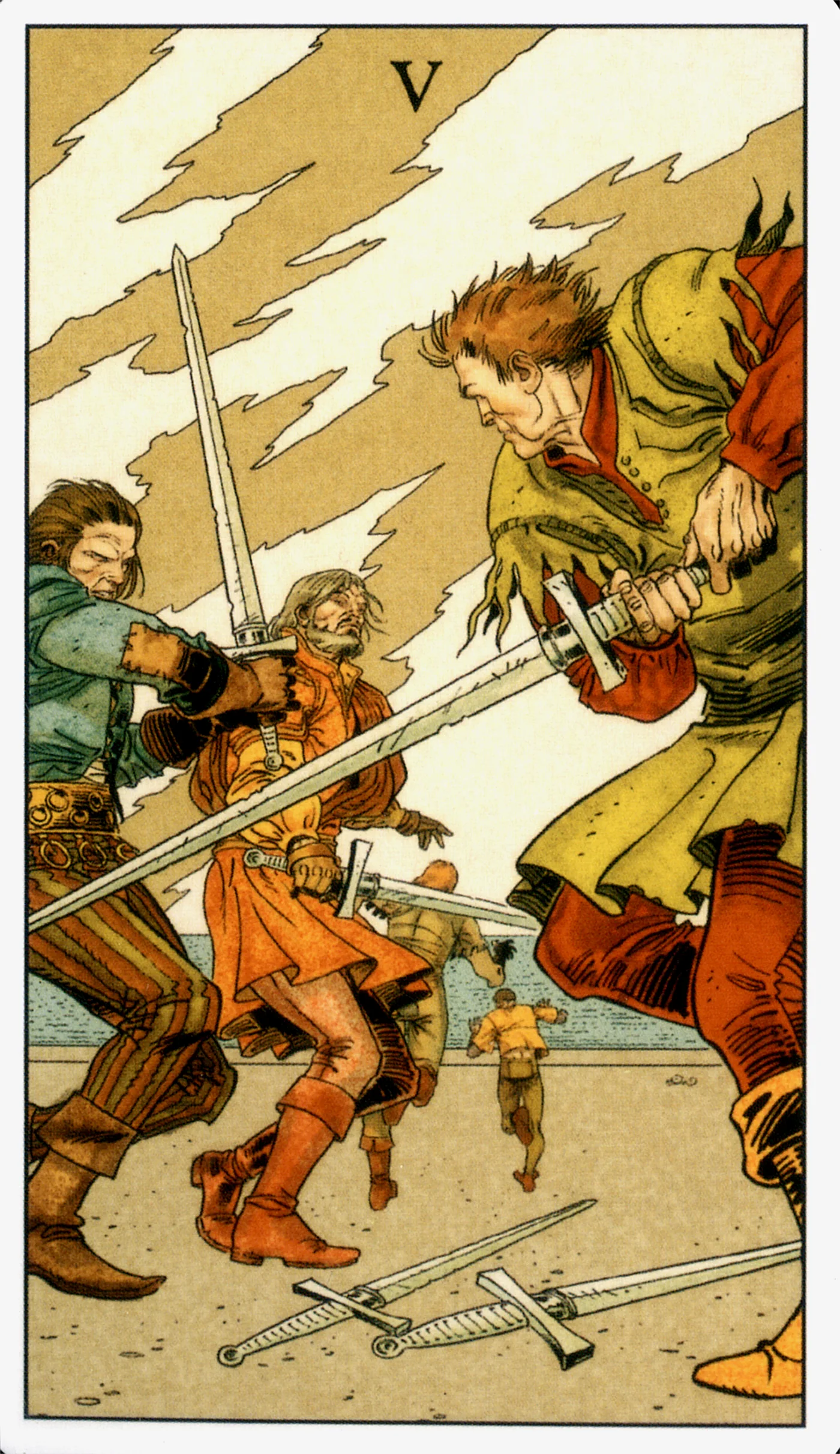
What apparently happens just before
What actually happened
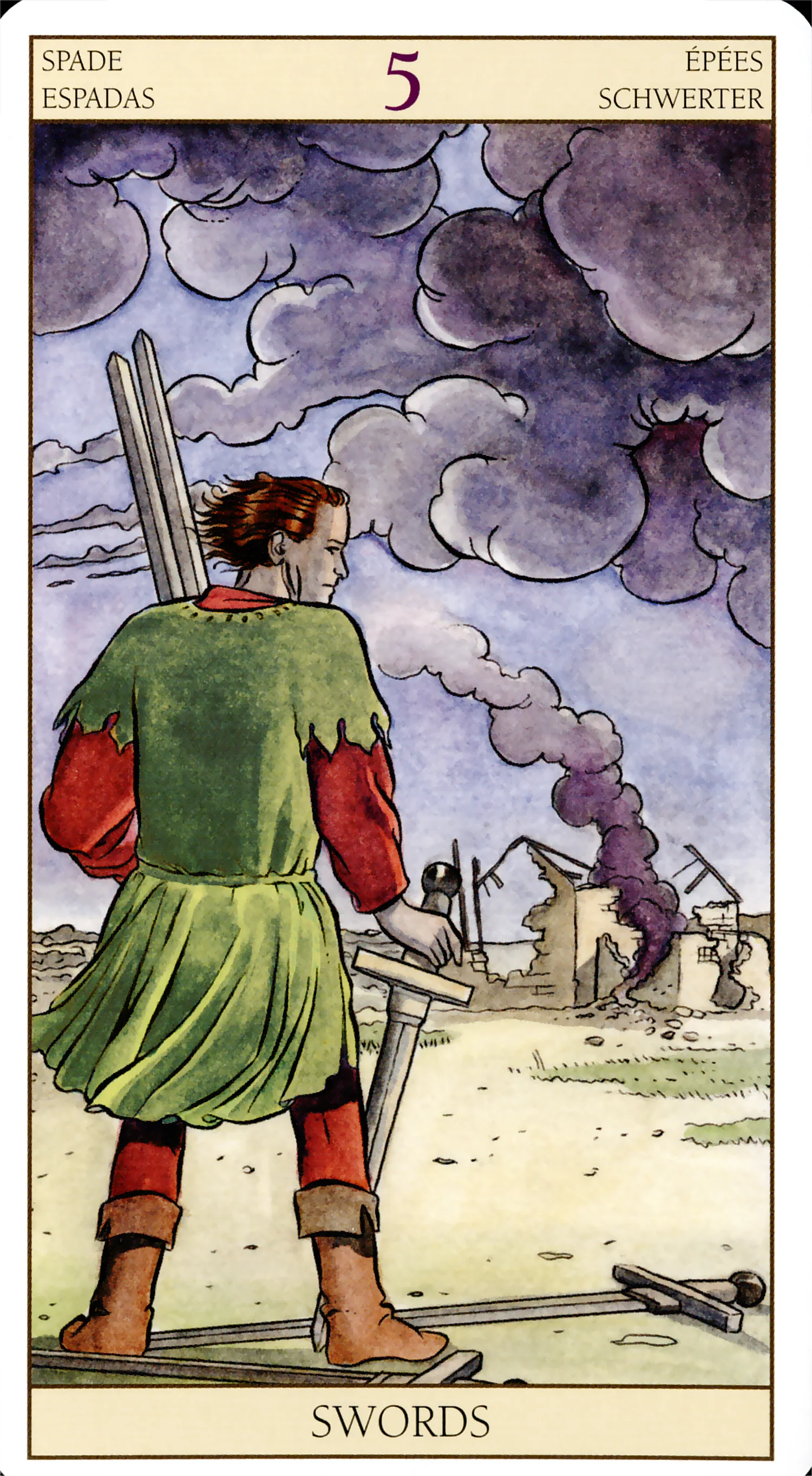
What happened on the opposite side
What apparently happened afterwards
Symbols in the Five of Swords tarot card
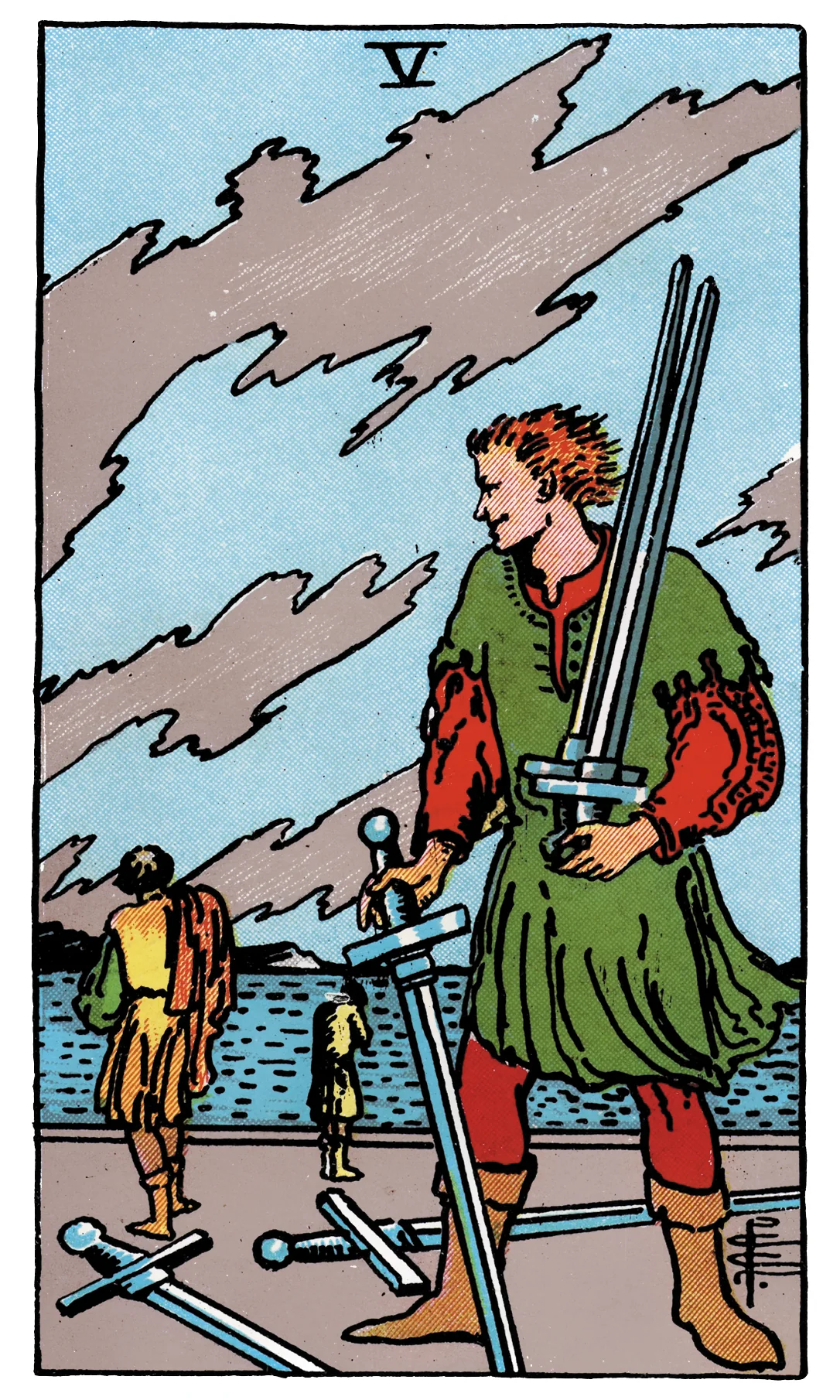
The verified Rider-Waite-Smith portrait bears the numeral V. A foreground figure holds three swords, while two more lie on the ground. Two figures are farther away beside water, beneath a sky of ragged clouds. The five blades establish this portrait's numbered Swords rank.
The picture can depict the aftermath of a contest rather than its opening move. Who holds the swords, who has turned away, and what has been left behind? Many modern readers use those details to consider the difference between possession and a satisfying outcome.
The wider hero is an expanded panorama. Use the separate RWS portrait for observations about Pamela Colman Smith's composition. Another version of the card may emphasise different details; the inherited four-deck comparison and gallery are there to explore those differences.
The Five rank, Swords suit, and traditional interpretation
This is a numbered Minor Arcana card, not the fifth Major Arcana trump. In many modern systems, Swords relates to thought, language, and the element Air. Golden Dawn-influenced correspondences associate this Five with Venus in Aquarius. Air is also associated with Gemini in some wider systems, but that does not make Gemini this card's specific correspondence.
In The Pictorial Key to the Tarot, A. E. Waite describes a figure left in possession of the field after two others retreat. His own divinatory wording stresses loss and dishonour. That historical account is harsher than many modern repair-focused readings. Treat it as one interpretive source, not a verdict on your character or a prediction of harm.
Reflection: what do the 5 of Swords mean for this question?
A short tarot meditation inspired by the picture can help you pause: look at the ground around the figures, then ask what would remain if the argument ended today. The exercise is reflective, not a way to uncover hidden facts.
If you use a tarot card meanings cheatsheet, add one practical question beside the keywords: "What would a fair outcome require?" A tarot forum can offer another reader's interpretation, but it cannot verify your circumstances or replace a direct conversation.
The illusion to watch for is that winning automatically makes the situation better. Consider what the method costs; the outcome alone does not tell the whole story. Keep what protects your dignity and responsibilities; reconsider what simply prolongs the contest.
One card, many perspectives
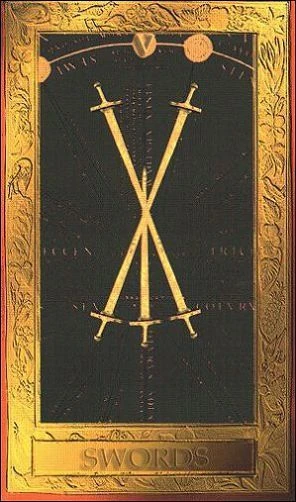
See Five of Swords Card from Other Decks
Discover how other tarot decks interpret this card. Select a deck to explore its full review and gallery.





Five of Swords FAQ
What does the Five of Swords mean upright and reversed?
Upright, it often concerns conflict, defeat, or a victory with an unwelcome cost. Reversed, it may invite repair or point to unresolved resentment. Consider the methods being used and what a fair next step would look like.
Does the Five of Swords prove someone is dishonest?
No. It can prompt reflection on unfair behaviour, but it cannot establish dishonesty or reveal another person's private feelings. Check the facts, ask directly where safe, and consider actual behaviour.
Is the Five of Swords a yes or no card?
Many readers lean toward no or not by this method, particularly upright. Reversed may shift attention toward repair or ending the dispute. Neither orientation guarantees an outcome or replaces consent.
What should I do after pulling the Five of Swords?
Identify what the disagreement is costing, separate the issue from personal attacks, and choose one response you can control. That might be a clear request, a specific apology, a boundary, or a decision to walk away.