Explore the Millennium Tarot Cards
Browse the complete card sequence from Dorothy Simpson Krause’s Millennium Tarot. Choose a group to filter the continuous gallery, or select a card for the full-size Lightbox.
78 verified cards shown
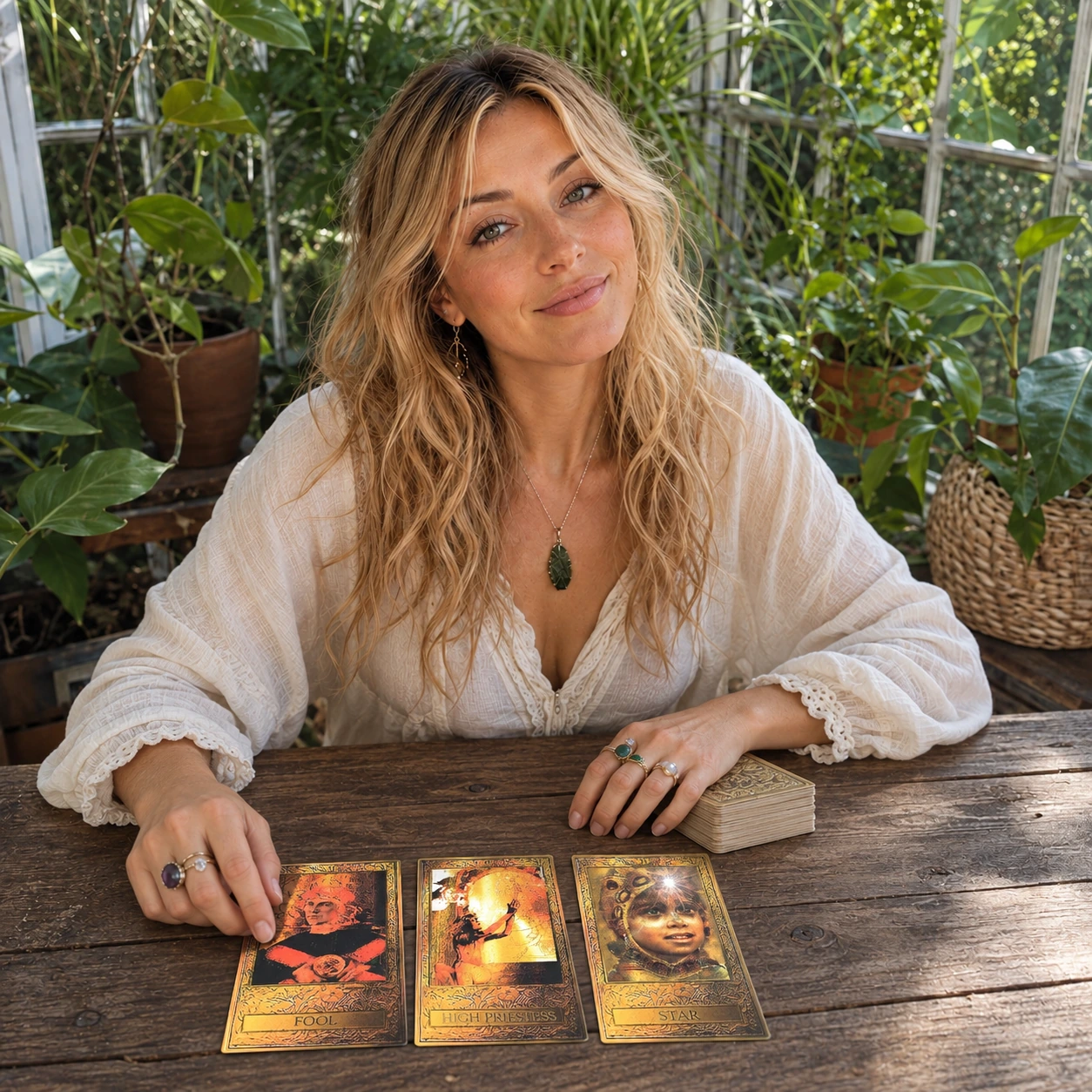
Aurica’s Quick Take
Millennium Tarot feels like opening an old theatre door and finding several centuries waiting on the other side. Dorothy Simpson Krause layers antique portraits, handwritten marks, diagrams, and tarnished gold until each card seems half memory and half dream, while Marina Dubois’s accompanying text gives those images another voice. I love that the pictures ask me to notice what glows, what hides, and which face I cannot stop watching.
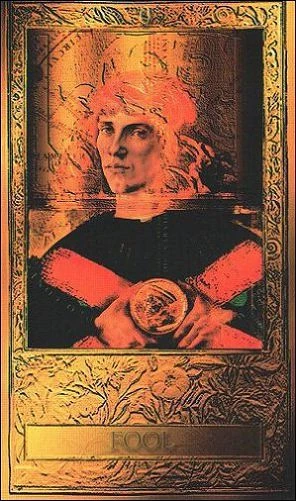
The Fool is my doorway into that mood. The orange-red portrait feels still and watchful, while the round object held near the heart becomes a private compass. I would not rush straight to “take the leap.” I would ask what the seeker already carries, which old identity is loosening, and whether curiosity or restlessness is leading.
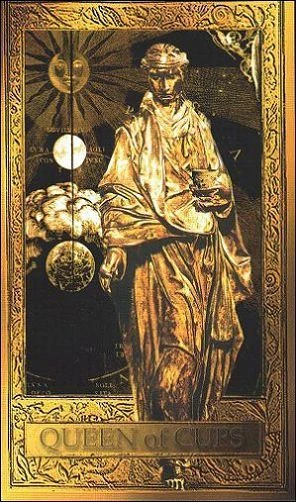
The High Priestess reaches toward a huge circle of light; The Star looks outward beneath a bright point at her brow; the Queen of Cups sits in gold beside three orbiting circles. Together they suggest a lovely reading rhythm: feel what is calling, name the hope clearly, then give that feeling a form you can actually live with.
I reach for this deck around memory, creative identity, and emotional patterns. I begin with the detail that catches my eye, return to the card’s familiar tarot role, and then listen to the neighbouring cards before deciding what the image asks of me.
Its collage rewards patience rather than flat keyword practice. Give the image one honest question and a little breathing room, and Millennium Tarot can help you turn an old story into a brave new doorway.
What is Millenium Tarot?
Millenium Tarot is a tarot deck with its own visual identity. Instead of treating the cards like plain flashcards, it asks you to read mood, symbol, color, expression, and atmosphere together.
This makes the deck useful for readers who want more than memorized keywords. The best tarot decks give you something to notice right away, then reward a second look with deeper meaning.
Deck details at a glance
- Deck: Millenium Tarot
- Use: tarot review, deck browsing, journaling, and intuitive reading
- Best for: intuitive readers, tarot collectors, journalers, and anyone who chooses decks by artwork and atmosphere
- Not ideal for: readers seeking a completely neutral deck, plain keyword cards, or artwork that does not shape the reading
- Watch for: color, symbol, posture, atmosphere, repeated details, and visual storytelling
Artwork and first impression
The first impression of Millenium Tarot matters because the artwork sets the emotional weather of a reading. Notice what your eye catches first: a face, animal, object, doorway, color, gesture, or empty space.
That first detail is often the doorway into the card. Some decks speak loudly and quickly. Others ask you to sit quietly and let the symbolism open slowly. A deck is working when it gives you clear things to notice without making the reading feel forced.
Card study
The Fool — carrying the first spark
A pale face meets us without theatrical movement, set against burnt orange marks that feel part portrait and part weathered page. The figure wears black; broad coral-red sleeves cross the body, and both hands gather around a round medallion at the centre. That closed, careful pose makes this Fool less like a leap and more like the breath before one.
In a reading, I would let the medallion become the question: what small truth are you already holding? Upright, the card can open a beginning led by curiosity and self-trust. In shadow, those crossed arms may show a new life being protected so fiercely that it cannot begin. Ask what deserves shelter, then what gentle action would let it breathe.
How it reads in practice
In practice, Millenium Tarot works best when you combine classic tarot meanings with direct observation. Start with the card title, then ask what the image adds. Does it make the message softer, sharper, stranger, more practical, or more emotional?
This keeps the reading grounded. Tarot does not need to sound complicated to be helpful. A clear question, a careful look, and one practical next step are often more useful than a dramatic prediction.
Four-card constellation
Four ways to cross a threshold
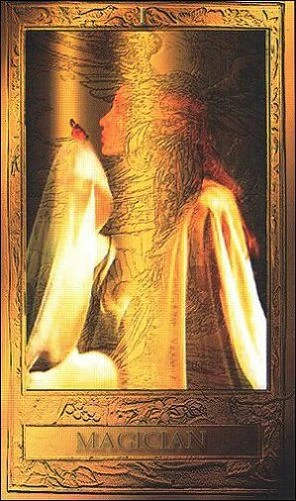
The Magician, The Lovers, The Chariot, and The World turn change into a sequence: shape the raw material, choose what you can stand beside, give that choice direction, then recognise the wider life it has made. I would use these four when a reading needs movement without rushing past meaning.


Beginner friendliness
Beginners can use Millenium Tarot if the art feels readable and interesting. If the images make you want to keep looking, that curiosity can carry you through the learning stage.
Try a one-card daily pull for a week. Write three notes: what you noticed first, the traditional meaning, and one real-life action. This simple routine teaches the deck’s voice without overwhelming you.

Card study
The High Priestess — reaching into the light
A seated figure rises from the lower left, her dark hair and warm skin held against a glowing amber field. Both arms reach upward, one hand opening toward a huge pale disc that dominates the card. Fine diagram-like lines and faint figures sit inside that circle, while a small white blossom and darker fragments hover near the upper edge.
The scale matters: intuition here is not a tiny whisper tucked safely away, but a bright mystery larger than the person touching it. Upright, this card asks for stillness long enough to notice what the conscious mind cannot organise yet. In shadow, fascination can become projection. In an actual reading, name the feeling first, then wait for a neighbouring card to show where that feeling belongs.
Love and relationship readings
For love readings, Millenium Tarot can help you look at emotional patterns instead of chasing a yes-or-no answer. Ask what needs care, what is being avoided, where trust is growing, and what boundary would make the situation healthier.
For friendship and family questions, look for distance, closeness, protection, movement, and repeated symbols. Those clues can show whether the energy feels open, guarded, tired, playful, or ready for repair.
Four-card constellation
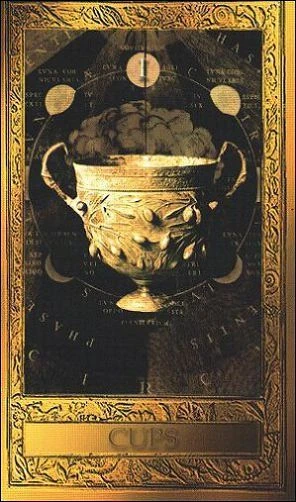
A cup becomes a relationship
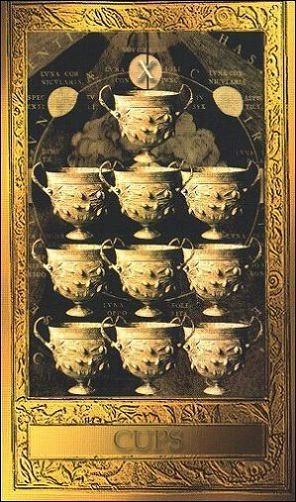
The Ace, Two, Queen, and Ten of Cups move from one ornate vessel to a mirrored pair, then to a living figure and a full arrangement of ten. The repeating gold cups make emotion feel tangible: something held, exchanged, embodied, and finally shared. Use this quartet when love needs to be read as a pattern of care rather than a single promise.

Career, money, and creative readings
For career and money questions, Millenium Tarot is most useful when you ask about focus, timing, pressure, confidence, and the next practical move. Watch for symbols of movement, delay, support, risk, or discipline.
For creative work, use the deck like a mirror. Ask what wants to be made, what is blocking the idea, and what small action would bring it back into the real world.

Card study
The Star — hope with a human face
The Star is a close portrait rather than a distant landscape. A young face looks slightly upward, mouth softly open, with dark eyes and jewel-like ornaments tracing the left side of the head. The brightest point blooms above the brow, throwing fine rays across the face, while scraps of text and warm, worn colour sit behind it.
Hope becomes intimate here. Upright, this Star can be the moment a person dares to look toward light again, not because every answer has arrived but because the face is still receptive. In shadow, longing may be dazzling enough to hide what is directly in front of you. In a reading, ask what hope illuminates clearly—and what practical next step would keep that hope from becoming only a beautiful glare.
Pros and cons
| Pros | Cons |
|---|---|
|
|
Four-card constellation
Giving a vision weight
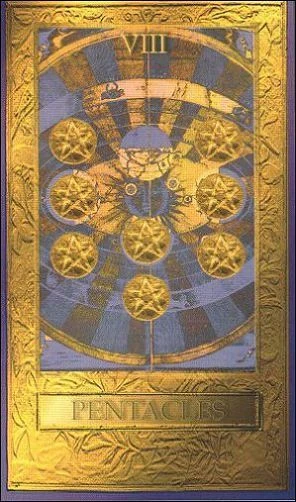
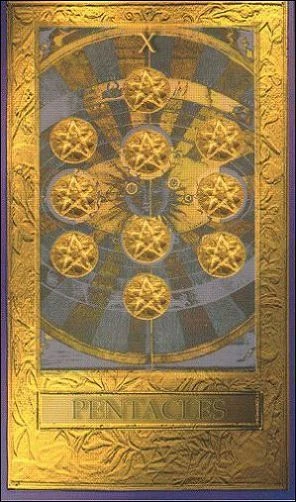
The Ace, Eight, Queen, and Ten of Pentacles gather the suit around pattern, practice, stewardship, and lasting form. Their repeated discs and gold-framed geometry bring the deck back to the hands and the calendar. I like this four pack after an emotional reading: it asks what can be made, repeated, cared for, and passed forward.


Final thoughts on Millenium Tarot
Millenium Tarot is worth exploring if its world already feels interesting to you. The right tarot deck is not always the most famous one; it is the one you will actually use, study, and return to.
Use your honest reaction as the test. If several cards make you pause and ask what they mean, the deck has the spark a useful reading tool needs.

Millennium Tarot FAQ
Is Millenium Tarot good for beginners?
It can be beginner-friendly if the artwork feels clear to you. New readers should keep a simple tarot keyword list nearby while learning.
What kind of readings is Millenium Tarot best for?
It is best for daily pulls, journaling, emotional check-ins, creative questions, and readings where image and mood matter.
Does Millenium Tarot follow traditional tarot meanings?
It uses tarot structure, but the deck theme gives those meanings its own flavor. Read both the card title and the picture.
Who should skip Millenium Tarot?
Skip it if you want a completely neutral deck, plain keyword cards, or artwork that does not shape the reading.
How do I compare Millenium Tarot with other tarot decks?
Look at several major arcana, minor arcana, and court cards. The minor cards are especially important because they show how the deck handles everyday life.
Can Millenium Tarot be used for serious readings?
Yes. A themed or unusual tarot deck can still give serious guidance when the question is clear and the interpretation is grounded.