
The Knight of Swords tarot card meaning feels like a clean wind arriving through an open window: bracing, clarifying, and impossible to ignore. This Knight carries an idea into motion. Upright, the card can encourage swift action, honest words, and brave decisions. Reversed, it signals that speed may have tipped into impulsivity, aggression, confusion, or effort without a true direction.
This is bright, active mental energy—not a promise that everything will suddenly happen at once. In a reading, notice where determination feels enlivening and where your mind is racing ahead of your deeper knowing. The card can help you meet your own choices with honesty; it cannot reveal another person’s private thoughts or guarantee what comes next.
This court card may describe a situation, an approach, or a person archetype. Anyone can embody it, regardless of gender, age, appearance, or zodiac sign. Read it against the question, its position, nearby cards, and the evidence available in everyday life.
Knight of Swords Tarot Card Meaning at a Glance
- Main keywords: fast action, bold words, ambition, rushing
- Upright meaning: chasing a goal with energy, courage, and a strong mood. In the Swords suit, this connects to thoughts, words, truth, stress, and decisions
- Reversed meaning: rushing, inconsistency, or pushing too hard. The reversed meaning asks you to check how you are handling thoughts, words, truth, stress, and decisions
- Yes or no: yes, but slow down enough to avoid mistakes
- Best question to ask: What is this card trying to help me understand right now?
Knight of Swords upright meaning: courage with clear direction
The Knight of Swords upright often arrives with the sensation of leaning into the wind: alert, committed, and ready to move. You may be prepared to defend an idea, begin a demanding project, or finally say what has been circling in your mind. Its healthiest expression is brave and decisive without becoming hasty or careless.
When the Knight of Swords appears upright, let your vision sharpen before you charge. Name the point you are trying to reach, gather the essential facts, and choose one clean next move. Forward momentum can be exhilarating, but it serves you best when your direction is sound and your awareness stays open.
This card can represent assertiveness and a sharp mind. It can also show a headstrong, single-minded style that overlooks tone, limits, or other people’s input. Think before you speak, especially when a true statement could still be delivered with unnecessary force.
In practical terms, the upright Knight of Swords may support a concise proposal, a difficult but respectful conversation, or a rapid response to a genuine deadline. This is quick thinking and fast decision-making at its best. Courage does not require a manufactured battle; it means acting on what matters while accepting correction.
Tarot card meanings for this Knight in a reading
Begin with the card's position in a tarot reading. In the past, it may describe an argument, bold decision, or intense period that still shapes the question. In the present, it can highlight urgency and communication. In a future position, treat it as preparation for a faster pace—not a fixed prediction.
As an obstacle, the Knight of Swords can represent a hasty assumption, a sharp tongue, or pressure to act before you understand the consequences. As support, it can show intellectual courage, honest debate, and the willingness to cut through distraction.
If the card represents a person archetype, look for observable behaviour: direct speech, strong opinions, fast decisions, and an unwavering focus on a goal. Do not use it to label someone as uncaring or dangerous. A court card describes a pattern, not a complete personality.
Knight of Swords in love and relationships
In a love reading, this Knight can feel like a conversation that has gathered too much electricity to remain unspoken. It may point to frank words, fast-moving attraction, or a longing to resolve uncertainty now. Let both people have room to speak, breathe, and choose freely. Intensity is not the same as intimacy, and pursuit is not proof of commitment.
If you are single, be clear about what you want without trying to rush another person's pace. A quick connection may be exciting, but compatibility becomes clearer through time and consistent behaviour. The Knight of Swords cannot confirm someone's feelings.
In an established relationship, the card may invite you to bring a difficult subject into the light. Choose a moment when neither person is cornered. Speak about the specific behaviour, soften your grip on being “right,” and listen for what is tender beneath the words. Understanding what needs to change can matter more than winning the argument.
Career, money, work, and study
For career or study, the Knight of Swords brings a bright beam of concentration. It can suit a pitch, exam period, research sprint, debate, interview, or project that needs a firm decision and quick action. Clear enough space to see the real priority; one well-aimed effort is more powerful than ten frantic starts.
With money, pause before an impulsive purchase or an agreement made under pressure. Read the terms, compare options, and seek qualified advice where the stakes require it. The card can prompt a better question, but it does not promise income, investment returns, or a particular job result.
Knight of Swords reversed meaning: what the card can warn against
Reversed, this Knight can feel like a storm of thoughts with nowhere to land. Impulsiveness, recklessness, harsh words, or unfocused mental energy may be taking over, making impulsive decisions more likely. You might be reacting before checking the facts, or trying to force a result that also depends on another person’s timing and choice.
The reversed Knight of Swords often shows blocked momentum as well as excess speed. Frustration can build when you know what you want to say but cannot find the right approach. Slow down enough to separate the urgent part from the emotional charge around it.
In communication, the reversal can suggest that your sharpest words are standing guard over a softer feeling. Before you send the message, ask what you truly want the other person to understand. Remove the accusation, keep the honest centre, and make room for a reply. Direct does not have to mean cruel.
Sometimes the card describes exhaustion after sustained intensity. Rest, delegation, or a narrower target can be strategic rather than weak. Swords reversed can also point to missed opportunities when hesitation follows a reckless start. Use practical support when a pattern is causing serious trouble.
A reversed card can feel like energy caught in a crosswind: blocked, excessive, delayed, or turned inward. Let the question and surrounding cards show which direction fits. You do not have to choose the darkest interpretation to take the message seriously.
Knight of Swords yes or no meaning
Many readers treat this as a conditional yes when courage and quick action genuinely suit the question: yes, if your aim is clear and you can move responsibly. Reversed, it leans toward “not yet.” Give the missing facts, uneasy timing, or impulsive edge a little space to settle first.
A yes-or-no draw is a reflection tool, not a reliable forecast. It cannot decide consent, safety, medical care, legal action, or a major financial commitment. For those questions, use direct information and qualified help.
Advice from this Knight: act clearly, not merely quickly
The Knight of Swords advises purposeful movement. Hold your aim in one hand and your awareness in the other: what do you know, who will be affected, and which next step can be changed if new information appears? Conviction becomes wiser when it can still listen.
If a conversation matters, prepare the heart of what you need to say and one sincere question. Notice whether you are reaching for connection or simply trying to trample resistance. Listening is not surrender. It is the quiet moment in which intuition, evidence, and another person’s reality can meet.
If you feel stalled, set a brief period for focused work and remove one distraction. If you feel overcharged, wait until your body and voice have settled before sending the message. The same card can call for action in one context and restraint in another.
Reading prompts
- What deserves a direct response now?
- Which fact should I check before I move?
- Where am I confusing urgency with importance?
- How can I be honest without becoming harsh?
- What would purposeful courage look like today?
For a daily pull, pair one clear action with one gentle safeguard. Make the call, then write down what was agreed. Submit the application, then keep a copy. Begin the study session, then stop at the time you promised yourself. Momentum feels better when it does not sweep you away.
One archetype, four perspectives
Knight of Swords Across Four Tarot Decks
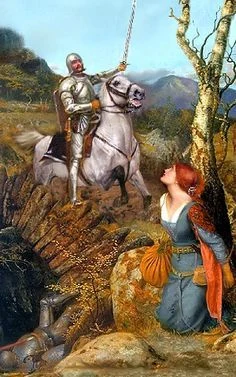
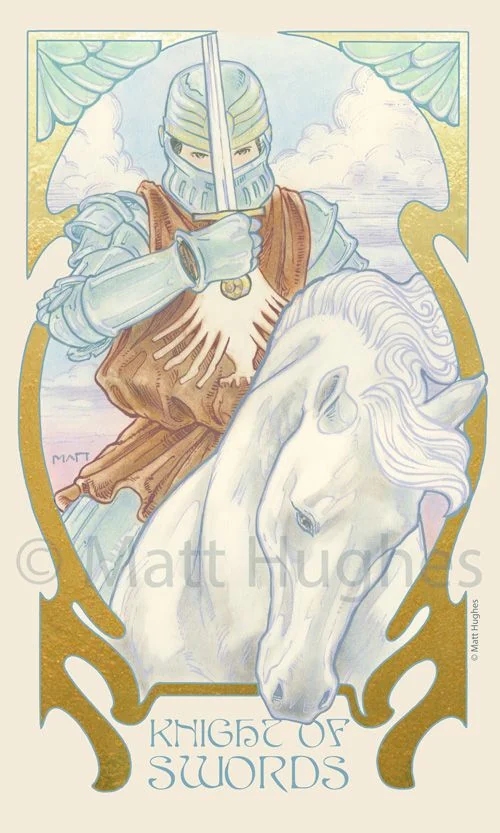
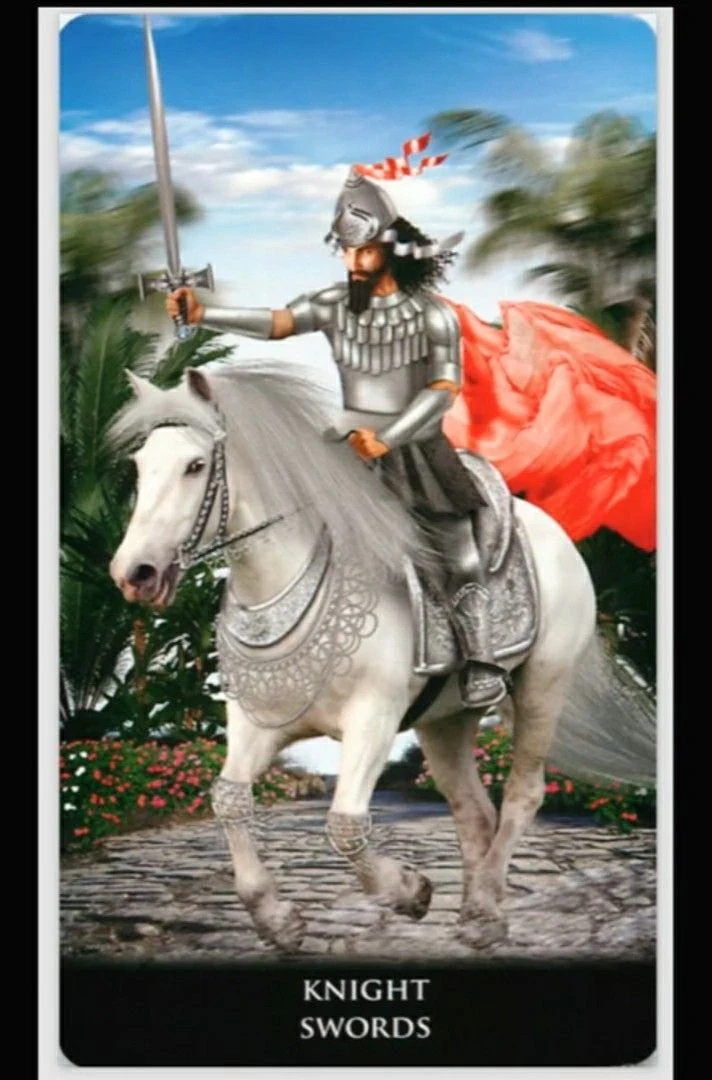
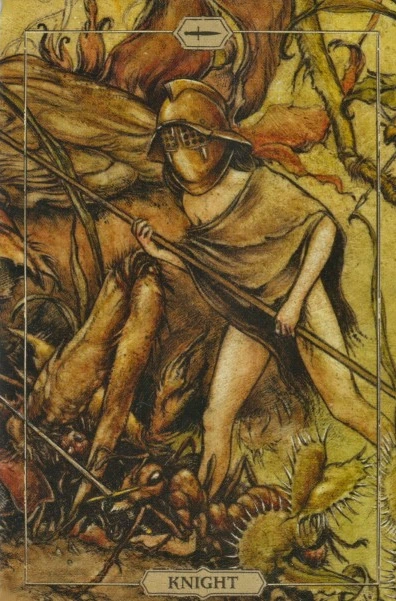
Compare the familiar Rider-Waite-Smith card with the moments before, behind and after the classic scene in three Lo Scarabeo decks.
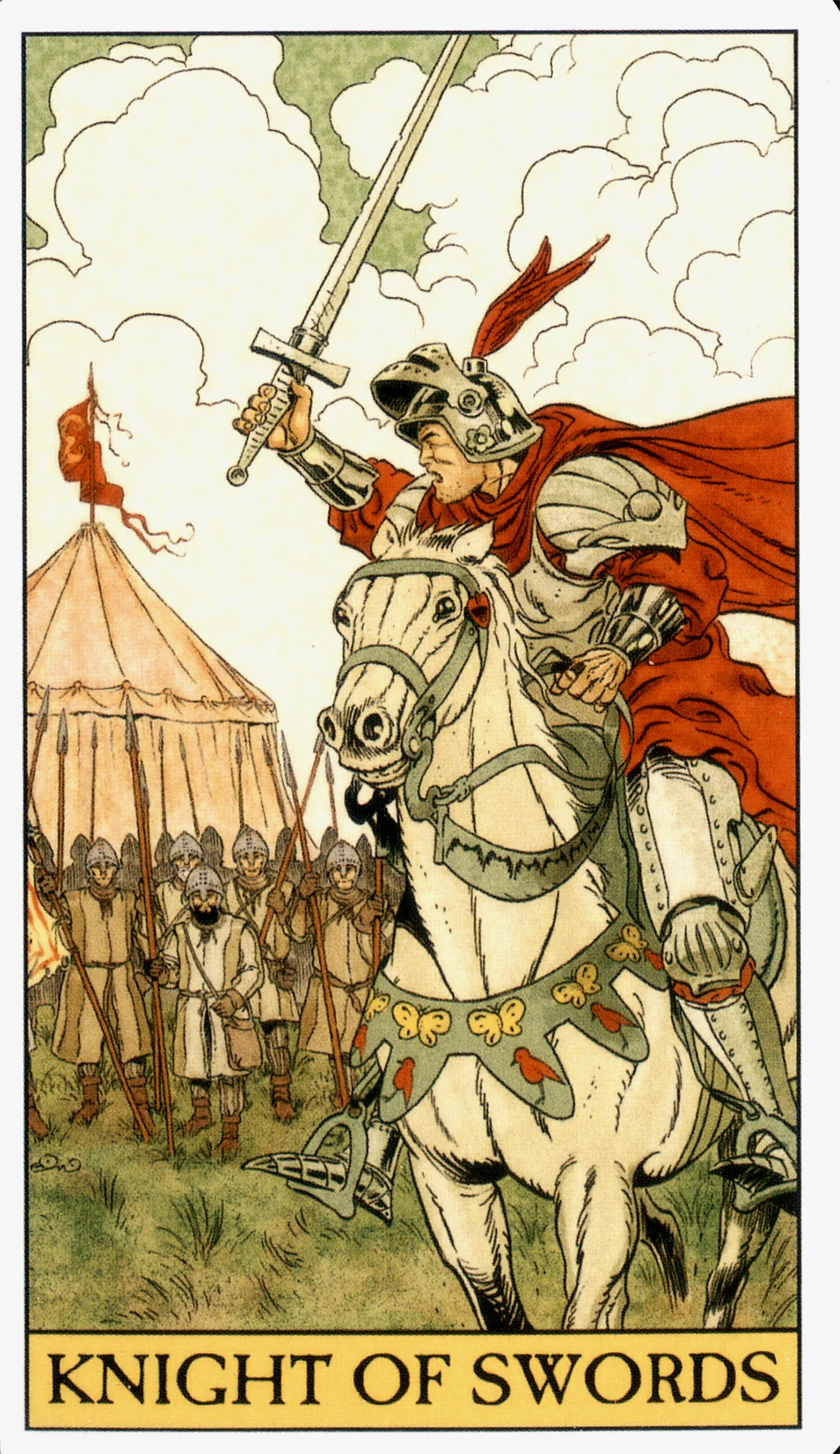
What apparently happens just before
What actually happened
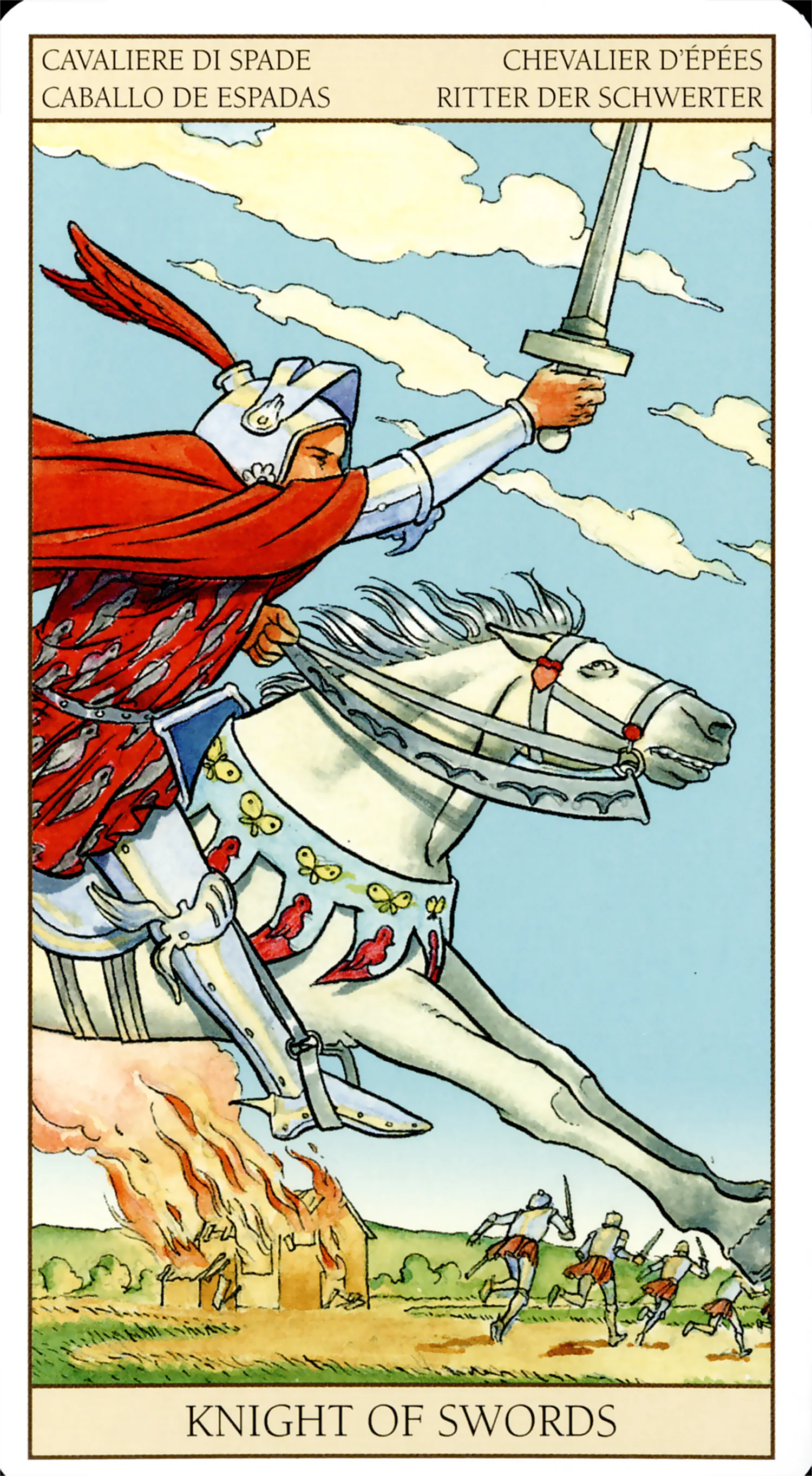
What happened on the opposite side
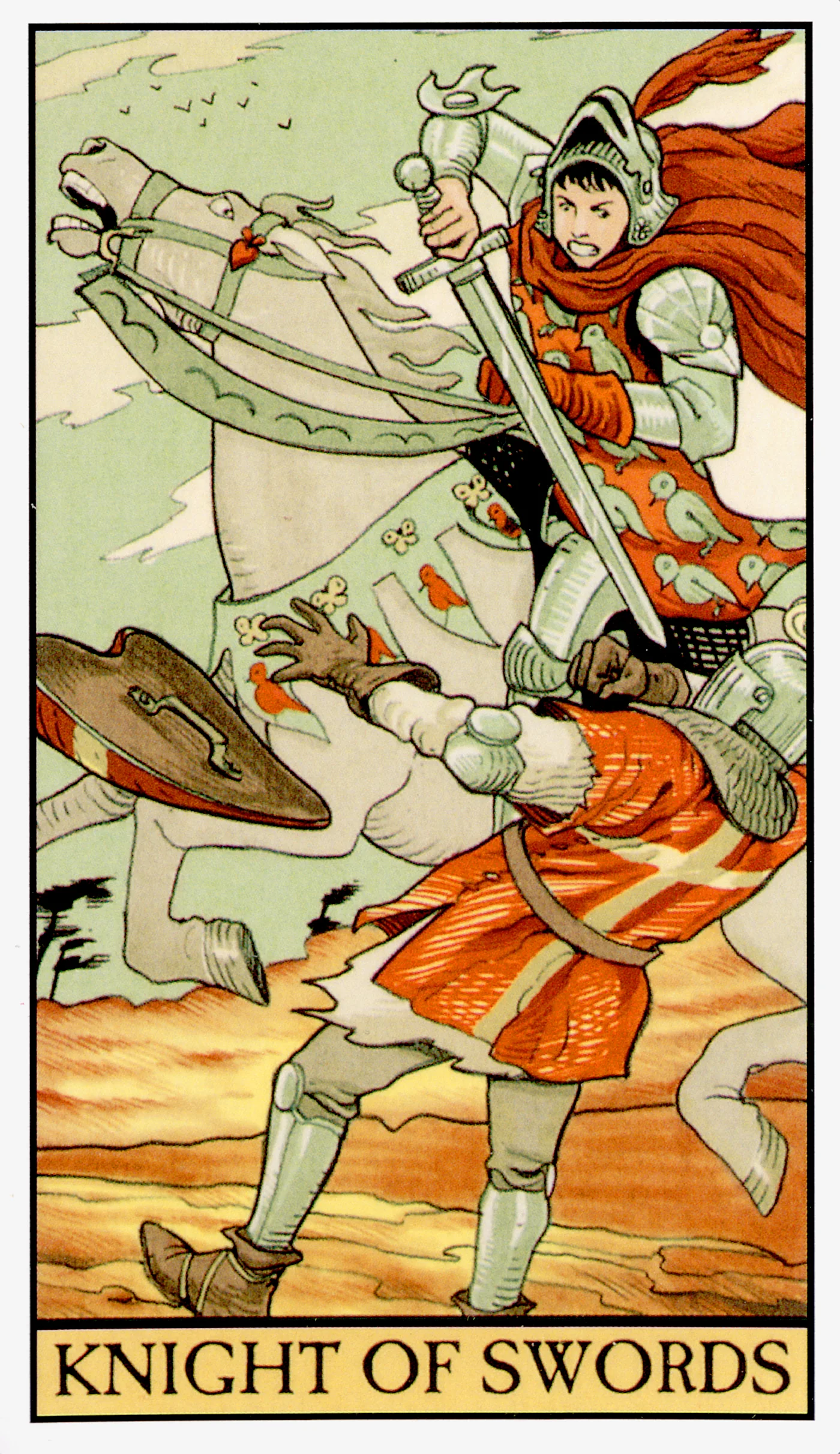
What apparently happened afterwards
Card description, imagery, and symbolism
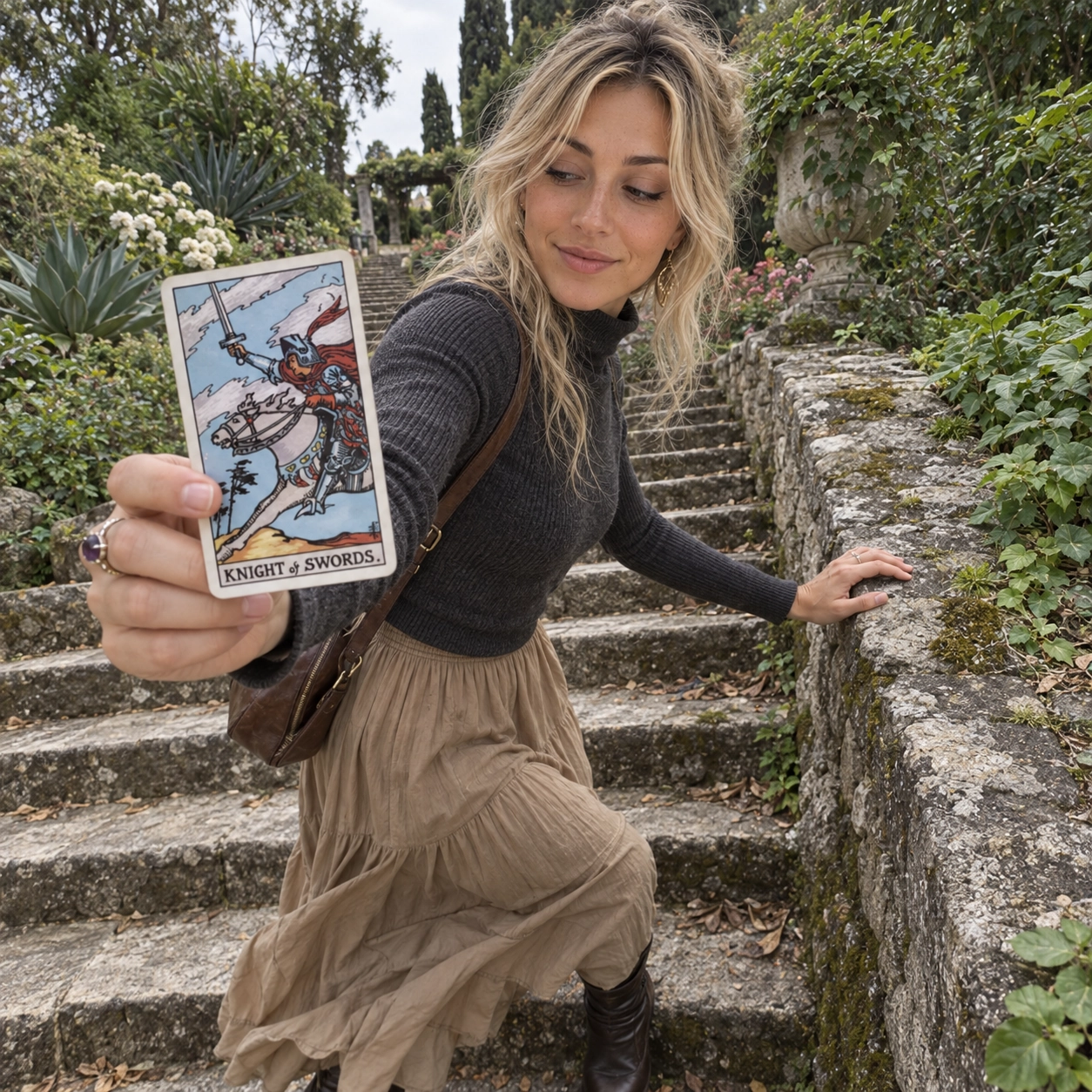
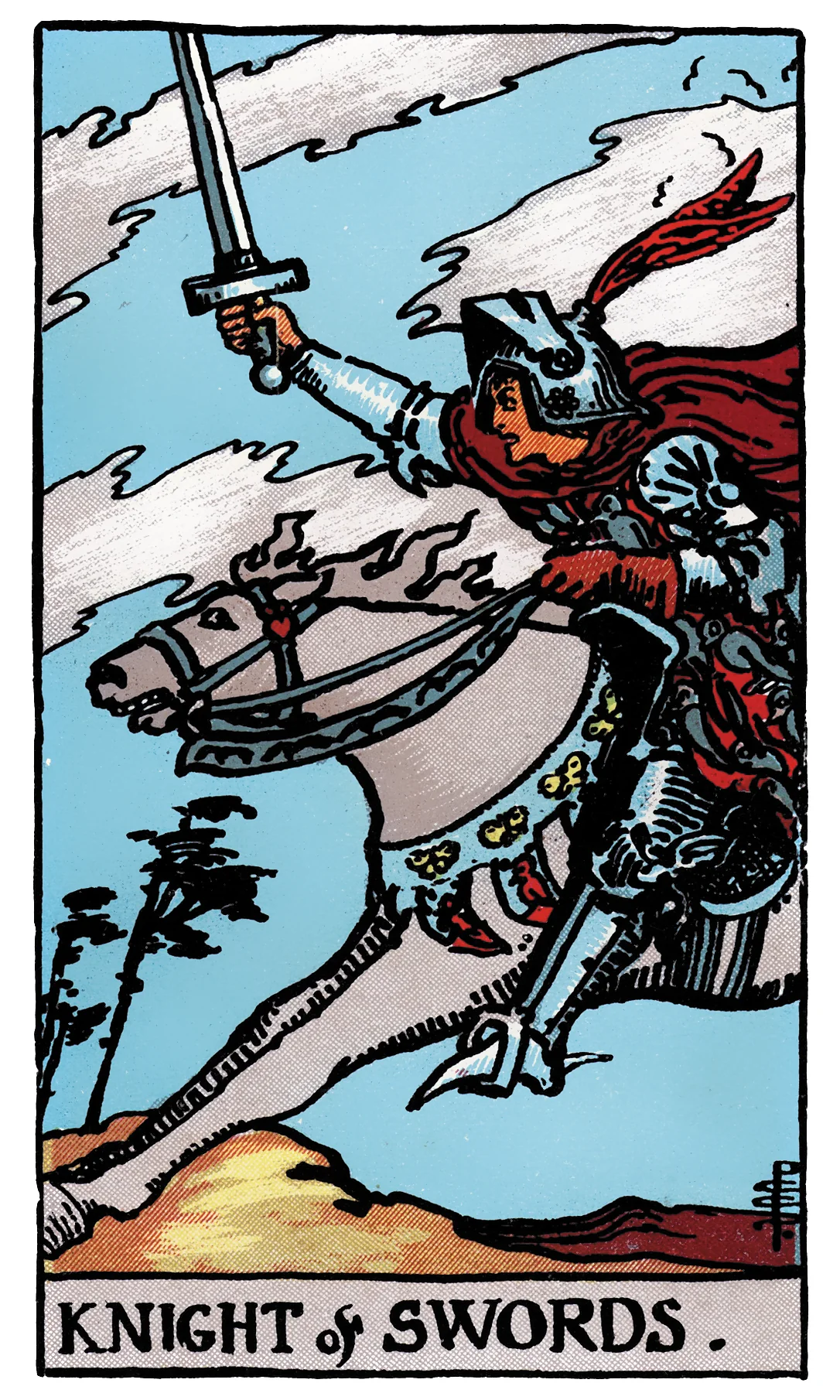
The verified Rider-Waite-Smith portrait almost seems to rush off the card. An armoured rider charges from left to right on a white horse, raising a sword in the right hand. The horse stretches forward, red tack flashing against its body, while windswept trees and clouds stream behind them. Birds cross the turbulent sky, and the lower title reads KNIGHT of SWORDS.
The figure is brandishing his sword, a dangerous weapon in literal terms, so symbolic readings should not romanticise great force. In tarot convention, swords often relate to thought, language, conflict, truth, and decisions. The white horse and swift movement can suggest conviction; they do not prove purity, victory, or a future event.
A. E. Waite described this Knight as riding “in full course.” His divination list included skill, bravery, capacity, defence, opposition, and resistance; reversed terms included imprudence and incapacity. These historical meanings illuminate the tension between capable action and poor judgement, but they are not universal rules.
The Swords suit and Knight court rank
In a standard tarot deck, this court card belongs to the suit of Swords in the Minor Arcana. It follows the Page and precedes the Queen and King. The Knight of Swords is associated with air in many modern systems, while some court-card systems blend Knight energy with the fire element. These correspondences vary, so check the guide for your deck.
The Knight is not tarot card number 13. Number XIII in the Major Arcana is usually Death, while this is an unnumbered court card. It can represent a role, style, or stage of action rather than a literal man.
Comparing the Knight of Swords with nearby cards
Compared with the Knight of Wands, both cards can move quickly. The Knight of Wands is commonly read through passion, enterprise, and appetite for experience. Its wand belongs to fire imagery, while the Knight of Swords puts more emphasis on ideas, argument, and a defined intellectual aim.
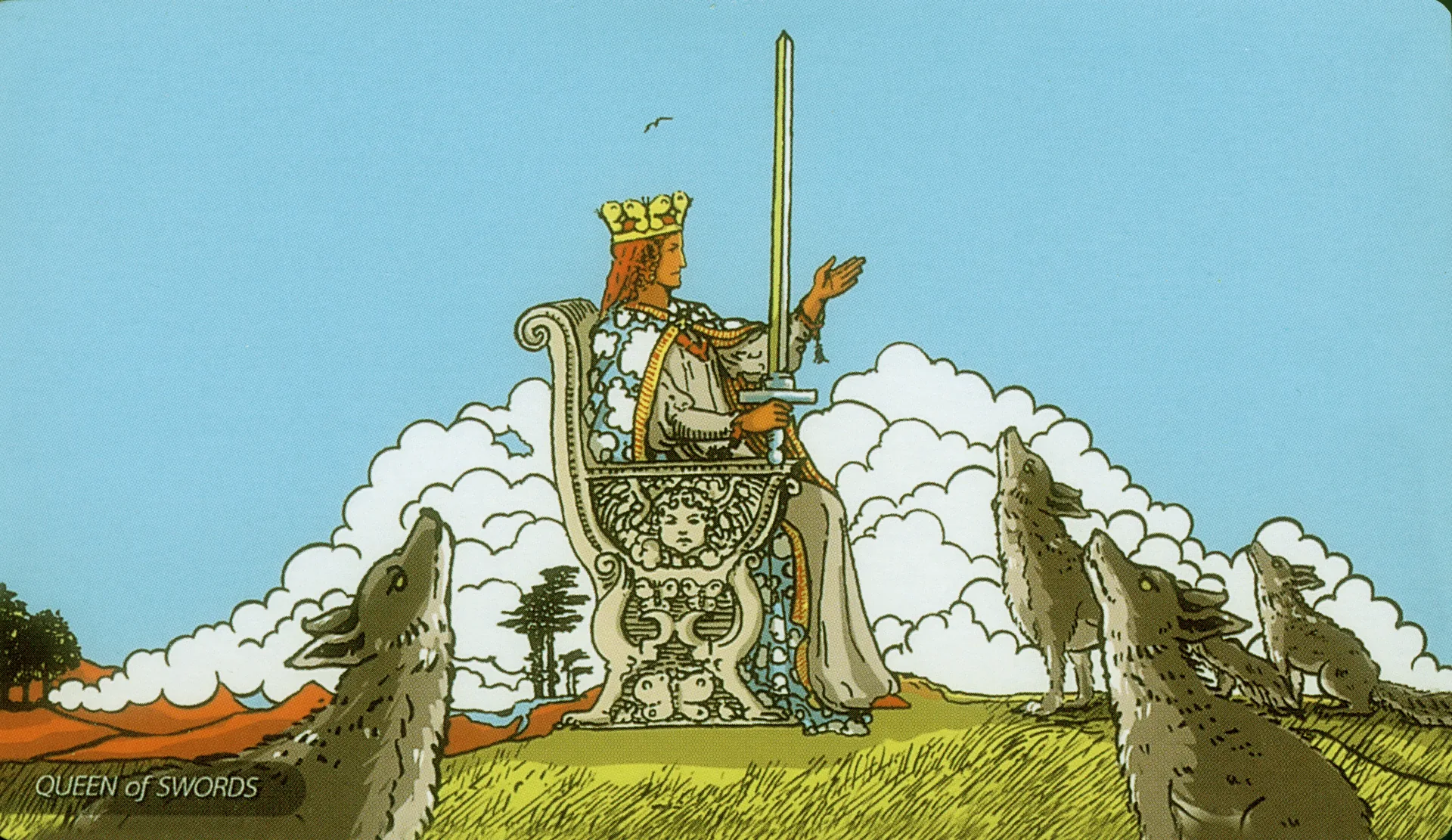
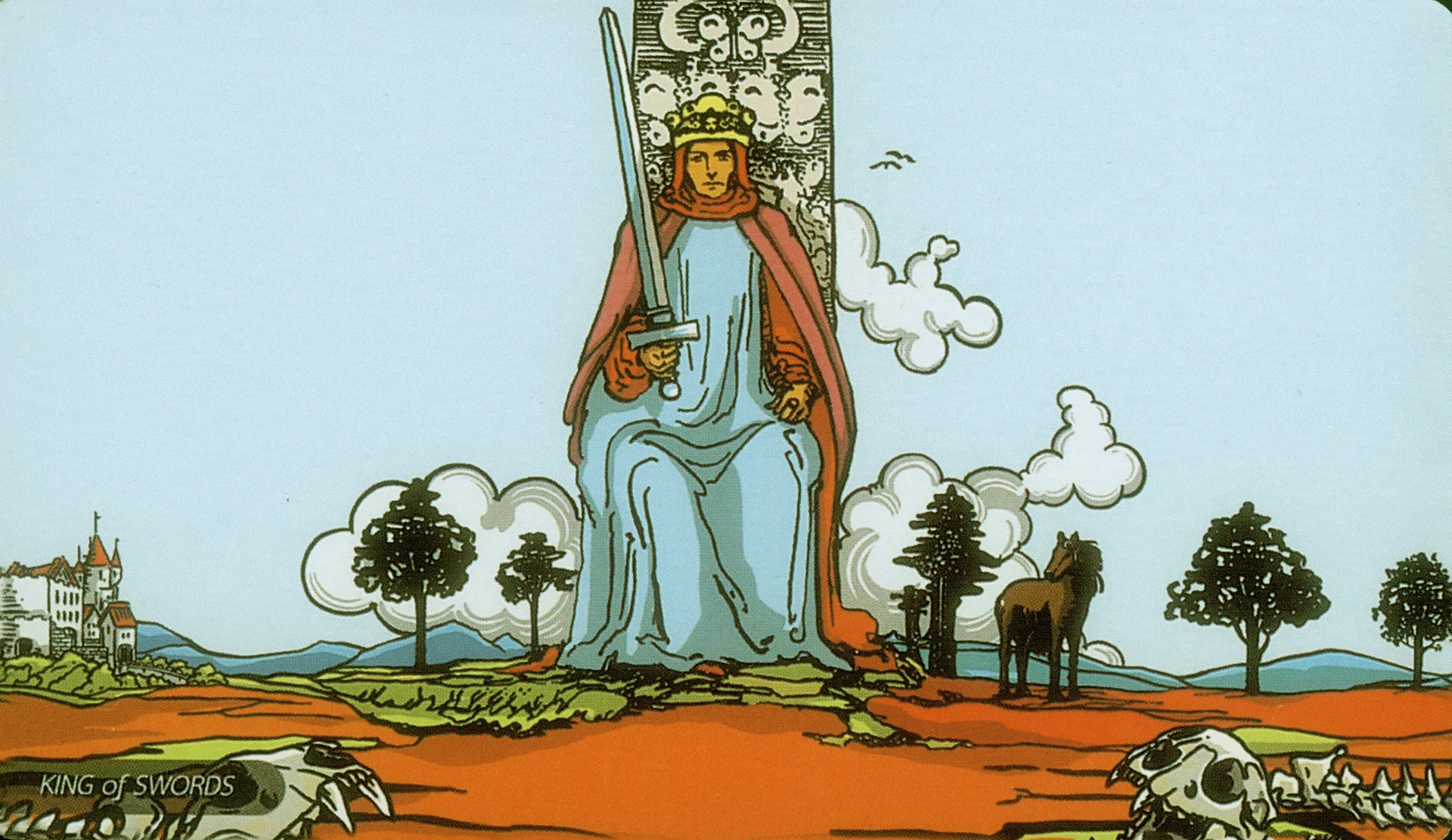
The Page of Swords often observes, asks, and gathers information; the Knight commits that mental energy to movement. The Queen of Swords can suggest discernment and boundaries, while the King of Swords can emphasise structured judgement or authority.
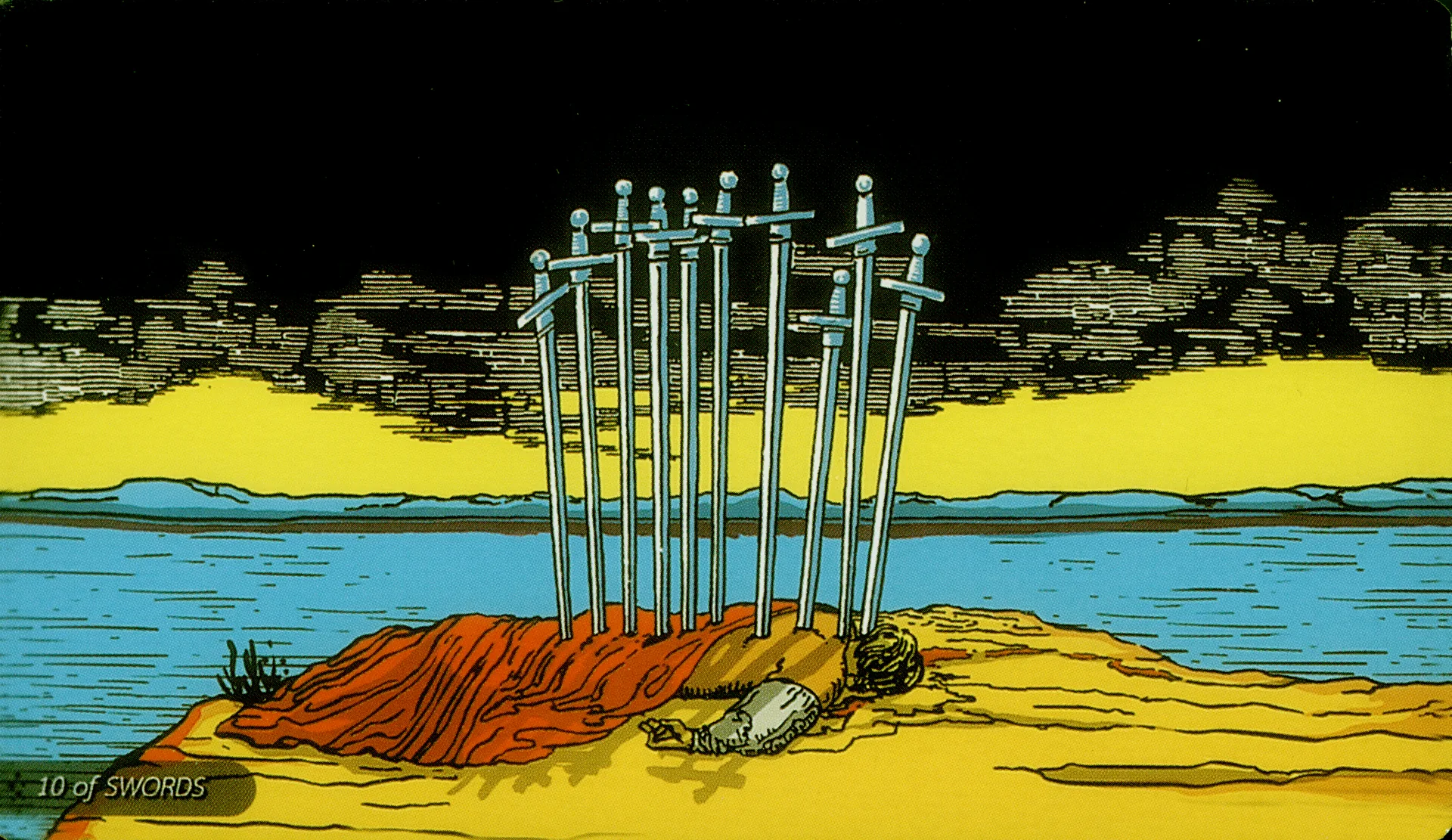
Do not confuse this charging figure with the Ten of Swords, whose scene and interpretation are different. When several Swords appear together, consider whether the reading is highlighting communication, a decision, pressure, or conflict rather than assuming disaster.
Helpful questions for your reading
- What is my actual goal, and have I named it clearly?
- What could I miss if I think and act fast?
- Which potential dangers can I reduce before acting?
- Am I prepared to fight for a principle, or am I creating a fight?
- What would a direct approach sound like with respect included?
One card, many perspectives
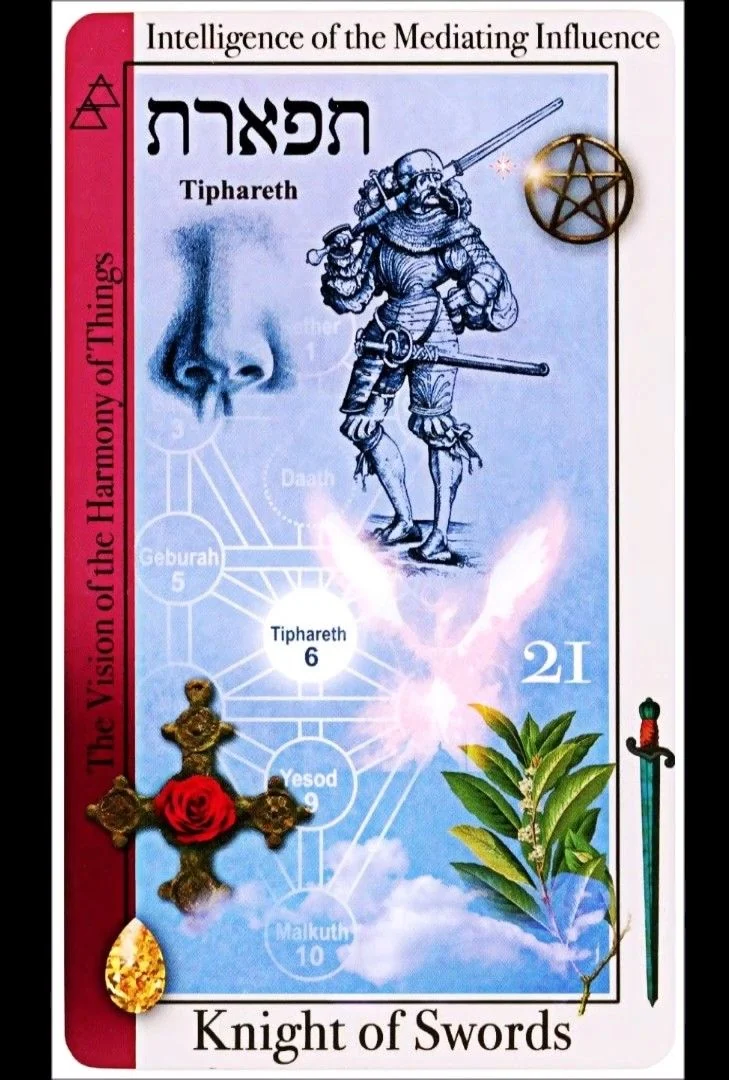
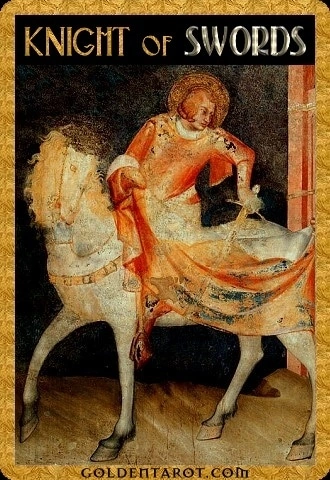
See Knight of Swords Card from Other Decks
Discover how other tarot decks interpret this card. Select a deck to explore its full review and gallery.






Frequently asked questions
What does the Knight of Swords mean upright and reversed?
Upright, it commonly points to decisive action, courage, direct communication, and strong mental focus. Reversed, it may signal impulsivity, aggression, poor direction, blocked momentum, or words delivered without enough care.
Who does the Knight of Swords represent?
It can represent anyone showing a direct, fast-thinking, goal-focused approach. It may also describe a situation or a part of your own behaviour. The card does not fix a person's gender, age, zodiac sign, or private motives.
What does this Knight mean in a love reading?
It may highlight candid conversation, intense pursuit, or a relationship moving quickly. Use it to examine pace, communication, and mutual choice. It cannot prove another person's feelings or guarantee commitment.
Is the Knight of Swords a yes or no card?
Many readers lean toward a conditional yes when swift, responsible action suits the question. Reversed, it often suggests pausing to check facts and timing. A symbolic draw is not a substitute for direct evidence or consent.
What should I do after pulling this card?
Name the goal, check one essential fact, and choose a clear next step. If emotions are running high, wait before sending the message. Purposeful action is more useful than speed for its own sake.