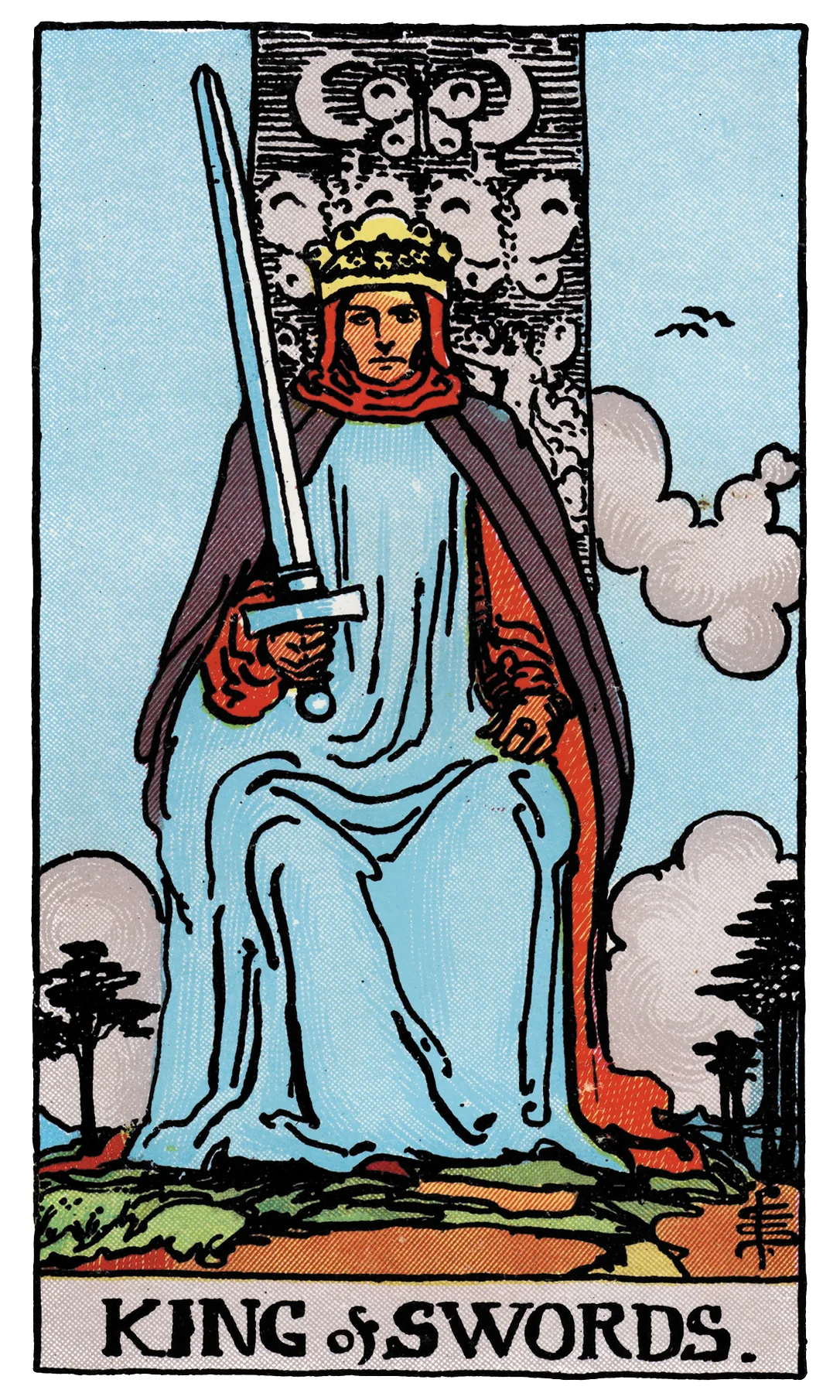
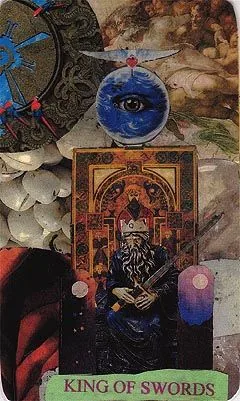
The King sits squarely on a carved seat, holding his sword upright in his right hand. I read the direct gaze as an invitation: bring the whole truth, not merely the most convenient version. This card values truth, clarity, and self-respect, yet it also remembers that every difficult conversation involves a tender human being.
Quick meaning: The King of Swords tarot meaning is ethical clarity in action. This Minor Arcana court card asks how intellectual power is being used—and who lives with the decision. Upright, the King of Swords tarot card meaning centres on discernment, independent thought, clear communication, and compassionate boundaries. Reversed, it can point to bitterness, harsh judgement, withheld feeling, or intelligence being used to intimidate rather than illuminate.

King of Swords Tarot Card Meaning at a Glance
- Main keywords: logic, authority, fair decisions, strategy
- Upright meaning: responsible action, strong judgment, and mature control of this suit. In the Swords suit, this connects to thoughts, words, truth, stress, and decisions
- Reversed meaning: control issues, stubbornness, or leadership without empathy. The reversed meaning asks you to check how you are handling thoughts, words, truth, stress, and decisions
- Yes or no: yes when the decision is rational and well planned
- Best question to ask: What is this card trying to help me understand right now?
King of Swords Upright Meaning
The upright form of this King asks for clear thinking joined to an ethical heart. This card has the stillness of someone who can hear a difficult argument without being swept away by it. Its finest expression is not coldness but reason used responsibly: the ability to name what is true without using truth as a weapon.
In a tarot reading, this upright court card can point to discernment, independence, fairness, articulate speech, and constructive criticism. It may describe the energy you need rather than a particular person. Gather the facts, notice your intuition, and let both inform one clean decision.
King of Swords Meaning in Tarot Cards and the Minor Arcanum
Among traditional tarot card meanings, this King is the figure who tests whether knowledge is being used wisely. In a tarot deck, the image can feel formal, but its question is intimate: can you be honest without becoming hard?
As a court card in the Minor Arcana, this King is an archetype rather than a fixed gender, age, or zodiac identity. It can describe your approach, another person's visible behaviour, the atmosphere around a choice, or advice for meeting the moment. Context matters more than trying to identify a powerful man, authority figure, or future partner in your life.
Put simply, the King of Swords represents intellectual authority held to an ethical standard. The card represents more than cold logic: it asks you to unite evidence, experience, and consequences when making decisions. The King of Swords also represents the moment when private insight must become a fair, explainable choice.
This King feels like a clear bell in a noisy room: intellectual mastery guided by principle, not intelligence displayed for applause. In a card reading, the King of Swords can suggest a need for clear standards, careful language, and decisions you could explain openly. The card may also invite you to detach from the first emotional surge long enough to see the pattern—without detaching from compassion.
Its strength is the meeting of intellect, ethics, and lived experience. The suit of Swords deals with ideas, language, decisions, conflict, and the stories we tell ourselves. The King brings those airy themes inward and asks: what do you know now that you did not know before, and how can that wisdom make you fairer rather than harder?
When this King appears, separate evidence from assumption. Listen for the quiet sentence beneath the noise—the one your body seems to recognise before your mind finishes arguing. You may need to ask a precise question, set a respectful limit, seek mutual understanding, or admit that an old interpretation no longer fits. This no-nonsense quality is useful when it protects fairness and equality; it becomes a shadow when it leaves no room for context.
King of Swords Love and Relationships Meaning
Upright in love
In love and relationships, the upright King favours mutual respect, independence, and clear communication. For an established partnership, the card asks both people to say what they need and to listen without making the other person pay for being honest. Affection is not proved by mind-reading. A calm boundary can create more intimacy because everyone knows where they stand. There is tenderness in that kind of certainty; it makes room for a wholehearted yes as well as an honest no.
If you are dating or single, this card may encourage wise standards rather than a defensive checklist. Notice consistency between words and actions. Stay curious, but do not explain away behaviour that repeatedly unsettles you. The card does not guarantee a relationship or identify a specific future partner; it helps you choose with open eyes.
Reversed in love
Reversed in love, the card can suggest that one person is controlling the conversation, treating emotional concerns as irrational, or using silence as leverage. When reversed, this King may ask how power moves through your dealings with others. Stay with what you can actually observe, then name your own needs. Tarot can open a conversation, but it cannot diagnose someone or read their private intentions for you.
Reversal may reveal resentment, aloof communication, an argument being rehearsed instead of resolved, or old hurt colouring a new exchange. One person may withhold warmth to feel safer, while the other hears only rejection. The remedy is not a sugary version of softness. It is the courage to name the feeling as well as the fact: “I was hurt,” “I need clarity,” or “I cannot continue like this.”
Traditional card meanings sometimes describe this court card as a mature man, stern father, judge, lawyer, or authority figure. Those labels are possibilities, not an identity test or prediction. In a modern reading, focus on the visible qualities—reason, accountability, expertise, and the use or misuse of power—rather than guessing someone's gender, profession, or secret motives.
King of Swords Career, Money, Study, and Legal Matters
Work and career
The King of Swords typically appears when authority and power need mature handling. In work or study, this may mean asking who sets the rules, whose knowledge counts, and whether the process is as fair as the outcome.
When it comes to careers, this card often highlights authority and expertise. The upright King of Swords stands for leadership that is stern but fair: expectations are visible, evidence matters, and personal power serves the work rather than the ego. It can suit research, policy, writing, teaching, strategy, mediation, or legal matters, yet it never guarantees a job title or outcome.
For career questions, the King of Swords can be an astute problem-solver, editor, researcher, adviser, mediator, or leader who makes expectations explicit. The upright card supports careful analysis, a well-framed proposal, and feedback that improves the work. If you must offer constructive criticism, be specific about the issue and equally specific about what a better result looks like.
Reversed, watch for office politics, intimidating delivery, perfectionist standards, or a razor-sharp reply sent too quickly. Read the message again before you press send. If a decision affects other people, invite the missing perspective without surrendering your professional judgement.
Money and practical choices
For financial decisions, old guidebooks might say “use your head” or “use your logic.” I would soften that into something more complete: check the figures, then ask what the choice costs emotionally, practically, and ethically. Reason is a lamp. Let it illuminate the numbers without asking it to silence the small, wise sensations in your body.
In a money reading, the King prefers facts over fear: check the numbers, compare terms, and ask direct questions. This is practical tarot guidance, not a guarantee of profit or loss. The useful next step may be a budget, a second opinion, or a clearer agreement rather than a dramatic move.
School and study
For study, this card rewards intellectual independence. Test a source, sharpen a thesis, and explain your reasoning in plain language. If the reversed King appears, notice whether fear of being wrong is making you procrastinate or over-edit. A strong argument can still be revised.
King of Swords Reversed Meaning
At its simplest, reversal suggests a split between intelligence and integrity. The reversed King still represents intellectual force, but “mind-over-matter” becomes risky when feelings, bodies, or other people are treated as obstacles rather than information.
The reversed King can show intellectual authority losing its ethical centre. A reversed King of Swords may point to manipulation, abuse of a position of authority, decisiveness without listening, or a lack of self-discipline behind a polished argument. It may also describe emotional coldness that leaves you or someone else beginning to feel helpless.
In another expression, discernment loses its balance. Clarity may harden into suspicion, honest speech may become cruel or vindictive, or a good boundary may turn into a guard that keeps everyone out. At other times, the sharp edge points inward through perfectionism, relentless self-criticism, or fear of trusting your own judgement.
Do not treat the reversed King of Swords as a prediction of punishment, divorce, or betrayal. Ask what has made the current situation feel unsafe or emotionally charged. A pause can soften the delivery without asking you to abandon the truth.
King of Swords Advice
The King’s advice feels like opening a window in a stuffy room: tell the truth cleanly, and let everyone breathe again. Before speaking, ask whether your words are accurate, necessary, and proportionate. You do not have to make a boundary sound apologetic, but you can deliver it without cruelty.
If your mind is crowded, write two columns: what I know and what I am assuming. The white space between those two columns often reveals the real question, glinting there like the edge of the upright sword. Then choose one sentence you can say or one action you can take today. Clarity becomes trustworthy when it leads to grounded behaviour.
King of Swords in Past, Present, and Future Positions
Past position
In the past, this card may show a lesson in independence, a decisive conversation, or an upbringing that prized intellect and self-reliance. The point is not to label the past as cold. Ask what that experience taught you about speaking up and what tenderness it may have left unexpressed.
Present position
In the present, the card places discernment at the centre of the reading. Review the current situation without embellishment. A fair decision may require one clarifying question, firmer criteria, or the courage to say, “That does not work for me.”
Future position
In a future position, the card suggests that clear judgement will be useful ahead. This is not a fixed prediction. Prepare by gathering information, defining your limits, and practising the conversation you want to have.
King of Swords Yes or No
For a yes-or-no tarot reading, the King of Swords is a qualified yes when the choice is evidence-based, ethical, and respects your boundaries. If facts are missing or communication is evasive, the answer leans toward not yet: ask the direct question first.
A more revealing follow-up is, “What truth would help me decide?” Yes/no divination compresses a complex situation, while this King prefers enough context to make a wise choice.
King of Swords Combinations and Comparisons
Card combinations adjust the interpretation rather than creating a fixed formula. With the Eight of Swords, the card's clarity may expose a belief that has kept you feeling trapped. With Justice, truth, fairness, and accountability move to the centre; in legal or official matters, read the pair as a call for evidence and an even-handed decision rather than a promised outcome.
Beside the King of Wands, compare confident expression with cool discernment. The King of Wands may warm the room through presence and creative courage, while the King of Swords cuts through confusion with precise language. Together they can suggest speaking plainly without dimming your vitality.
One archetype, four perspectives
King of Swords Across Four Tarot Decks
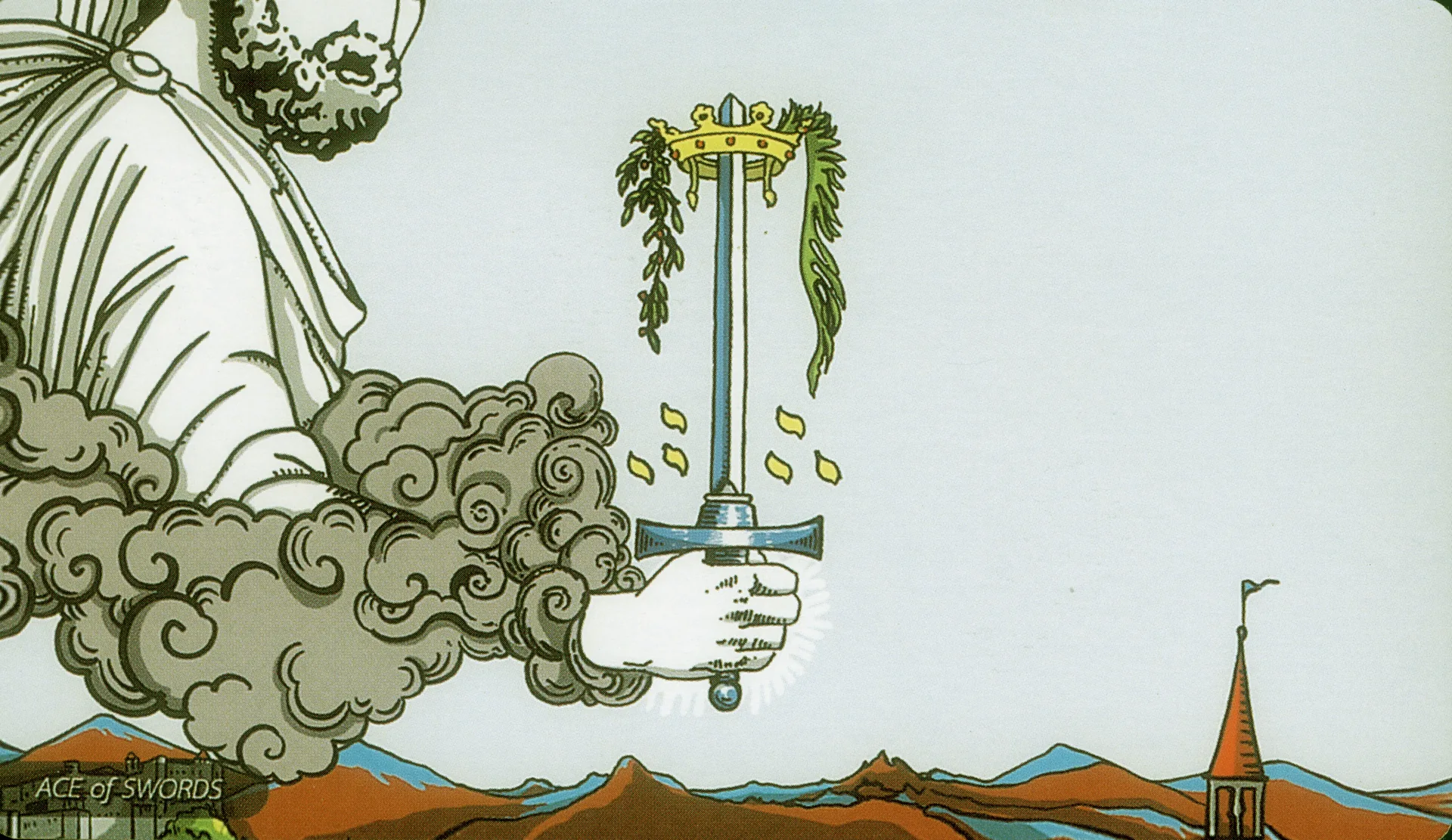
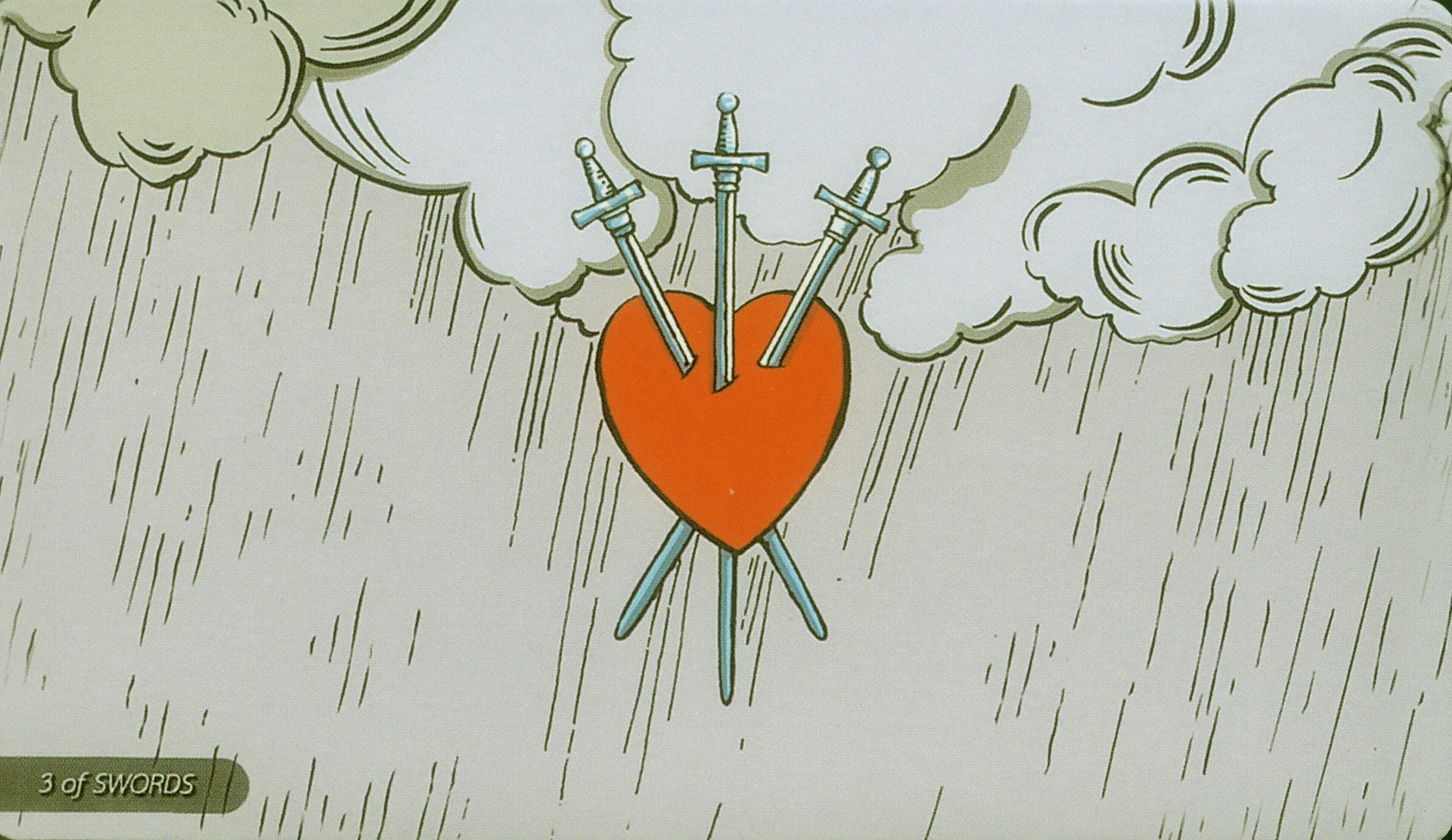
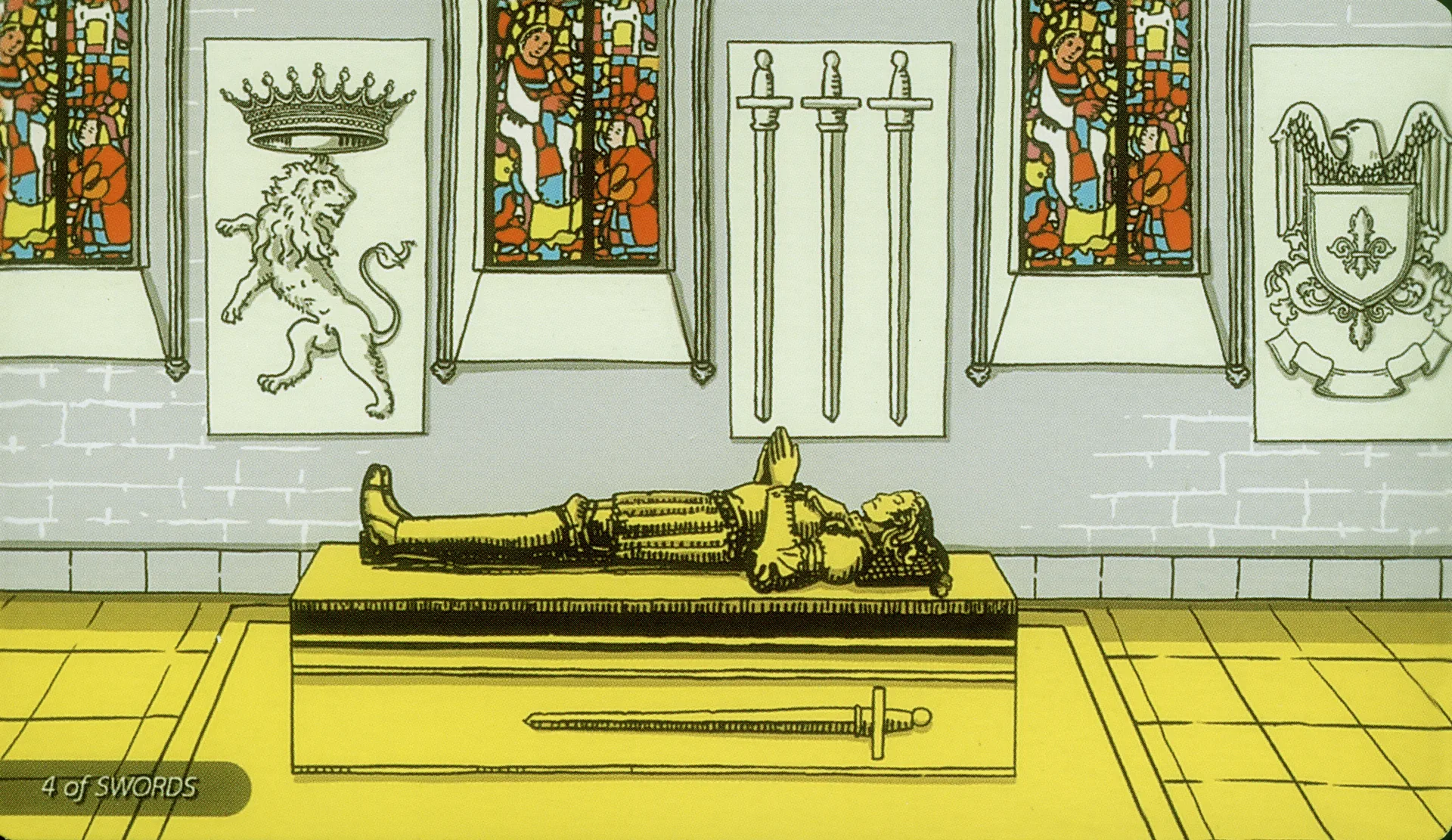
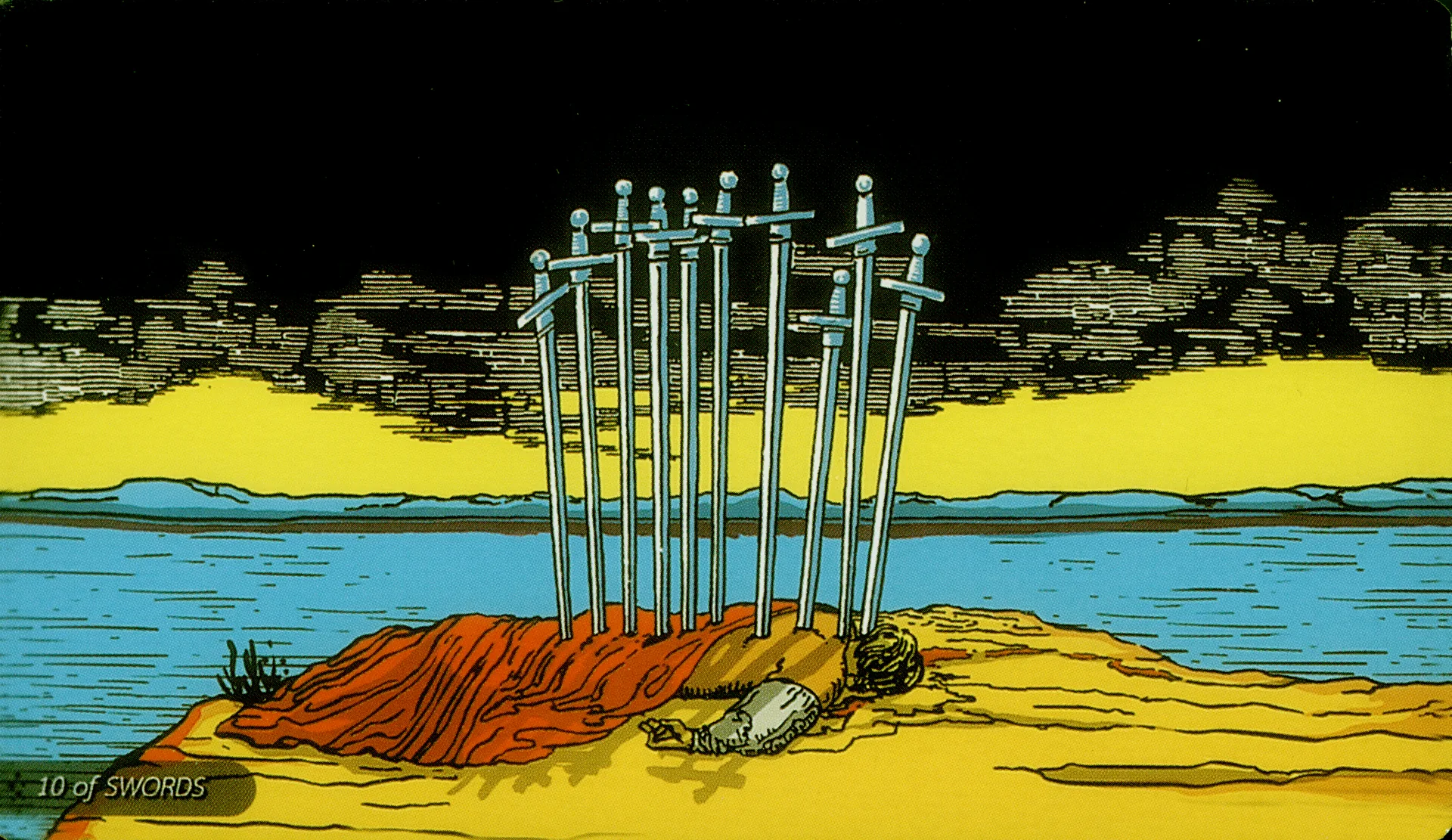
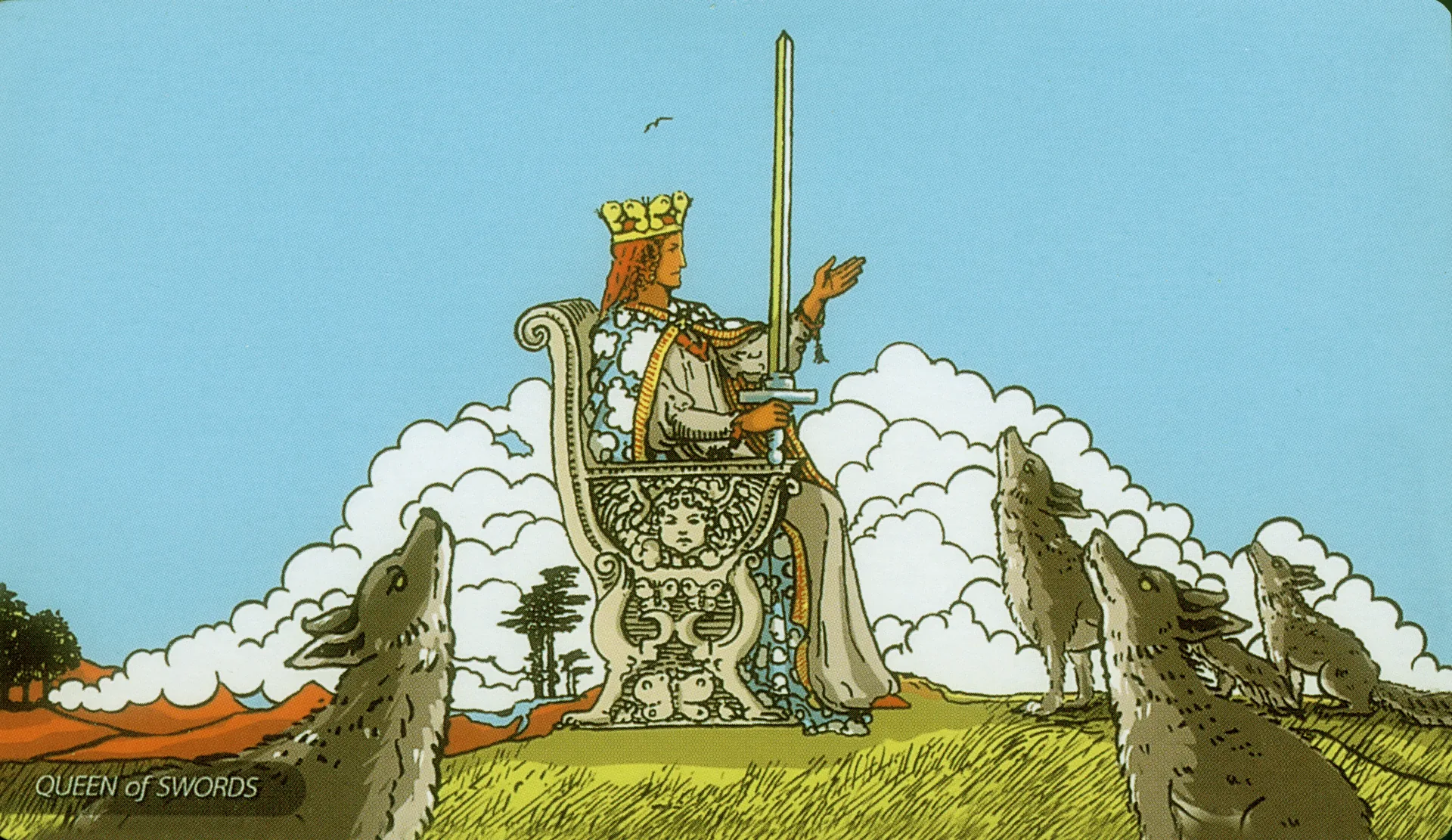
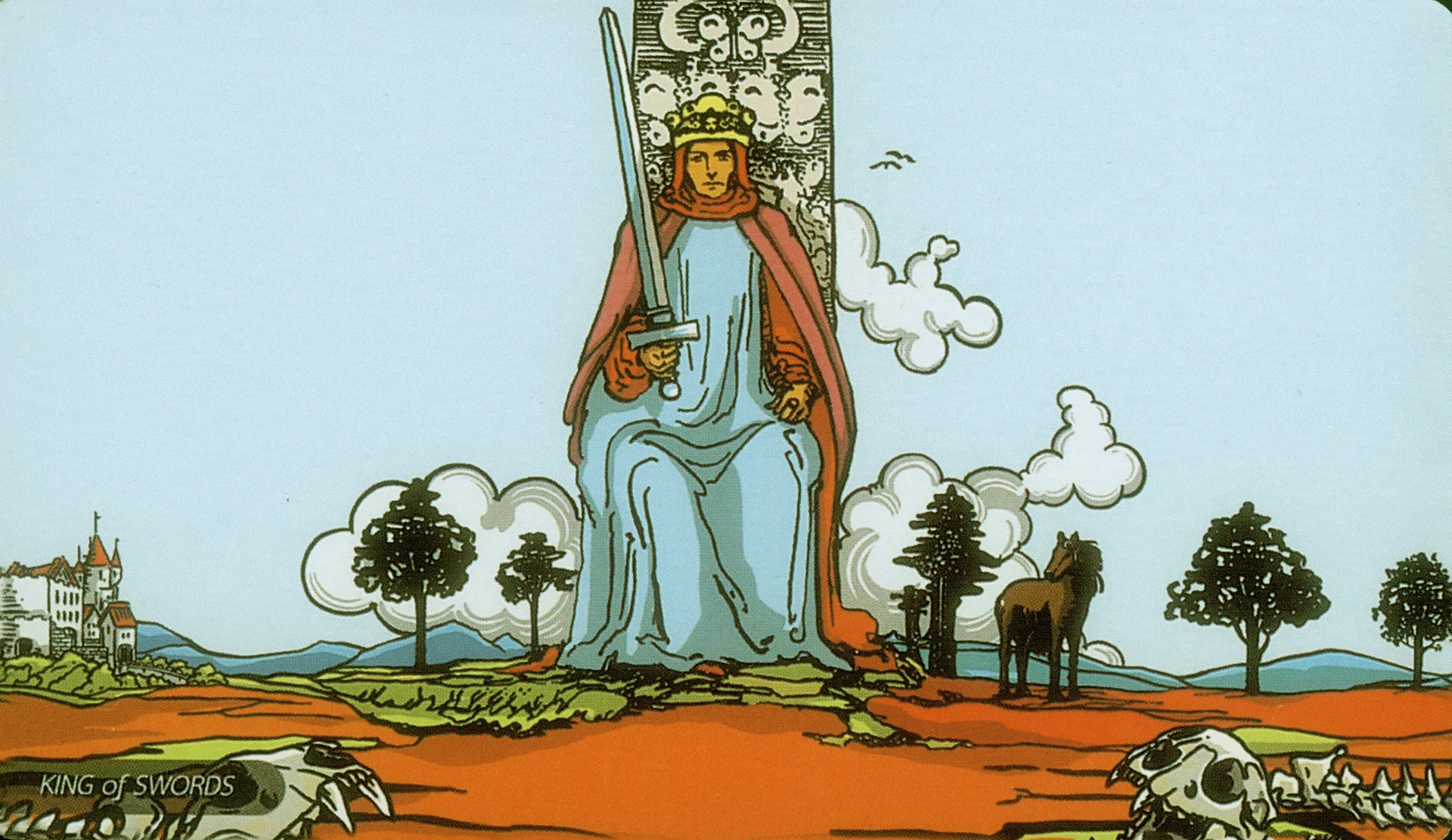
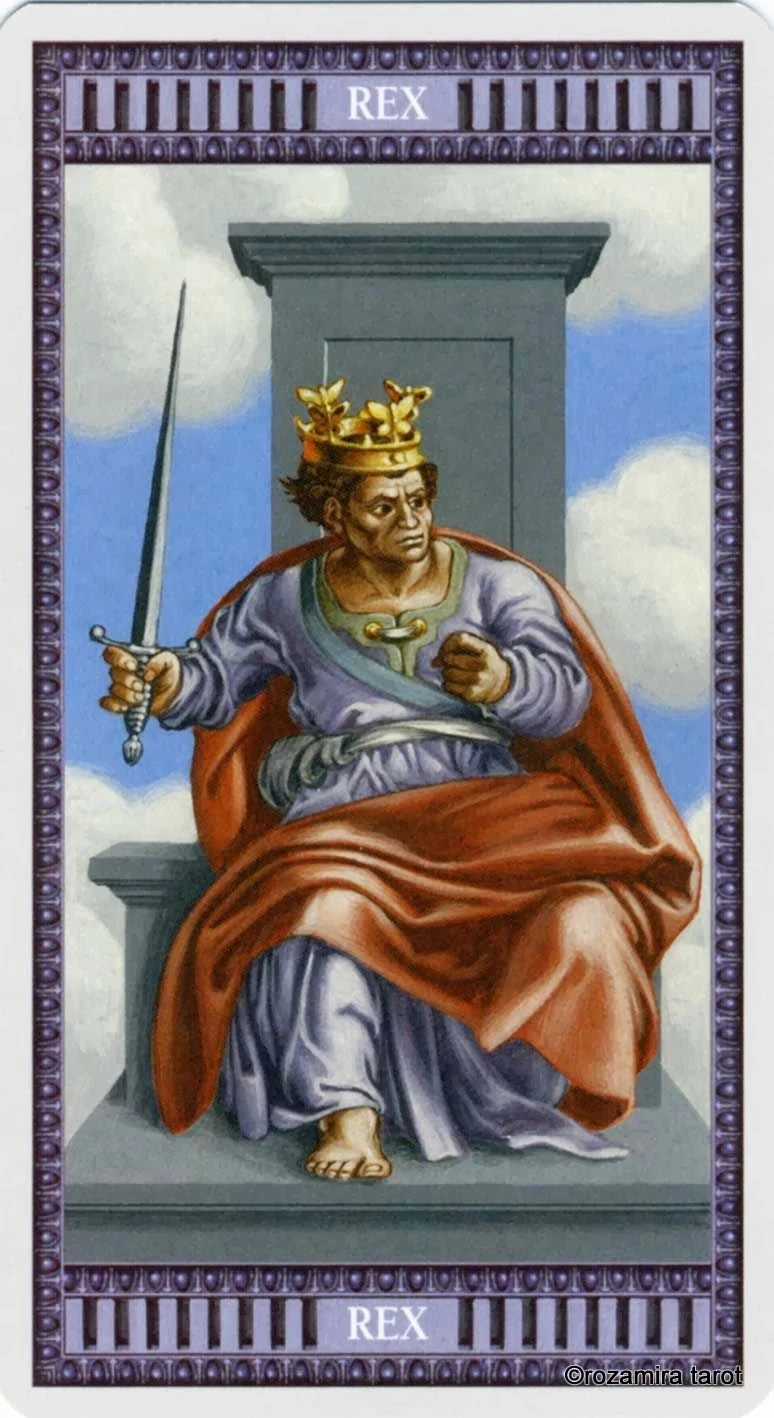
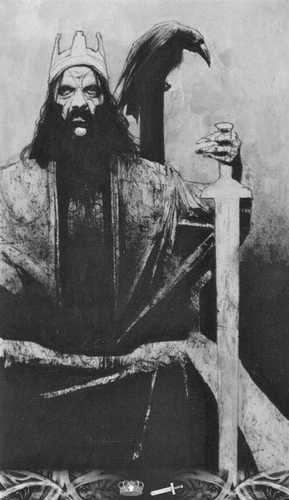
Compare the familiar Rider-Waite-Smith card with the moments before, behind and after the classic scene in three Lo Scarabeo decks.
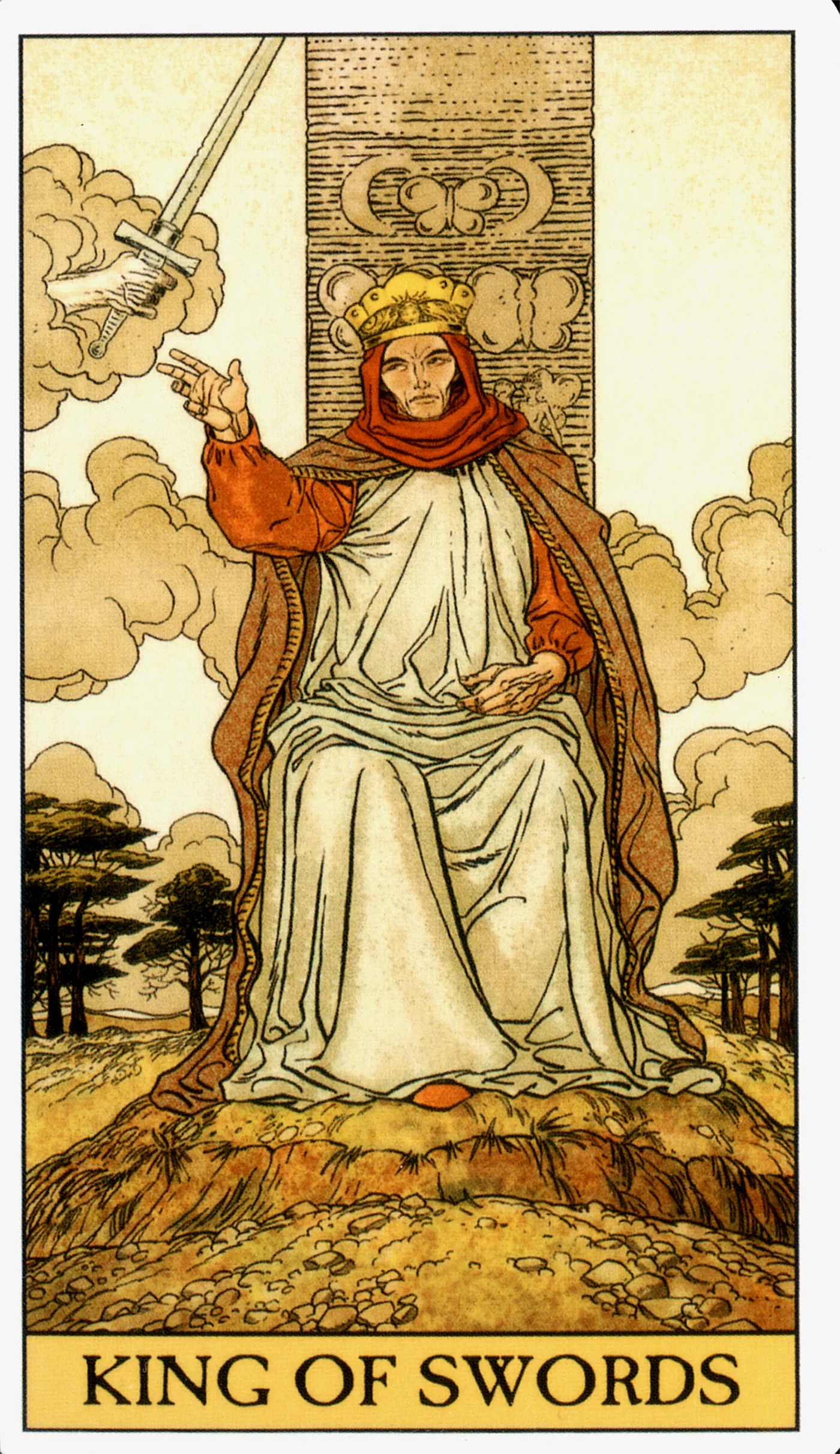
What apparently happens just before
What actually happened

What happened on the opposite side
What apparently happened afterwards
King of Swords Symbolism, Associations, and Card Description
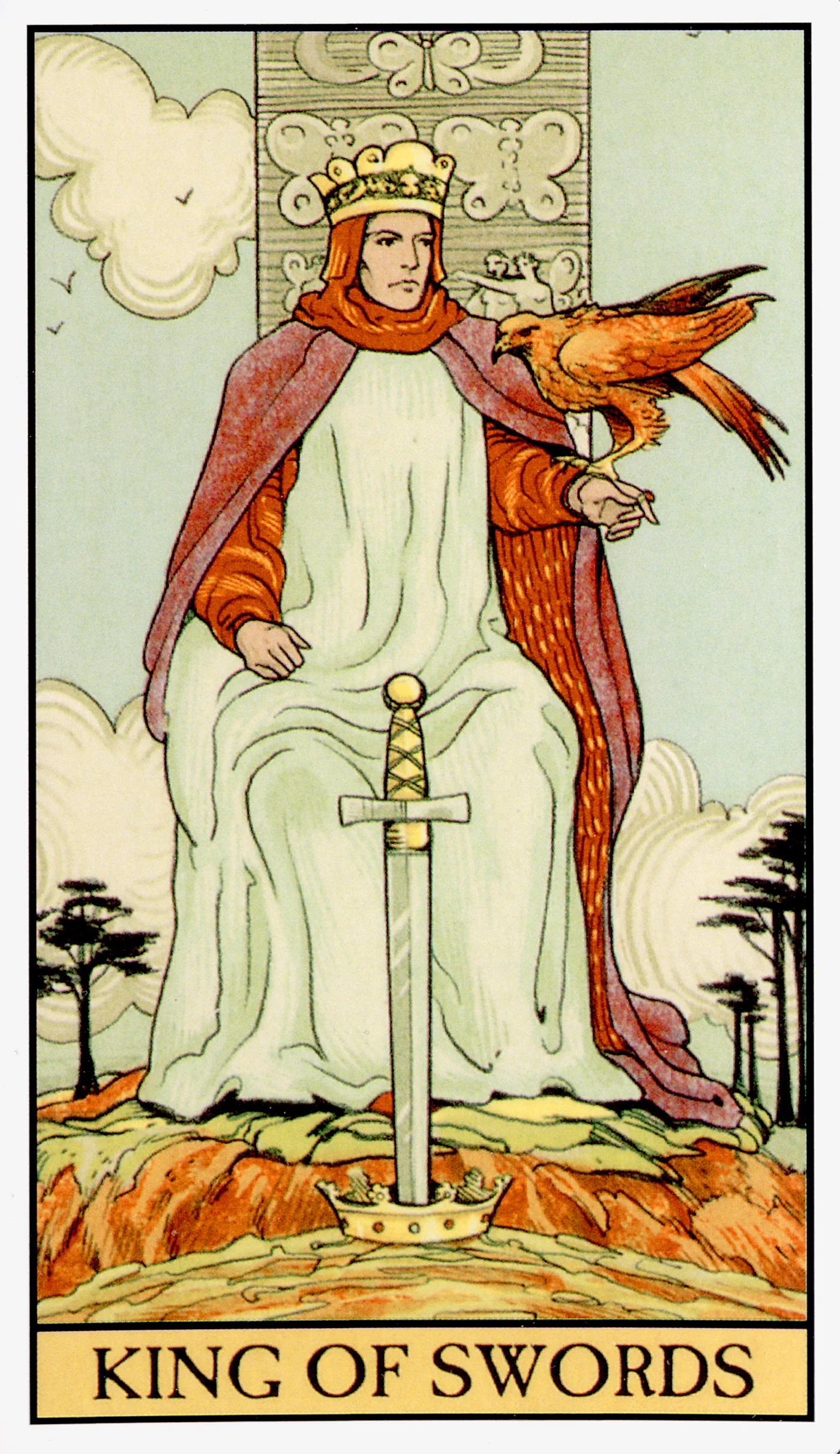
In the Rider-Waite-Smith image, the King sits facing us on a stone throne. He holds the sword upright in his right hand, its blade slightly angled rather than perfectly rigid. The direct gaze and steady posture make the scene feel like a quiet hearing: facts are welcome, but excuses will not be mistaken for evidence.
A butterfly appears among the throne details, alongside crescent moons. The King is wearing a crown, a blue tunic, and a purple cape; the sword in his right hand rises through the centre of the scene. Some readers see the butterfly and moons as signs of transformation and perception, the blue as clear thinking, and the purple as spiritual knowledge. Those correspondences are interpretive rather than universal. Trees and clouds move in the distance, keeping the stone-and-steel scene connected to a living world. Visual details vary across tarot decks, so let the image in front of you lead.
The King of Swords is associated with the element of air in many tarot traditions. Gemini, Libra, and Aquarius may be used as symbolic lenses for communication, justice, or big-picture thought. Treat these correspondences as deck- and tradition-dependent: they are not proof of anyone’s zodiac sign, personality, or birth chart.
King of Swords Astrology, Archetype, and Negative Meanings
As an archetype, the King of Swords is sometimes described as a stern authority figure, judge, or master strategist. Those phrases are symbolic history, not rules about gender, profession, or personality. The archetype can be highly intelligent, eccentric, witty, and intellectually independent in anyone. At its best, this energy speaks plainly while remaining fair; at the shadow edge, it may sound like a severe courtroom cross-examination.
These so-called negative meanings are not a verdict on someone's character. Words such as aloof, vindictive, or cruel describe a possible pattern, not a diagnosis. Look for the softer need beneath the guard: safety, respect, accurate information, or time to think.
How to Read Court Cards Without Stereotypes
Some older lists call the King a “mature male,” a stern father, or even an absent father. Those phrases can illuminate a particular reading only when the surrounding cards and real situation support them. They should never be used to invent a person, assign blame, or claim hidden family history.
The King need not be a man, father, boss, or judge, or someone who appears conventionally masculine. Court cards can describe a role, capacity, communication style, or developmental task. Anyone can embody this King's truthful, strategic, self-disciplined qualities—or the shadow of being severe, aloof, controlling, or manipulative.
Try reading the card as a verb: discern, clarify, articulate, govern, decide. This keeps the interpretation active and avoids pretending tarot can discriminate between real people by gender, age, relationship status, or appearance.
Reflection Prompts for the King of Swords Tarot Card
- What do I know from evidence, and what have I filled in?
- Where would a clear boundary create more peace?
- How can I be truthful without trying to punish?
- What feeling sits beneath my most logical argument?
- Which sentence would make this situation easier to understand?
One card, many perspectives
See King of Swords Card from Other Decks
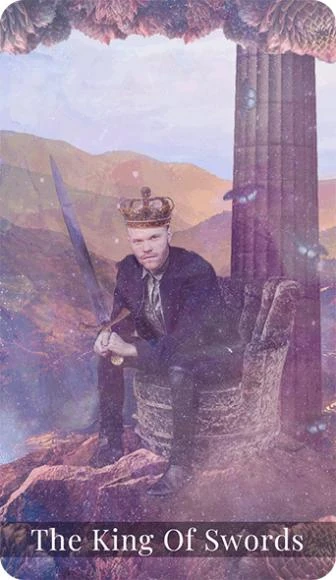
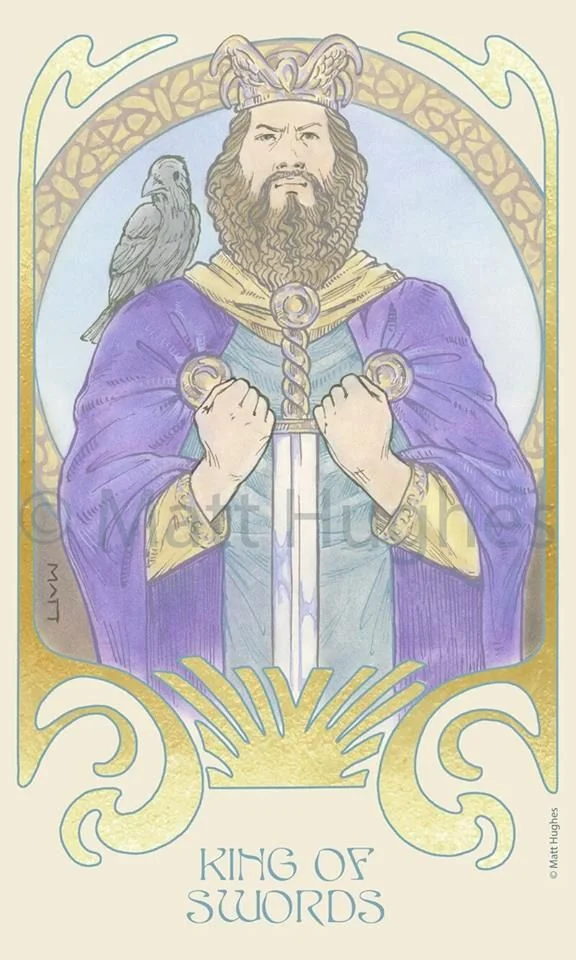
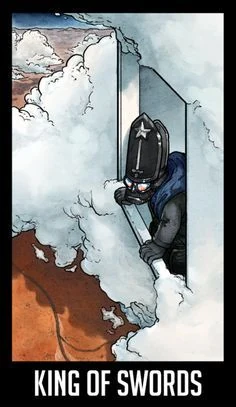
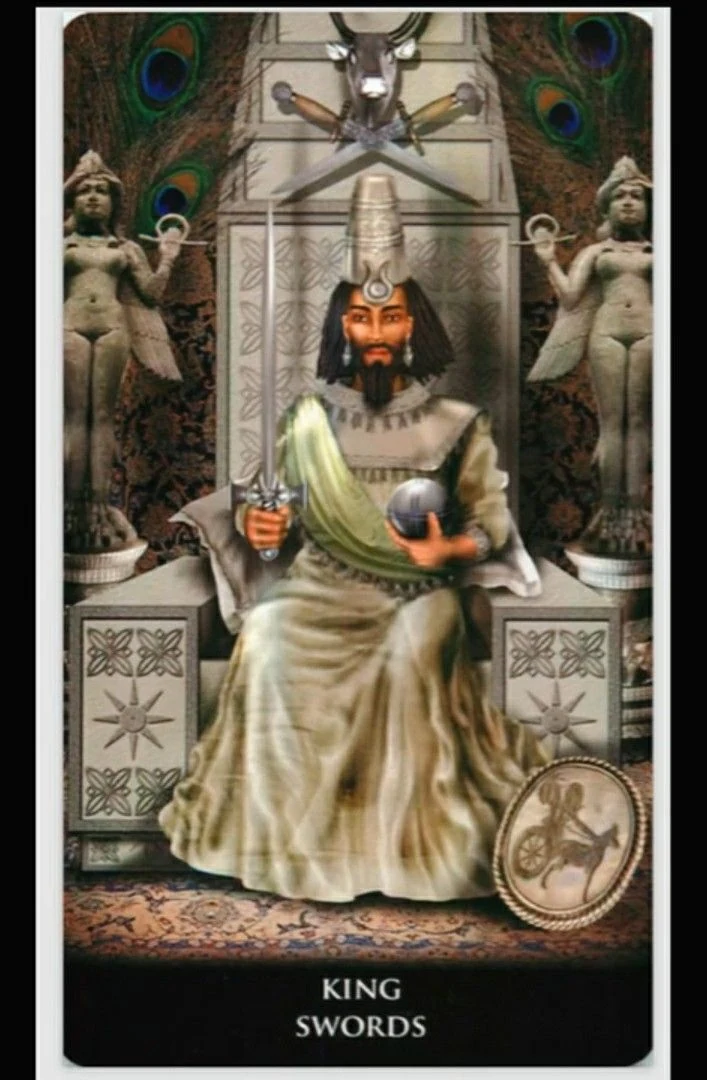
Discover how other tarot decks interpret this card. Select a deck to explore its full review and gallery.




King of Swords FAQ
What is the main meaning of the King of Swords?
The main meaning is clear judgement guided by experience. Upright, it highlights discernment, independence, fairness, and honest communication. Reversed, it can show harsh judgement, suppressed emotion, suspicion, or a boundary becoming a wall.
Is the King of Swords a positive tarot card?
It can be deeply helpful, though not always comfortable. Its gift is clarity. Whether the experience feels positive depends on the question, surrounding tarot cards, and how thoughtfully truth is expressed.
What does the reversed King of Swords warn against?
It asks you to notice cutting speech, cynicism, self-criticism, withheld warmth, or conclusions reached before all the facts are known. It is an invitation to rebalance precision with emotional maturity, not a forecast of cruelty.
Does the King of Swords represent a specific person?
Not reliably. It may describe a person's visible approach, but it can also represent your own energy, a role, or advice. Avoid using one tarot card to assign a fixed gender, zodiac sign, marital status, diagnosis, or secret motive.
What should I do after pulling the King of Swords?
Name the question precisely, separate evidence from assumption, and choose one honest next step. If a conversation is needed, plan language that is both firm and fair.