Mansions of the Moon Tarot Card Gallery
Browse the available archival card fronts in tarot order. Choose a group or open any card for a larger carousel view.
Showing all available cards.
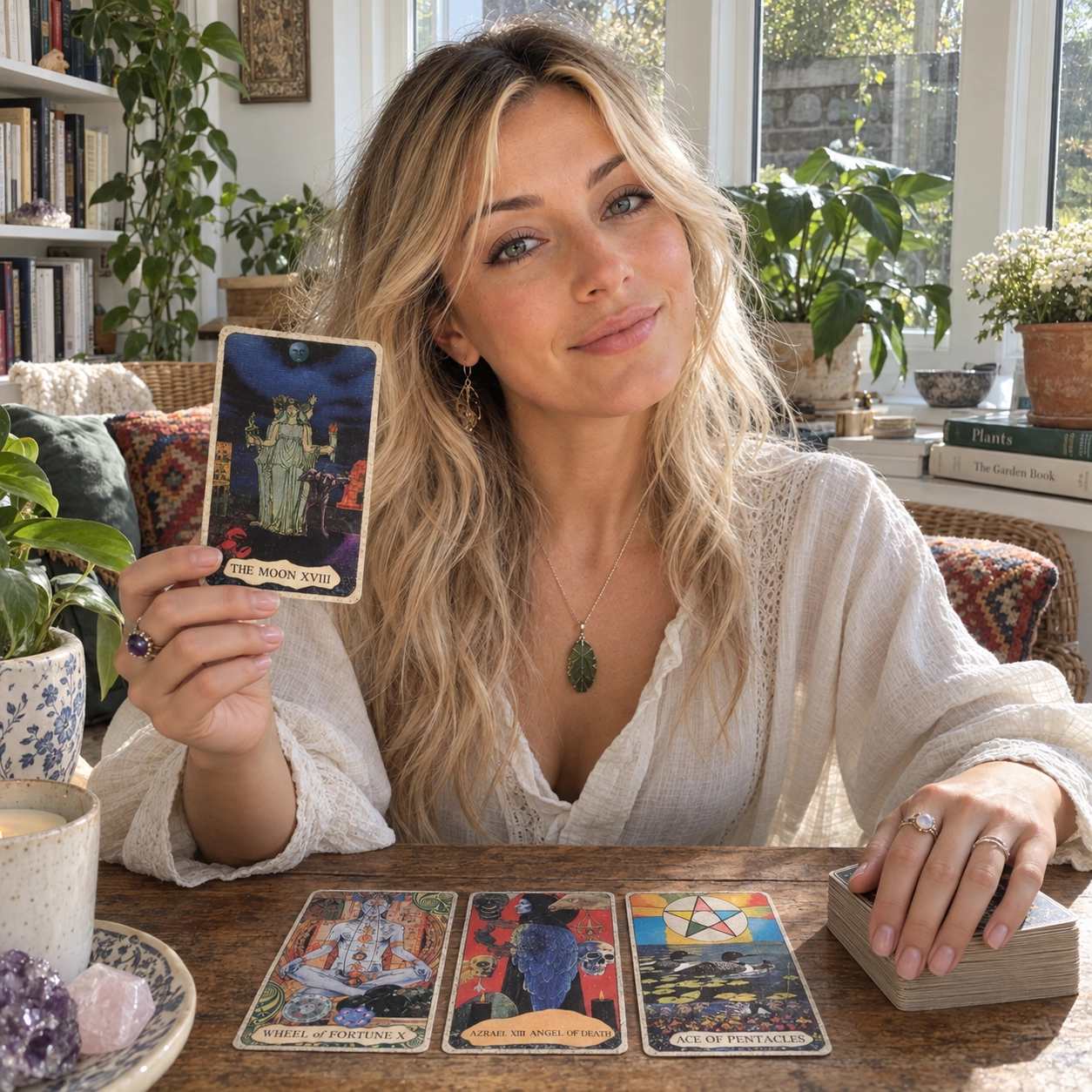
Aurica’s Quick Take
I am drawn to the way these collages feel hand-gathered rather than polished smooth. A face, a flower, a diagram, and a sudden flare of colour can share one small frame, so each card asks me to slow down and notice which fragment speaks first.
I would bring this deck to reflective readings, creative questions, and moments when a familiar tarot meaning has gone flat. Its images reward patient looking: name the card, choose the detail that catches your eye, and let the relationship between those two things shape the message.
There is something brave and tender in a deck that leaves its seams visible. Let that openness remind you that your own pieces can meet in surprising ways, and that a clear next step can still shine through a complicated picture.
Mansions of the Moon Tarot Review: an archival collage deck with a singular voice
Mansions of the Moon Tarot was created and illustrated by the artist credited as Zadok and self-published in 1999. Records document both a Major Arcana edition and a complete edition. The surviving cards show dense handmade collage: devotional pictures, diagrams, animals, architecture, plants, faces, and bodily imagery meet without being digitally smoothed into one scene.
The title is evocative, but it is not evidence that the deck teaches a specific astrological system. I read what is visible on each card and use its familiar tarot title as the anchor. That keeps the imagery vivid without asking the deck to support claims its surviving record does not establish.
Deck-specific card study
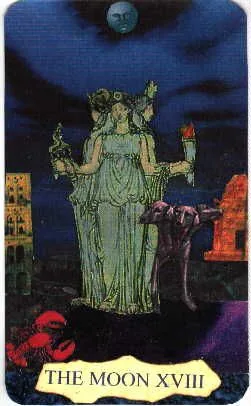
The Moon: a many-faced guide carrying fire into the dark
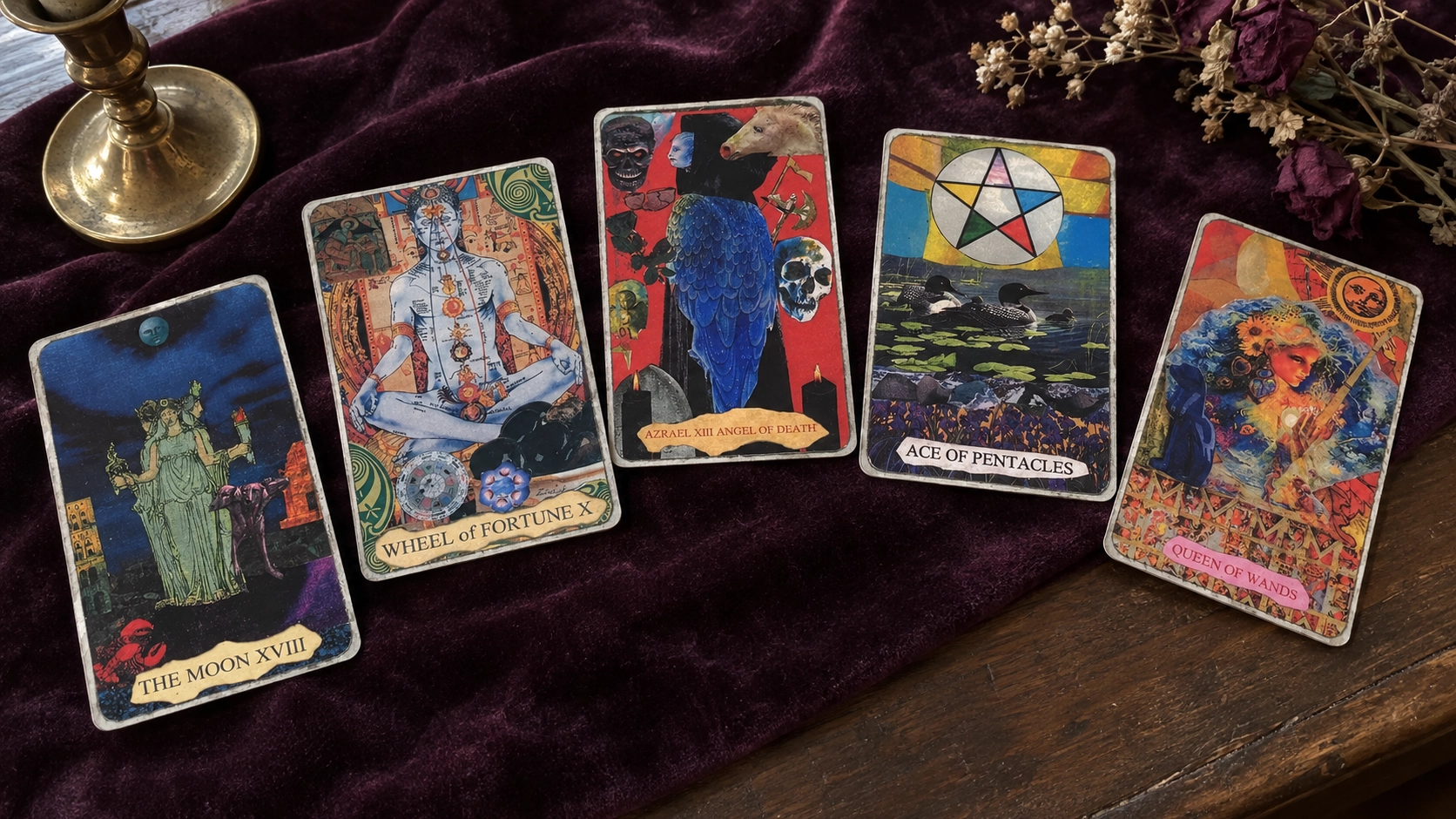
A blue-black sky fills most of this card, with a pale moon face suspended high above the scene. Several faces gather above a long pale robe. One hand holds a small branching object while the other raises a red-tipped torch; block-like buildings and dark animal forms sit below.
The clustered faces make uncertainty feel active rather than empty, while the torch offers limited but useful light. In a reading, this Moon can describe following the next visible clue without pretending the whole story is clear. Its shadow is projection: several fears speaking at once. Ask which voice comes from observation and which comes from atmosphere.
How the collage language changes a reading
With a cleaner pictorial deck, the eye often moves from figure to action to outcome. Here, attention may jump between a face, an animal, a small diagram, a bright patch of red, and a piece of architecture before it settles on a story. That scattered first response is useful, but it needs a firm tether.
I use three passes. First, name the traditional function of the card in one sentence. Second, list the three visible fragments pulling most strongly. Third, ask what relationship those fragments create for the question. The aim is not to decode every borrowed image; it is to discover which pieces form a meaningful sentence now.
Four-card moment
Intuition through study, solitude, distance, and dream
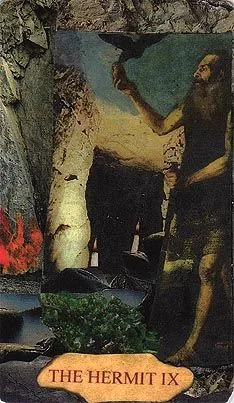
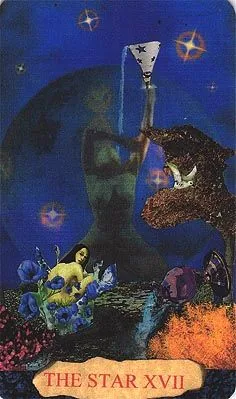
The High Priestess studies what is hidden, the Hermit withdraws to hear it, the Star restores orientation, and the Moon tests whether the reader can remain observant inside uncertainty.

A steady method for complex cards
The deck rewards a slow pace and a precise question. Begin with one card, one visible detail, and one sentence about how the two connect. If the interpretation cannot be traced to the card title, something clearly present in the image, or the question itself, simplify rather than adding more mystery.
This method is especially helpful for a reader who already knows the broad tarot structure but has begun to read on autopilot. The collage interrupts the memorised answer and restores the useful pause between seeing and deciding.
Deck-specific card study
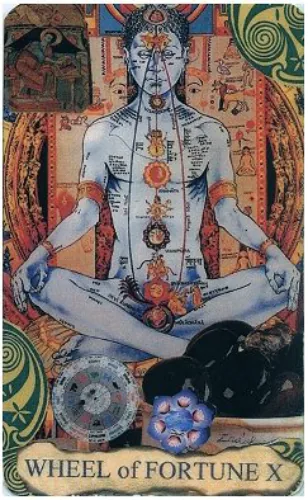
Wheel of Fortune: the turning pattern runs through the body
A pale blue, cross-legged figure dominates the card. A vertical sequence of coloured circles runs from pelvis to crown while fine labels and diagram lines cover the body. Chart-like forms fill the background; dark stones and a small blue flower-like form gather near the lower edge.
Instead of showing fortune only as an external wheel, the collage places cycles inside a seated body. Change moves through attention, habit, and response. Upright, this can be a turning point that asks for alignment rather than control. In shadow, the diagram becomes over-analysis. Ask which part of the cycle is already embodied and which remains theory.
Reading thresholds rather than fixed answers
Some questions are really about a threshold: the moment between inherited belief and chosen commitment, between keeping a pattern and answering a call. The cards below work well together because each adds a different kind of responsibility rather than repeating the same message.
When these images appear, I would resist the urge to make one symbol carry the entire reading. Let the cards disagree a little. Tension between them often shows where a choice is alive.
Four-card moment
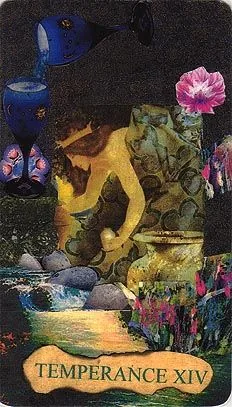
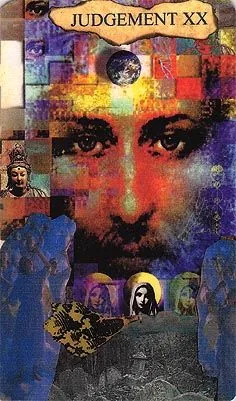
Belief, relationship, balance, and awakening
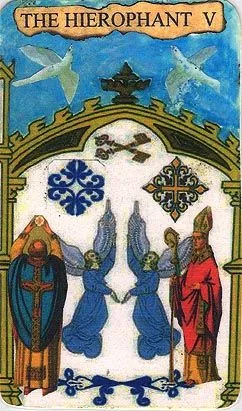
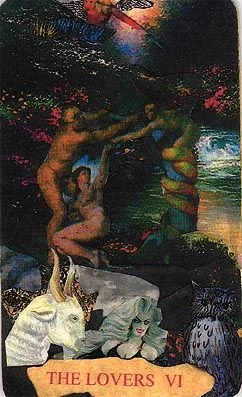
This sequence moves from inherited teaching to chosen relationship, then to integration and a final call to answer. It works as a spread for what you are willing to commit to, combine, and become accountable for.
Who is this deck likely to suit?
It is a strong match for collage artists, dream journalers, experienced tarot readers, and collectors of late-twentieth-century self-published decks. It may frustrate anyone who wants crisp contemporary printing or an image system that explains itself through obvious repeated scenes.
A confident learner could use it beside a plain tarot reference, separating structure from response: “This is the Five of Cups” is the anchor; “the image feels enclosed and heavy” is the visual impression. Both matter, but they are different kinds of evidence.
Deck-specific card study
Azrael XIII: transformation among many endings
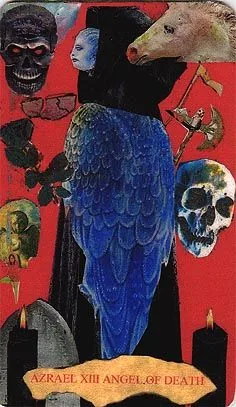
The printed title reads “AZRAEL XIII ANGEL OF DEATH.” Against a vivid red ground, a dark central figure is largely covered by an enormous blue feathered wing. Human, animal, masked, and skeletal faces crowd the field; an axe-like tool appears above and two black candles burn below.
The card refuses a single tidy emblem of ending. The wing both protects and obscures. Upright, it can show change that must be named, grieved, cut away, or carried across a threshold. In shadow, the surrounding faces suggest fixation on every possible loss. Ask what ending is actually present, not every ending imagination can produce.
Material life as a practice
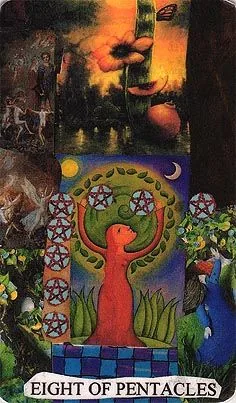
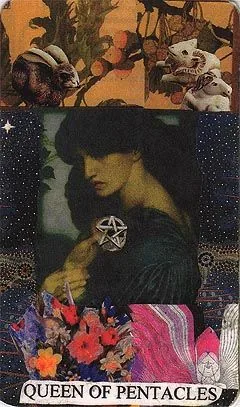
The Pentacles in this deck bring all that symbolic abundance back to work, care, repetition, and stewardship. They are useful when a reading feels atmospheric but the question needs a practical answer. What can be held? What can be repeated? What deserves protection?
Placed together, the four cards below form a grounded progression. Potential matters, but only practice reveals whether it can become dependable.
Four-card moment
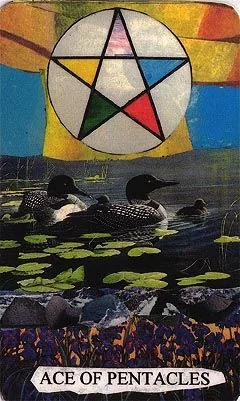
Resources becoming craft, care, and authority
The Ace offers potential, the Eight requires repetition, the Queen protects what can grow, and the King tests whether skill has matured into stewardship rather than display.

What to know when viewing an archival listing
Mansions of the Moon Tarot is out of print. The archive destination on this page is a record for the exact deck and currently shows it as unavailable; it is not presented as a retail offer. Documented editions differ, so a collector comparing an independent listing should confirm which edition is shown from photographs of the actual cards.
No reliable evidence was found here for the original packaging, companion text, or card-back design. Those details are therefore left unstated. The final image below is a card-focused editorial scene, not a claim about how the deck was packaged.
Aurica’s golden rule for reading with this deck
Let one fragment earn its relevance before you chase the next. Choose the detail that genuinely connects to the question, explain that connection, and only then bring in a second symbol. The rule turns visual abundance into disciplined interpretation.
Final Thoughts
Mansions of the Moon Tarot is memorable because it feels assembled by a particular artistic mind at a particular moment in small-press tarot history. Its familiar card titles keep a reading anchored, while the visible seams and collisions keep the images from becoming predictable.
For the right reader, that friction is a gift: it asks for attention instead of speed and makes an old card feel newly encountered. Approach it slowly, stay close to what is visible, and let the clearest fragment open the next honest question.
Mansions of the Moon Tarot FAQ
Who created and illustrated Mansions of the Moon Tarot?
The deck was created and illustrated by the artist credited as Zadok and self-published in 1999.
Which editions of Mansions of the Moon Tarot are documented?
Records document a 22-card Major Arcana version and a 78-card complete version. Anyone comparing an independent listing should confirm the edition from photographs of the actual cards.
What kind of artwork does the deck use?
The cards use dense handmade collage, bringing together figures, animals, plants, architecture, diagrams, and printed fragments. Visible seams and shifts in scale are part of the deck’s distinctive visual language.
Does the title mean this is a lunar astrology deck?
The title alone does not establish that the deck teaches a specific astrological system. This review stays with the documented history, familiar tarot titles, and symbols that can be seen on the surviving card images.
Is Mansions of the Moon Tarot suitable for a new reader?
It is likely to work better after a reader knows basic tarot structure. Its layered collage can be rewarding, but a learner may want a plain tarot reference nearby while separating the card’s established function from a personal response to the image.
Is Mansions of the Moon Tarot still in print?
The exact deck is out of print, and the linked Tarot Garden page is an unavailable archival record rather than a current retail offer.


