Tarot of Mermaids Cards
Explore the verified card fronts recovered from the authorized Tarot of Mermaids source board. The board did not provide every card in this edition, so unavailable cards are omitted rather than replaced with artwork from another deck. Select any card for the full-size Lightbox.

Aurica’s Quick Take
Tarot of Mermaids is a 78-card Lo Scarabeo deck conceived by Pietro Alligo and illustrated by Mauro De Luca. Its merfolk do not live in a soft storybook sea. They inhabit a world of lantern light, storms, wreckage, desire, vigilance, ceremony, and deep-water uncertainty.
That tension is the deck’s strength. The imagery can look alluring at first glance, then reveal a warning, a power struggle, or an emotional cost. I find it most useful for relationship dynamics, shadow work, creative blocks, and questions where attraction and risk are tangled together.
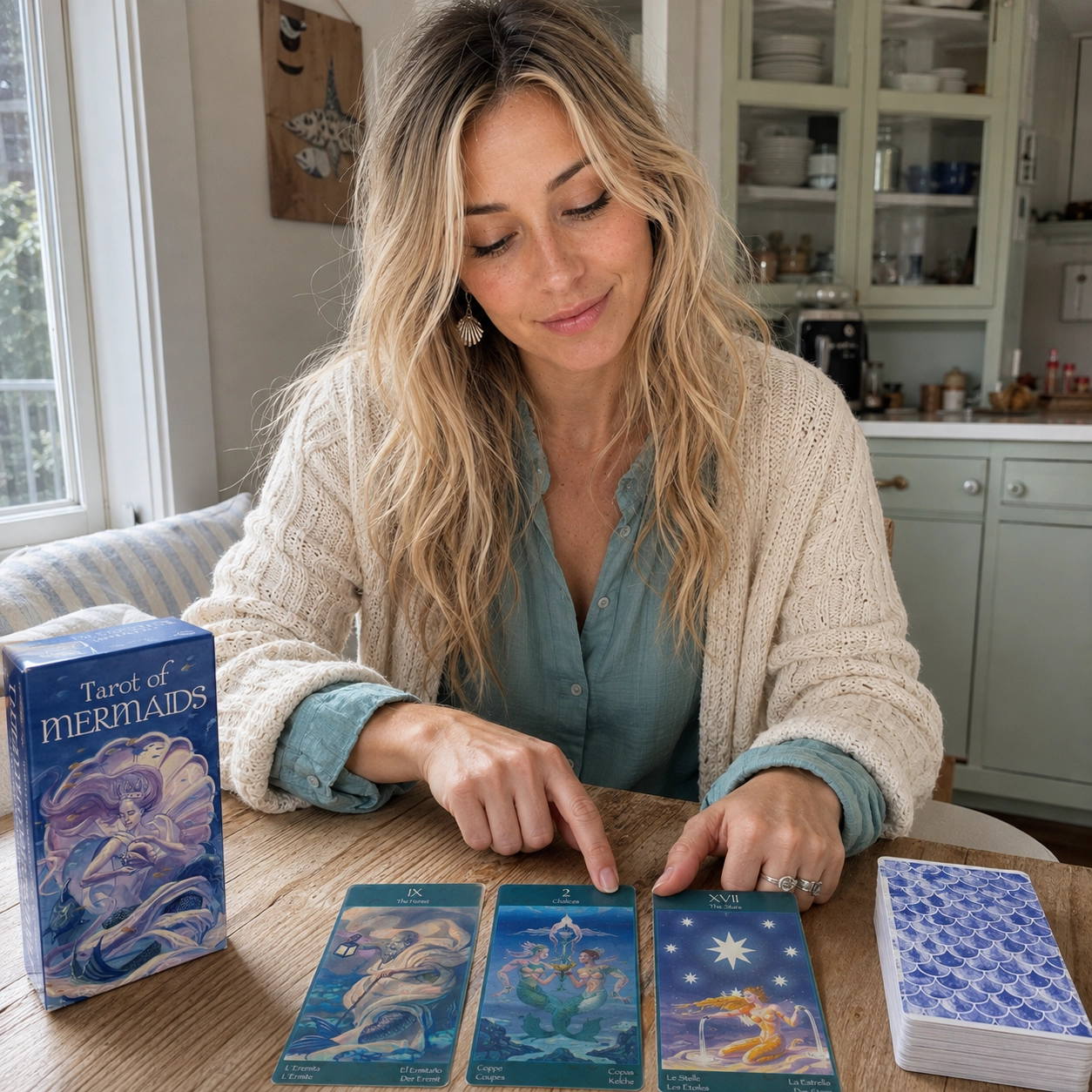
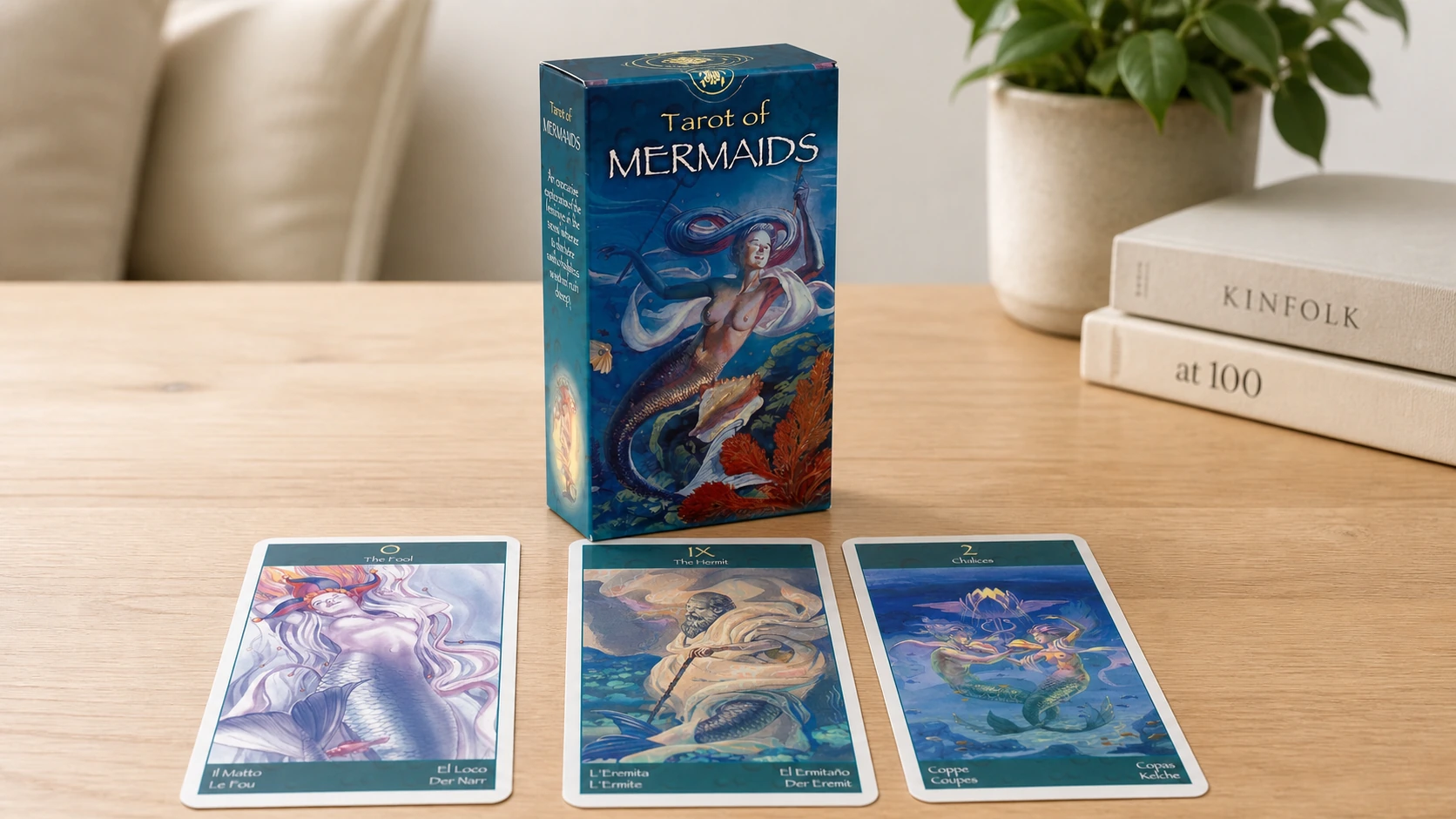
I begin by noticing where the current seems to pull. The Hermit raises his lantern through murky water, Two of Chalices asks whether closeness still leaves room to breathe, and The Stars opens a brighter horizon beyond them. I let that first feeling surface, then test it against each card’s familiar tarot role and the story made by its neighbours.
This is not a deck I hurry. I give its watchful faces and changing weather time to speak, especially when a beautiful choice carries a hidden undertow. If you meet these mermaids with honest eyes, they can help you trust your own inner compass and swim toward the shore that truly welcomes you.
Tarot of Mermaids review: beauty with a dangerous undertow
BENEATH THE SURFACE
What makes this mermaid deck feel different
De Luca translates familiar tarot functions into marine situations rather than simply adding tails to standard scenes. Oars, shells, coral, tridents, submerged ruins, waves, and sea creatures become part of the reading grammar. Wands can resemble paddles or poles; court figures feel like rulers of distinct underwater territories; even quiet cards carry the pressure of an environment where visibility and movement can change quickly.
The palette shifts meaning too. Gold and orange often bring heat, agency, and exposed emotion, while blue-green cards can feel private, strategic, or difficult to read at once. The white border and multilingual footer give the deck an older Lo Scarabeo character that collectors may enjoy, but they also make the illustrations slightly smaller than a borderless modern deck.
This is not the 2019 Mermaid Tarot by Leeza Robertson and Julie Dillon. The artwork, box, creators, and visual system are different, and this review keeps those editions separate.
CARD STUDY
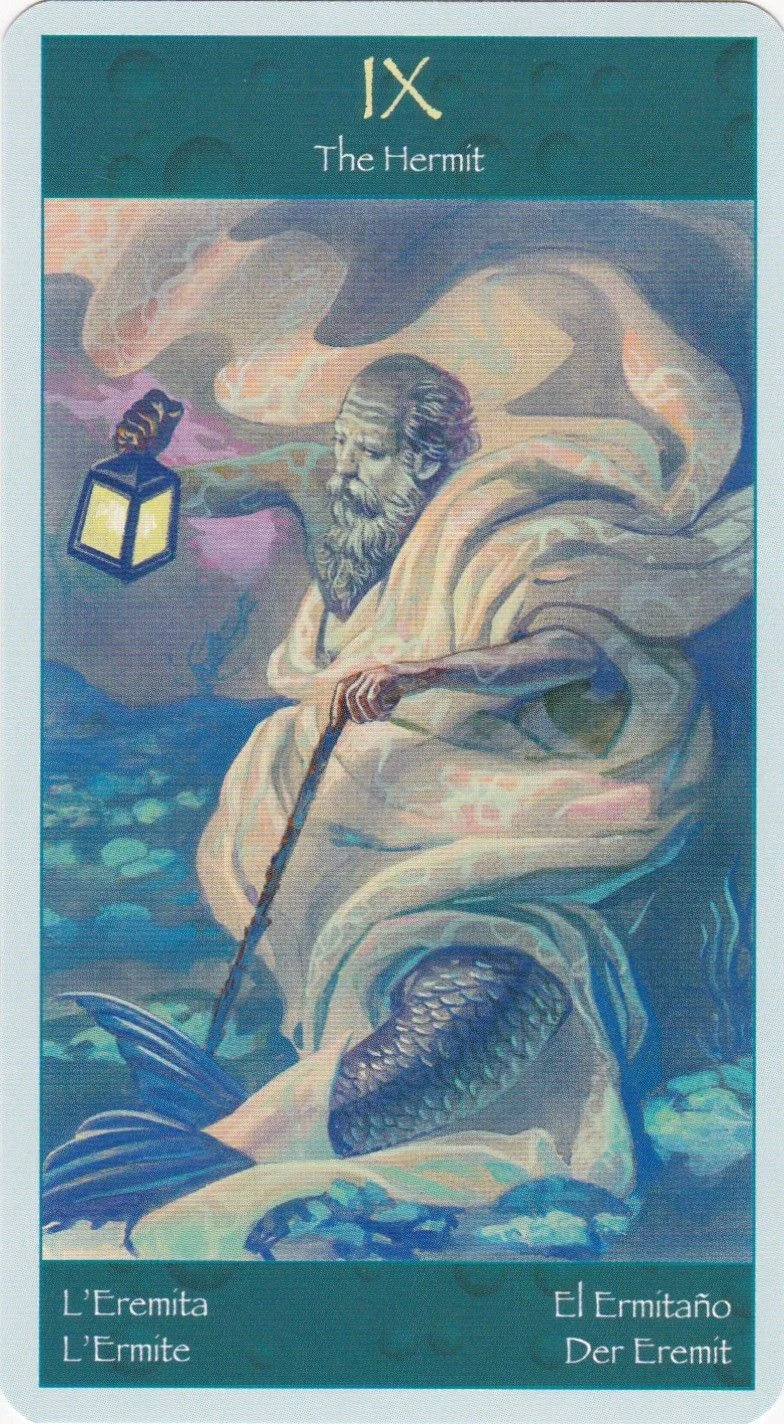
The Hermit: carrying light through low visibility
An elderly bearded merman steadies himself with a staff while holding a square lantern into the darkness. His heavy pale cloak drifts around him, and the rocky seabed makes the scene feel slow and effortful rather than serene.
The lantern is practical, not decorative: it creates only enough light for the next step. Upright, this Hermit favors deliberate solitude, patient investigation, and guidance earned through experience. In shadow, the same image can show withdrawal becoming habit or caution hardening into fear.
In a reading I would ask, “What can you verify from where you are?” The card does not demand a complete map. It asks for one honest pool of light and the discipline to move within it.
READING BEHAVIOR
How Tarot of Mermaids reads in practice
This deck reads best when you begin with visible action. Notice who is moving, who is watching, what is being carried, and whether the water looks calm, crowded, stormy, or difficult to cross. Then add the traditional card meaning. That sequence keeps the interpretation grounded while allowing the marine setting to contribute something specific.
The deck is especially articulate about boundaries. Water connects everything, but it also hides distance and depth. In relationship readings, that makes the cards good at showing emotional availability, mixed signals, rescue patterns, mutual exchange, and the difference between intimacy and enmeshment.
For practical questions, translate the scene into behavior: secure the boat, share the cup, carry fewer swords, wait for clearer visibility, or choose the current instead of fighting it. The imagery becomes most useful when it leads to a concrete next step.
FOUR-CARD CURRENT
From solitude to return
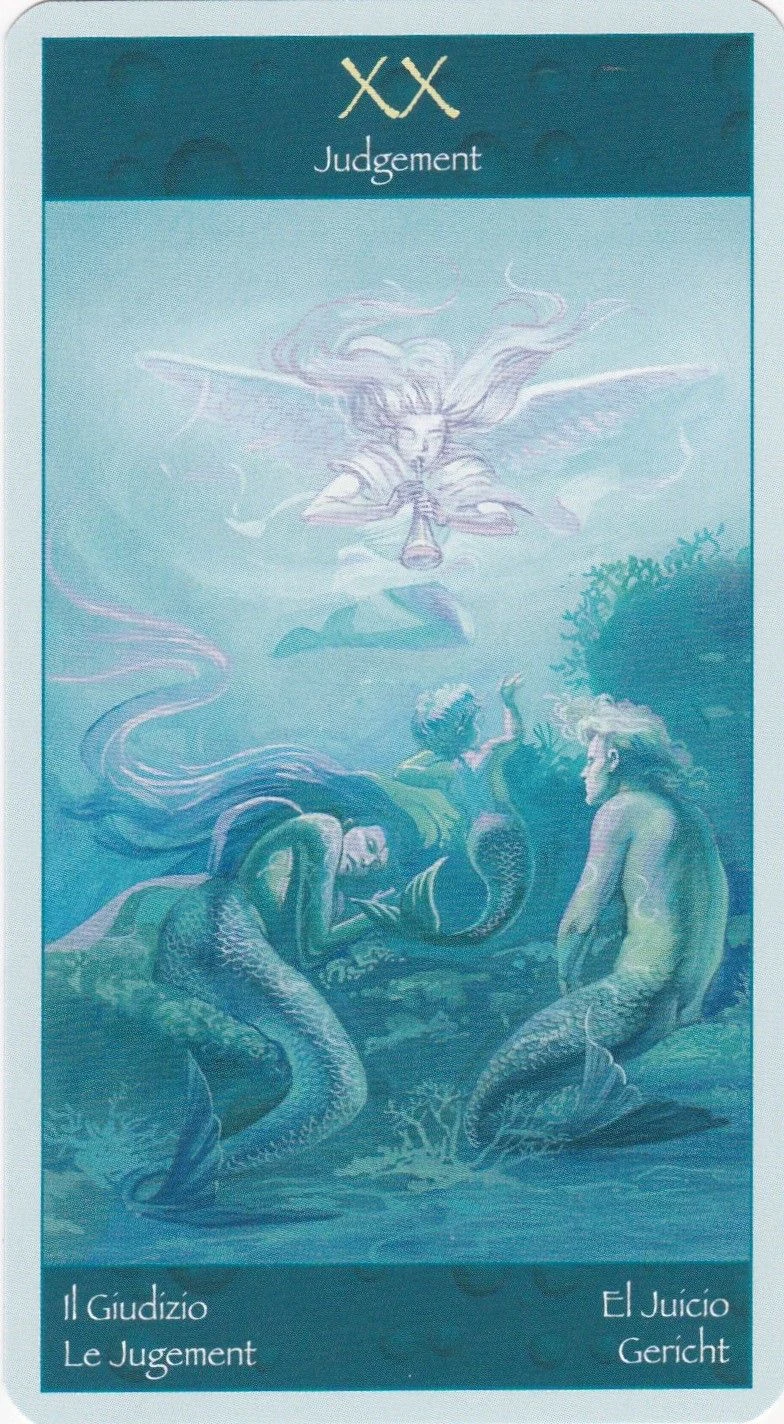
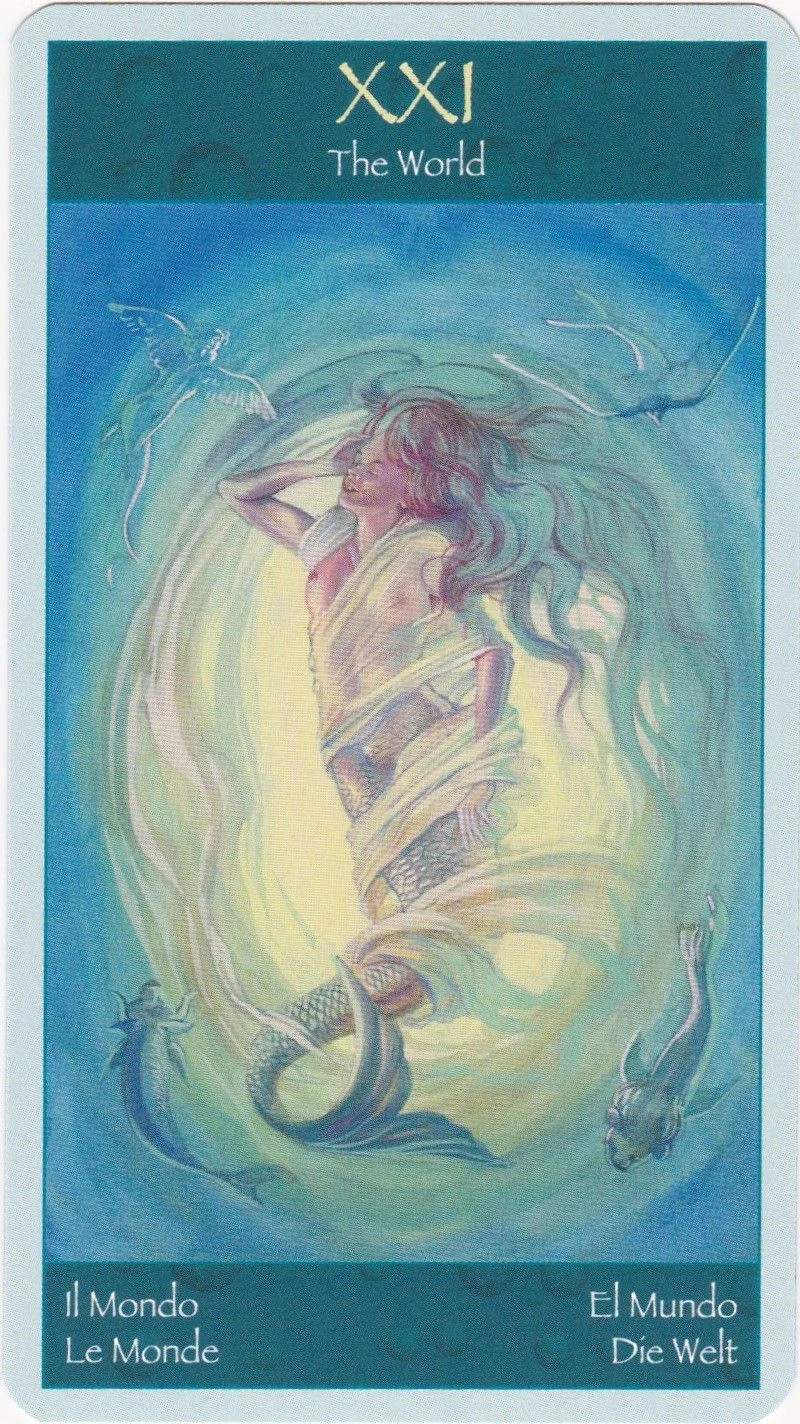
The Hermit, The Stars, Judgement, and The World form a complete deep-water arc: finding a private light, recovering orientation, answering a call, and returning with a larger sense of wholeness.

LEARNING THE DECK
Beginner friendliness and a three-level prompt ladder
Tarot of Mermaids follows the familiar major and minor arcana structure, so readers who know Rider-Waite-Smith meanings have a useful foundation. It is not a keyword deck, however. Some scenes reinterpret the traditional action strongly, and the courts use Knave rather than Page. Beginners may want the guidebook nearby while they learn the deck’s visual vocabulary.
A useful first-week practice is to draw one card, name three concrete details, write the traditional meaning, and finish with one sentence beginning, “In this sea, the card changes because…” That last sentence teaches the difference between memorizing tarot and actually reading this deck.
CARD STUDY
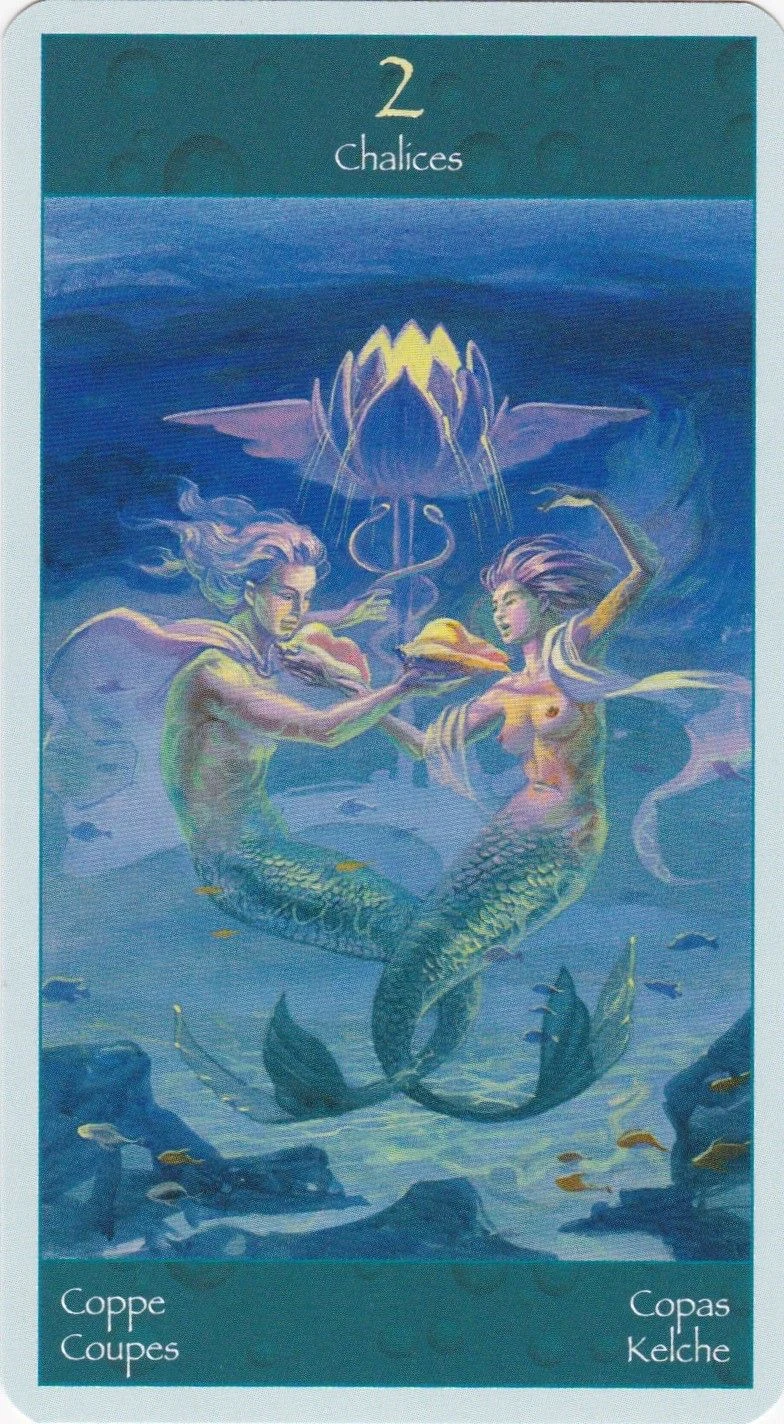
Two of Chalices: connection without losing shape
Two merfolk face one another and extend a shared vessel between them. Their bodies mirror without becoming identical, while fish and the open water below keep the exchange rooted in a living environment rather than a sealed romantic bubble.
Upright, the card supports reciprocity, attraction, emotional recognition, and an agreement both people can enter willingly. Its shadow is subtler: mirroring can become projection, and a beautiful exchange can still fail if either person gives up their own direction.
For love readings, ask what is genuinely mutual—not merely intense. For collaboration, ask what each person contributes and what terms protect the relationship after the first wave of enthusiasm passes.
ART AND PERSONALITY
A deck of motion, weather, and watchful faces
The figures often appear mid-action: rowing, carrying, approaching, defending, listening, or turning toward something outside the frame. That gives readings momentum. Even when the message is reflective, the cards rarely feel static.
Faces matter here. Some characters meet the viewer, while others look past us toward a threat, promise, or memory. I would not flatten those expressions into fixed keywords. A guarded gaze can mean strategy in one spread and exhaustion in another; the surrounding cards decide which current is strongest.
The deck’s sensuality is part of its symbolism, but it is paired with danger and consequence. Readers who enjoy mythic ambiguity will find more to work with than readers seeking gentle affirmations or minimal scenic detail.
FOUR-CARD CURRENT
Agency under pressure
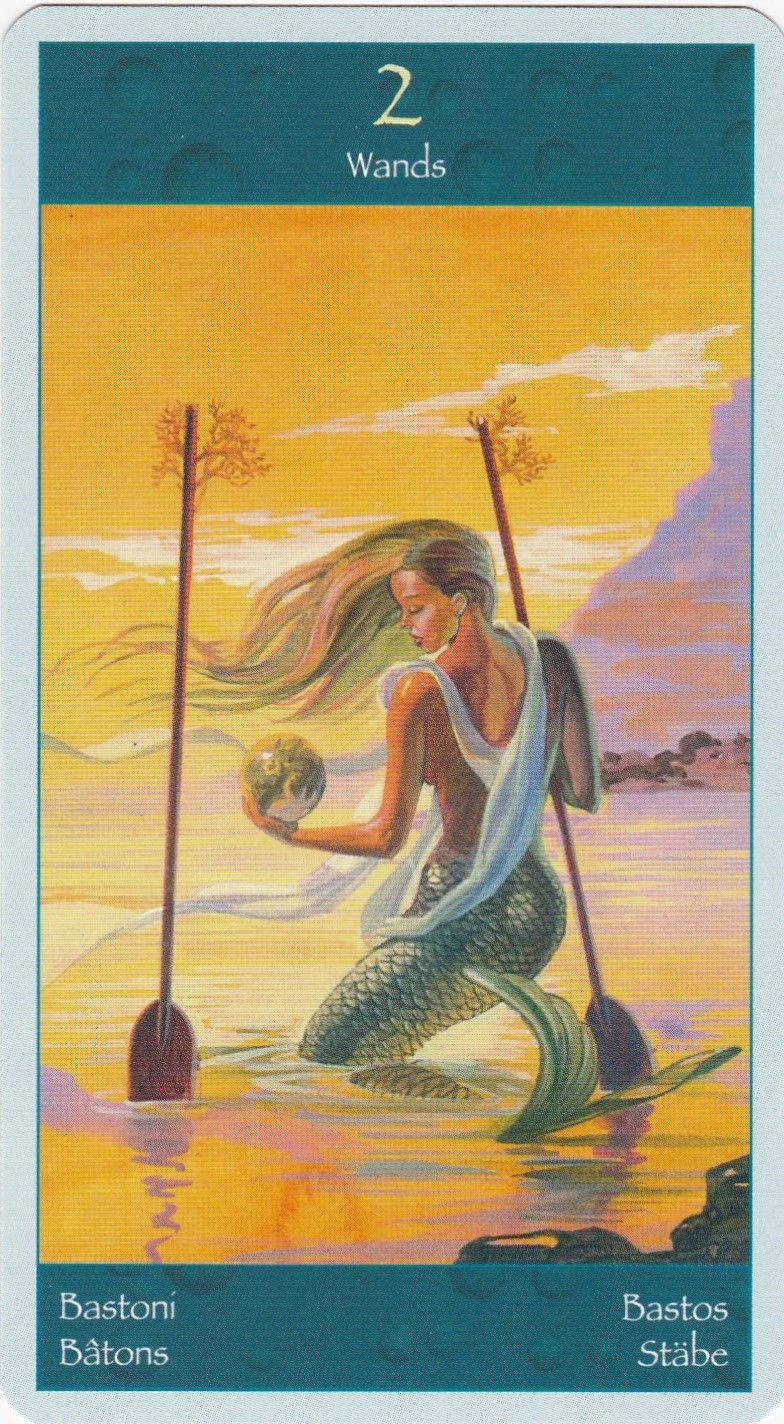
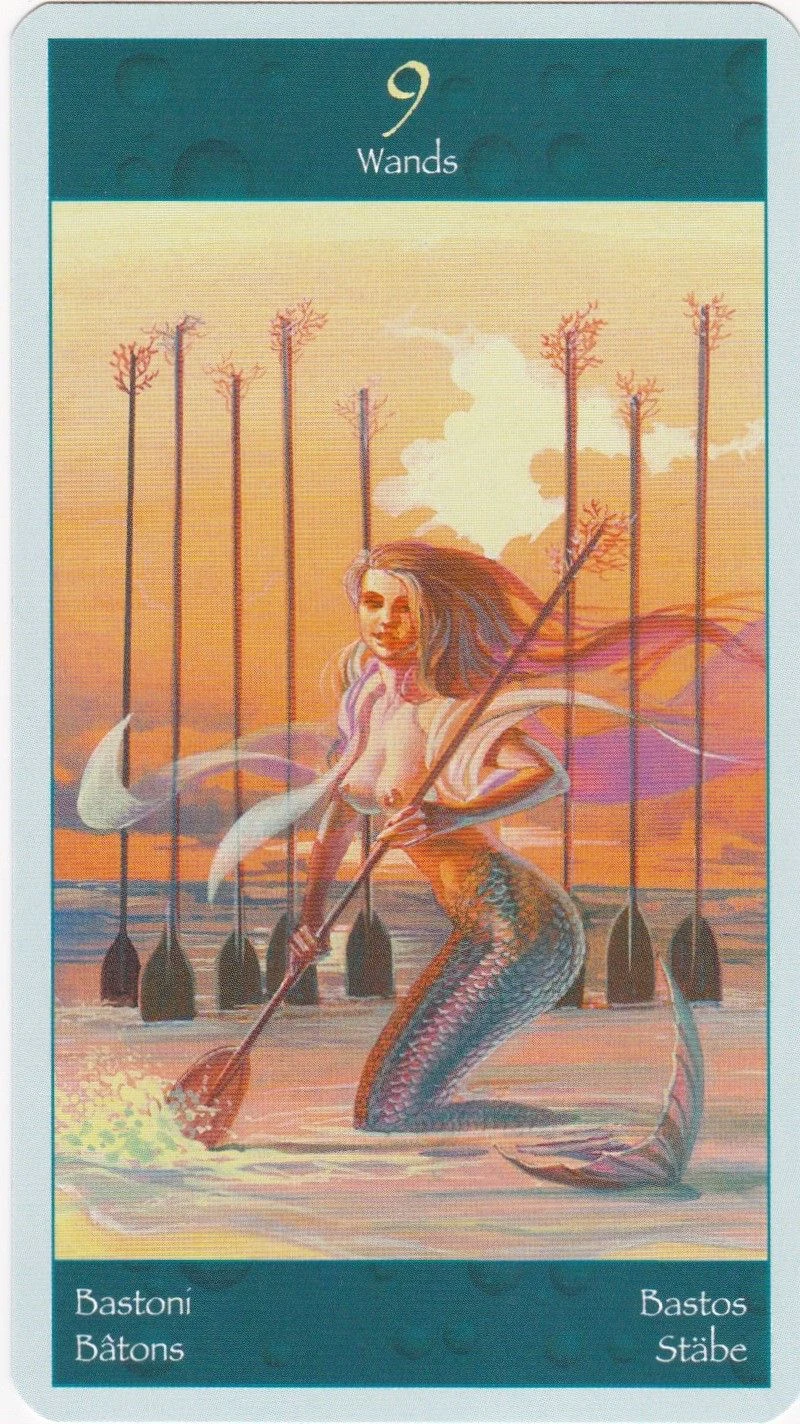
Two, Seven, Nine, and Queen of Wands show four kinds of power: choosing direction, defending position, sustaining effort, and embodying mature command without pretending the current is easy.


WHO IT SUITS
Who should buy Tarot of Mermaids—and who should skip it
Choose it if you…
- enjoy mermaid folklore with beauty and danger in equal measure;
- read through color, posture, atmosphere, and visual narrative;
- want a sea-themed deck that still uses standard tarot structure;
- like older Lo Scarabeo multilingual editions and detailed scenic minors;
- use tarot for relationships, creativity, shadow work, and emotional boundaries.
Skip it if you…
- want borderless cards or large modern typography;
- prefer gentle affirmation decks with consistently comforting imagery;
- need every scene to mirror Rider-Waite-Smith composition closely;
- dislike nudity, sensual mythic art, or darker emotional undertones;
- want the separate 2019 Mermaid Tarot by Robertson and Dillon.
What I like most: the deck understands that water is never just “emotion.” It is also pressure, distance, reflection, concealment, movement, and survival. That range keeps repeated readings from sounding the same.

CARD STUDY
Seven of Swords: strategy has a carrying cost
A blue-green mermaid moves through a strong current while gripping a bundle of long swords. More pointed forms rise behind her, and the entire image leans into motion. She looks capable, but the load is awkward and attention is divided.
This version emphasizes the physical cost of strategy. Upright, it may describe discretion, timing, protecting information, or choosing an indirect route. In shadow, it can show avoidance, divided loyalties, or a clever plan that becomes too cumbersome to maintain.
My practical question for this card is, “What are you trying to carry without being seen?” The answer often reveals whether privacy is wise—or whether secrecy has become the real burden.
Final Thoughts
Golden rule: read the current before you read the creature.
Before deciding what a figure means, look at the water around them. Is it carrying, resisting, hiding, reflecting, or threatening? That environmental clue often tells you whether the card’s traditional energy is flowing cleanly or meeting pressure.
I recommend Tarot of Mermaids to readers who want an expressive, mythic, and occasionally unsettling sea deck. Its strongest readings come from the meeting point between traditional structure and De Luca’s underwater storytelling. If you want another oceanic perspective afterward, compare it with the Ocean Tarot or the more surreal Navigators Tarot of the Mystic Sea.
QUESTIONS BEFORE YOU DIVE IN
Tarot of Mermaids FAQ
Is Tarot of Mermaids good for beginners?
It can work for beginners who enjoy detailed scenic art and are willing to use the guidebook. The deck follows familiar tarot structure, but several scenes reinterpret traditional imagery and the court cards use Knave rather than Page.
Who created Tarot of Mermaids?
The deck was conceived by Pietro Alligo, illustrated by Mauro De Luca, and published by Lo Scarabeo.
Is this the same deck as Mermaid Tarot by Leeza Robertson?
No. Tarot of Mermaids is the Pietro Alligo and Mauro De Luca Lo Scarabeo deck. Mermaid Tarot by Leeza Robertson and Julie Dillon is a separate 2019 deck with different artwork and packaging.
What readings suit this deck best?
It is particularly strong for relationship dynamics, emotional boundaries, creative blocks, shadow work, and choices where attraction and risk are mixed together.
Does Tarot of Mermaids follow Rider-Waite-Smith structure?
It uses the standard 78-card major and minor arcana framework, so Rider-Waite-Smith knowledge helps. Its underwater scenes and multilingual Lo Scarabeo presentation give many cards a distinct visual emphasis.
Why are some cards absent from the gallery?
The gallery includes only card fronts that could be verified from the authorized source board. Unavailable cards were omitted rather than replaced with artwork from another edition.
MORE WATER-WORLD TAROT