The verified partial gallery below preserves the earlier black-title and gold-border presentation recovered for this page. The current linen-finish printing shown by U.S. Games uses a white title band while retaining Kat Black’s core collage artwork. No uncertain substitutes have been inserted.
Golden Tarot Card Gallery
Browse this verified partial archive in canonical order. Use the official deck-group filters, then select any card for a larger accessible view.

A note from Aurica
Golden Tarot feels like opening a small door into a candlelit court. Kat Black’s figures carry the stillness of old paintings, yet their glances are wonderfully alive. I watch the hand that pauses, the face that turns, and the little animal waiting at the edge; that quiet detail often becomes the heart of my reading.
I especially love The Fool stepping forward in pale clothes against the dark ground. She looks tender rather than careless, as if courage can be soft and uncertainty can still contain grace. I begin with the gesture that catches me, then test that feeling against the card’s traditional role and the surrounding spread.
The Magician may bring focus, while the Two of Cups asks whether two people are truly meeting each other. I reach for this deck when a question needs patience, emotional nuance, and one practical next step. Let Golden Tarot help you trust the quiet clue that shines for you—your next brave step may already be glowing at the edge of the picture.
Golden Tarot by Kat Black: the short review
Golden Tarot takes the familiar Rider-Waite-Smith structure and rebuilds it from late-medieval and early-Renaissance paintings. Kat Black’s collages do not feel like a museum catalogue cut into rectangles. Figures, landscapes, architecture, gestures, and tiny symbolic details are joined into scenes that read as one world.
The result is richly coloured, devotional without being narrowly religious, and surprisingly practical in a reading. It is especially rewarding for readers who like to pause over faces, hands, clothing, rooms, and background action. The imagery can look solemn at first, but the emotional language is direct once you begin asking what each person is doing and where the scene is moving.
Best for: Rider-Waite-Smith readers, art lovers, collectors of gilt-edged decks, and anyone who prefers layered narrative imagery to sparse modern minimalism.
Golden Tarot deck details
| Creator | Kat Black |
|---|---|
| Publisher | U.S. Games Systems, Inc. |
| Structure | 78 cards: 22 Major Arcana and 56 Minor Arcana |
| System | Rider-Waite-Smith based |
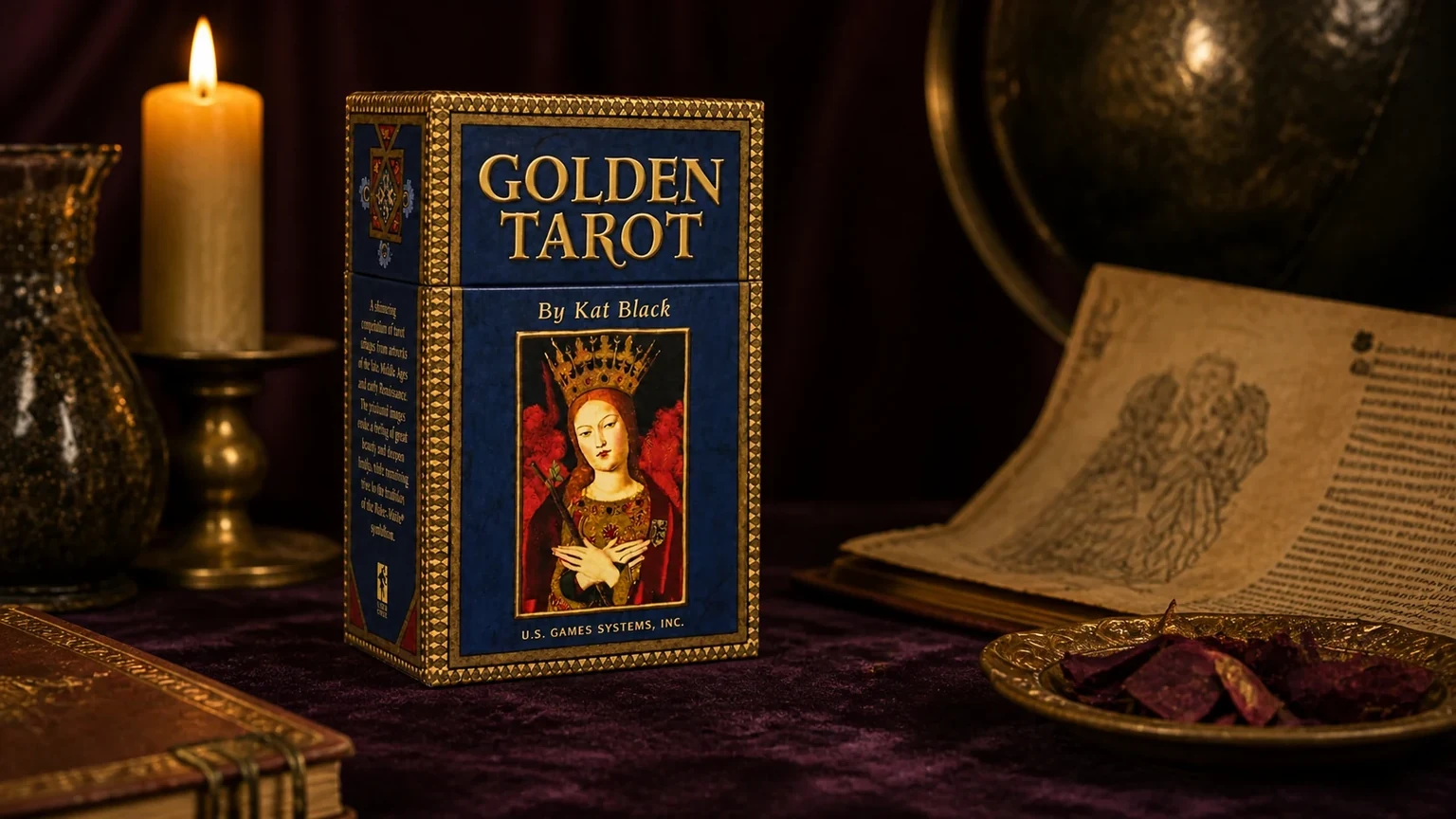
| Current edition | Gold-gilt, linen-finish cards in a rigid telescoping box |
| Guidebook | Illustrated 198-page companion book |
| ISBN | 978-1-57281-434-9 |
| Gallery here | A verified partial archive from the supplied Pinterest board |
What makes Kat Black’s collage style work?
Many collage decks announce their construction. Golden Tarot usually hides it. Black adjusts scale, colour, horizon lines, framing, and gesture until borrowed fragments behave like one scene. A face from one painting may meet a hand from another, yet the emotional exchange still feels intentional. That craft matters in divination because the eye can follow action rather than getting stuck on the cut-and-paste method.
The historical source material also brings a ready-made vocabulary of devotion, authority, labour, illness, travel, temptation, courtship, and social rank. Those themes fit tarot naturally. They can make the deck feel formal, but they also give ordinary questions unusual depth: a workplace disagreement becomes a question of patronage and loyalty; a relationship card becomes a study in proximity, posture, and who is allowed to speak.

The Fool: innocence with an old-world edge
This Fool is not striding toward a cliff. The pale figure stands inside a dark woodland scene with a round object held close and a small animal nearby. The image reads as vulnerable, curious, and slightly uncanny. In a reading, I would still begin with openness and the untested path, but I would ask what protection or preparation the querent needs before stepping beyond the familiar.
Reading the breath before action
The Fool becomes more useful when I resist the urge to turn it into a command to leap. In Golden Tarot, the surrounding darkness and delicate figure make me notice the moment before movement: the breath, the uncertainty, and the small question of whether curiosity is being supported by enough care.
That pause matters in an actual reading. If The Fool appears beside a confident card, the opening may be ready to use. Beside a card of confusion or scarcity, the same invitation can ask for preparation first. The picture stays hopeful, but it does not make recklessness look romantic.
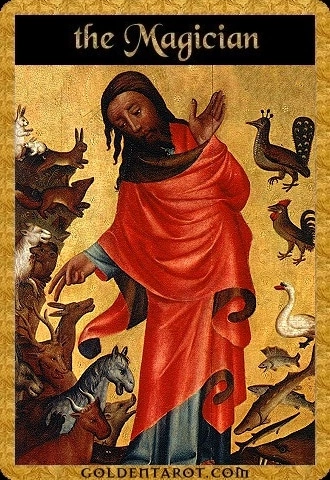
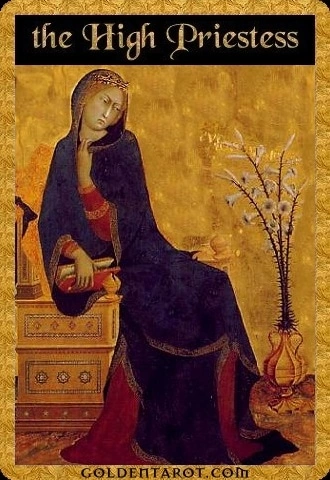
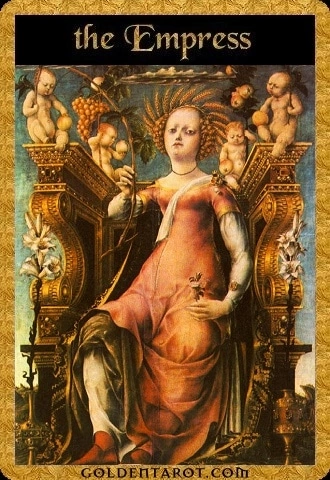
The four cards that follow show how a beginning gathers shape. Possibility becomes skill, skill listens inwardly, and inner knowing grows into something tangible. Read them as stages rather than four separate speeches.
Beginning again without losing your centre
The Fool, The Magician, The High Priestess, and The Empress move from possibility to action, inner knowing, and embodied growth. Together they are useful when a new project needs both confidence and patience.
How the figures speak across the cards
Kat Black’s people rarely feel sealed inside their own frames. Their bodies lean, wait, offer, retreat, and listen. When several cards are placed together, I look for a conversation made from posture: who faces the centre, who turns away, and whose hands are open or guarded.
This creates a gentle way to read difficult relationships without inventing motives. A turned shoulder does not automatically mean betrayal; it may show privacy, exhaustion, or a need to gather courage. The surrounding cards decide which possibility carries weight.
That is why the Two of Cups is such a revealing next study. Its warmth is not only in the idea of partnership. It lives in the quality of attention between two people and whether that attention can be sustained.

Two of Cups: relationship shown through attention
Two figures face one another with a cup raised nearby. The scene is quiet rather than theatrical. It works because the card gives the reader a clear relational question: are both people equally present? In supportive positions it can show mutual recognition, repair, or a promising agreement. In a difficult spread it may expose polite closeness without real reciprocity.
Following the emotional current
The Cups suit often looks soft, but softness is not the same as simplicity. In this deck, cups appear among formal clothes, measured gestures, and rooms shaped by custom. Feeling has to find a way through expectation, pride, tenderness, and the fear of being misunderstood.
When I read several Cups together, I trace where emotion is moving. Is it being offered freely, held too tightly, poured into the wrong place, or received with care? That question gives the suit practical edges and keeps a relationship reading from dissolving into vague romance.
The next four cards form an emotional arc—from the first opening of the heart to the responsibility of carrying feeling wisely. Their sequence is useful for asking not only what someone feels, but what they are ready to do with that feeling.
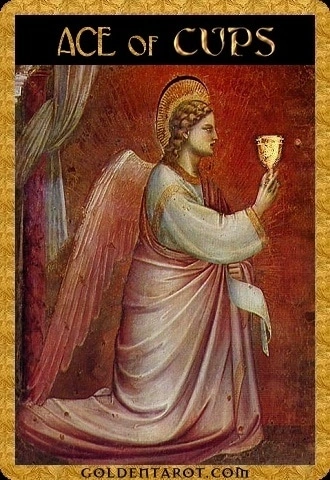
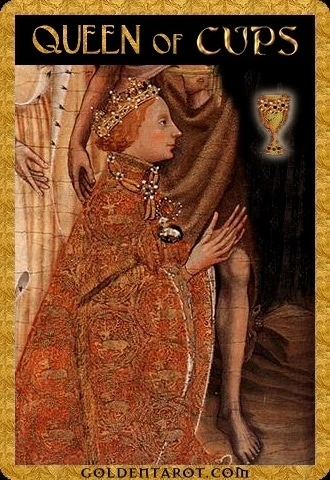
From attraction to emotional maturity
Ace, Two, Queen, and King of Cups trace feeling from first opening through partnership and mature stewardship. Notice whether emotion is being offered, received, contained, or controlled.

When beautiful cards carry difficult news
Golden Tarot can make a hard message look exquisite. The gold, velvet colour, and old-master faces may tempt the eye to admire the surface and move on. I find the deck reads better when beauty becomes an invitation to stay with discomfort rather than a veil drawn over it.
Before naming disaster, I look for scale. Is the whole structure failing, or is one room no longer safe? Is the shock already happening, or is the card exposing a truth that has been held back? Nearby cards tell me whether the task is protection, release, repair, or simply admitting what can no longer continue.
The Tower makes this process vivid because its disruption is witnessed. It asks who else is affected and where support might come from once the old arrangement breaks.
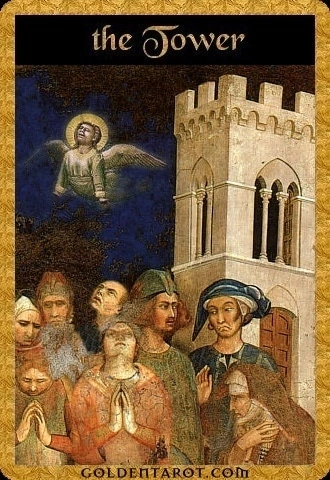
The Tower: disruption witnessed by a community
Kat Black’s Tower places the structure behind a group of figures, making upheaval feel public and shared. Rather than reading it only as private catastrophe, I would ask who else is affected, who sees the warning, and what support exists after the old arrangement breaks. The card can be severe, but it also makes collective truth harder to ignore.
Giving a crisis spread room to breathe
After The Tower, I leave a little more space between the cards. It is a simple physical choice, but it changes the reading. The eye no longer experiences every image as one wall of pressure, and the next card has room to show whether it brings grief, relief, help, or a new direction.
I also turn advice into something small enough to use. A dramatic card does not always require a dramatic response. Sometimes the wisest movement is to gather accurate information, ask for support, sleep before deciding, or stop defending a structure that has already finished its work.
The recovery sequence below moves from restriction through rupture and into renewed visibility. It is hopeful without pretending that hope erases what happened.
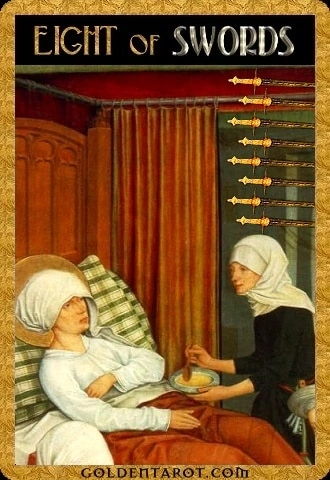
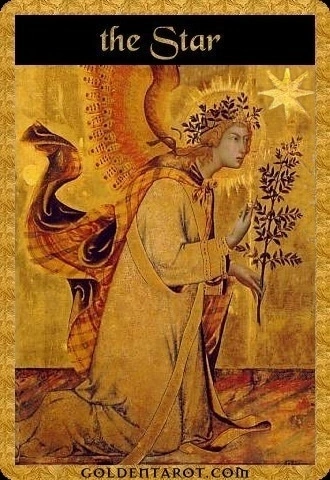
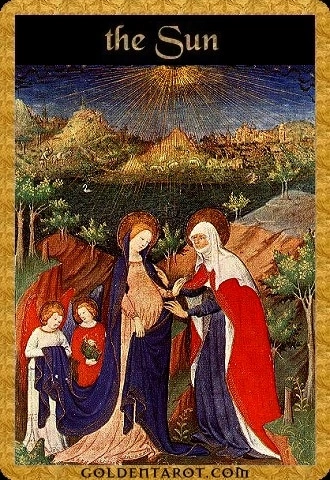
Pressure, rupture, hope, and clarity
The Eight of Swords, The Tower, The Star, and The Sun form a clean recovery arc. The spread does not pretend the crisis is painless; it asks what can be released, restored, and finally seen.
How does Golden Tarot read?
Golden Tarot reads most smoothly when you begin with the visible story. Look at gaze, distance, hands, barriers, weather, status, and movement. Then connect those clues to the card’s established Rider-Waite-Smith function. This prevents the ornate art from becoming decoration and prevents traditional keywords from flattening the scene.
The deck is strong for three-card and five-card readings, especially when positions ask about motivation, tension, advice, or likely movement. Large spreads are possible, but the visual density can become tiring. Leaving a little space between cards helps the gold frames behave as boundaries rather than visual noise.

The Hermit: solitude as careful attention
Golden Tarot’s Hermit is a haloed monk seated in a dark woodland, his rust-coloured robe gathering around a long staff. A deer leans close to his open hand, two books rest on the rock behind him, and a building rises through the trees. The design makes solitude feel observant rather than empty. In a reading, it can ask where study, gentleness, and a quieter pace would reveal more than another burst of activity.
Strengths and possible drawbacks
What works especially well
- Detailed narrative scenes provide many entry points for intuitive reading.
- Rider-Waite-Smith structure makes the deck approachable despite its distinctive art.
- The historical collage style is coherent across suits and Major Arcana.
- Gold-gilt edges and the rigid box give the current edition a substantial collector feel.
- The illustrated guidebook adds useful artwork and interpretation context.
What to consider
- Readers who dislike Christian or devotional imagery may find some source paintings emotionally distant.
- The dense scenes can be overwhelming in very large spreads.
- The supplied gallery depicts an earlier border treatment, so packaging and frames may differ from a new copy.
- Gilt edges naturally show wear with frequent shuffling; that is cosmetic rather than a reading problem.
Who is Golden Tarot best suited to?
Choose this deck if you enjoy art history, dramatic human scenes, symbolic detail, and a classic tarot structure. It is friendly enough for an attentive beginner but deep enough for an experienced reader who wants to work visually rather than recite keywords. It also makes a strong study deck for journaling because a single card can support several observations before interpretation begins.
You may prefer something else if you need minimalist imagery, modern everyday representation, or very fast visual scanning. Golden Tarot rewards the reader who is willing to sit with a face, a room, or a gesture until the emotional pattern appears.
TarotFans may earn a commission from qualifying purchases made through sponsored links, at no extra cost to you.
Final Thoughts
Golden Tarot is at its best when you let the painted figures meet your question before reaching for a memorised keyword. Follow the glance, the lifted hand, the distance between two people, and the small creature waiting at the edge of the scene. Kat Black’s gilded world can feel formal, yet its wisdom is deeply human: pause, notice what is really happening, and choose the next honest step that brings a little more light into the room.
Golden Tarot by Kat Black FAQ
Who created Golden Tarot?
Golden Tarot was created by Australian collage artist Kat Black and published by U.S. Games Systems. The deck combines people and settings from late-medieval and early-Renaissance paintings.
How many cards are in Golden Tarot?
The deck contains 78 cards: 22 Major Arcana and 56 Minor Arcana. This page presents a verified partial gallery rather than claiming complete image coverage.
Does Golden Tarot follow Rider-Waite-Smith meanings?
Yes. Its structure and broad symbolic roles remain close to Rider-Waite-Smith, translated into Kat Black’s historical-art collage scenes.
What comes with the current edition?
U.S. Games describes 78 gold-gilt, linen-finish cards in a rigid telescoping box with an illustrated 198-page guidebook.
Why do the gallery borders differ from the current product?
The supplied Pinterest gallery shows an earlier black-title and gold-border presentation. The current linen-finish edition uses a white title band while retaining the core collage artwork.
Is Golden Tarot suitable for beginners?
Yes. Beginners can use familiar Rider-Waite-Smith meanings, while the detailed gestures and settings provide intuitive clues for deeper study.