
The Two of Wands tarot card meaning centres on planning a direction before you commit to it. Upright, it commonly suggests looking beyond your current situation, comparing options, and deciding how to use the resources you already have. Reversed, it can raise questions about indecision, fear of change, or a plan that needs more detail.
Imagine choosing between staying in a familiar job and applying for a role elsewhere. Both paths have something to offer. This card invites you to find out what each would actually involve, rather than deciding from excitement or worry alone.
You may also see the name written as 2 of Wands. It is the same Minor Arcana card. Its upright and reversed interpretations are tools for reflection, not a forecast that you must move, travel, or make a dramatic change.
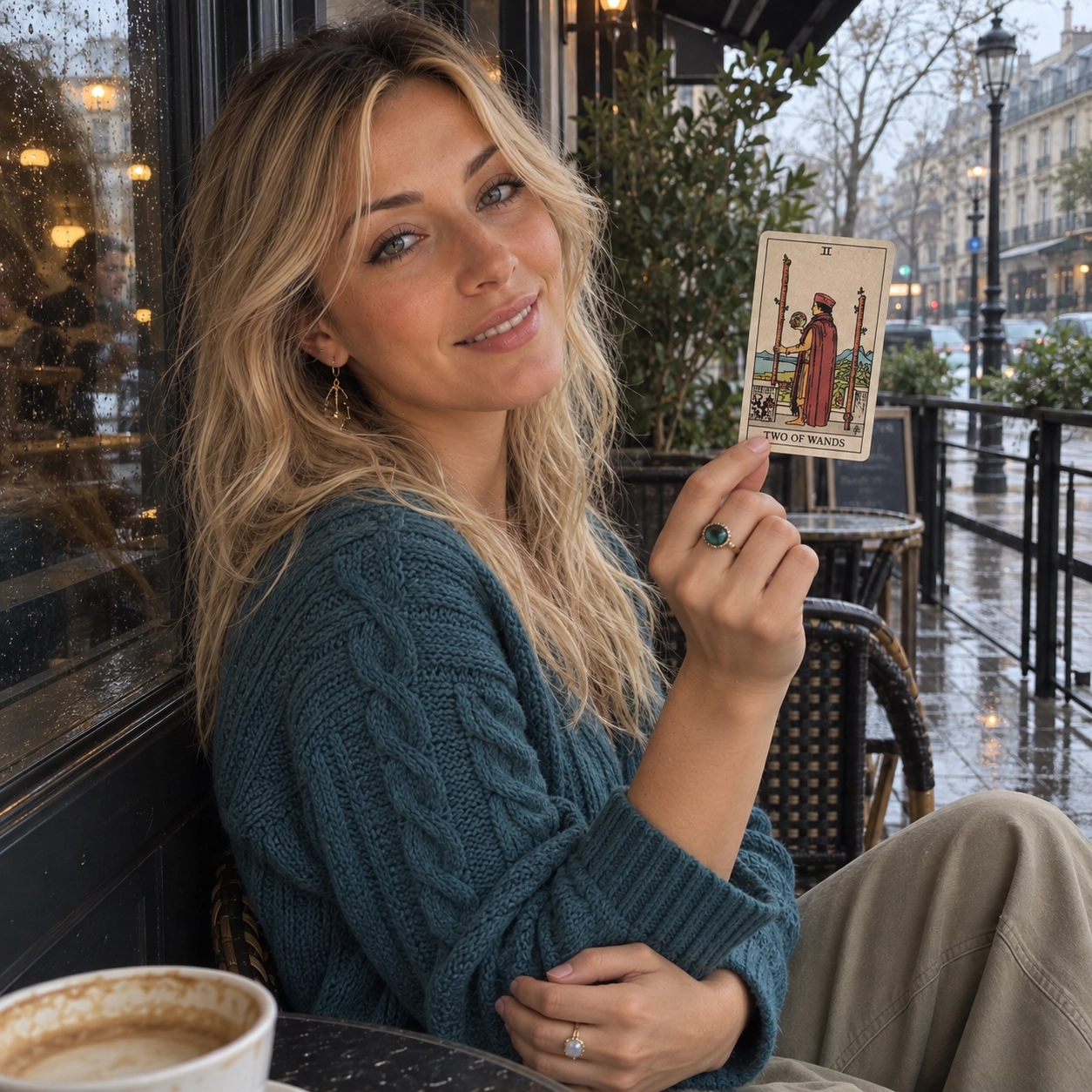
2 of Wands Tarot Card Meaning at a Glance
- Main keywords: planning, future vision, choosing a direction
- Upright meaning: you are weighing options and learning how to hold two needs at once. In the Wands suit, this connects to energy, passion, creativity, confidence, and action
- Reversed meaning: avoidance, confusion, or a choice that keeps getting delayed. The reversed meaning asks you to check how you are handling energy, passion, creativity, confidence, and action
- Yes or no: yes if you make a clear plan
- Best question to ask: What is this card trying to help me understand right now?
Two of Wands upright meaning: turn a possibility into a plan
The upright Two of Wands often belongs to the planning phase. An idea has become interesting enough to investigate, but you have not yet committed to everything it requires. Use that time to compare the possibilities before making promises.
You might be considering a new course, a move, or a different career path. List what attracts you to each option, then check the ordinary details: entry requirements, travel time, available support, and cost. A good plan makes an appealing future easier to assess.
Two of Wands upright can also invite you to expand your horizons. That need not mean overseas travel. Visit a local workshop, talk to someone doing work you admire, or borrow a book about a subject outside your usual interests. You can explore new possibilities without turning your life upside down.
There is pleasure in having something to look forward to. Allow yourself to imagine what you would enjoy, then give the idea a fair test. If you want to run a weekend stall, visit a market and ask about the fees before buying a large stock of supplies.
Two of Wands in a tarot reading: which decision is yours?
When this card appears in a tarot reading, connect it to the question and its position in the spread. In a past position, it may describe an earlier decision or a plan you are still following. In the present, consider the options you can investigate now. In a future position, ask how you could prepare for a choice, not which event is guaranteed to happen.
In an advice position, the card encourages deliberate preparation. In an obstacle position, it may prompt you to notice endless planning that postpones a manageable action. The Two of Wands asks whether you need more information or whether you already have enough for a modest next step.
Twos in tarot often invite comparison, partnership, or a choice between two paths. This Wands card commonly brings that comparison to intention and action. Tarot meanings become more useful when you name the decision rather than trying to make every detail fit.
Two of Wands love tarot meaning: talk about the future
In a love tarot reading, this card often prompts questions about direction. Are you hoping for similar things? If one person wants to relocate and the other wants to stay, discuss what each option would mean before making a shared commitment.
If you are single, think about what kind of dating experience fits your life. You may want to meet people outside your usual circle, or you may prefer to make more time for connections you already enjoy. Neither choice requires a dramatic reinvention.
Within the relationship, two lovers can have different ambitions without either being wrong. Ask what is negotiable and what matters too much to promise away. A useful conversation might cover where you want to live, how much time you want together, or how a course or job change would affect your routine.
Your love life cannot be settled by a card. It cannot reveal another person's private feelings or decide whether a particular relationship may be holding you back. Look at communication, consent, and actual behaviour. If you are feeling restless, explain what you miss rather than assuming your partner already knows.
Career, money, and school: compare the real options
For work or study, the Two of Wands suggests comparing the next stages available to you. A promotion, a new qualification, or a new path may sound attractive; find out what the daily work would be like. Speak to someone with direct knowledge and check the requirements.
For example, compare two courses by timetable and total cost, not just the photographs in the prospectus. If you are considering freelance work, estimate expenses and discuss the change with anyone who would share the financial risk. Your long-term goals need practical conditions in which to develop.
You may encounter the claim that the Two of Wands represents financial stability. Treat that as an interpretation about planning or existing resources, not proof of your bank balance or a promise of profit. Review actual income, commitments, and uncertainty before taking on debt or investing.
Likewise, a reversal cannot diagnose financial instability. If money is a concern, work from real figures and seek qualified advice when needed. Check what you can afford and which commitments would be difficult to reverse.
Two of Wands reversed meaning: separate hesitation from a missing plan
The reversed Two of Wands can suggest indecision, a restricted outlook, or reluctance to leave a familiar situation. It can also point to lack of planning. Those are different problems: one needs a clearer decision, while another needs better information.
Fear of the unknown might be holding you back even when a small experiment is available. If you want to change careers, arranging one conversation with someone in that field is different from resigning tomorrow. The card urges you to make the first action proportionate to what you know.
Two of Wands reversed suggests checking whether your plan is yours. You may be pursuing a goal because it sounds impressive or because someone else expects it. Consider what you would choose if you did not have to defend it to an audience.
Sometimes hesitancy is sensible. You may lack funds, a clear agreement, or the time to manage another commitment. A reversal need not mean you are timid. It can be a prompt to keep a useful boundary while you gather what is missing.
Two of Wands reversed indicates a planning question in many modern guides, not an inevitable setback. If you have rushed ahead without a plan, check what you can revise now. If you have planned for months, set a date for one low-risk test instead of waiting for certainty.
Two of Wands yes or no meaning
Some readers lean toward a qualified yes when upright: proceed if you have a workable plan and have compared the alternatives. Reversed, they may suggest waiting, revising, or gathering information. These are reading conventions, not reliable predictions.
For a question such as whether to visit an open day, a symbolic yes can help you notice your interest. For signing a contract, choosing treatment, or assuming another person's agreement, use the relevant facts and advice. Tarot cards cannot replace those checks.
Advice: choose your next steps before choosing the whole future
At a crossroad, start by writing down the options as they actually are. Include staying where you are if that is a real choice. Then name one thing you would need to learn about each option before deciding.
The Two of Wands is a card of perspective in many modern readings. A useful next step might be asking about a course, checking a lease, or testing whether you enjoy an activity often enough to commit to it. A conversation or a visit can tell you something that another evening of imagining cannot.
Try to align your plan with the life you want to live, including ordinary pleasures and responsibilities. An exciting opportunity for growth may still be wrong for this month. You can embrace new opportunities gradually and keep commitments that matter to you.
Health and spirituality: plan with appropriate support
For health, the card can prompt practical questions about arranging care, support, and routines. It cannot diagnose a condition, promise a cure, or determine pregnancy. Use qualified care and real medical information for those decisions.
For spirituality, consider whether a practice gives you room to learn rather than pressure to be certain. You might visit a group, read about a tradition, or try a brief reflective routine before making a larger commitment. A tarot deck and an oracle deck can support different kinds of reflection; neither needs to become an authority over your life.
Many modern traditions associate the Wands suit with fire and initiative. In Golden Dawn-derived correspondences, this Two is commonly linked with Mars in Aries. That association is tradition-specific, not a universal rule or a way to infer someone's personality from one card.
One archetype, four perspectives
Two of Wands Across Four Tarot Decks
Compare the familiar Rider-Waite-Smith card with the moments before, behind and after the classic scene in three Lo Scarabeo decks.
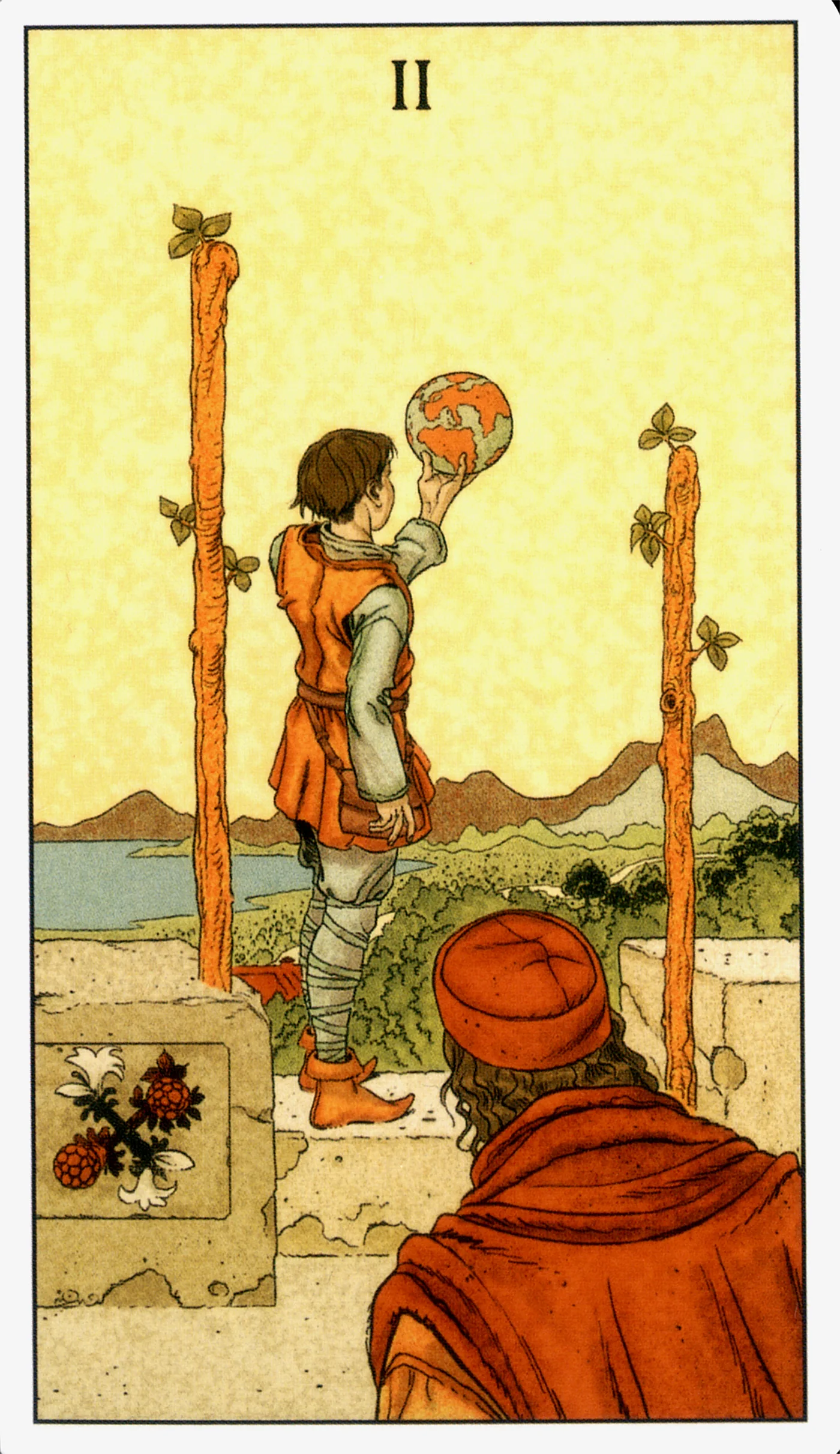
What apparently happens just before
What actually happened
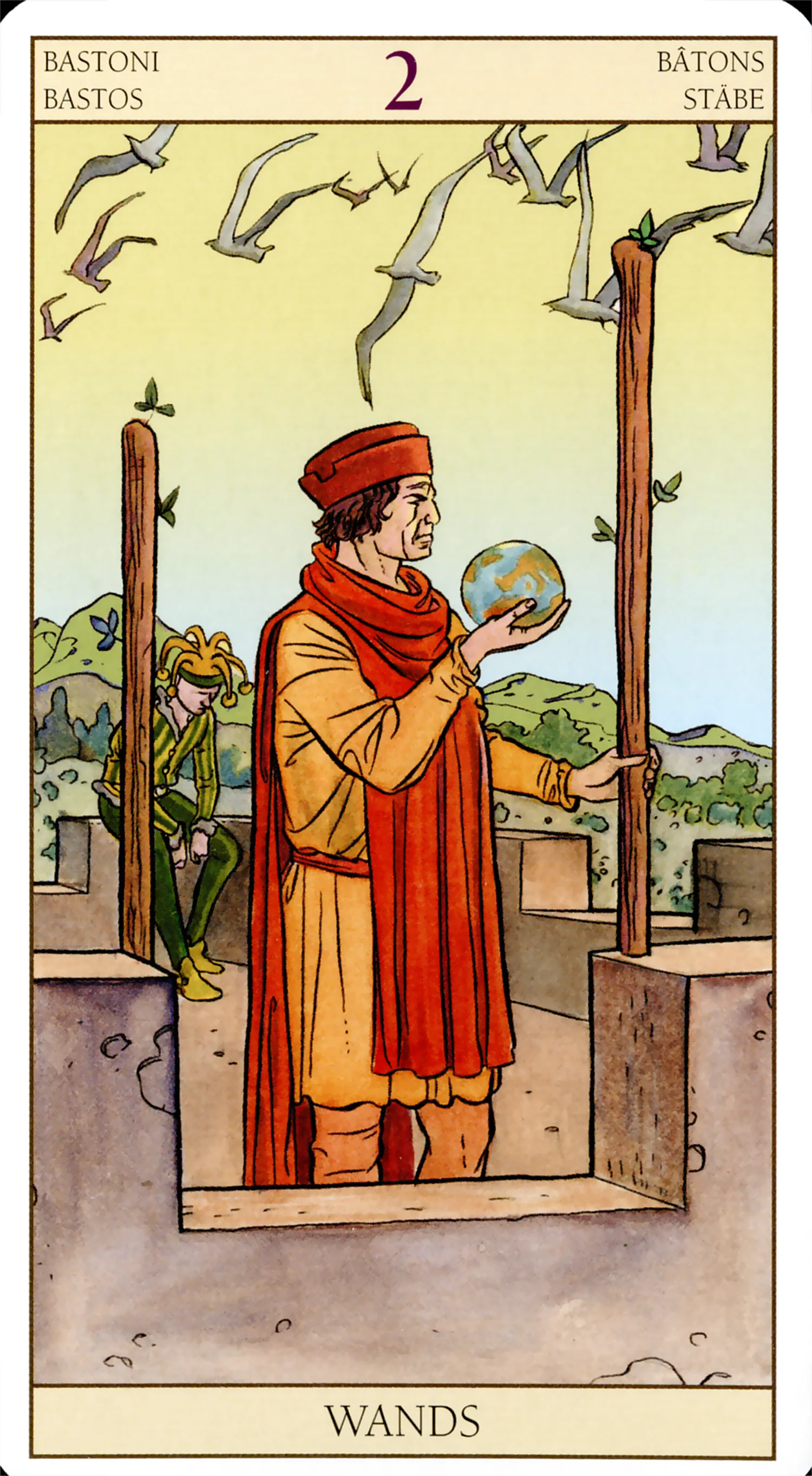
What happened on the opposite side
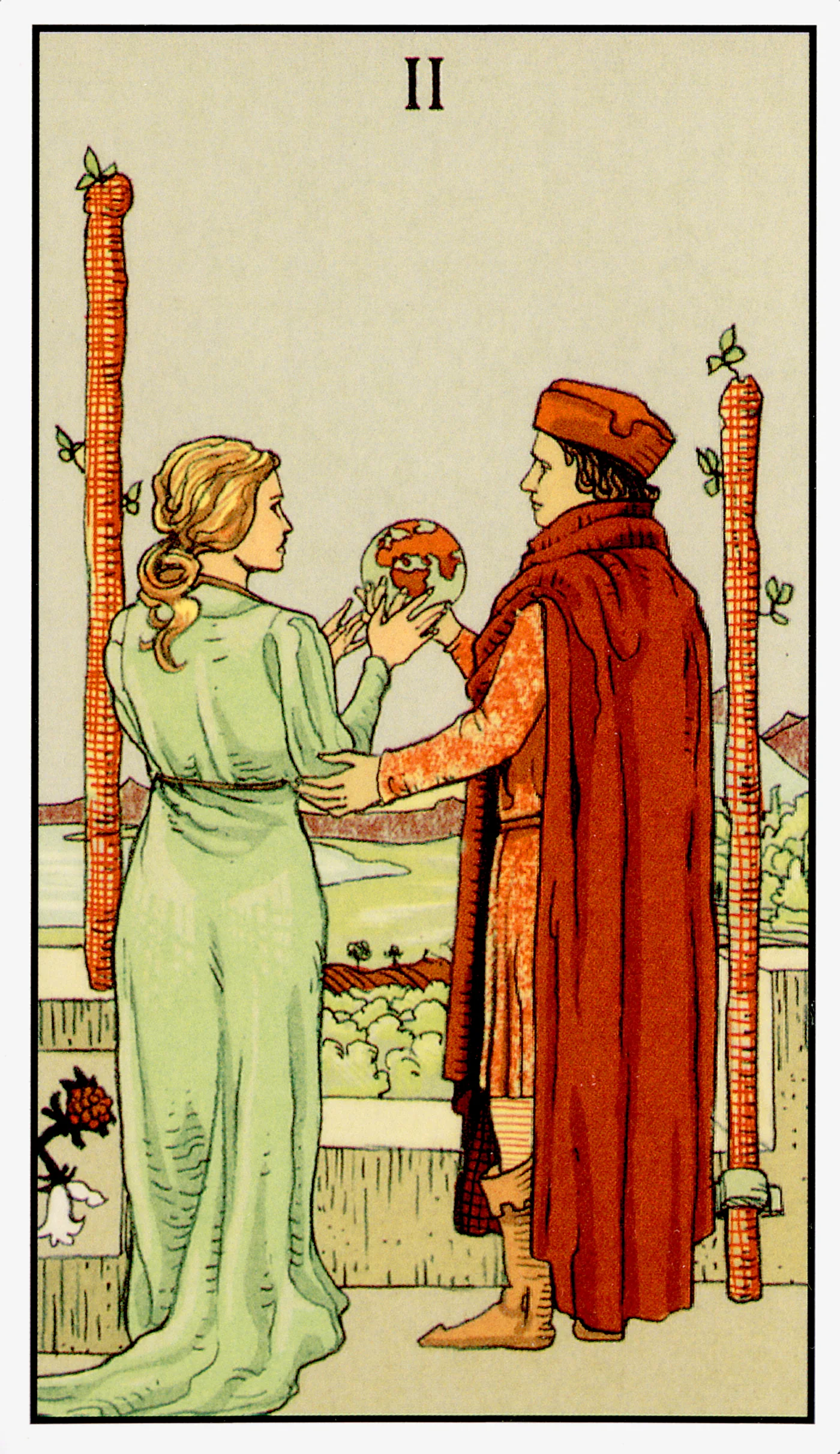
What apparently happened afterwards
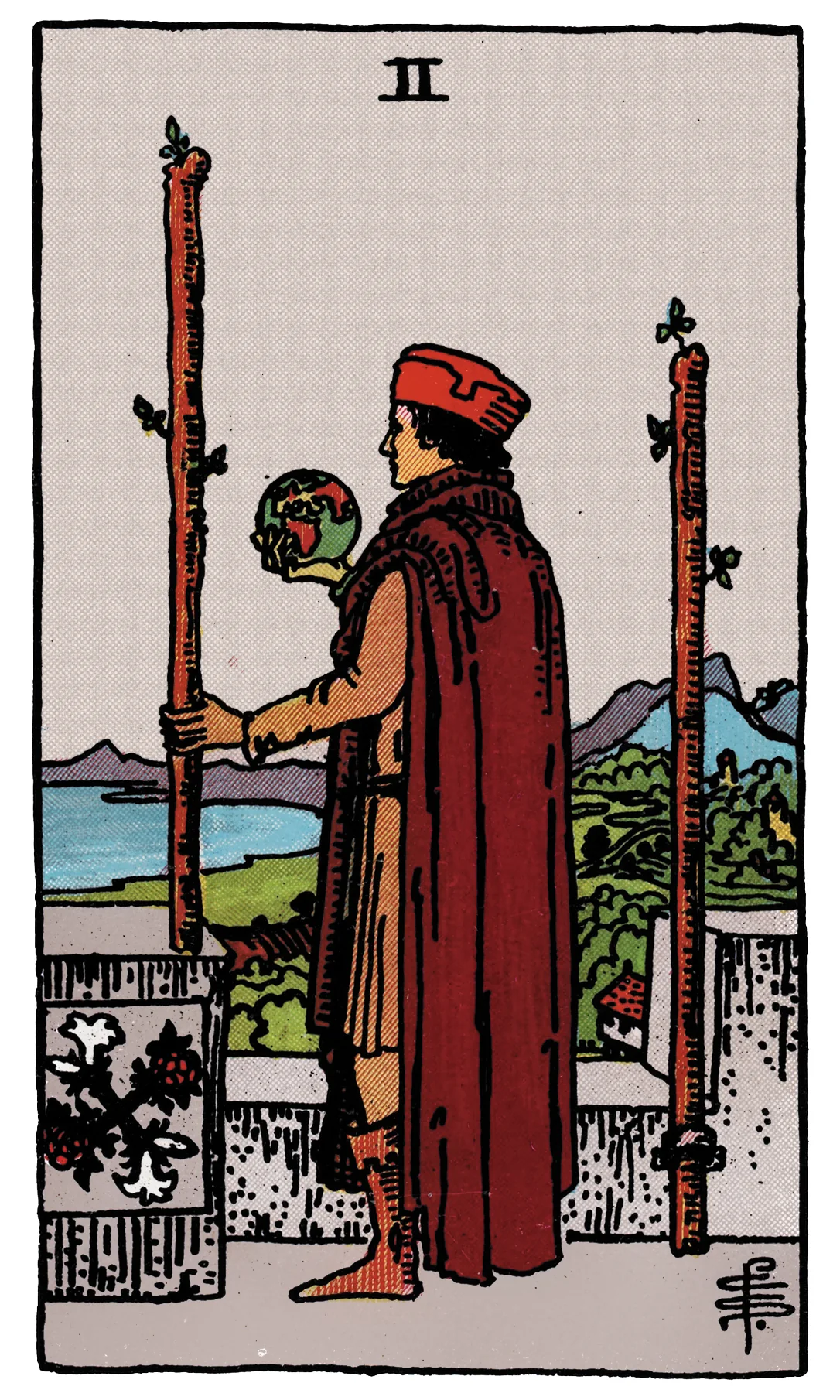
Two of Wands tarot card description: a globe and two staffs
The verified Rider-Waite-Smith portrait shows the Roman numeral II above a standing figure on a stone terrace. The figure wears a red cap and a dark red cloak over a warm-coloured tunic, holding a small globe near the face and gripping a tall sprouting staff with the other hand. A second staff stands on the right, secured near its base to the stonework.
Beyond the terrace are blue water, green land, distant hills, and buildings. The foreground stonework bears a crossed flower motif. The picture shows a man standing above a wider landscape; it does not show him setting out on a journey.
A traditional card description often says he looks out to the horizon. The visible distance gives readers a useful prompt to compare familiar territory with a broader view. Calling the globe a symbol of ambition or possibility is an interpretation, not a fact about what the figure is thinking.
The two wands represent a contrast between what is already established and what you could choose to pursue in many readings. The held staff and the secured one support that contrast visually. They do not require you to label one option as brave and the other as cowardly.
Colours can contribute to how you read the scene, but there is no single rule about what the red tones signify. The figure's clothing, globe, staffs, and outlook are visible; claims that particular colors represent a fixed emotion depend on the reader's tradition.
Rank and suit: the Two follows the Ace of Wands
This is the Two rank, conventionally numbered two, of the Wands suit in the Minor Arcana. It is one of the numbered suit cards among the standard deck's 78 cards, not a Major Arcana trump or a court card. The portrait's II agrees with that rank.
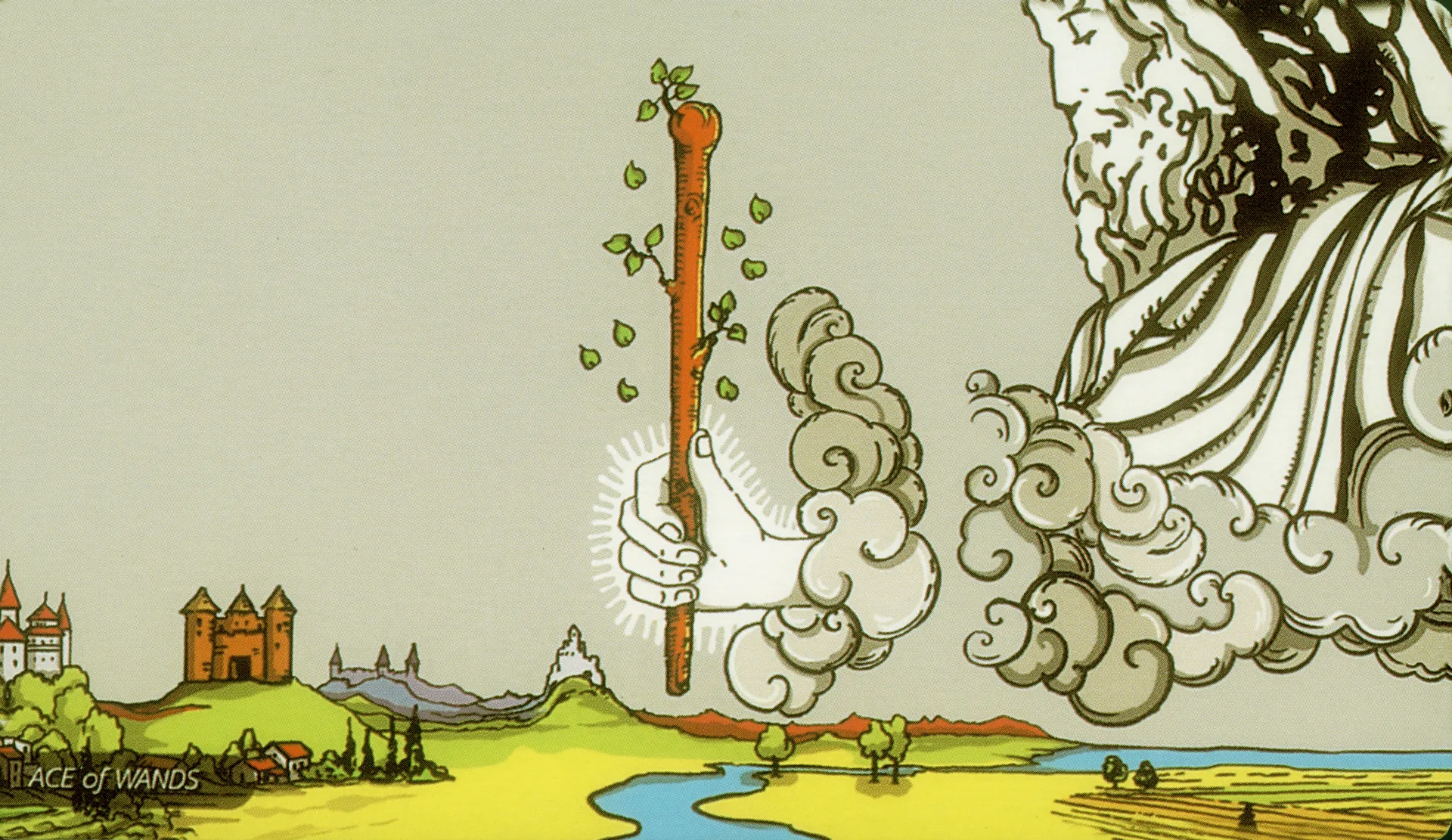
The Ace of Wands commonly introduces an impulse to begin. The Two of Wands signifies the stage of assessing a direction, while the Three of Wands is often read through the wider consequences of a step already taken. These distinctions help you read the sequence without treating it as a guaranteed story.
Nearby tarot cards: read the choice in context
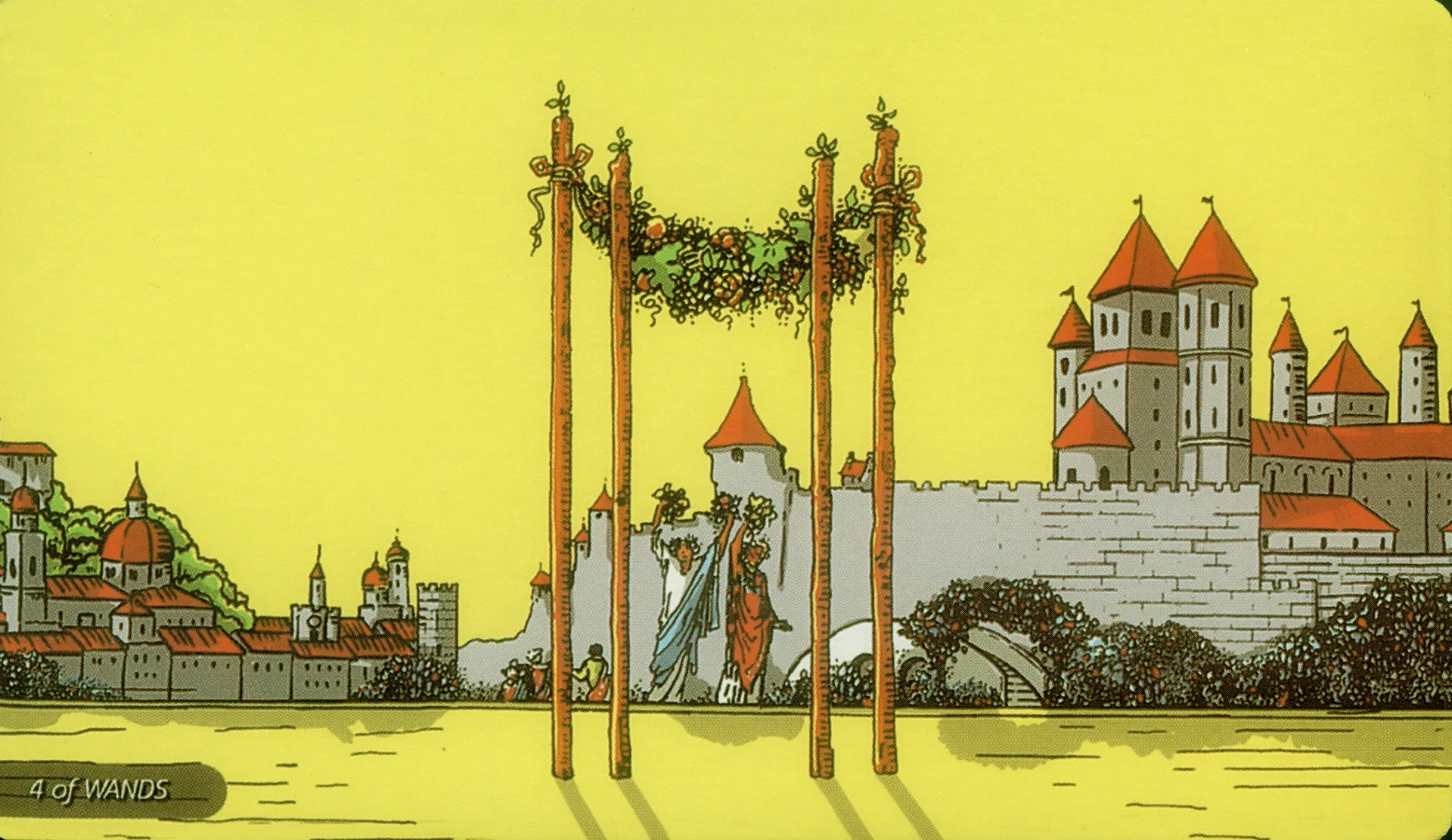
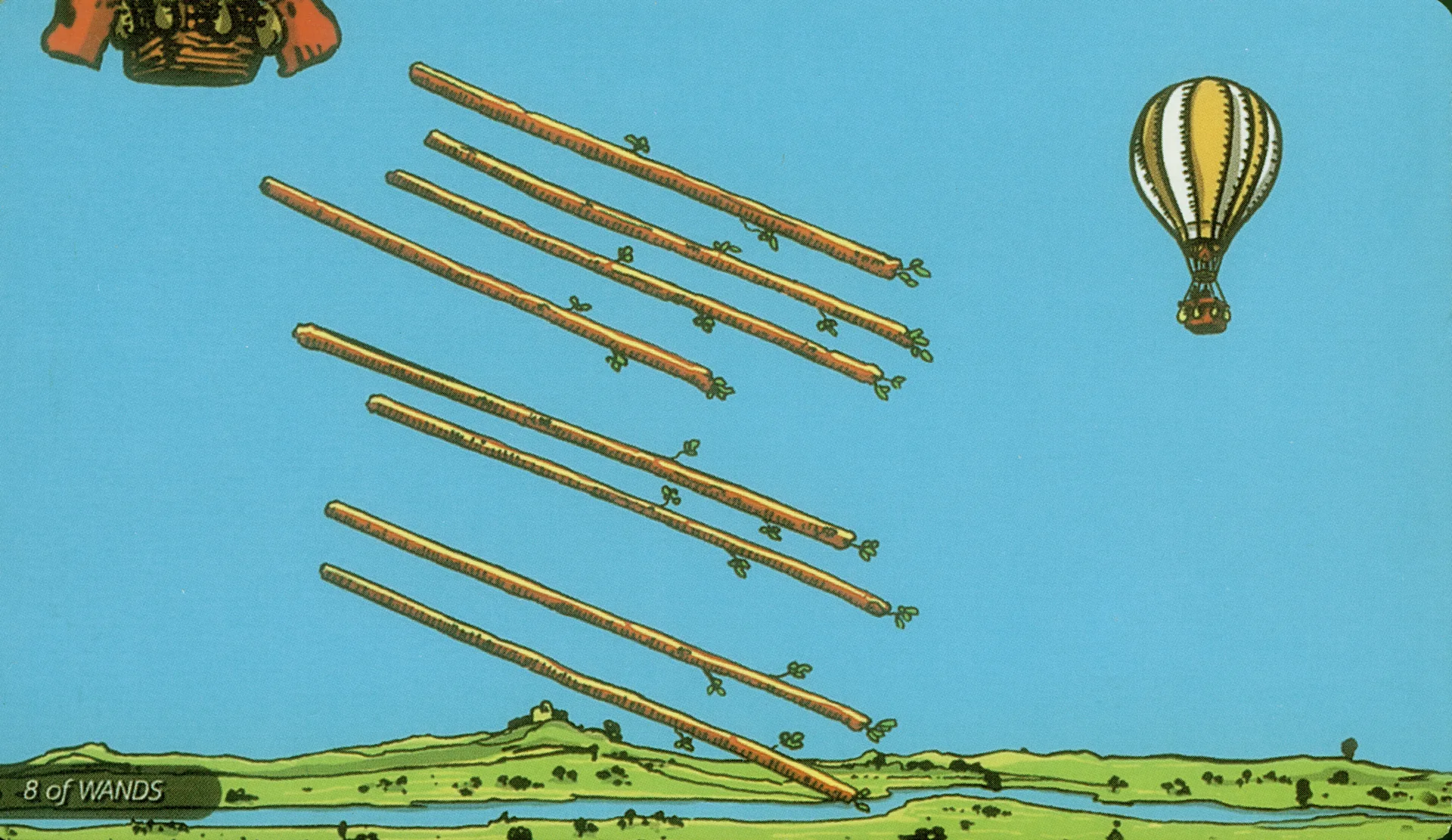
With the Three of Wands, ask whether preparation is ready to become a practical action. With the Four of Wands, consider how a proposed change might affect your home or shared commitments. With the Eight of Wands, check whether the pace has increased faster than your planning can handle.
With the Seven of Pentacles, consider what has already received your time and whether it deserves more. These combinations suggest questions, not fixed outcomes. A surrounding card can change the emphasis from choosing a direction to reviewing the cost of that choice.
Wands keywords and questions for your own reading
A brief tarot cheat sheet for this Two might use planning, perspective, choice, and fear of change. The keywords are reminders; they cannot explain every situation. Ask which word fits what you know and which does not.
What are the real options? What would each require from you? What is missing from the plan, and what could you learn before committing? Write your answers before drawing more cards. The Two of Wands card becomes easier to use when the question has a clear scope.
If you use a free tarot reading or a quick online guide, compare its tarot card meanings with your own deck's picture and the question you asked. A short definition can start a useful reflection without settling the decision for you.
One card, many perspectives
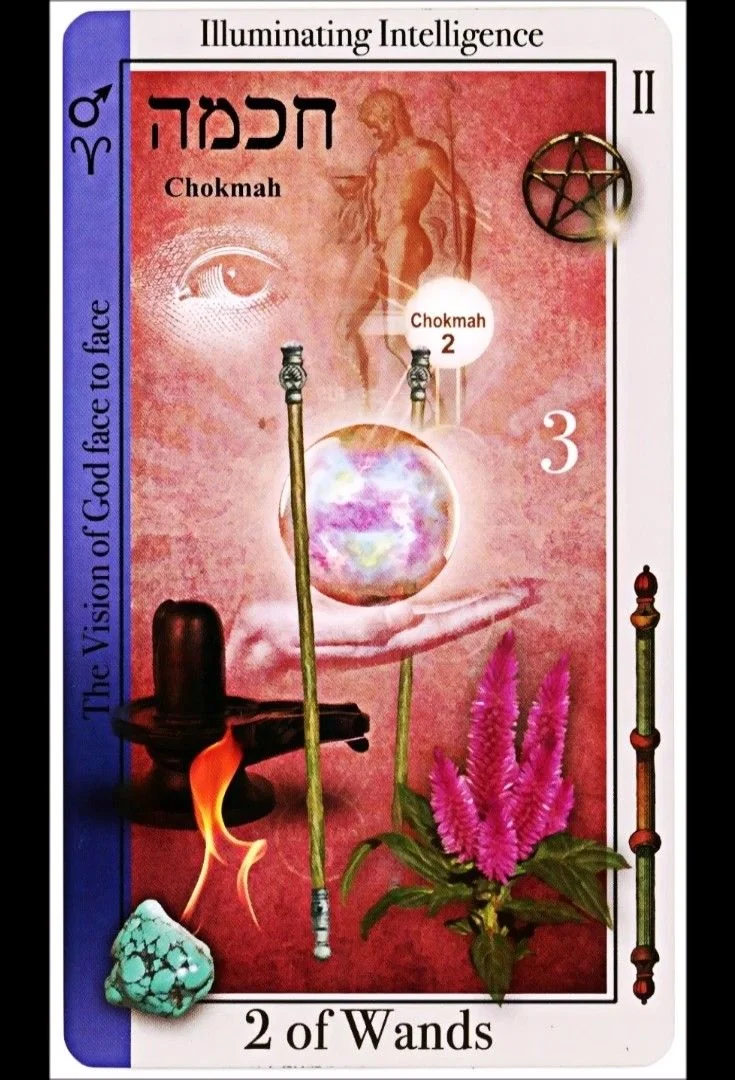
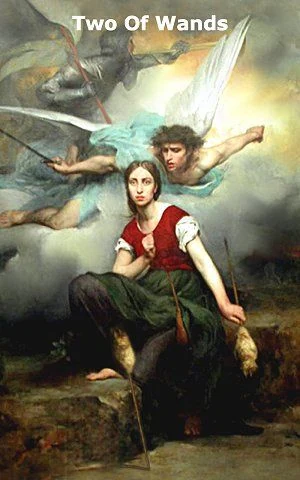
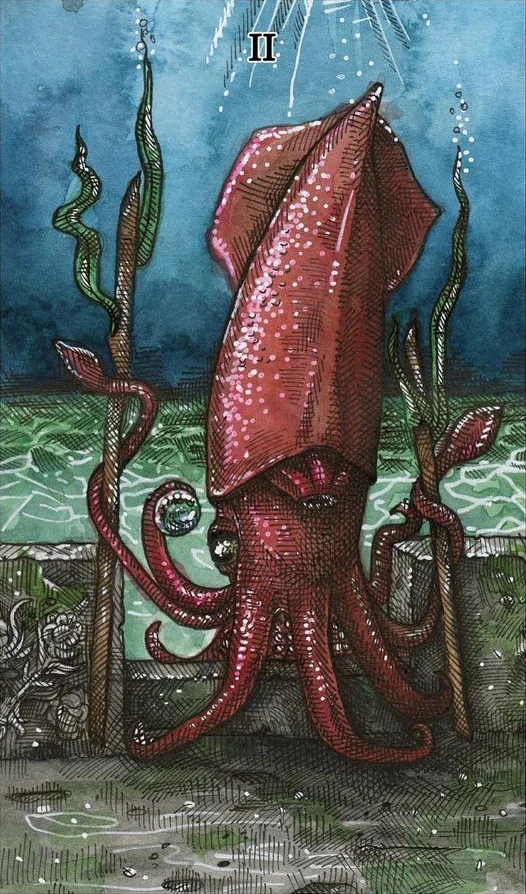
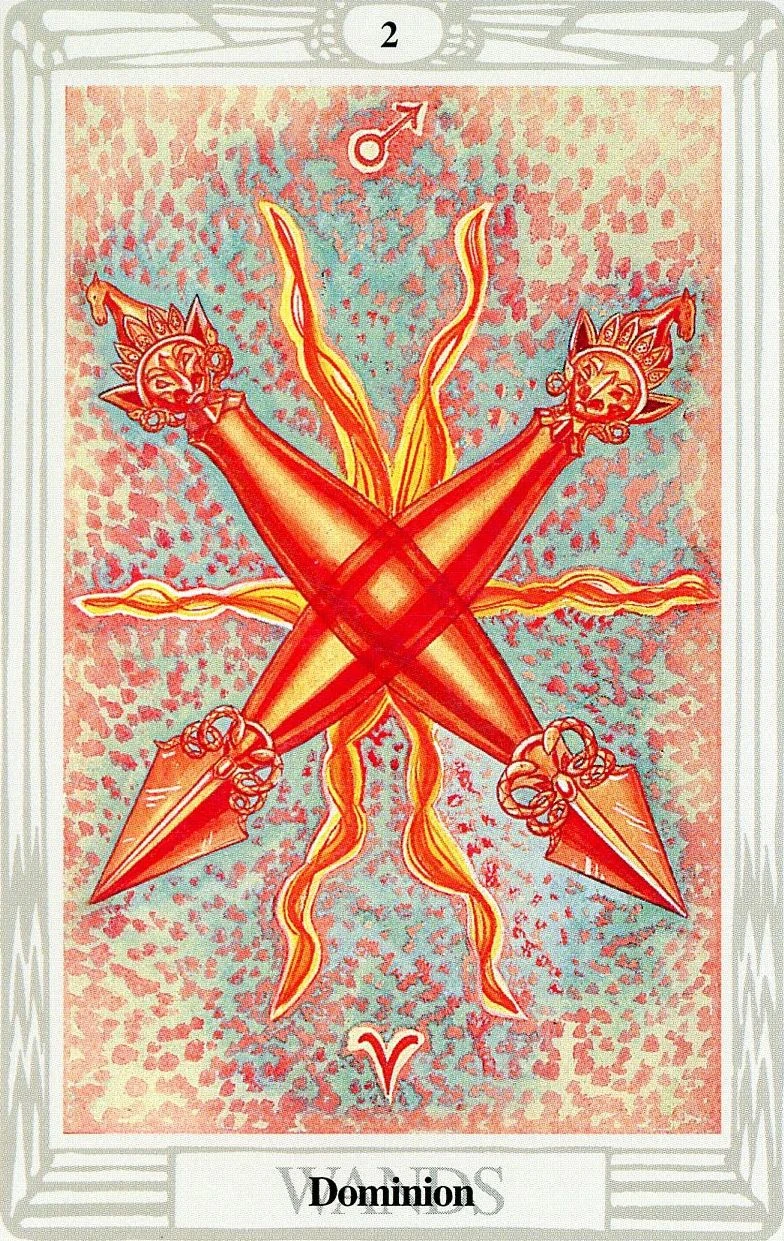
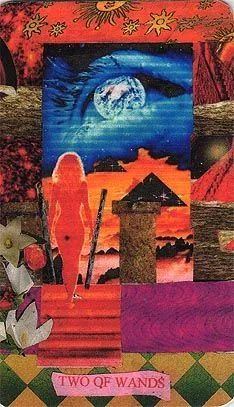
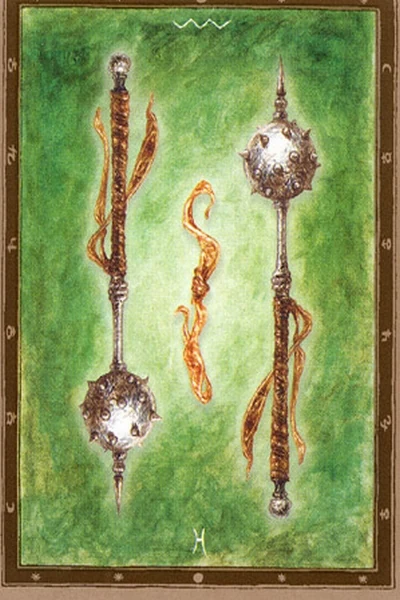
See Two of Wands Card from Other Decks
Discover how other tarot decks interpret this card. Select a deck to explore its full review and gallery.






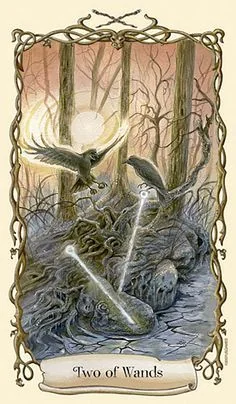


Two of Wands FAQ
What does the Two of Wands mean upright and reversed?
Upright, it commonly suggests planning a direction and comparing options before committing. Reversed, it can prompt questions about indecision, fear of change, or missing preparation. Read either orientation against the actual choice and information available to you.
Does the Two of Wands mean I will travel?
It can prompt reflection on travel or a wider outlook, but it does not predict a trip. Check your actual plans, budget, and practical requirements. Exploring something unfamiliar can also happen close to home.
Can the Two of Wands tell me someone's feelings?
No. A card cannot reveal another person's private feelings or consent. It may help you consider relationship direction, but communication and actual behaviour are the relevant evidence.
What should I do after pulling the Two of Wands?
Name the choice, compare the real options, and find one useful piece of information before making a larger commitment. If you already know enough for a low-risk test, choose when to try it and how you will review the result.