Explore the Puppet Theatre Tarot Cards.
Browse verified exact-edition artwork from Maria Kurara’s Russian-language Puppet Theatre Tarot. The deck uses renamed Major Arcana, the elemental groups Energy, Mind, Emotions, and Matter, plus its optional special cards. Choose an official group to filter the continuous gallery, or select any card to open the full-size Lightbox.
Showing all verified cards.

Aurica’s Quick Take
There is something tenderly theatrical about this deck. Every wooden figure steps forward for one honest scene, and posture, distance, and colour say what words cannot. I reach for it when a question feels tangled, because the cards bring me back to the emotion moving underneath.
I let the first image that catches my eye speak, then compare its mood with the card’s tarot role and the company it keeps. That small pause turns a recital into a real conversation.
Puppet Theatre Tarot reminds me that even when the script is uncertain, we can still enter the next scene with gentleness, courage, and a little more trust in ourselves.
A theatre of archetypes, masks, and honest questions
Puppet Theatre Tarot is Maria Kurara’s Russian authorial deck, first issued in a scarce 100-copy author edition in 2015. Its articulated figures inhabit miniature stages where a tilt of the head, a held prop, or an empty space can carry as much meaning as the printed title.
The full system contains 80 cards: 22 Majors, four 14-card elemental suits, and two optional special cards. Energy corresponds with fire and Wands, Mind with air and Swords, Emotions with water and Cups, and Matter with earth and Pentacles. The author edition shown in the review uses Princess, Knight, Queen, and King as its courts.
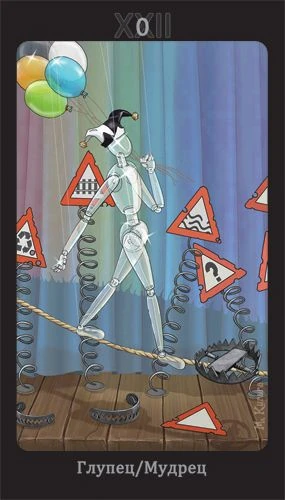
The Fool / Wise Man
A pale puppet crouches near the front of a dark stage while a second upright figure stands behind, both enclosed by heavy curtains. The low figure’s exposed posture feels vulnerable; the standing figure’s stillness feels watchful. In a reading, I treat that contrast as a question: which part of you is ready to step into experience, and which part is observing from the wings?
Upright, the card gives permission to begin with curiosity while keeping one thread of wisdom in hand. In shadow, it can show either reckless innocence or so much self-monitoring that the first step never happens.
How Puppet Theatre Tarot reads
Kurara’s theatre is expressive rather than literal. The card names offer a handrail, but the real movement comes from gaze, posture, props, and the emotional distance between figures. Begin with one clear question. Name the detail that pulls your attention, then ask whether it supports, complicates, or quietly contradicts the card’s familiar tarot function.
The two special cards are particularly useful when a reading becomes muddy. Question Asked Incorrectly invites you to reshape the enquiry; Future Is Hidden reminds you that not every curtain is meant to rise on demand.
A beginning with momentum
Use these four positions for the spark, the available strength, the brave experiment, and the hope worth carrying forward.
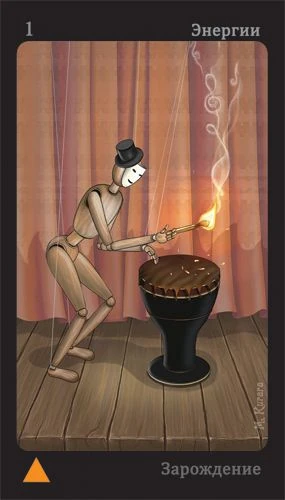
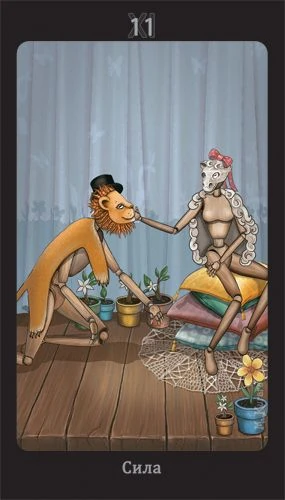

Read from left to right, but notice which figure appears most ready to move. That card often reveals where momentum is already gathering rather than where you think it ought to begin.
Learning the deck’s elemental language
Start with the Majors, then let the renamed suits become familiar through lived questions. Energy asks what wants action. Mind examines thought, strategy, and the stories we repeat. Emotions gives feeling a body and a voice. Matter brings the reading back to time, work, resources, and what can actually be sustained.
Because the cards are in Russian, readers who do not speak the language may want a personal reference sheet at first. That is not a weakness if you enjoy visual study; it can slow you down just enough to notice what a familiar English title might have made you skim.
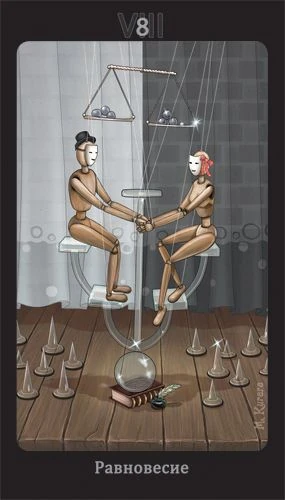
Balance
A jointed figure stands on a narrow beam while a wheel-like form turns beneath and a small bird perches nearby. The scene is not restful symmetry; it is balance as active adjustment. Every limb appears to be negotiating gravity in real time.
In a reading, Balance asks what can be shifted rather than forced. Upright, it favours responsive timing and a measured middle path. In shadow, it can reveal exhausting over-correction—changing yourself at every wobble instead of choosing a steadier centre.
When emotion becomes visible
The Emotions suit is especially moving because its scenes give private feeling a public stage. Instead of asking whether an emotion is sensible, ask where it sits in the body of the card: turned away, reaching forward, held at a distance, or asking to be witnessed.
This approach works beautifully for journaling. Write one sentence from the figure’s point of view, then one from the audience. The difference between those voices often reveals what you feel and what you think you are expected to feel.
When feeling needs a witness
Lay these cards for what is present, what lies beneath it, what can be understood, and what may become whole.

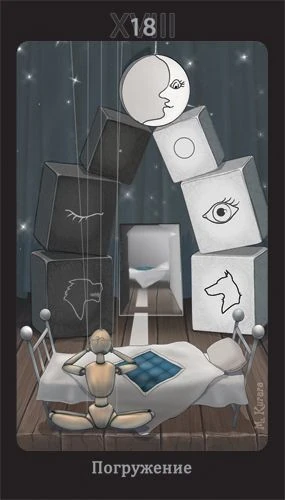
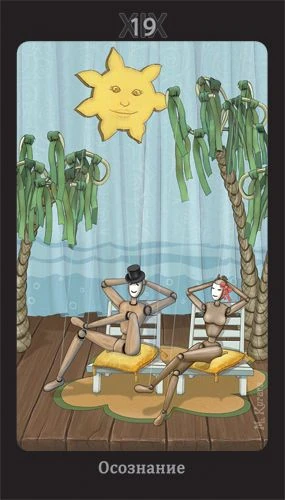
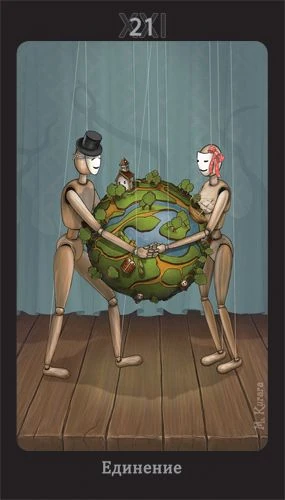
This is not a spread for rushing toward repair. Let each card have its own scene, then look for the gesture that repeats across the four; repetition is often the feeling asking to be named.
Who will connect with this deck?
Choose Puppet Theatre Tarot if you enjoy symbolic art, character-led storytelling, and decks that reward a second look. It is particularly strong for creative crossroads, relationship dynamics, identity work, and moments when you can sense a pattern but have not yet found language for it.
Readers seeking standard English titles, close Rider–Waite–Smith scenes, or a readily available mass-market edition may need patience. The 2015 author printing shown in the Gallery is scarce, while later Ves editions revise borders, some names, and court terminology.
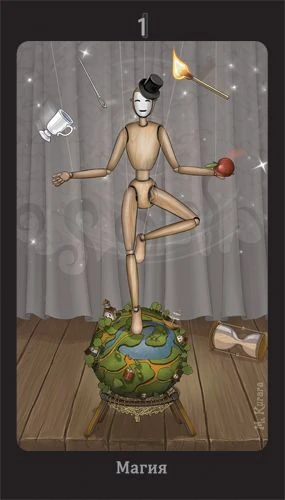
Magic
A central puppet balances on a globe with a flame lifted in one hand and a red sphere in the other, while small objects hover around the stage. The pose is precise but lively: concentration has become visible movement.
Magic is a bright invitation to work with what is already within reach. Upright, it joins attention with agency. In shadow, the clever arrangement can become performance for its own sake—appearing capable while avoiding the one honest action that would change the scene.
A practical reading method
For a three-card reading, try the role I am playing → the string I can loosen → the movement that becomes possible. Read the pictures before translating them into advice. If two figures face away from one another, name the distance. If a prop repeats, ask what function it serves. Then bring the answer back to one choice you can make in ordinary life.
The deck is imaginative, but it works best when the final interpretation is plain. Let the scene be poetic; let your takeaway be usable.
A grounded way forward
Let each elemental family answer one part of the decision: energy, thought, feeling, and practical reality.
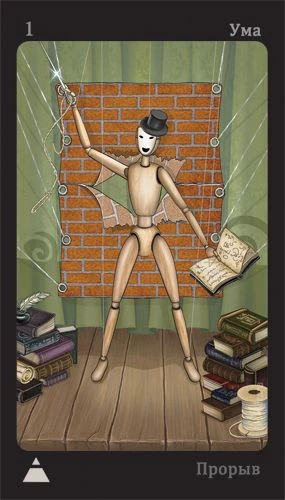
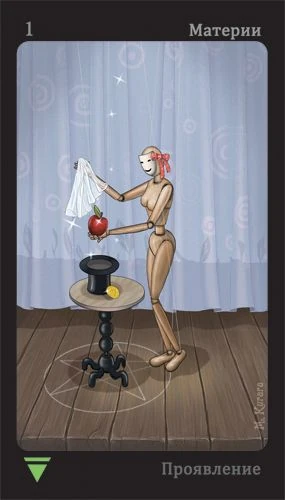
The most helpful answer is rarely the loudest card. Look for the element that is missing from your current plan, then give that card a small, concrete role in the next twenty-four hours.
Puppet Theatre Tarot Pros & Cons
What works beautifully
- Distinctive puppet-stage artwork rewards patient, intuitive reading.
- Elemental suit names make the deck’s four voices easy to compare.
- Two special cards create an honest pause when the question is unclear.
- Excellent for journaling, creative work, and relationship dynamics.
What to know first
- The reviewed author edition is scarce and its cards are in Russian.
- Later Ves editions change frames, some names, and Knight to Prince.
- The clean public Gallery is missing Two of Emotions.
- It is less direct for readers who want standard RWS imagery and English titles.
The golden rule: read the gesture before the script
Do not hurry to make every puppet stand for a fixed person or event. First notice what the body is doing, what it avoids, and what seems suspended. Then bring in the card’s traditional role. The deck becomes clearest when image and structure are allowed to answer one another.
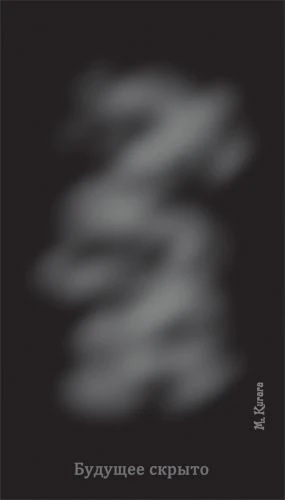
Future Is Hidden
This special card is almost entirely dark, with the Russian title sitting like a small sign at the foot of a closed stage. The absence of a revealed figure is the whole emotional event: the audience is present, but the scene does not open.
When it appears, I do not treat it as punishment or doom. It may mean the question is premature, another person’s choice is still moving, or certainty would narrow a possibility that needs room. Its useful expression is patience; its shadow is using mystery to avoid what is already knowable.
Sources checked
Final Thoughts
Puppet Theatre Tarot is not a deck that speaks in a flat, obedient voice. It whispers through the angle of a wooden wrist, the hush before a curtain rises, and the strange honesty of a character who cannot pretend to be flesh. Give it time and it becomes less like a set of illustrations and more like a company of actors who know exactly when to hold the silence.
For intuitive readers, artists, journalers, and collectors, that quiet theatricality can be wonderfully revealing. Begin with one card, one visible gesture, and one question you are willing to ask more gently; the next scene will meet you there.
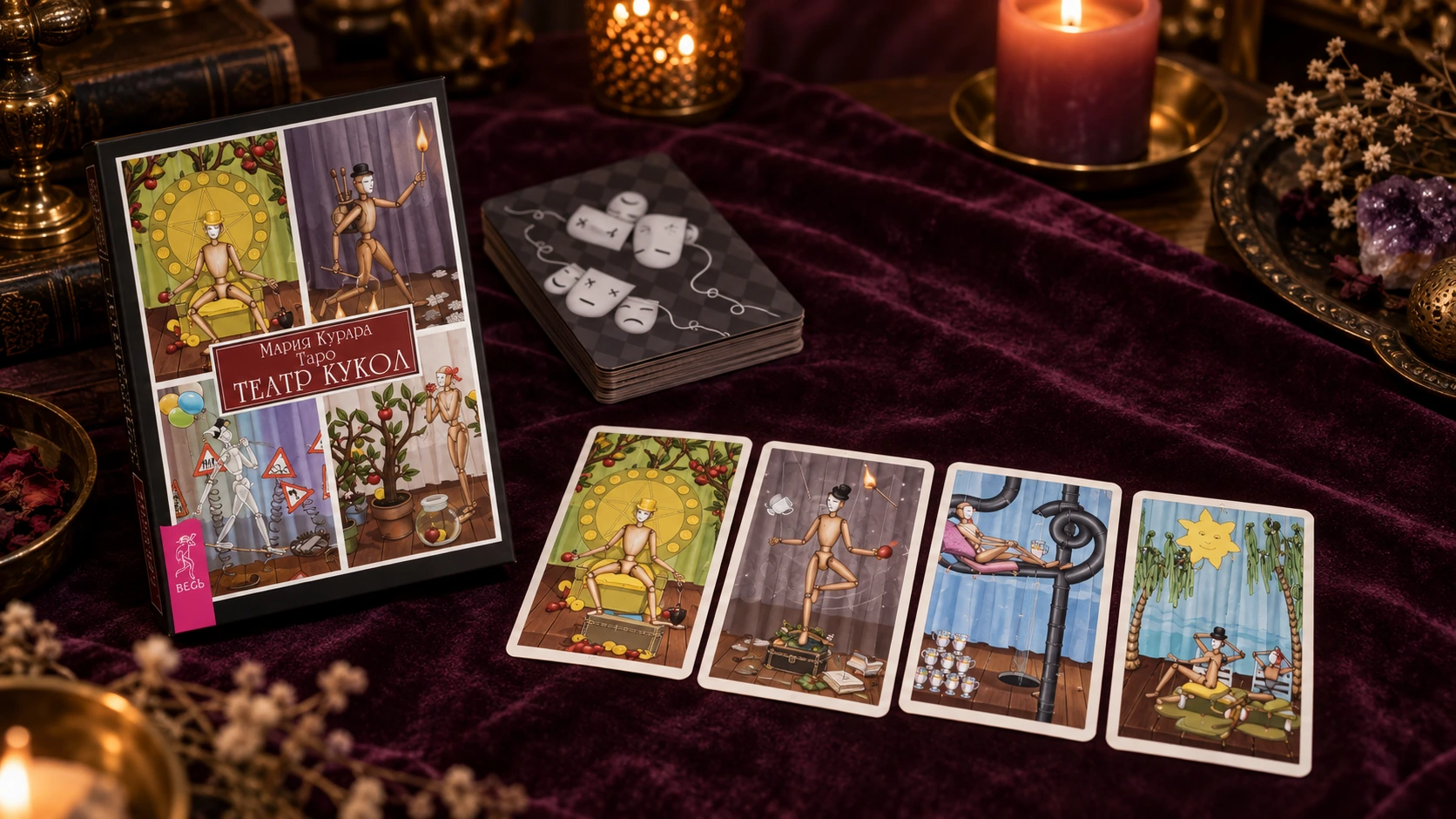 View Puppet Theatre Tarot from Ves
Frequently Asked Questions
Who created Puppet Theatre Tarot?
Maria Kurara created the deck as its author and artist. Her jointed figures turn each card into a small theatrical scene.
How many cards are in Puppet Theatre Tarot?
The documented system has 80 cards: 22 Major Arcana, 56 Minor Arcana cards, and two optional special cards.
Why are there 79 cards in this Gallery?
Two of Emotions is the one clean isolated front that could not be verified in the available source set. The Gallery keeps the other 79 exact-edition images and does not invent a replacement.
Is Puppet Theatre Tarot based on Rider–Waite–Smith?
It keeps familiar tarot arithmetic, but Maria Kurara gives it her own stage language. The suits become Energy, Mind, Emotions, and Matter, while the author edition uses Princess, Knight, Queen, and King as courts.
Is the Gallery the same edition as the current Ves product?
No. The Gallery and review video show the scarce 2015 author-edition artwork with dark frames and Knight courts. The linked Ves page is a later 80-card publisher edition, so packaging, borders, and some names may differ.
Is Puppet Theatre Tarot beginner-friendly?
It suits a visually curious beginner who enjoys learning through mood and gesture. Readers wanting standard English titles or very close Rider–Waite–Smith scenes may prefer to learn the Major Arcana and elemental suits gradually.