THE CARD GALLERY
Explore The Golden Tarot Cards
Browse the verified English-edition card fronts recovered from the supplied collection. Justice, The Hanged Man, The Devil, and The Star are not included in this preview.
Card artwork is shown from the authorized supplied Pinterest collection. Source signatures and watermarks are preserved.
Aurica’s Quick Take
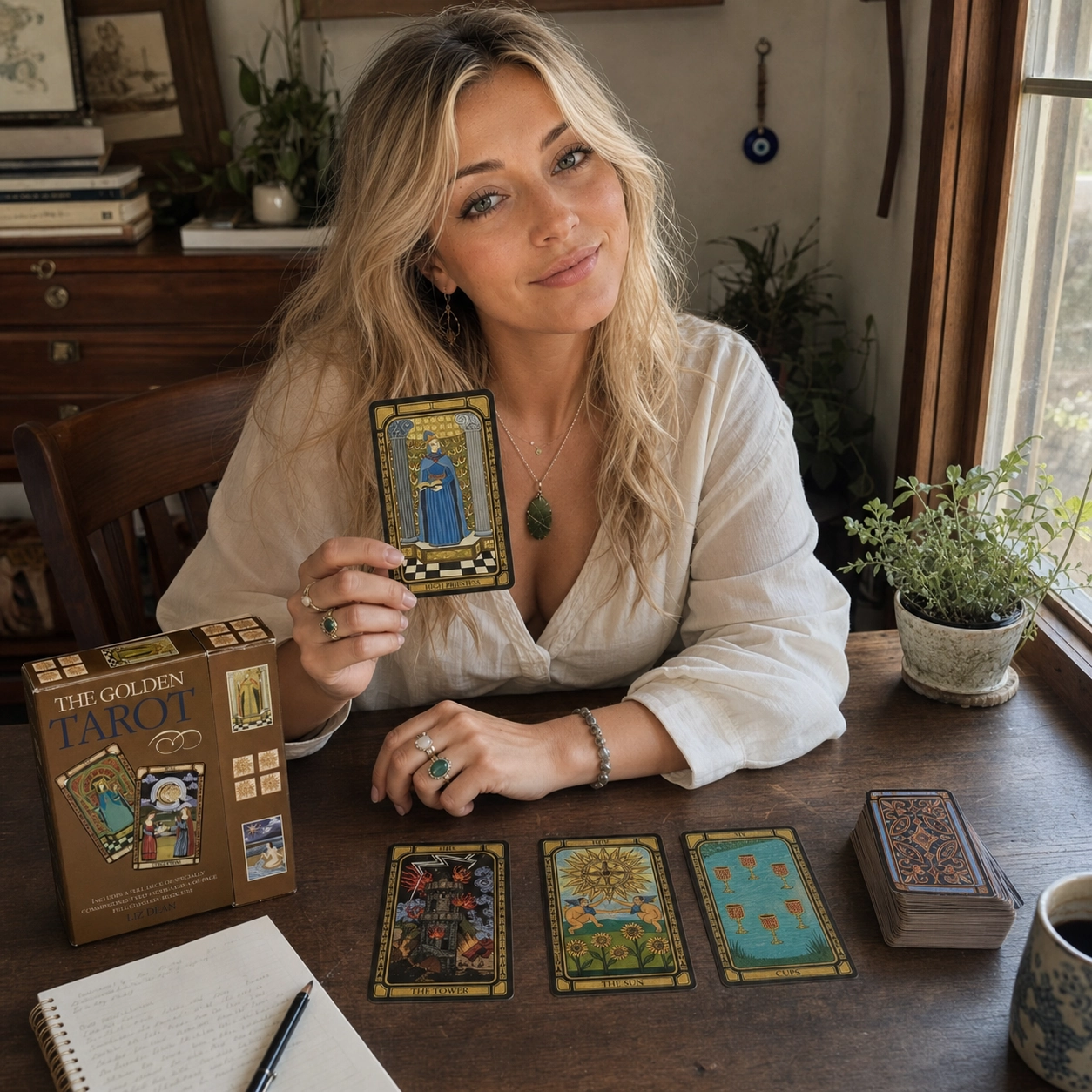
I am drawn first to the hush around these cards. Their gold frames feel like little doors in an old palace, while blue robes, burning towers and turquoise Cups give each message a clear emotional colour. Nothing needs to shout; one glance, gesture or sharply placed symbol is often enough to begin.
I like to let that first image speak before reaching for a memorised meaning. I notice where my eye settles, connect it with the card’s traditional role, then test the feeling against the question and neighbouring cards. The scene-led Majors bring drama; the quieter, emblematic Minors leave breathing room.
I would offer this deck to readers who want old-world beauty without losing familiar tarot landmarks. Beginners may need patience with the pip-like Minors, but the guide and recognisable symbols provide a sensible path. Let readings support reflection and choice—never replace qualified health, legal or financial advice.
THE GOLDEN TAROT REVIEW
Old-world gold with a clear reading voice
Some decks arrive like fireworks. The Golden Tarot arrives more quietly, as though a painted door has opened onto a small, jewel-coloured theatre. Gold architectural borders hold each scene in place. Robes fall in clean blocks of blue, red and green. Faces are simple and expressive, while repeated plants, planets, animals and ritual objects invite the eye to linger.
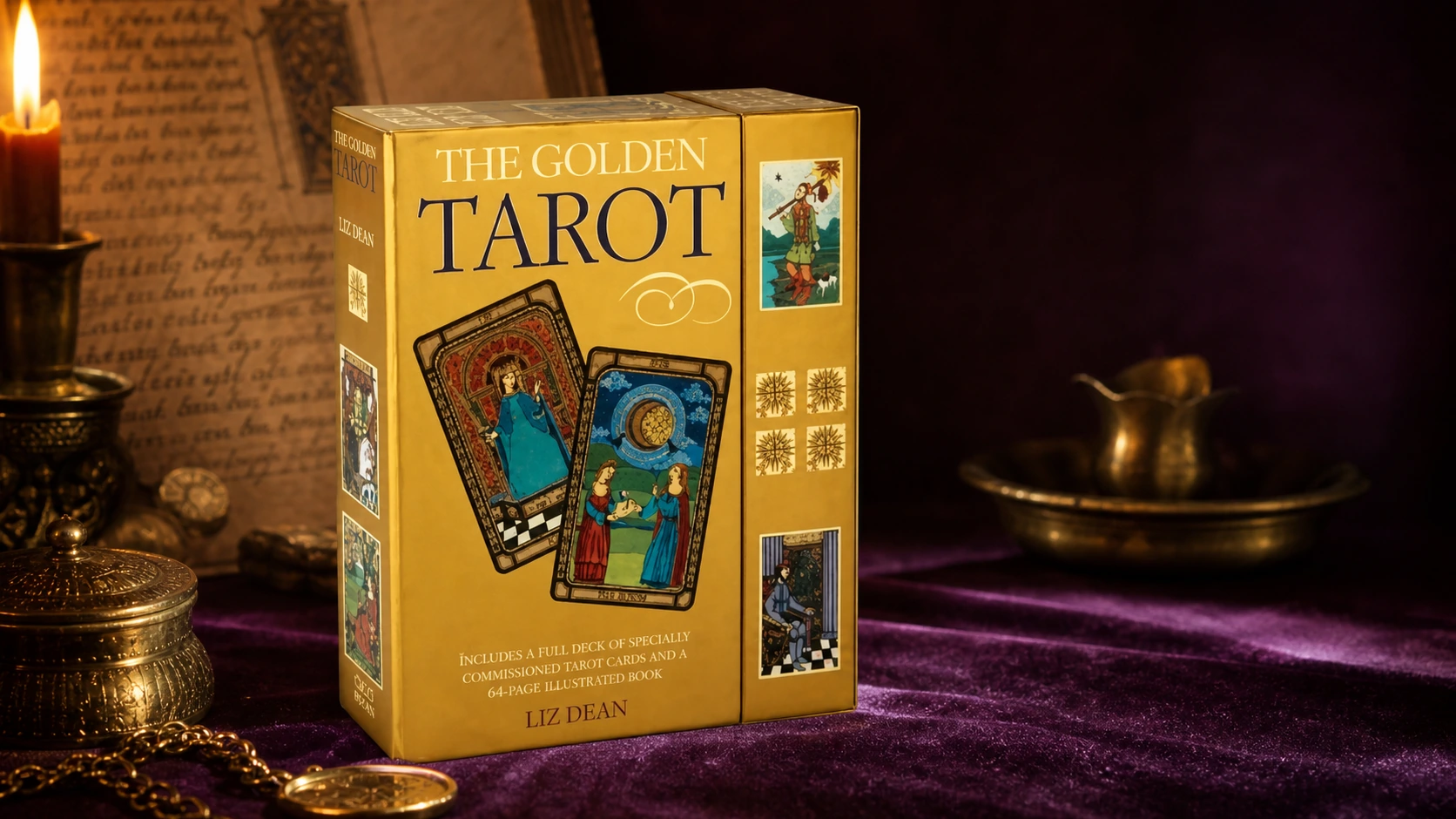
Liz Dean’s deck is inspired by the rich pattern and “naive style” of ancient Italian tarot cards, according to the publisher’s description. It is a standard 78-card tarot with the familiar four suits of Wands, Cups, Swords and Pentacles. The publisher also presents it as a learning deck: its archetypal symbols are intended to help a reader understand this pack and carry that knowledge into other tarot systems.
That promise feels honest when you look through the cards. The Major Arcana offers recognisable landmarks—The Fool’s first step, The Magician’s tools, The Tower’s lightning—yet the visual language is unmistakably its own. The deck does not chase photographic realism. It prefers pattern, emblem and storybook gesture, giving a reading the feeling of an illuminated manuscript made warm and usable for a modern table.
CARD STUDY
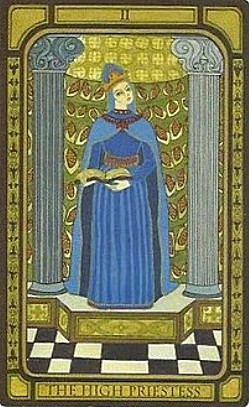
The High Priestess: knowledge held in stillness
Between two grey columns, the High Priestess holds an open book above a black-and-white tiled floor. Her unbroken blue robe, gold patterned hanging and slightly averted face make the scene feel watchful rather than passive: knowledge is available, but it asks for attention.
In a reading, she can signal intuition, privacy or a truth that is not ready to be forced. Her shadow is silence becoming avoidance. Ask: What do I already know, and why am I hesitating to name it? Let nearby Pentacles test the feeling with facts, while Wands can show where inner knowledge is ready to move.
How The Golden Tarot behaves in a reading
The deck speaks in two related voices. The Major Arcana is theatrical and scene-led: figures gesture, buildings rise, animals move and skies announce a change in atmosphere. Many Minor Arcana cards are more spare, arranging suit emblems across fields of colour. Rather than treating that as a flaw, I read it as a change of volume. The Majors tell me where the deep story is turning; the Minors often ask me to count, compare, feel the suit and pay attention to the structure of everyday life.
This makes the pack especially good for questions with a clear centre. “What is changing here?” suits its strong archetypes. “What should I practise next?” works beautifully with its orderly pips and court figures. For a relationship reading, watch the direction of faces and hands. For work or creative choices, notice whether the spread is dominated by tools, walls, roads, vessels or repeating emblems. The cards reward a reader who moves from visible detail to meaning instead of racing straight to a keyword.
Because the imagery uses familiar tarot symbols, experienced readers should settle in quickly. New readers can begin with the picture, then use the guidebook to confirm the card’s conventional function. The gentlest approach is to name three things before interpreting: what is visibly happening, what feeling it creates, and how that feeling touches the question.
FOUR CARDS, ONE STORY
Four moments when the story turns
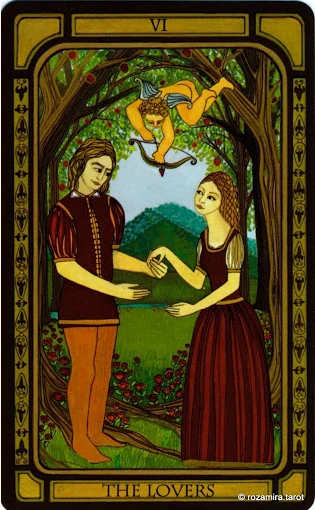
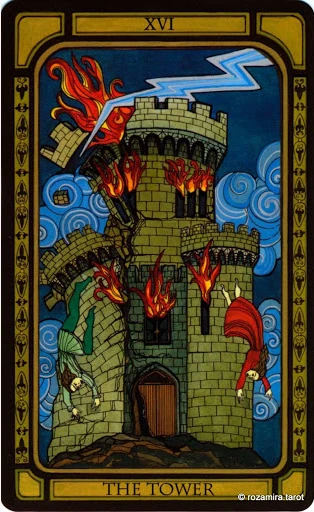
The Fool, The Lovers, Wheel of Fortune and The Tower each change the direction of a spread. Together they move from openness, through choice and changing circumstances, into the moment when an old structure can no longer hold.


Art, atmosphere and symbolism
The deck’s gold is not merely decorative. It behaves like a frame around memory, making every card feel preserved and significant. Deep blue often creates distance or inwardness; scarlet brings the eye back to desire, danger or decision; green grounds the image in growth and lived reality. The limited palette keeps even the busiest Major Arcana readable.
The publisher points to symbols such as the figure eight, crayfish, pomegranate, tower and astrological planets. You can use these as anchors rather than a test. If a symbol catches your eye, ask what it is doing in this particular card before reaching for a fixed definition. A wall can protect or imprison. A cup can receive, celebrate or remain painfully empty. A golden disk can suggest value, labour, security or the weight of what we are trying to preserve.
This is where the deck feels most generous. It offers recognisable doors into traditional tarot, but it leaves enough stillness around them for intuition to breathe. Its figures do not have to mimic real life to carry real emotion; a turned head, raised hand or burning window can hold the centre of the message.

CARD STUDY
Eight of Pentacles: progress without a performer
No craftsperson appears here. Eight ornate disks form a balanced pattern across a vivid green field, with small trees above and grasses below. By removing the worker, the card directs attention to the visible result: eight units repeated with care.
Upright, it favours practice, consistency and improvement one piece at a time; in shadow, repetition can become empty routine. Ask which habit is already producing results and what needs one careful pass—not dramatic reinvention. Nearby Cups may suggest emotional labour, Swords disciplined study, and Wands the craft that supports inspiration.
Questions that suit this deck
For an easy daily pull: “What symbol should I carry with me today?” Let the first colour, object or gesture answer before you open the guidebook.
For a medium-depth spread: “What is shown, what is hidden, and what is ready to change?” Three cards give the deck room to move between its quiet emblems and more dramatic scenes.
For a harder shadow question: “Which beautiful story am I using to protect an old structure?” This deck’s polished gold can make difficult cards look precious. That is useful: it reminds us that a pattern can be familiar, meaningful and still ready to end.
I would keep spreads fairly small while learning the pack. Three to five cards allow its repeated colours and symbols to form a conversation without turning the table into visual noise. If several pip-like Minors appear, use number and suit first, then add any colour or spatial pattern that stands out.
FOUR CARDS, ONE CURRENT
The emotional weather of Cups
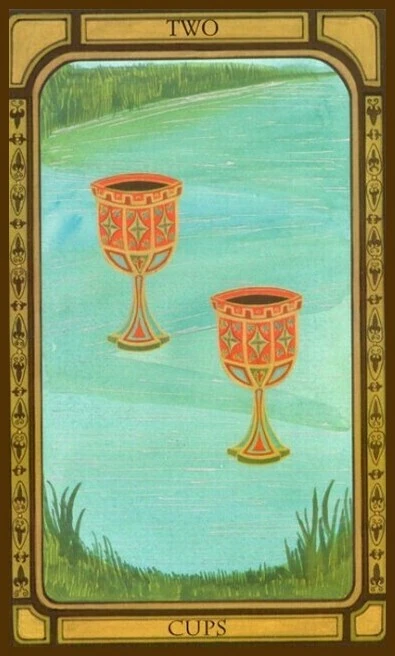
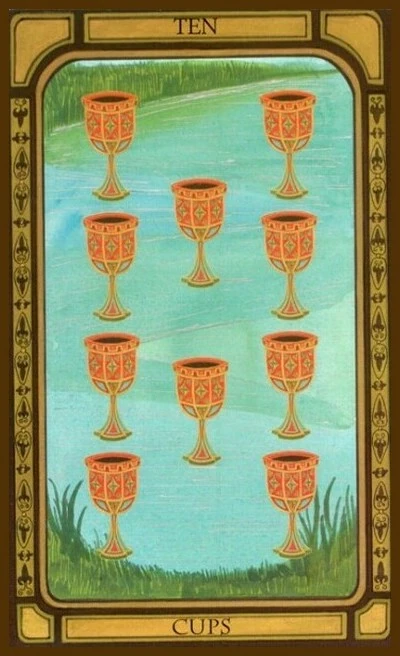
Ace, Two, Five and Ten of Cups trace feeling from the first opening, through exchange, into disappointment and finally the shape of shared fulfilment. Their repeated vessels make emotional quantity visible: what is offered, what is mirrored, what seems lost and what remains available.


Is The Golden Tarot beginner-friendly?
Yes—with one useful caveat. The deck’s structure and Major Arcana symbolism are familiar enough to support learning, and the set includes a full-colour step-by-step guide. The accompanying video describes it as a 78-card deck intended to help a new reader begin within a few hours. Still, some Minor Arcana cards are more emblematic than scenic. A beginner who expects every card to contain a complete Rider-Waite-Smith-style story may need time to become comfortable with number, suit and colour.
That challenge can be a gift. Pip-like cards teach you not to depend on one inherited picture. Start with the suit’s element and emotional territory, add the number’s movement, and then notice how this deck arranges the emblems. The result is not less intuitive; it is intuitive in a different way.
Readers who enjoy historic atmosphere, folk-art simplicity, bold pattern and traditional symbols are likely to feel at home. Those who want cinematic realism, diverse contemporary settings or fully scenic Minors may prefer a modern illustrated deck. Neither preference is more advanced. The best deck is the one whose visual language keeps you curious enough to return.
CARD STUDY
The Tower: the truth arrives as weather
A jagged bolt strikes a green stone tower beneath a dark blue sky. Flames fill the upper windows, masonry breaks away and small figures fall as curling clouds crowd the scene. Even the heavy gold border seems unable to contain the movement.
The lightning reveals a weakness already present. Upright, The Tower can mark sudden truth, a broken assumption or freedom after collapse; in shadow, it can show resistance to clear evidence. Ask whether the structure is a plan, belief, relationship pattern or public image—then find the neighbouring card that shows what can survive and be rebuilt.
AURICA’S GOLDEN RULE
Let the gold frame the message, not soften it
Beauty can make a difficult card easier to approach, but it should not make the truth smaller. Begin with the detail that catches the light, then ask what is happening inside the frame. The gold may tell you this moment matters; the figure, object or rupture tells you why.
Final thoughts
The Golden Tarot is a warm bridge between historical atmosphere and practical modern reading. Its most powerful cards feel like small painted stages, rich with gesture and consequence. Its quieter pips ask for a different kind of attention: less plot, more pattern. Together they create a deck that can teach both recognition and restraint.
I recommend it most to readers who love ornate borders, folk-like figures, traditional archetypes and the feeling of turning through an old storybook. It is approachable enough for a committed beginner and layered enough for an experienced reader who enjoys symbol-led interpretation. Give the deck time to teach you its two voices, and the contrast between them becomes part of its charm.
QUESTIONS BEFORE YOU CHOOSE
The Golden Tarot FAQ
How many cards are in The Golden Tarot by Liz Dean?
It is a standard 78-card tarot deck: 22 Major Arcana and 56 Minor Arcana across Wands, Cups, Swords and Pentacles. The set is presented with a full-colour step-by-step guidebook.
Is The Golden Tarot suitable for beginners?
Yes. The publisher describes it as a learning-friendly deck built around recognisable archetypal symbols. Beginners should know that several Minor Arcana cards are more pip-like than fully scenic, so number and suit meanings matter.
Does this deck follow Rider-Waite-Smith meanings?
It uses many familiar tarot archetypes and a standard 78-card structure, so Rider-Waite-Smith knowledge transfers usefully. Its ancient-Italian-inspired art and simpler pip arrangements give it a distinct visual voice rather than making it a direct visual copy.
What comes with the deck?
The publisher and review video describe a full deck of 78 cards with a full-colour step-by-step guidebook. Check the current retailer listing before purchase because packaging and availability can change.
What kind of readings suit The Golden Tarot?
It works well for daily reflection, choice points, creative questions, relationship patterns and spreads about change. Small three-to-five-card layouts make it easier to compare the deck’s colours, gestures, numbers and repeated symbols.
Which edition does this review cover?
This page covers Liz Dean’s The Golden Tarot associated with ISBN 9781906094867 and the Amazon product identifier 1906094861. Check those identifiers when comparing similarly named golden tarot decks.
CONTINUE THE JOURNEY
 Golden Art Nouveau Tarot
 Tarot of the Golden Wheel
 Medieval Europe Tarot
 Russian Tarot of St. Petersburg
 Tarot Grand Luxe
 The Gilded Tarot