Cult Of Weimar Tarot Cards
Browse the verified available cards in tarot order, use the official-group filters, and open any card for a larger carousel view.

Cult Of Weimar Tarot quick take
Cult Of Weimar Tarot is a theatrical shadow deck with cabaret glamour, old-city mood, and a sharp eye for masks, performance, and hidden motives. It is not a soft beginner deck. It is better for readers who enjoy atmosphere, character, and psychological tension.
The available TarotFans gallery is honestly presented as partial. Its verified cards are labelled by their tarot names and sorted in best-effort order: Major Arcana first, then Swords, Cups, Coins, and Wands.
I feel as though the curtain has already risen when I lay these cards down. The Magician’s clockwork halo gives him the cool nerve of a performer who knows every eye is upon him, while The Star steps through softer light, tender but never naïve. Before I name a meaning, costume, posture, and gaze tell me who is claiming the room and who is watching from its edges.
In a reading, I begin with the familiar tarot role, then ask what the figure may be revealing or concealing. The Moon’s amber disc and narrowing corridor make uncertainty feel physical: the path is there, yet fear changes its shape. Nearby cards show me whether that tension is honest caution or a story performed because the truth feels exposed. This deck may enter dark rooms, but it reminds me that noticing the mask is the first brave step toward a truer role—and that the light we find backstage can still guide us home.
How it matches the Light Seer’s-style standard
Against the Light Seer’s Tarot page style, this review now follows the same visual rhythm: YouTube, clean CTAs, native gallery, table image, expanded card studies, four-card rows, pros and cons, one final clickable image, and six FAQs.
Major Arcana card study
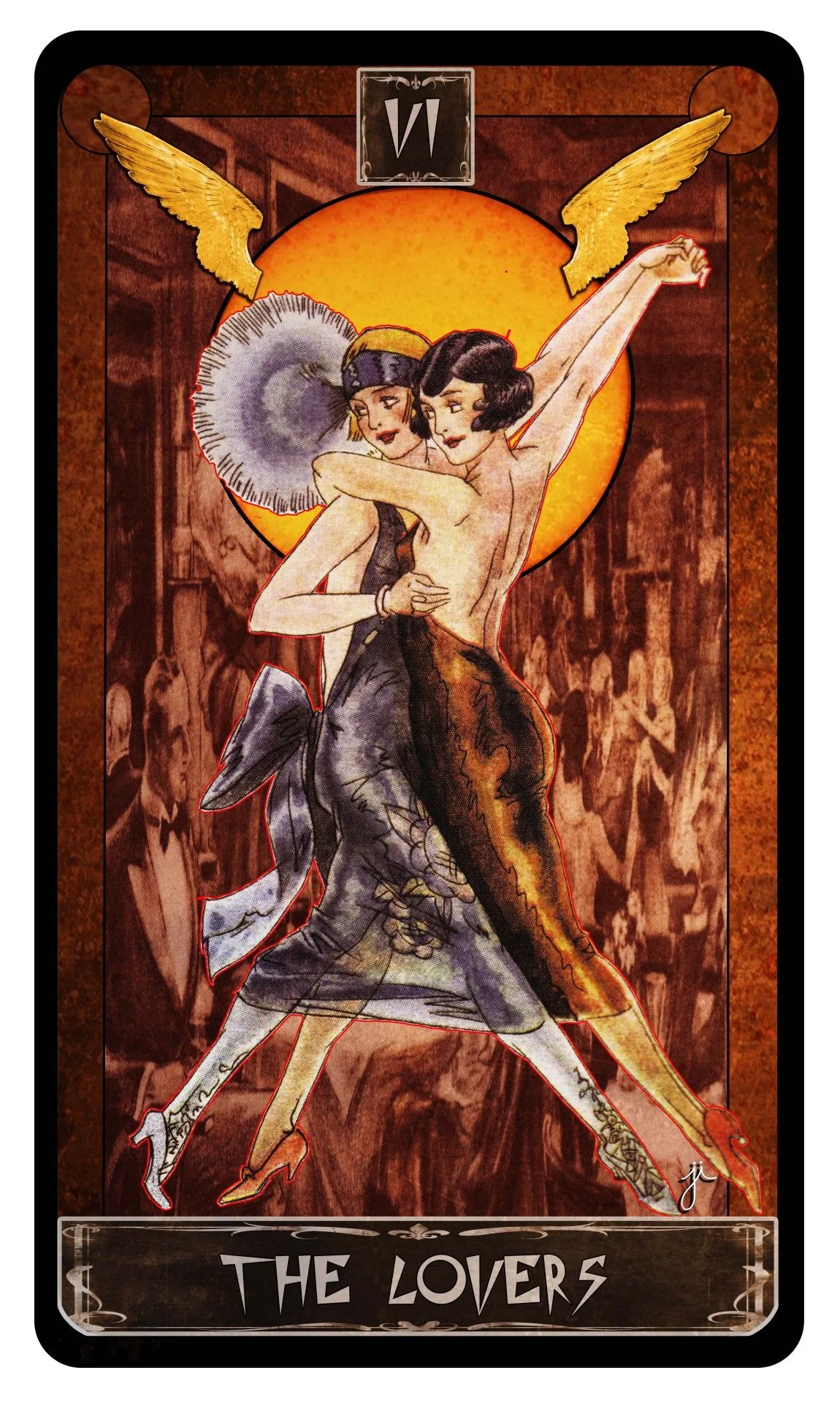
The Lovers: intimacy under stage lights
The Lovers card is not only romantic here. The figures feel close, exposed, and almost watched by the room around them. That gives the card a more adult emotional pressure than a simple “true love” reading.
In a spread, this image can ask whether desire is honest, performed, hidden, or brave. It keeps the traditional theme of choice, but the choice feels social and personal at the same time.
Artwork and first impression
The artwork has a collage-like cabaret voice: sepia light, deep reds, black borders, theatrical clothing, and people who seem to be acting and confessing at once. The deck often reads through posture and costume as much as through tarot symbols.
Where Light Seer’s Tarot often feels open, healing, and sunlit, Cult Of Weimar feels interior, smoky, and coded. That contrast is useful. This deck is strongest when the question involves identity, desire, power, secrets, performance, or the difference between public image and private truth.
Four-card moment
Major Arcana as cabaret archetypes
These early Major Arcana cards introduce the deck’s stage: innocence, skill, intuition, and creative power. Read together, they show how identity becomes performance before it becomes truth.


How Cult Of Weimar Tarot reads in practice
I would read this deck by asking three simple questions: who is performing, what is being hidden, and what truth is trying to get through the costume? The cards reward looking at faces, hands, props, curtains, coins, blades, and the angle of the body.
For daily pulls, it may feel intense, but it can be excellent for journaling. Pull one card and write one line for the mask, one line for the truth, and one line for the next brave action.

Shadow-reading card study
The Moon: fear, glamour, and the strange hallway
The Moon image leans into unease. The glowing moon, dark passage, and theatrical face create a feeling of walking through a dream where every symbol has a double meaning.
Traditionally, The Moon warns of confusion and instinct. In this deck, it also asks how much fear is costume, how much is intuition, and what becomes visible when the lights are low.
Four-card moment
Swords as wit, danger, and performance
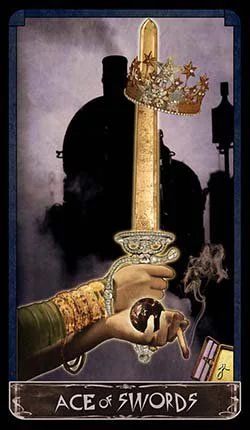
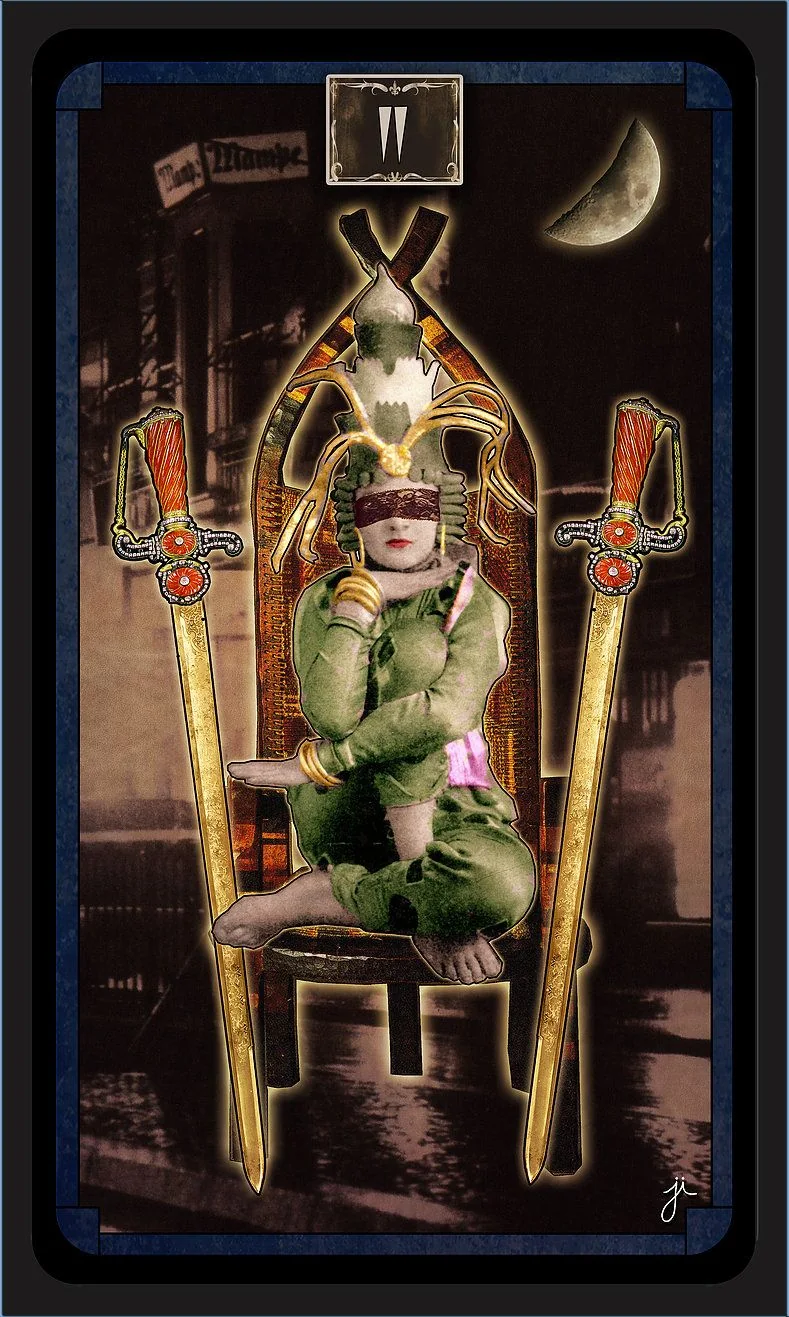
The Swords cards feel clever and sharp rather than plain. They suggest wit, social risk, and cutting honesty — perfect for readings about communication, boundaries, and uncomfortable clarity.


Best questions for this deck
Cult Of Weimar Tarot is best for questions like: What role am I playing? What is the room not saying? Where am I giving away power? What desire needs honesty? What truth is hidden behind style, charm, or fear?
It is less ideal for very gentle reassurance readings. If someone needs softness, choose a warmer deck. If someone needs the truth with velvet curtains and a little bite, this one fits.
Minor Arcana card study
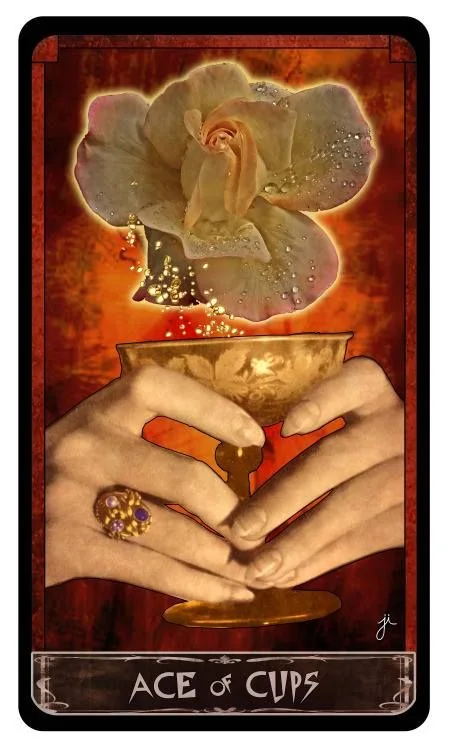
Ace of Cups: feeling as a dangerous bloom
The Ace of Cups uses beauty, hands, and a glowing flower-like form to make emotion feel precious but not simple. The card is tender, yet it also carries heat and risk.
In readings, this can be a new feeling, a creative opening, or a relationship moment that needs care. The Weimar mood reminds us that attraction and intuition both deserve honesty.
Four-card moment
Coins as status, survival, and exchange
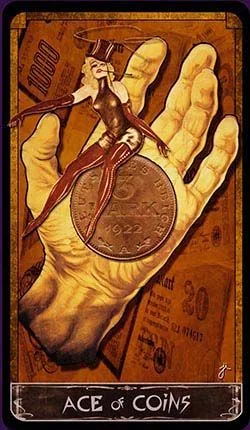
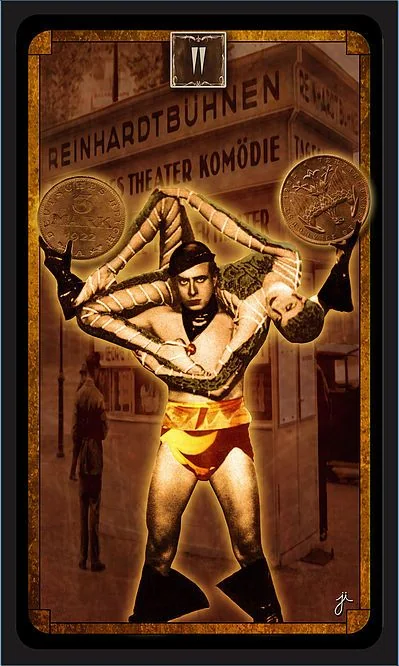
Coins in this deck do not feel like neutral money. They carry status, hunger, performance, and survival. This makes the suit useful for questions about work, value, class, control, and what security costs.


Pros and cons
| Pros | Cons |
|---|---|
| Rich cabaret atmosphere and strong psychological symbolism. | Darker tone may feel too intense for soft daily readings. |
| Excellent for shadow work, identity questions, and relationship tension. | The TarotFans gallery is partial, so use the cards shown rather than assuming complete-deck coverage. |
| Images reward slow study of costume, posture, objects, and mood. | Beginners may need extra time translating the deck’s theatrical language. |
TarotFans golden rule
If a card looks dramatic, do not stop at “dark” or “beautiful.” Ask what the drama is protecting. This deck becomes much clearer when you treat every costume, prop, and pose as a clue.
Final thoughts
Cult Of Weimar Tarot is for readers who like their tarot atmospheric, theatrical, and psychologically sharp. It has enough beauty to pull you in and enough shadow to make the reading matter. The result is a deck that feels less like a simple fortune-telling tool and more like a room full of people telling the truth sideways.

FAQ
Is Cult Of Weimar Tarot beginner-friendly?
It can work for confident beginners, but it is not the easiest first deck. The imagery is theatrical and symbolic, so it rewards readers who enjoy interpretation.
Is the TarotFans gallery complete?
No. The gallery is clearly presented as a verified partial set and makes no complete-deck claim.
What kind of readings suit this deck best?
It is strongest for shadow work, identity questions, relationship tension, creative blocks, and questions about masks, power, and hidden motives.
Does it read like Rider-Waite-Smith?
It keeps tarot structure, but the voice is more cabaret, collage, and psychological. Use traditional meanings as a base, then read the faces, props, posture, and mood.
Why compare it with Light Seer’s Tarot?
Light Seer’s is the TarotFans layout and warmth benchmark. Cult Of Weimar is darker, but this review follows the same visual rhythm: video, CTA, gallery, studies, four-card moments, final CTA, and FAQ.
Who will like Cult Of Weimar Tarot most?
Readers who enjoy vintage atmosphere, cabaret style, shadow work, symbolic detail, and decks with a strong artistic personality will probably get the most from it.