Witches Tarot Card Gallery
Explore the verified deck in canonical tarot order. Choose a group, then open any card for a larger carousel view.
Aurica’s Quick Take
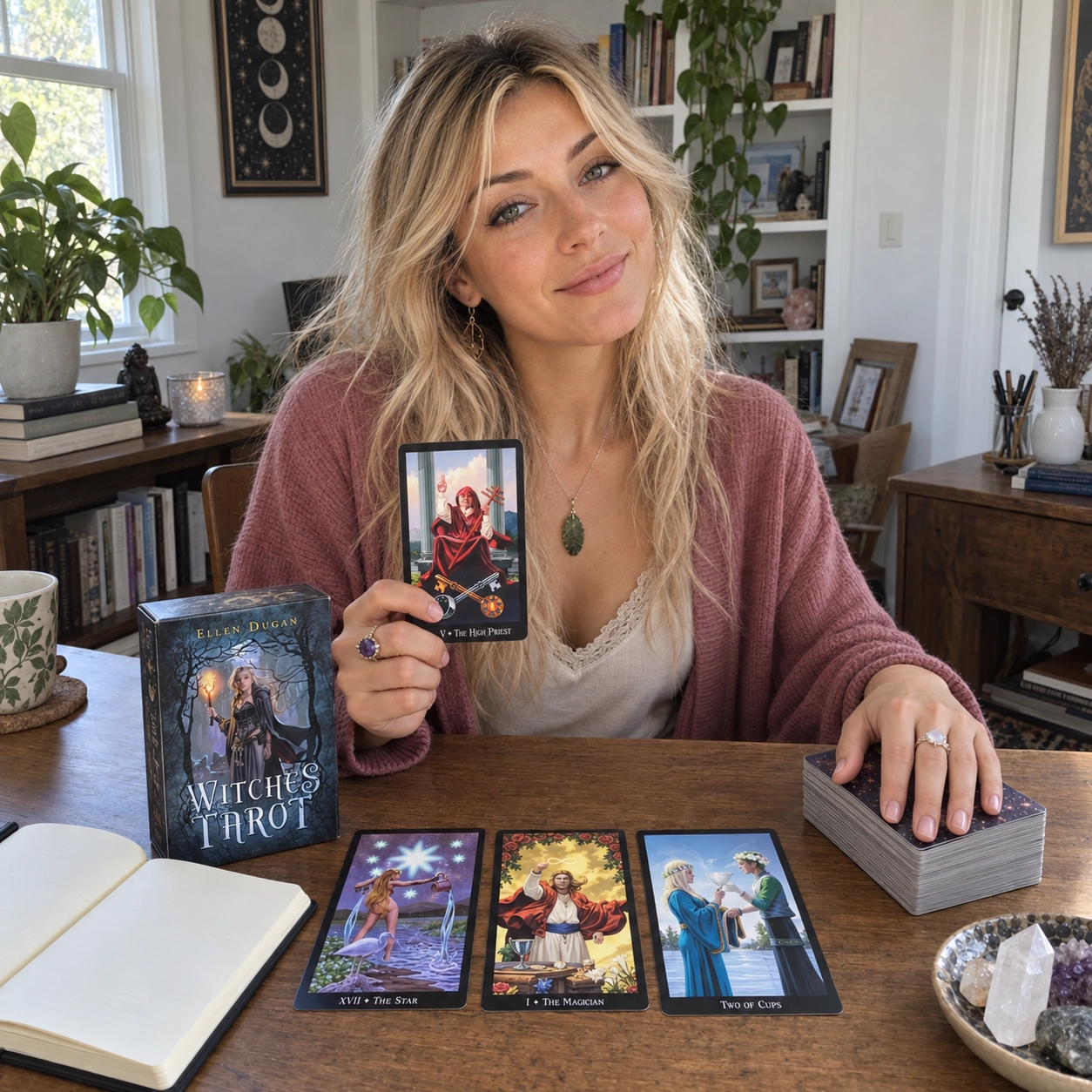
Witches Tarot feels like a lamp carried through blue woods. Moonlit paths and bright elemental flashes invite my imagination in, while familiar tarot meanings keep my feet on the ground.
I keep returning to The High Priest. His red robe and ritual tools make wisdom feel like something we practise. I would ask which small daily ritual could give an insight a steady shape.
The Star, The Magician, and Two of Cups bring hope, intention, and honest connection. Trust your spark, tend it gently, and let your own wise light lead the next step.
What Makes Witches Tarot Different?
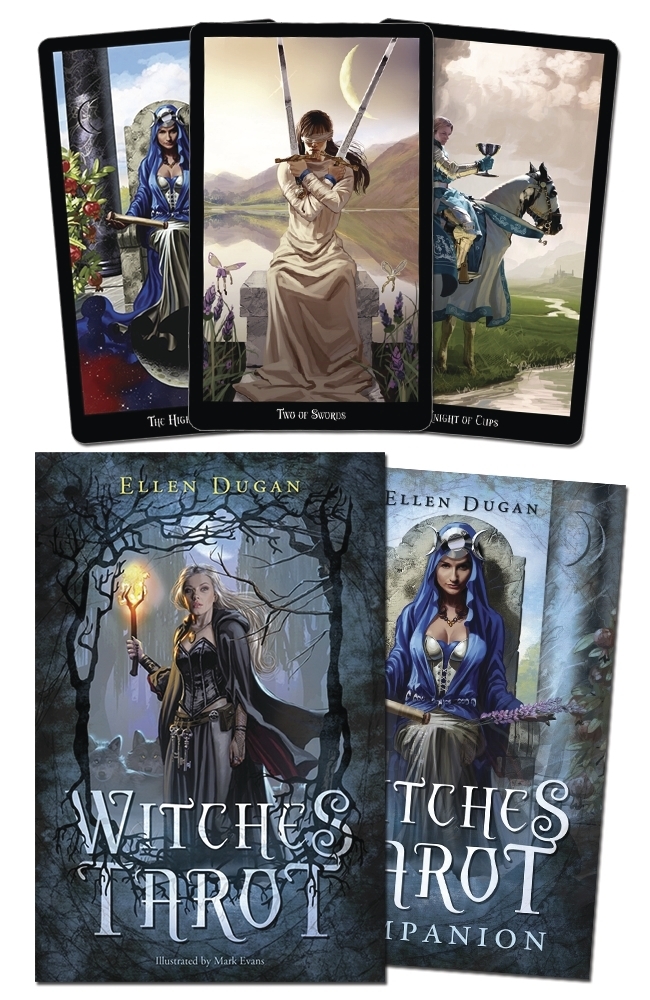
Witches Tarot opens like a door at dusk: blue woodland, candle flame, polished chalices, and figures who seem caught halfway through a spell. Ellen Dugan keeps the familiar tarot journey beneath that atmosphere, while Mark Evans fills it with Pagan ritual, elemental colour, and the feeling that intention matters.
The deck changes a few Major Arcana names without cutting their roots. The High Priest carries the teaching role of the Hierophant, The Shadow Side turns the Devil’s chains toward conscious shadow work, and Karma gives Judgment a sense of consequence and return. Those choices feel less like a new language than a different accent—warm, magical, and direct.
Deck-specific card study
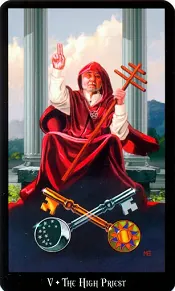
The High Priest: giving intuition a steady form
The red-robed teacher sits upright, surrounded by tools that make spiritual practice visible and physical. His raised hands suggest instruction, while the ordered symbols below him ask for discipline rather than blind obedience. Upright, he can point to a trusted method, mentor, or ritual; in shadow, he can show rules that have become too tight. In a reading, I would ask which structure protects the spark and which one is only asking to be obeyed.
How Witches Tarot Reads in Practice
I find the deck easiest when I read the picture in two passes. First I notice the emotional weather: who looks guarded, where the light falls, which tool or animal pulls the eye. Then I return to the card’s traditional job and let the surrounding cards decide whether that first feeling is a promise, a warning, or a practical next step.
The images can be dramatic, but their advice is often simple. A blazing wand asks where energy wants to move. A guarded figure asks what needs protection. A calm cup scene asks whether feeling is flowing between people or pooling in one place. That makes the deck useful for real questions without stripping away its wonder.
Four-card moment
Intention Becoming Action
These four cards move from conscious skill to creative flame, steady craft, and visible completion.


Love, Trust, and Emotional Magic
In relationship readings, Witches Tarot does not confuse chemistry with certainty. Its glowing figures can make attraction feel immediate, yet the Cups and Swords keep asking who is listening, what has been promised, and whether two people are meeting each other in the same emotional room.

Relationship card study
Two of Cups: the courage to meet halfway
Two figures face each other with raised cups, creating a balanced exchange rather than a chase. The blue water and open air soften the moment, while their mirrored gesture makes reciprocity impossible to ignore. Upright, the card can show attraction, trust, or a sincere agreement; in shadow, it asks whether harmony is being performed while one person carries the emotional weight. I would read it beside nearby cards to see whether the meeting has roots as well as sparkle.
Questions for Easy, Medium, and Deep Readings
For an easy daily pull, ask, “What energy deserves my attention today?” For a medium spread, ask, “What intention, action, and boundary will move this forward?” For a deeper reading, ask, “Which part of my power feels hidden, who taught me to hide it, and what safe practice can bring it back into the light?”
Four-card moment
A Relationship Reading With Boundaries
This line holds attraction, choice, shadow, and healing in one honest conversation.


Career, Money, and Creative Spellwork
The Wands and Pentacles feel especially alive here. They show the difference between wanting a result and tending it: the first flame of an idea, the repetitive work that gives it muscle, and the material choices that let it support more than a passing mood. I use this deck to turn a vague ambition into one visible action.

Work and legacy card study
Ten of Pentacles: what your work is building toward
The card gathers people, place, and material symbols into a scene of continuity. Nothing here feels like a coin won in isolation; the abundance has history and relationship around it. Upright, it can speak of durable security, family resources, or work that outlives the first burst of effort. In shadow, it may reveal inherited expectations or a polished picture hiding uneven support. I would ask not only what success looks like, but who gets to feel safe inside it.
Art Style, Personality, and Beginner Fit
Mark Evans paints with theatrical light, saturated colour, and clear human gesture. The deck is not quiet or minimalist; it wants moonlight on the path and fire in the hand. Beginners who enjoy that visual richness can still anchor themselves in familiar suits and card order, while experienced readers will find plenty of small symbols to deepen a spread.
The best way to learn it is slowly. Choose one visible detail, name the feeling it creates, connect it to the card’s traditional function, and then check whether the neighbouring cards support that impression. This keeps intuition imaginative without letting it float away from the question.
Four-card moment
From Shadow Into Clearer Light
These cards trace fear, honest seeing, decisive truth, and the warmth that follows.


Who Will Love This Deck?
Witches Tarot will feel at home with readers who enjoy Pagan imagery, practical ritual, elemental symbolism, and a strong Rider–Waite–Smith foundation. It suits people who want magic to feel lived-in rather than distant: a candle lit with intention, a boundary named clearly, a creative plan given a date.
Readers who prefer spare abstraction or historically traditional Christian imagery may find its atmosphere too specific. That is not a flaw; it is the deck being honest about the room it wants to create.
What I Like Most
I love the deck’s confidence. It lets beauty and directness sit together, so an image can feel enchanting without becoming evasive. The renamed Majors also invite a fresh conversation: authority becomes spiritual practice, bondage becomes the shadow we can face, and awakening becomes Karma asking what our choices have set in motion.
Buying Guidance
Choose this edition if Ellen Dugan’s practical witchcraft voice and Mark Evans’s luminous fantasy art both appeal to you. Before buying, look closely at The High Priest, The Shadow Side, Karma, and several suit cards; if those scenes feel readable rather than merely decorative, the rest of the deck is likely to open naturally in your hands.
The Golden Rule for Reading Witches Tarot
Let the atmosphere open the door, but let the card’s traditional function and its neighbours decide where the doorway leads. Magic sharpens a reading when it gives intuition a shape; it muddies one when every beautiful feeling is treated as proof.
Final Thoughts
Witches Tarot is a bright, wholehearted bridge between familiar tarot and contemporary Pagan practice. It reads with fire, colour, and emotional immediacy, yet it rewards the reader who pauses long enough to turn enchantment into one grounded choice. If its world calls to you, this is a deck that can make everyday reflection feel purposeful, creative, and quietly brave.

Witches Tarot FAQ
Is Witches Tarot good for beginners?
Yes, especially for a beginner who enjoys Pagan imagery and wants familiar Rider–Waite–Smith structure beneath it. I would learn one card at a time, noticing the scene first and checking the guidebook when a renamed Major such as The High Priest, The Shadow Side, or Karma appears.
Who created Witches Tarot?
Witches Tarot was written by Ellen Dugan and illustrated by Mark Evans. Dugan’s practical witchcraft perspective shapes the deck’s atmosphere, while Evans gives the cards their luminous figures, ritual objects, and moonlit landscapes.
Does Witches Tarot follow Rider–Waite–Smith meanings?
Mostly, yes. The deck keeps the familiar suits and core tarot journey, so standard meanings remain useful. Its renamed Majors and Pagan symbolism add another emotional layer rather than replacing that structure.
What readings suit Witches Tarot best?
I like it for relationships, creative work, confidence, spiritual practice, boundaries, and moments when intention needs a practical form. The artwork is expressive enough for intuitive reading but structured enough to keep advice grounded.
Which Major Arcana cards are renamed?
The Hierophant becomes The High Priest, Wheel of Fortune becomes The Wheel of the Year, The Devil becomes The Shadow Side, and Judgment becomes Karma. These names shift the emotional doorway into each card while preserving its place in the Major Arcana sequence.
What should I notice before buying?
The imagery is openly witchy and Pagan, with ritual tools, elemental correspondences, and dramatic fantasy figures. If that visual language feels welcoming, the deck offers an accessible bridge between traditional tarot and a modern magical practice.