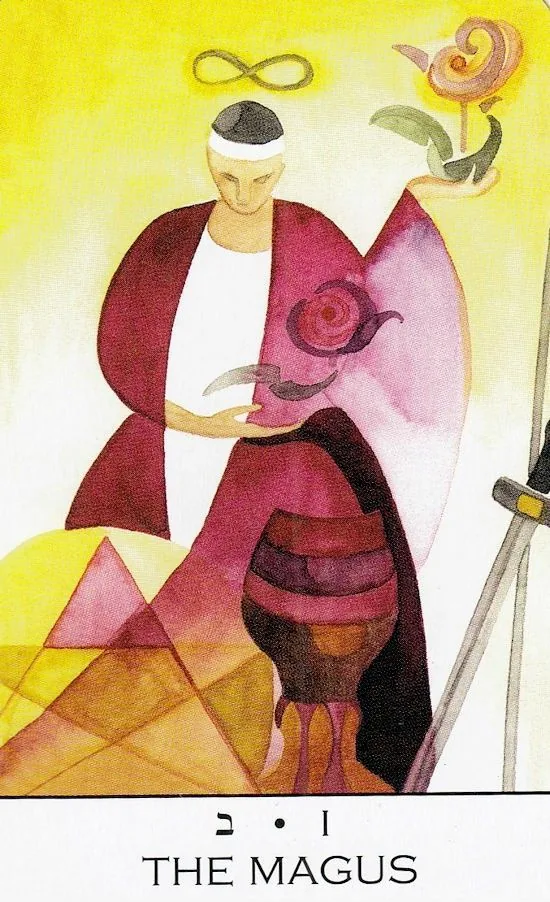
Tarot D card gallery
Partial gallery: 40 of 102 reading-card fronts, plus one genuine card back. The remaining 62 fronts are omitted because no individually verified clean counterpart has been acquired. No watermarked archive cards have been published.
These faces carry numerals and symbols rather than printed word titles. Captions describe source symbols; court equivalents are conventional labels, not native guidebook names. Pause positions and source numbers identify the original archive only. Cards follow that evidenced grouped archive sequence, not a claim to a fully verified official guidebook order.
Evidence: Schiffer exact-edition product, ISBN 9780764349409; clean full assets from Pinterest and Aeclectic; identity comparisons against the original source archive (watermarked, evidence only).
Named omissions: 62 reading-card fronts
These are descriptive/source identities or conventional equivalents, not an invented guidebook-name list. The eight guidebook headings available in publisher samples are retained where verified. Archive filenames make each omission individually traceable.
Major / Tale of Time: Philosopher (I variant; review alias) [archive 05.jpg]; The High Priestess [archive 06.jpg]; The Empress [archive 07.jpg]; Strength (VIII) [archive 12.jpg]; Wheel of Fortune [archive 14.jpg]; Justice (XI) [archive 15.jpg]; Death [archive 17.jpg]; The Devil [archive 19.jpg]; The Tower [archive 20.jpg]; The Star [archive 21.jpg]; The Moon [archive 22.jpg]; The World [archive 25.jpg]
Fire / Wands: Remnant Ashes (Fire 0) [archive 26.jpg]; 2 of Fire [archive 28.jpg]; 4 of Fire [archive 30.jpg]; 5 of Fire [archive 31.jpg]; 6 of Fire [archive 32.jpg]; 8 of Fire [archive 34.jpg]; 9 of Fire [archive 35.jpg]; 10 of Fire [archive 36.jpg]
Earth / Pentacles: 0 of Earth [archive 42.jpg]; Ace of Earth [archive 43.jpg]; 2 of Earth [archive 44.jpg]; 3 of Earth [archive 45.jpg]; Securing Possessions (4 of Pentacles) [archive 46.jpg]; Empty Hands (5 of Pentacles) [archive 47.jpg]; 6 of Earth [archive 48.jpg]; 7 of Earth [archive 49.jpg]; 8 of Earth [archive 50.jpg]; 9 of Earth [archive 51.jpg]; 10 of Earth [archive 52.jpg]; ∞ of Earth [archive 53.jpg]; Page of Earth [archive 54.jpg]; Knight of Earth [archive 55.jpg]; Queen of Earth [archive 56.jpg]; King of Earth [archive 57.jpg]
Air / Swords: 0 of Air [archive 58.jpg]; Ace of Air [archive 59.jpg]; 2 of Air [archive 60.jpg]; 3 of Air [archive 61.jpg]; Gentle Slumbers (4 of Swords) [archive 62.jpg]; Opposing Forces (5 of Swords) [archive 63.jpg]; 6 of Air [archive 64.jpg]; 7 of Air [archive 65.jpg]; 8 of Air [archive 66.jpg]; 10 of Air [archive 68.jpg]; Knight of Air [archive 71.jpg]
Water / Cups: Ace of Water [archive 75.jpg]; 2 of Water [archive 76.jpg]; 3 of Water [archive 77.jpg]; 4 of Water [archive 78.jpg]; 5 of Water [archive 79.jpg]; Nostalgic Reflections (6 of Cups) [archive 80.jpg]; Pipe Dreams (7 of Cups) [archive 81.jpg]; 8 of Water [archive 82.jpg]; 9 of Water [archive 83.jpg]; ∞ of Water [archive 85.jpg]
Pause / Diffusion: Diffusion / Pause 4 (archive position, not a printed title) [archive 93.jpg]; Diffusion / Pause 9 (archive position, not a printed title) [archive 98.jpg]; Diffusion / Pause 10 (archive position, not a printed title) [archive 99.jpg]; Diffusion / Pause 11 (archive position, not a printed title) [archive 100.jpg]; Diffusion / Pause 12 (archive position, not a printed title) [archive 101.jpg]
Tarot D: The Didactic Tarot does not simply put new pictures on a familiar sequence. Jeffrey M. Donato’s deck gives the reader a journey told through Being, Doing, Thinking, Feeling, Pause, and Changing. Schiffer’s description identifies a 102-card set, a new Pause suit, and two additional cards for each elemental suit. The accompanying full-colour guidebook matters here: this is a system with its own story, not a standard tarot deck with a few unlabelled bonus cards.
That ambition is the attraction, and also the reason to slow down. Rather than treating every card as a quick translation of a memorised keyword, you can ask where you are in the story: acting, feeling, thinking, waiting, or noticing change. The publisher calls the deck a poetic mythology intended for both experienced and novice readers. That is an invitation, not a guarantee that every beginner will find its expanded structure effortless.
The independent flip-through below is a way to see a reader handle and discuss this particular deck. It should not be mistaken for the publisher’s specification of every printing.
What makes Tarot D different?
The most striking difference is Pause. Schiffer identifies it as a new suit, while its description frames the larger system around Being, Doing, Thinking, Feeling, Pause, and Changing. A pause is not just an absence of progress in a reading. As a question, it might ask what deserves attention before another decision is made. That is an interpretive suggestion drawn from the deck’s stated framework, not a quotation from its guidebook or a fixed definition of every Pause card.
The two additional cards in each elemental suit also make a one-to-one comparison with a conventional deck unreliable. If you use another tarot guide alongside this set, first check the card and its placement in Donato’s own book. Do not quietly force an unfamiliar card into the Page, Knight, Queen, or King position just because that is the court sequence you know.
A story to read, not a test to pass
Donato’s publisher describes the project as a personal journey mapped into a shared language of symbols and as an illustrated epic poem or story. That makes narrative a useful reading practice. In a small spread, you might ask what each image contributes to the scene and how the next card changes its mood. Does one card suggest a thought that has not become action? Does another invite a rest before a turning point? The answers belong to the particular cards drawn, not to a predetermined script imposed by this review.
This approach can be gentler than trying to memorise an expanded system in one sitting. Look at a card, record the detail that catches your attention, then compare your impression with the guidebook. A word or symbol that surprises you may be more helpful than a long list of meanings copied without context. The point is to listen more closely to the actual deck in your hands.
What the book contributes
Schiffer lists a full-colour, 160-page guidebook with the box set. The publisher also describes the deck as suitable for meditation and storytelling as well as tarot reading. With an unusual suit and extra elemental cards, the book is more than a nice accessory: it is the most direct source for how Donato explains his symbolic choices. We have not independently checked every page or spread in the book, so we will not promise a particular exercise, card meaning, or index that the listing does not establish.
Jeffrey M. Donato is the named creator in the publisher’s product listing and author biography. Schiffer says his interest in myth and storytelling led him to make his own version of tarot as a focus of graduate study. That background helps explain the deck’s teaching-minded name without claiming that the package follows any standard curriculum.
How to begin a reading with Tarot D
Try a three-card question that gives each position room: What is happening now? What needs attention? What might change if I respond thoughtfully? Before opening the book, write a sentence about each image and the feeling or action it evokes. Then use Donato’s text to check what you missed. This is a suggested exercise, not an official spread supplied with the deck.
If a Pause card appears, resist the urge to call it a delay and move on. Ask what the pause is protecting, making visible, or asking you to reconsider. If you draw an unfamiliar additional elemental card, read its own title and description rather than borrowing the meaning of the nearest conventional suit card. The deck’s difference becomes useful when it changes the question you ask, not when it makes the answer sound more complicated.
Who is likely to enjoy it?
Tarot D may appeal to a reader who likes illustrated myth, layered symbolism, and a deck that asks for unhurried attention. It may also appeal to someone who learns by comparing an image with a substantial companion text. The publisher explicitly pitches it to novice and experienced readers, but a new reader who wants the most widely taught, familiar card sequence should know that this deck adds a suit and extra cards. A conventional tarot reference will not account for all of its structure.
If you prefer a very small guide, quick keyword readings, or close compatibility with every ordinary 78-card spread tutorial, this may not be the easiest first purchase. None of that makes the deck better or worse in the abstract; it tells you whether its particular invitation fits the way you want to learn.
What to check before buying
Match the title Tarot D: The Didactic Tarot and creator Jeffrey M. Donato against the edition in the listing. Schiffer’s product entry describes a box set with 102 cards and a guidebook, but a second-hand copy may be missing either item. Ask for photographs of the box, booklet, and actual cards to confirm what a second-hand seller includes.
The publisher gives card dimensions of 3¾ by 5½ inches; those larger-than-small-pocket proportions are worth considering if handling size matters to you. We have not handled a copy, so cannot describe its stock, shuffle, finish, or durability from firsthand experience.
Final Thoughts
Tarot D: The Didactic Tarot makes space for a kind of reading that listens to the journey as much as the destination. Donato’s additional Pause suit and expanded elemental suits invite you to notice moments that a familiar sequence might rush past. Its guidebook and storytelling premise offer a way in, but the best reason to choose this deck is a genuine appetite for its distinct system. Let each unfamiliar card keep its own voice; the story will be richer for the attention you give it.
Tarot D: The Didactic Tarot FAQ
Who created Tarot D: The Didactic Tarot?
Schiffer credits Jeffrey M. Donato as its creator and names him in the author biography. The publisher describes the deck as the result of his long interest in symbolism, myth, and storytelling.
How many cards does the deck contain?
Schiffer’s box-set specification lists 102 art cards.
What is the Pause suit?
Pause is an additional suit in Donato’s system. The publisher does not supply each card’s meaning in the short product description, so use the included guidebook for its precise explanations rather than assuming the suit means only waiting or delay.
Does it follow standard 78-card tarot exactly?
No. The publisher says it adds a Pause suit and two extra cards in each elemental suit. A standard tarot guide can offer a point of comparison, but it cannot replace the deck’s own guide for its additional cards.
Does a new reader need to know tarot first?
Schiffer describes it as suitable for novices and experienced readers. A beginner can start with a small spread and the included book, while remembering that this expanded structure is different from the sequence taught in many general tarot introductions.
Sources and scope
The Schiffer product entry supplies the creator credit, system description, card total, book, and dimensions. The independent flip-through video offers a reader’s perspective on the deck. The reading exercises above are suggestions, not quotations from Donato’s guidebook.