Haindl Tarot is not a light, quick-glance deck. It is a layered, earthy, multicultural tarot with myth, Kabbalah, runes, I Ching references, elemental symbols, and sacred-art energy. If you like decks that reward slow looking, this one has a lot to give.
Think of it less like a simple “what will happen?” deck and more like a symbolic cave wall: every color, creature, glyph, and gesture can become part of the reading. That makes it powerful, but it also asks for patience.
Haindl Tarot Cards
Explore the complete Haindl Tarot artwork in official deck order. Choose a group below, then select any card to open its larger Lightbox view.
Haindl Tarot Quick Take
Choose Haindl Tarot if you want a serious symbolic deck for journaling, shadow work, spiritual reflection, mythic questions, and readings that need depth. Skip it if you want simple beginner scenes or bright everyday affirmations.
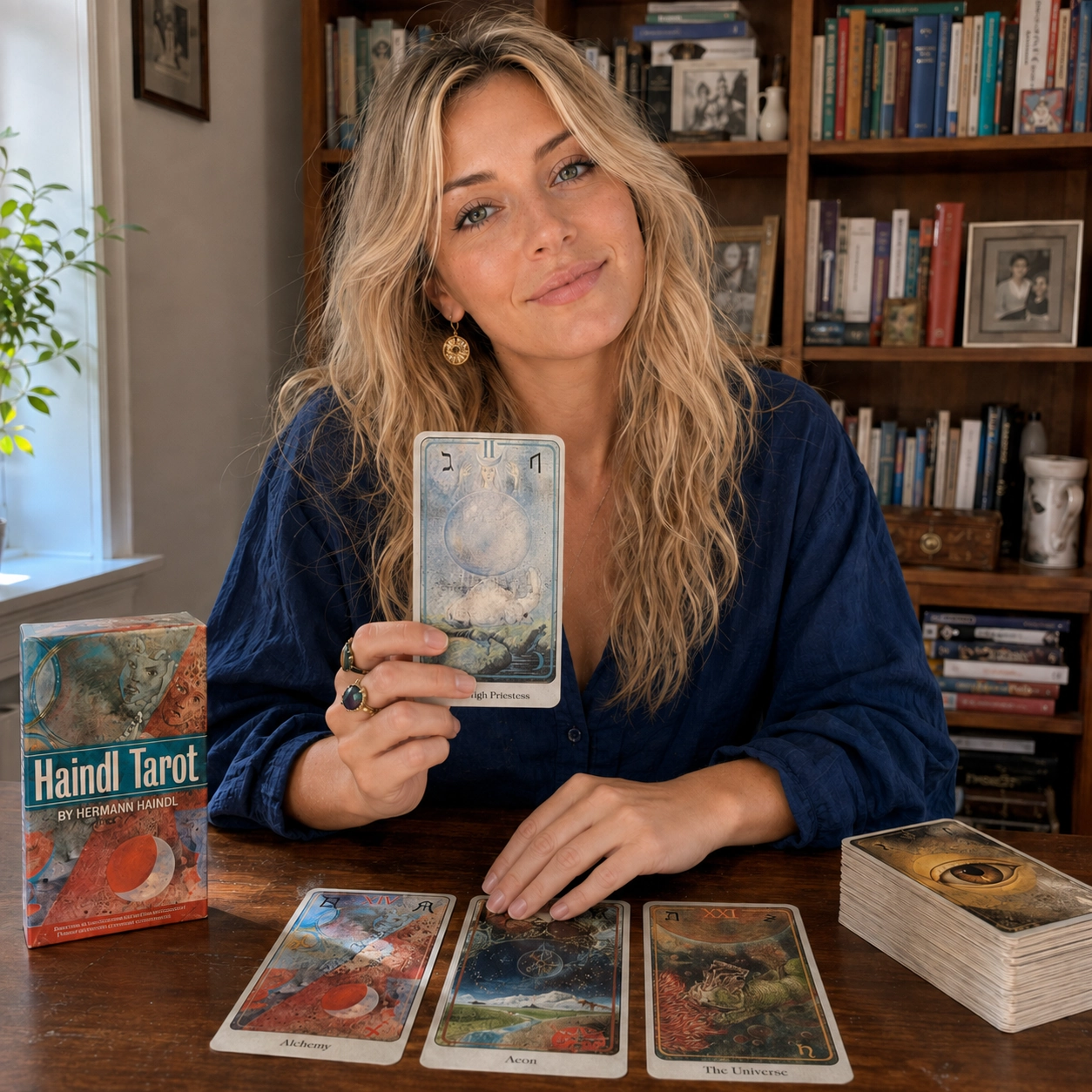
I feel this deck before I explain it. The painted surfaces seem weathered by memory: a pale moon opens inside The High Priestess, while Alchemy holds heat and coolness in the same breath. I begin with the detail that catches my eye, then ask how its mood changes the familiar work of the card.
Haindl Tarot rewards a slow spread. I like three cards with a little space between them, because its runes, Hebrew letters, elemental signs, and cross-cultural figures need room to speak without becoming a catalogue. I test that first intuitive pull against the question and the neighbouring cards, then name one clear step the reading can support.
This is the deck I would choose when a question feels older than today’s worry: grief, purpose, creative renewal, shadow work, or a turning point that asks for honesty. Haindl Tarot’s solemn beauty never closes the door on possibility; it reminds me that even an ancient pattern can loosen when we meet it with patience, courage, and hope.
What is Haindl Tarot?
Haindl Tarot is a 78-card tarot deck by Hermann Haindl, published by U.S. Games Systems. Its style is painterly, textured, and symbolic rather than cute or minimal. Many cards feel like fragments of ancient myth, ritual, landscape, and dream language.
The deck follows tarot structure, but it gives familiar cards a different mood. Temperance becomes Alchemy, Judgement becomes Aeon, and the court cards use Daughter, Son, Mother, and Father. That makes the deck feel more elemental and ancestral than many Rider-Waite-Smith-inspired decks.
Artwork and first impression
The first thing most readers notice is the texture. Haindl Tarot does not try to be polished in a glossy modern way. It feels weathered, ancient, and emotionally heavy, with colors that often move through teal, red, ochre, black, grey, and muted earth tones.
That visual weight is the point. The art asks you to slow down. Instead of spelling out a scene like a storybook, it gives you a symbolic field: a face, a mark, a shape, a natural force, a sacred diagram. You read the card by letting those pieces speak together.

Major Arcana art study
The High Priestess: mystery as stone, silence, and inner listening
In many traditional decks, The High Priestess sits between two pillars and guards a veil. Haindl keeps the feeling of hidden knowledge, but the image feels more ancient and earthy. She is not only a temple guardian; she feels like a presence carved out of deep time.
This changes the reading. In a Rider-Waite-Smith style deck, The High Priestess often says “trust your intuition” or “wait before acting.” In Haindl Tarot, she can feel heavier: listen to the dream, the ancestor, the body, the old symbol that keeps returning. The answer may not arrive as a neat sentence. It may arrive as a mood, image, or pattern you slowly recognize.
How Haindl Tarot reads in practice
This deck reads best when you combine three layers: the card title, the traditional tarot meaning, and the symbols in the image. A one-card pull can already feel full because the art gives you several doors into the message.
For clearer readings, keep the question grounded. Instead of asking for a dramatic prediction, ask what pattern is active, what needs respect, what needs release, or what choice would bring more honesty. Haindl Tarot rewards questions that leave room for nuance.
Four-card moment: entering the mythic path
Major Arcana as a journey through mystery


These four cards show how Haindl makes the Major Arcana feel less like cartoon milestones and more like initiations. The path begins with trust, will, hidden knowledge, and solitude.
Beginner friendliness
Haindl Tarot can work for a beginner who enjoys study, but it is not the easiest first deck. The minors and court cards may take extra time because the deck asks you to learn its symbolic system, not just memorize simple scenes.
A gentle way to begin is to pull one card, write three visible details, then add one traditional keyword. Keep your answer practical: one feeling, one lesson, and one next step. Over time, the repeated symbols start to become your own language.

Major Arcana art study
Alchemy: Temperance as sacred mixing, not just moderation
Haindl renames Temperance as Alchemy, and that one change matters. Traditional Temperance often shows balance, blending, and patience. Haindl’s version feels more like a spiritual laboratory: fire and water, body and spirit, old pain and new form.
In readings, this card can be less about “calm down” and more about transformation through careful mixing. Something in the querent’s life may need time, heat, and attention before it becomes useful. Healing is not a shortcut here; it is an art.
Love, relationship, and emotional readings
For love, Haindl Tarot is strongest with emotional truth, boundaries, old patterns, trust, repair, and spiritual connection. It is less suited to shallow yes-or-no questions because the cards often point toward deeper causes.
Ask questions like: “What pattern is asking for honesty?” or “What does this connection need in order to become healthier?” The deck can be intense, but that intensity helps when a relationship question has roots under the surface.
Four-card moment: emotion and repair
When the deck reads the heart beneath the story


This row is useful for relationship readings because it moves from emotional opening to dream/confusion, then into the mature water-court figures. Haindl makes feelings look deep, old, and sometimes difficult to name.
Career, money, and creative readings
For career and money, the deck can show pressure, timing, burnout, creative purpose, and the emotional meaning behind ambition. It is especially useful for artists and people making work that has a spiritual or symbolic layer.
For creative blocks, pull one card and let its color, texture, or symbol become a prompt. Haindl Tarot is excellent for that kind of image-led practice because the art does not close the meaning too quickly.

Major Arcana art study
Aeon: Judgement as awakening, memory, and the next age
Many traditional Judgement cards show an angel, a trumpet, and people rising. Haindl’s Aeon feels wider and stranger. It is less about a single announcement and more about a shift in time: the old life cannot hold the same shape anymore.
In a reading, Aeon can point to a calling, but it can also point to inherited patterns, collective change, or the moment when a person sees their life from a higher altitude. Compared with a traditional Judgement card, Haindl’s Aeon feels less church-like and more cosmic, ancestral, and historical.
Deck details at a glance
| Deck | Haindl Tarot |
|---|---|
| Creator | Hermann Haindl, with guidebook work associated with Rachel Pollack editions |
| Best for | Deep study, journaling, spiritual readings, mythic questions, shadow work, and symbolic interpretation |
| Style | Earthy, painterly, multicultural, intense, and contemplative |
| Difficulty | Medium to advanced; patient beginners can use it with notes and a guidebook |
| Watch for | Kabbalah, runes, I Ching, elemental systems, sacred art, and non-traditional court naming |
Pros and cons
| Pros | Cons |
|---|---|
|
|
Four-card moment: pressure, change, and renewal
When a reading needs honest transformation


This sequence shows why Haindl is useful for serious readings. The hard cards do not feel decorative; they feel like forces. The Star matters more after the rupture because hope has to be rebuilt, not simply wished for.
TarotFans golden rule for reading with Haindl Tarot
Do not rush the symbol into a keyword. With Haindl Tarot, the first meaning is often only the doorway. Let the color, animal, mark, number, and mood speak before you decide what the card “means.” If a card feels strange, write that down. The strangeness may be the message.
Final thoughts on Haindl Tarot
Haindl Tarot is worth exploring if you want a deck that feels old, layered, and spiritually serious. It is not trying to be simple. It is trying to be meaningful.
Use the full card gallery as your test. If several images make you pause, wonder, or want to write, this deck may become a strong study companion. If you want a fast, cheerful, highly literal reading style, it may feel too dense.

Haindl Tarot FAQ
Is Haindl Tarot good for beginners?
It can be, but it is better for patient beginners than total beginners who want simple scenes. Start with one-card pulls and a guidebook.
What is Haindl Tarot best for?
It is best for journaling, shadow work, spiritual reflection, mythic questions, creative prompts, and readings where symbolism matters.
Does Haindl Tarot follow traditional tarot meanings?
Yes, but with its own voice. It keeps tarot structure while adding elemental, mythic, Kabbalistic, rune, and I Ching layers.
Why are some card names different?
The deck uses names such as Alchemy and Aeon, and the courts use Daughter, Son, Mother, and Father. These choices support the deck’s elemental and spiritual tone.
Who should skip Haindl Tarot?
Skip it if you want a cheerful daily affirmation deck, very literal Rider-Waite scenes, or a deck that reads quickly without study.
Can Haindl Tarot be used for serious readings?
Yes. It is especially strong for serious readings when the question is clear and the reader is willing to sit with layered imagery.