Madam Lydia Wilhelmina’s Tarot Cards
Explore the verified Second Edition card artwork in official order. Choose a group or open any card for a larger carousel view.
Aurica’s Quick Take
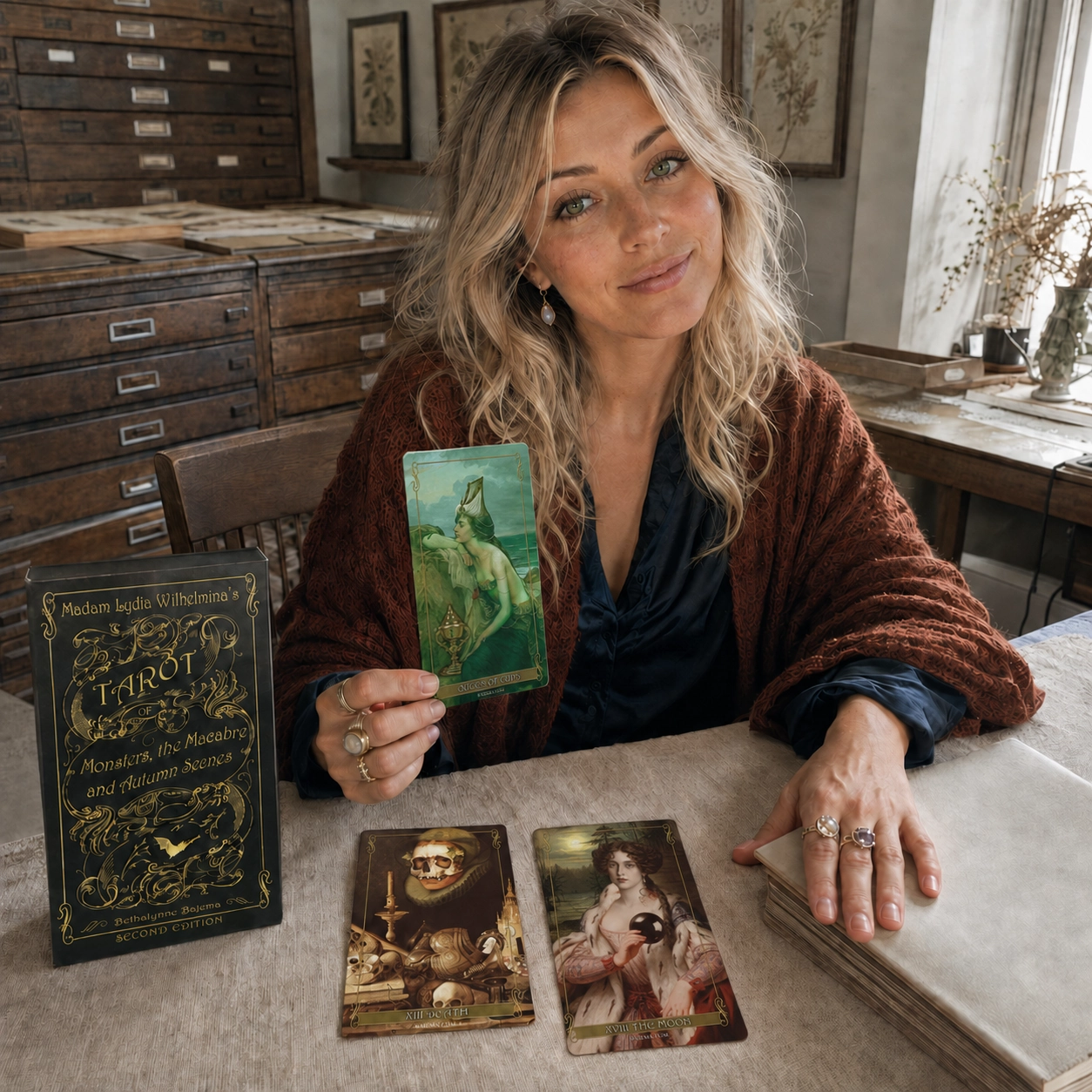
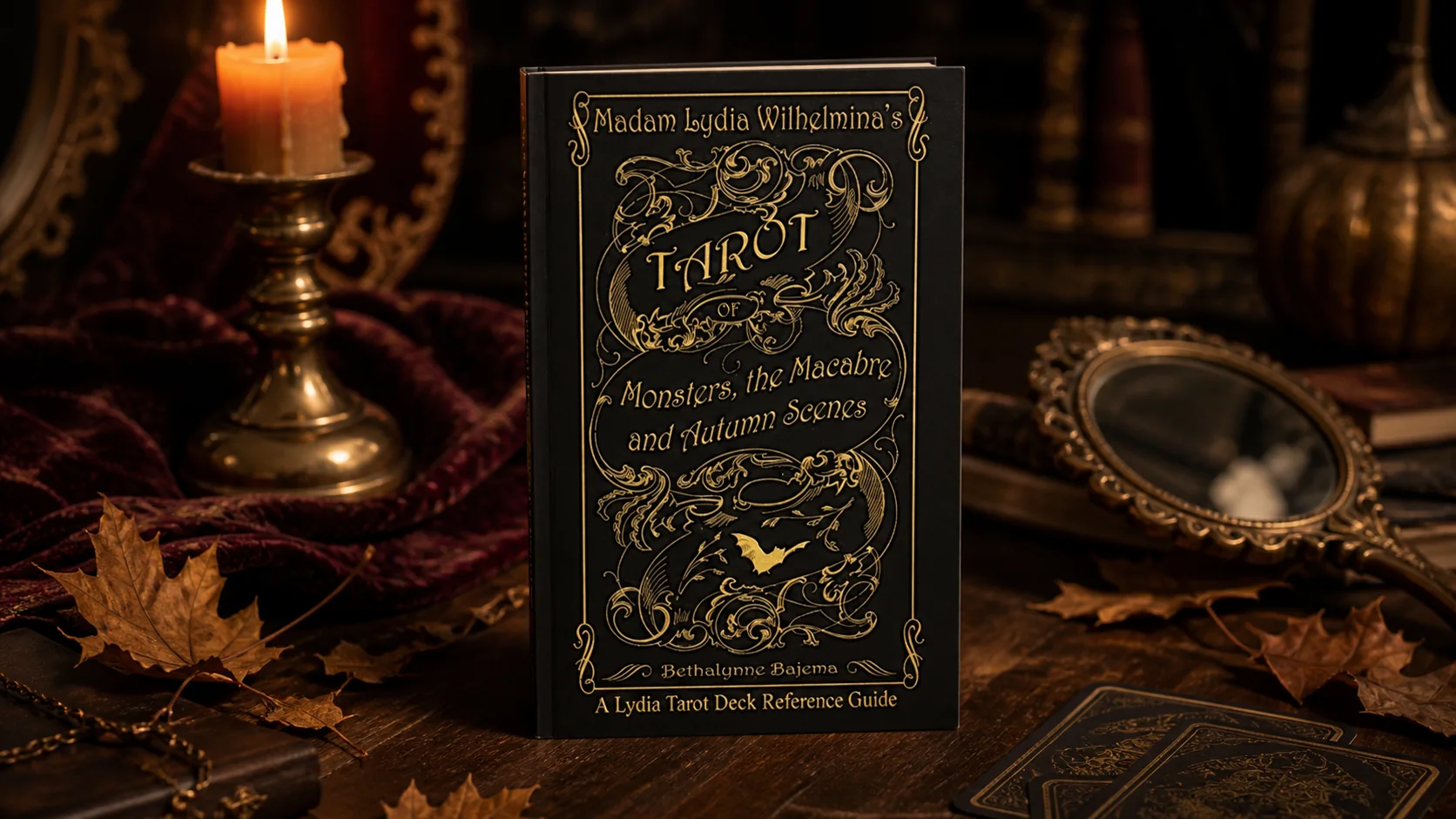
Madam Lydia Wilhelmina’s Tarot of Monsters, the Macabre & Autumn Scenes is Bethalynne Bajema’s 78-card Gothic collage deck: a Victorian cabinet of portraits, masks, skeletons, candlelit rooms, antique objects, autumn colour, and sly theatrical horror. I find its familiar tarot structure gives me a steady doorway into a world that feels anything but ordinary.
I love the sensation of discovering these cards in an old house where every drawer keeps a secret. Sepia faces, curling gold lines, dark masks, and sudden flashes of pumpkin orange make the spread feel inhabited. I begin with the detail that gives me a shiver or a smile, then return to the card’s traditional role so atmosphere sharpens the reading instead of swallowing it.
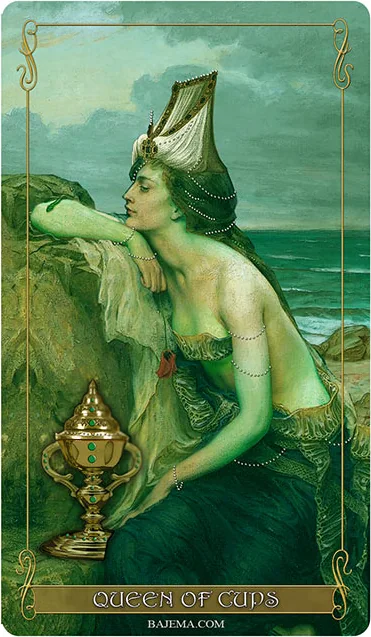
The Queen of Cups feels especially revealing here. Her sea-green stillness is soft but not passive; she seems to listen past the obvious answer. Beside Death or The Moon, that calm becomes a gentle invitation to sit with change, name the feeling beneath it, and notice which part of the story is ready to loosen.
I would reach for this deck when a question involves family patterns, creative identity, hidden motives, endings, or the strange roles we inherit without choosing. It asks for slow looking. A costume, a turned gaze, or an object held close can show me where the emotional pressure gathers, while the surrounding cards tell me whether to wait, speak, release, or begin again.
This is a strong choice for collectors, intuitive readers, dark-folklore lovers, and anyone who wants a spread to unfold like a beautifully haunted tale. I let its autumn rooms remind me—and you—that even the oldest story can open a hidden door, and we still get to choose the brave, living path beyond it.
What exactly is Madam Lydia Wilhelmina’s Tarot?
Created by Bethalynne Bajema, the deck follows a familiar Rider–Waite–Smith sequence: 22 Major Arcana, then Wands, Cups, Swords, and Coins with Page, Knight, Queen, and King courts. The verified source set used here is the out-of-print Second Edition. The recovered gallery contains 68 unambiguous same-edition card fronts; ten missing cards have not been guessed or replaced with lookalikes.
Bajema’s collage method places historical portraits and painted figures inside dark ornamental borders, then changes their emotional temperature with masks, skulls, animals, pumpkins, antique implements, and autumn landscapes. The result is more séance-room scrapbook than conventional fantasy illustration.
The Magician — charm, tools, and deliberate display
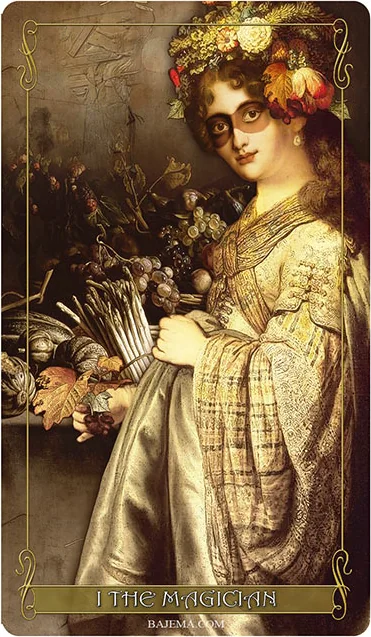
A richly dressed woman faces us with a composed gaze, an open fan held across her body. Flowers crowd her hair and costume while deep shadow gathers behind her. The figure feels less like a stage magician and more like a host who understands exactly how appearance shapes attention.
The fan, elaborate dress, and floral abundance turn the Magician’s traditional skill into social and aesthetic agency. The tools are not laid out on a table; the figure herself is the arrangement. In a reading, this supports intentional self-presentation and the ability to gather resources around one purpose. Its shadow is performance without substance—being so occupied with the effect that the actual work disappears.
How the deck reads in practice
Begin with the card’s standard tarot function, then let the collage tell you what kind of scene you have entered. A court may feel aristocratic, haunted, comic, or predatory. A familiar Major may trade textbook clarity for an expression, costume, or object that points toward memory, secrecy, status, or mortality.
The deck is especially good at questions involving family patterns, creative identity, hidden motives, endings, and the stories people inherit. It rewards slow looking. Name the first detail that unsettles or delights you, then ask what that reaction contributes to the card’s established meaning.
The masked procession
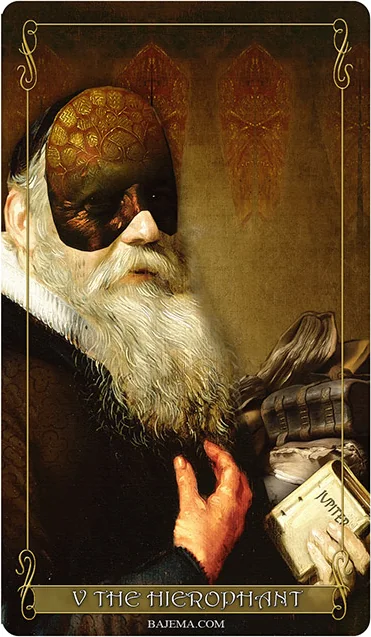
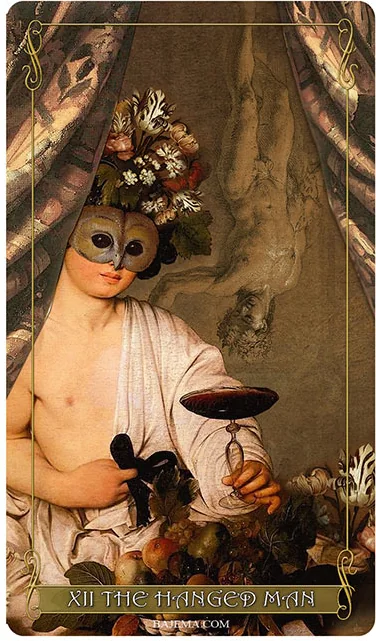
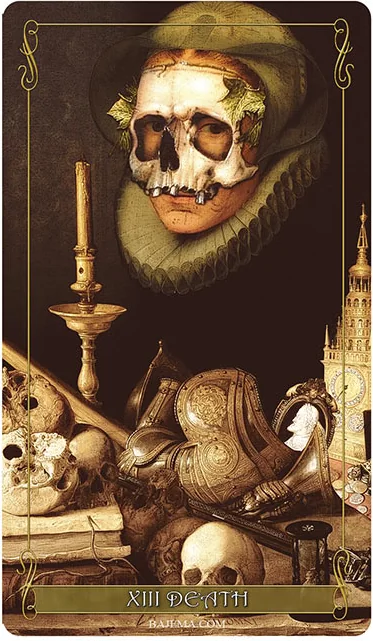
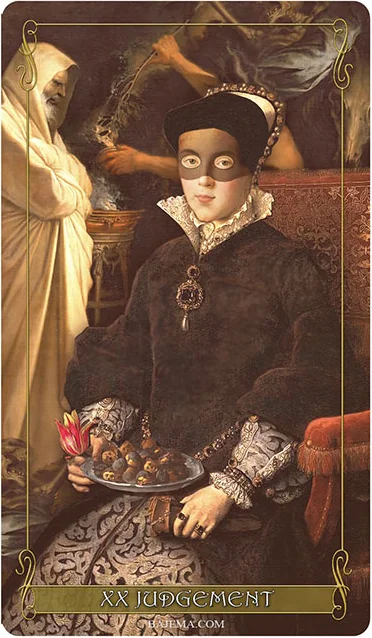
These four Majors use disguise, ritual, suspension, and reckoning to ask what is concealed—and what can no longer remain hidden.
Is it beginner-friendly?
Structurally, yes: the suits, courts, and Major Arcana sequence give a beginner a dependable map. Visually, it is a medium-difficulty first deck. The collage language is atmospheric rather than instructional, and a figure’s expression may matter more than an obvious RWS prop.
A useful learning method is to keep a classic reference nearby. Write one sentence for the traditional function, one for the most conspicuous visible detail, and one for the action the combination suggests. That prevents the Gothic mood from becoming a vague keyword such as “dark” or “mysterious.”
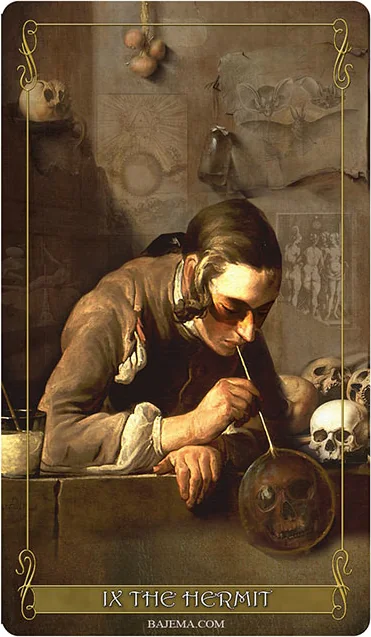
The Hermit — study beside the skull
A solitary man bends over his work in a dim interior. A small flame or lamp, books, instruments, and a skull gather around the desk, while clocks or antique mechanisms recede into brown shadow. The scene feels private, patient, and materially grounded.
Here wisdom is not an abstract beam of light; it is the discipline of staying with difficult evidence. The skull keeps mortality beside scholarship, reminding the reader that time is limited. Upright, the card favours research, quiet practice, and honest self-examination. In shadow, solitude hardens into obsession or postponement—the study never ends because the person is afraid to return to the world.
Questions this deck handles well
Easy — one card
What detail deserves my attention today? Name it without interpretation first, then decide what practical response it invites.
Medium — three cards
What am I showing, what am I concealing, and what wants to be acknowledged? This fits the deck’s recurring masks, portraits, and staged interiors.
Hard — five cards
What story have I inherited, where does it still direct me, what must end, what can be preserved, and what new role am I ready to inhabit?
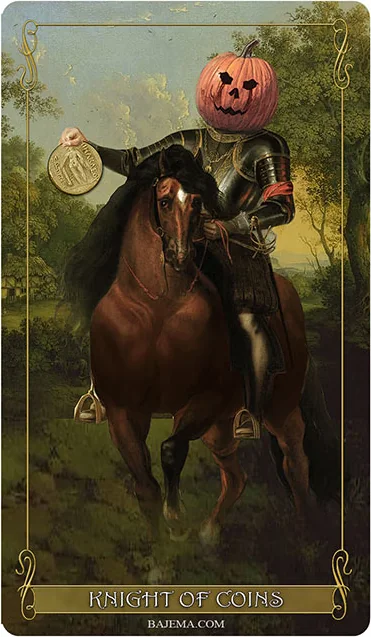
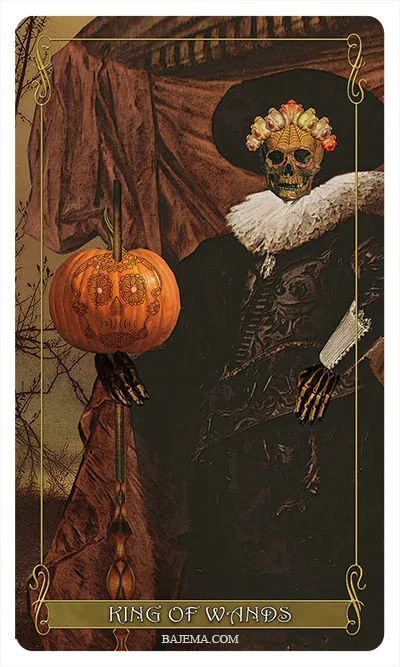
Autumn courts
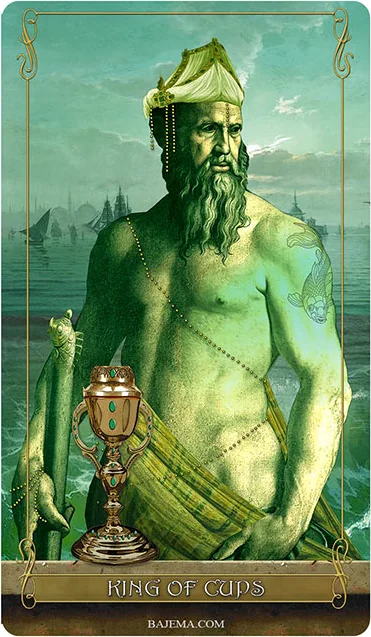
These courts balance harvest colour with theatrical authority: movement, charisma, feeling, and stewardship each arrive in a different costume.
Art style, personality, and audience fit
The deck’s personality is ornate, melancholic, witty, and occasionally grotesque. Sepia and moss green hold the historical collage together; black masks, white skulls, pumpkin orange, burgundy, and gold supply theatrical punctuation. The images are rarely neutral. They arrive with a setting and implied backstory.
Best for: collectors of independent and out-of-print decks, shadow-work readers, writers, visual journalers, Halloween readers, and people drawn to antique portraiture. Think twice if: you dislike skulls or masks, need a bright reassuring palette, or want every RWS symbol reproduced literally.
The Moon — an object held close
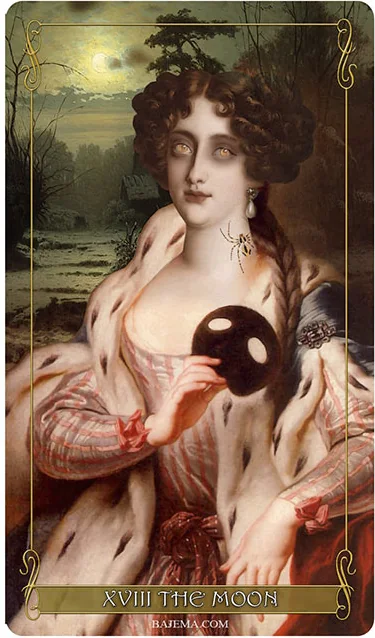
A pale woman in historical dress faces forward while holding a dark circular object near her chest. A muted landscape and water sit behind her; her expression is calm but difficult to read. The black disk becomes the composition’s gravitational centre.
The Moon’s uncertainty is concentrated into something apparently tangible yet opaque. The figure does not flee it; she carries it. In a reading, this can describe living beside unanswered feelings without pretending they are resolved. Its useful expression is patient attention to dreams, instinct, and ambiguity. Its shadow is protecting the mystery so fiercely that no evidence is allowed to change the story.
What to know before searching for a copy
The verified source identifies this as a 78-card Second Edition and describes it as out of print. Treat listings carefully: ask for photographs of the exact edition, all card fronts or a counted stack, the guide/reference material, the box or wrap, and the card backs. Do not assume that similarly named Lenormand or fortune-telling cards belong to this tarot.
The deck itself remains an out-of-print collector item. The Amazon link on this page leads to Wilhelmina’s Monsters: Orica’s Macabre & Autumn Scenes, so use the gallery and walkthrough to confirm the tarot edition separately when evaluating a second-hand deck.
Pressure in the Swords
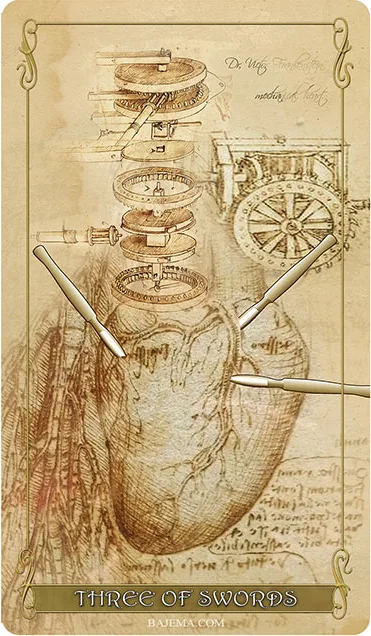
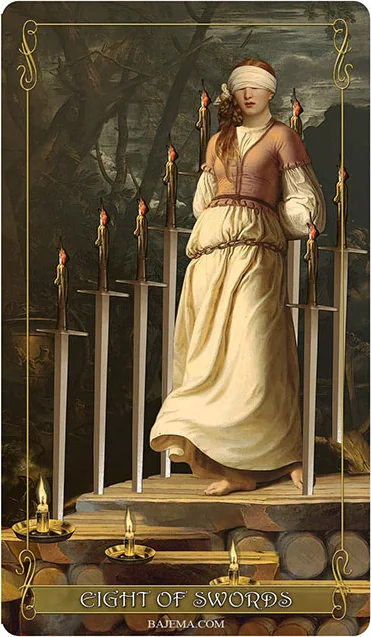
These four cards move from injury through restriction and sleepless thought toward the difficult authority to name what is true.


Orica’s golden rule
Do not let atmosphere replace evidence. Let the first shiver or fascination open the reading, then return to the card title, the visible objects, and the real question. This deck is most useful when its Gothic drama sharpens attention rather than turning every message into an omen.
Final Thoughts
Madam Lydia Wilhelmina’s Tarot has a rare, coherent world. Its old portraits, masks, skulls, autumn courts, and theatrical interiors make even familiar cards feel discovered rather than explained. The traditional structure keeps that world readable while the collage invites personal association.
For the right reader, it is memorable precisely because it is not neutral. Approach it slowly, verify the edition when buying second-hand, and let each strange detail earn its place in the interpretation.
FAQ
How many cards are in Madam Lydia Wilhelmina’s Tarot?
The deck contains 78 cards in a traditional tarot structure. The current TarotFans gallery contains 68 verified Second Edition card fronts; ten unavailable cards have not been guessed or substituted.
Who created Madam Lydia Wilhelmina’s Tarot?
Bethalynne Bajema created the deck and its Gothic historical-collage world.
Does it follow Rider–Waite–Smith structure?
Yes. It uses 22 Major Arcana and the suits Wands, Cups, Swords, and Coins, with Page, Knight, Queen, and King courts.
Is Madam Lydia Wilhelmina’s Tarot good for beginners?
A visually confident beginner can use it, but its collage symbolism is less literal than a teaching deck. A classic RWS reference helps while learning its voice.
Is the deck still in print?
The verified Second Edition source is described as out of print. Availability is mainly collector or second-hand, so buyers should confirm the exact edition, all cards, and included reference material.
What readings suit this deck best?
It is especially effective for shadow work, inherited patterns, creative identity, endings, hidden motives, seasonal readings, and visual journaling.