Deck of the Dead Tarot Cards
Browse the verified card-front images recovered from the original TarotFans source. Cautious labels remain where printed titles are not safely legible; no missing cards are invented. Choose a group or select a card to open the larger carousel view.
A note from Aurica
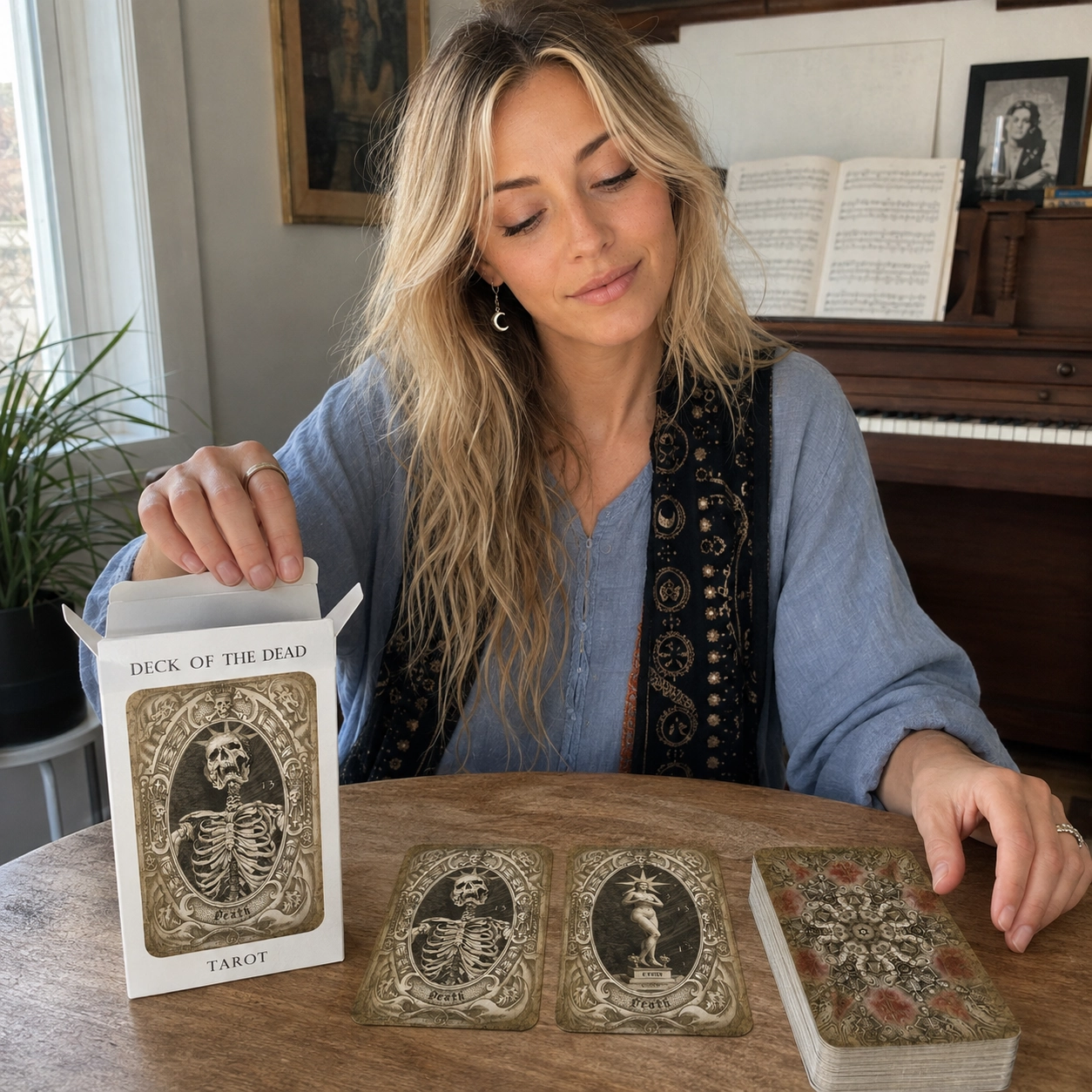
Deck of the Dead Tarot feels like opening an old cabinet in a quiet house and finding that every vanished life has left a story behind. I love the sepia engravings, the tiny skulls tucked into the borders, and the strange tenderness that appears beneath all that bone. Death does not feel like a threat here; it feels like a steady witness, reminding me that endings give shape to what mattered.
When I read with this deck, I begin with the card that makes me pause. I notice whether a figure is reaching, retreating, grieving, or standing bravely in the open, then I return to the card’s familiar Rider-Waite role and listen to what its neighbours add. The Star beside Death, for example, does not erase loss. It lets hope arrive honestly, like morning light finding its way into a room that has been dark for a long time.
This is the deck I would choose for questions about change, legacy, creative rebirth, or the truth we avoid because naming it might alter everything. Its antique pictures can look severe at first, yet they reward a patient gaze. I ask what must be released, what deserves to be remembered, and what small living thing is already beginning underneath the old story.
For all its graveyard beauty, Deck of the Dead Tarot is wonderfully alive: witty, humane, and brave enough to sit beside a difficult feeling without trying to hurry it away. Let its bones clear a little space around your question, and you may discover that the next chapter is not an ending at all, but a door you are finally ready to open.
Deck of the Dead Tarot review: gothic memento mori with readable tarot bones
Deck of the Dead Tarot is a gothic, antique-feeling tarot that treats death less like a jump scare and more like a reminder to live honestly. The recovered card gallery shows saints, skeletons, old portraits, graveyard moods, coins, swords, cups, and wands filtered through a sepia collage world. It is dark, but it is not empty-dark. The deck keeps asking what has ended, what still matters, and what truth becomes clearer when we stop pretending time is unlimited.
As a reading deck, it stays more practical than its dramatic name suggests. The scenes are busy in places, but the tarot structure is familiar enough that a Rider-Waite-Smith reader can work with it without learning a new oracle system. I would not choose it for a client who wants only soft reassurance. I would choose it for questions about release, grief-aware decisions, ancestor work, old roles, hard boundaries, and the kind of fresh start that only appears after something has truly been named.
The TarotFans native gallery below keeps the evidence honest: 70 usable card-front images are available from the recovered source set. A few labels remain cautious because not every printed title is safely legible, so this upgrade preserves the count instead of pretending the deck has been fully reconstructed.

Card study
The Fool: beginning while time is watching
The Fool is the best doorway into the deck. In a brighter tarot, The Fool can feel like innocence, curiosity, or a spontaneous leap. Here, the same beginning feels braver because the whole deck reminds us that life is finite. The card asks what you would dare to start if you stopped waiting for a perfect moment.
In a real reading, I would use this Fool for restarting after loss, burnout, or a period of fear. It says to travel light, but not carelessly. The leap matters because the old threshold has already closed behind you.
How Deck of the Dead reads in real spreads
The deck’s strongest readings are direct but not cruel. It does not soften endings into vague positivity, yet it also does not turn every difficulty into doom. The death language often works as compost: what is finished can feed what comes next. That makes it helpful for questions like: What should I release? What pattern keeps haunting me? What lesson belongs to my past but is still shaping my present?
I especially like the deck for small spreads. A three-card layout such as what is ending, what remains, what can grow suits it beautifully. The artwork has enough symbolic density that a ten-card spread can feel crowded, but one to five cards give the images room to speak.
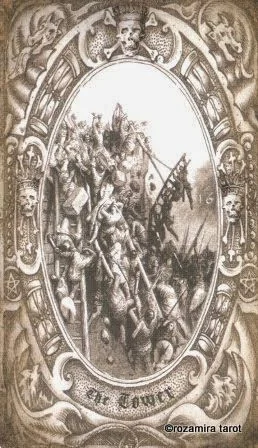
Majors: mortality, authority, revelation, completion
These four majors show the deck’s signature mix of antique ceremony and sharp tarot structure.


Artwork, tone, and symbolism
The visual language is vintage collage rather than polished fantasy illustration. Many cards feel like old religious engravings, mourning jewelry, cabinet-card portraits, cemetery sculpture, or pages from a strange devotional book. That gives the deck a strong ancestor feeling even when the reading is not literally about ancestors.
Because the art can be intricate, I read it in layers. First I name the traditional meaning. Then I ask what the dead, antique, saintly, skeletal, or grave-like detail adds. A skull may speak about finality. A formal pose may speak about duty. A ruined scene may speak about consequence. The deck becomes most useful when tradition and atmosphere are allowed to answer together.

Card study
The High Priestess: listening at the veil
The High Priestess feels naturally at home in this deck. She becomes a keeper of dreams, silence, family stories, and the kind of knowing that arrives before words do. In relationship readings, she may say that more is hidden or still forming.
For spiritual practice, this card is strong for journaling, ancestor questions, and slow intuitive work. The caution is to stay grounded. Let the symbol open, but do not force it to become a dramatic prophecy before it is ready.
Where grief begins to move
The High Priestess asks for stillness before the Cups carry feeling into motion. I pause here to notice which memory is asking to be honoured and which one is ready to loosen its hold; that small distinction keeps a tender reading from becoming a gloomy one.
Cups: grief, memory, care, departure
The Cups are where the deck becomes surprisingly tender, showing emotion as something that moves through memory instead of avoiding it.


Best uses and who should skip it
Deck of the Dead Tarot suits readers who enjoy gothic symbolism, memento mori art, cemetery imagery, antique books, saints, skeletons, and decks that can sit with difficult truths. It is a strong match for shadow work, endings, legacy questions, creative rebirth, grief-aware journaling, and practical decisions where denial has become expensive.
You may want to skip it if you prefer bright colors, clean modern scenes, soft angelic reassurance, or cheerful everyday pulls. Beginners can use it if they love the art, but I would not force it on someone who is already anxious about tarot. The deck is honest, beautiful, and a little theatrical; that is the gift and the limitation.
Swords: hard truth and mature boundaries
The Swords strip shows how the deck handles clarity: not as coldness, but as the courage to stop negotiating with an exhausted story.


Naming the ending without surrendering to it
The Swords prepare the ground for one final close look at an ending. Here the Ten of Swords becomes less a spectacle and more a clean boundary: the moment we stop feeding what has already finished.

Card study
Ten of Swords: the clean ending you can finally name
The Ten of Swords is intense in almost any tarot, and Deck of the Dead does not soften it. I appreciate that. Some readings need a card that says the story has reached its limit.
The healing message comes after the shock: once something is truly over, you can stop spending energy pretending it is still alive. In this deck, Ten of Swords is not only about hurt. It is about the first honest breath after naming the hurt.
What grows after the old story closes
Once the ending has a name, the Wands restore warmth and movement. Their fire does not deny what was lost; it shows where courage, appetite, and creative life are gathering again.
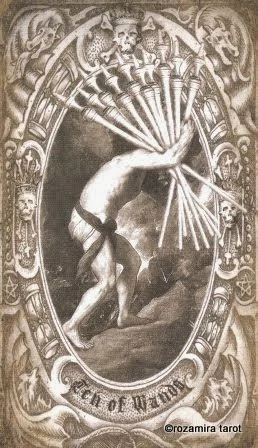
Wands: fire after the funeral
The Wands prove that this is not only a deck of endings. Fire still returns, but it asks which burden is really yours to carry.


Final Thoughts
Deck of the Dead Tarot is not trying to make tarot cute. It is trying to make tarot honest. In my hands, it reads like an old symbolic mirror: sometimes stern, sometimes ornate, sometimes deeply comforting because it admits that endings are real and still not the end of meaning.
If you want light daily sparkle, choose another deck. If you want a gothic tarot that can speak about grief, release, inherited patterns, spiritual seriousness, and brave new starts, this one deserves a close look. The 70-card gallery is enough to decide whether its visual world opens something in you or feels too heavy for your table.
Deck of the Dead Tarot FAQ
Is Deck of the Dead Tarot beginner-friendly?
It can be beginner-friendly for someone who already knows basic tarot or strongly loves gothic collage art. The structure is familiar, but the mood is heavy enough that very nervous beginners may prefer a softer first deck.
How many cards are shown in the TarotFans gallery?
The native gallery currently shows 70 usable card-front images from the recovered source set. The review keeps that count honest and does not invent the missing cards.
Is Deck of the Dead Tarot only for dark readings?
No. The deck is gothic, but it can read practical questions about release, timing, relationships, work, creative rebirth, and emotional honesty. The death imagery mainly adds seriousness and memento mori symbolism.
Does it follow Rider-Waite-Smith meanings?
Mostly, yes. The minors are illustrated and the deck is close enough to standard tarot that Rider-Waite-Smith readers can usually find their footing while still noticing the deck’s antique, death-themed twist.
Where can I find Deck of the Dead Tarot?
The creator’s official Tarot by Seven product page lists the deck in three sizes and is the source-backed place to compare the current edition and options.