Darkness of Light Tarot Card Gallery
Browse this verified partial card gallery from Tony DiMauro’s Darkness of Light Tarot. Choose a group below, then select any card for a larger carousel view.
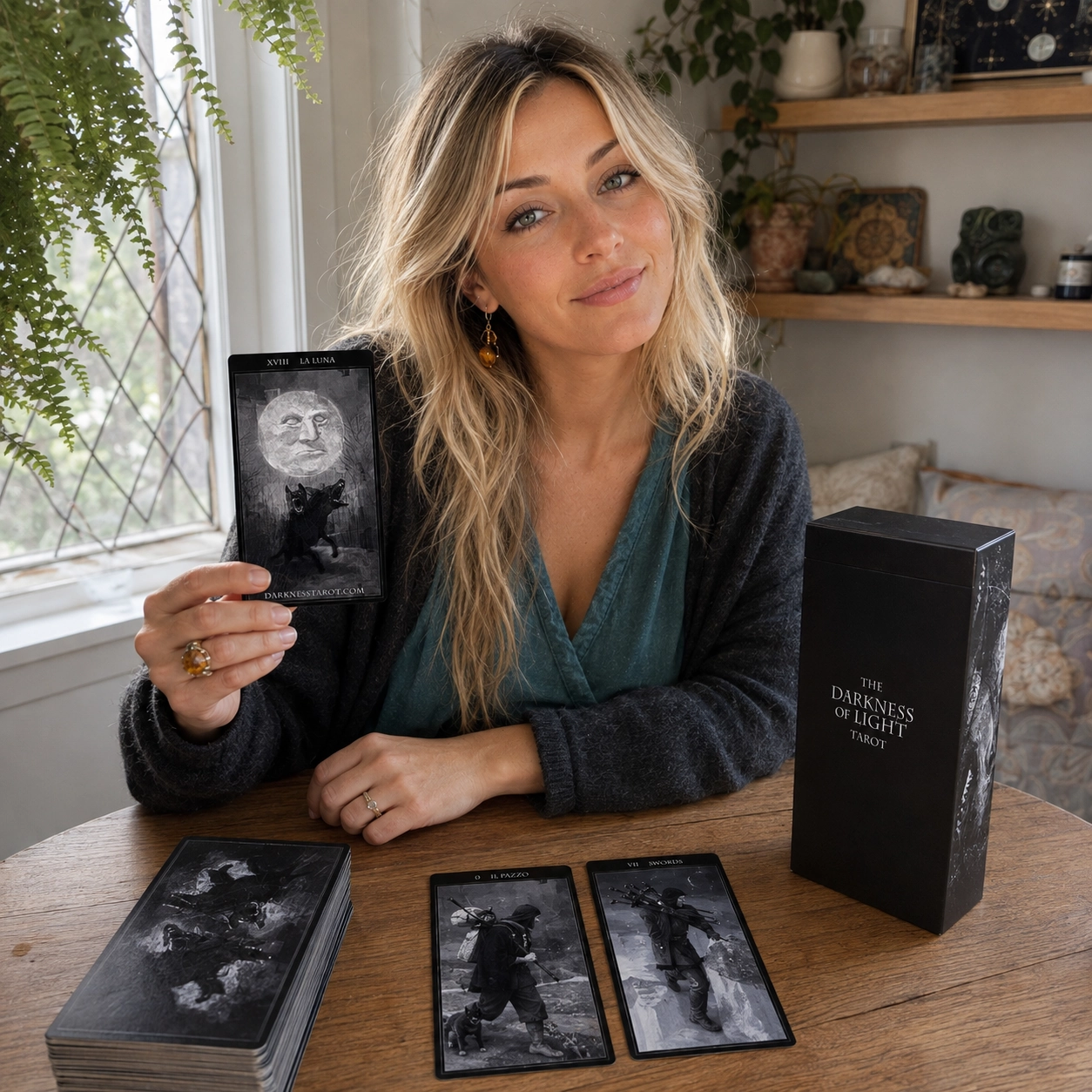
A note from Aurica
Darkness of Light Tarot feels like stepping onto a moonlit road just after the rain, when every shadow has an edge and every small glimmer matters. I love how Tony DiMauro lets beauty and unease share the same breath. La Luna’s enormous human face hangs over those dark, restless animals like a feeling too large to ignore, asking me to notice what my instincts know before my tidy explanations arrive.
In a reading, I begin with the image that makes my body react. Then I return to the card’s familiar tarot role and look at what the neighbouring cards change. Beside Il Pazzo, the Moon can turn uncertainty into a brave first step; beside the Seven of Swords, the same fog may be warning that fear, secrecy, or clever avoidance is shaping the path. The deck rewards that patient conversation between atmosphere and structure.
I would reach for these cards when a question has become difficult to name: a relationship full of mixed signals, a creative choice that feels risky, or an old pattern quietly following me. The grayscale world strips away distraction, while each figure’s posture carries the emotional colour. I ask what is moving, what is frozen, and where the smallest patch of light appears; that usually reveals the most honest next action.
This is not a deck that asks you to banish darkness or pretend every answer is comfortable. It invites you to hold contrast with tenderness, to recognise that caution and hope can sit at the same table. Darkness of Light Tarot reminds you that even when the whole road is not visible, the light you can see is enough for one true, courageous step forward.
Darkness of Light Tarot Review: moonlit drama with real reading bite
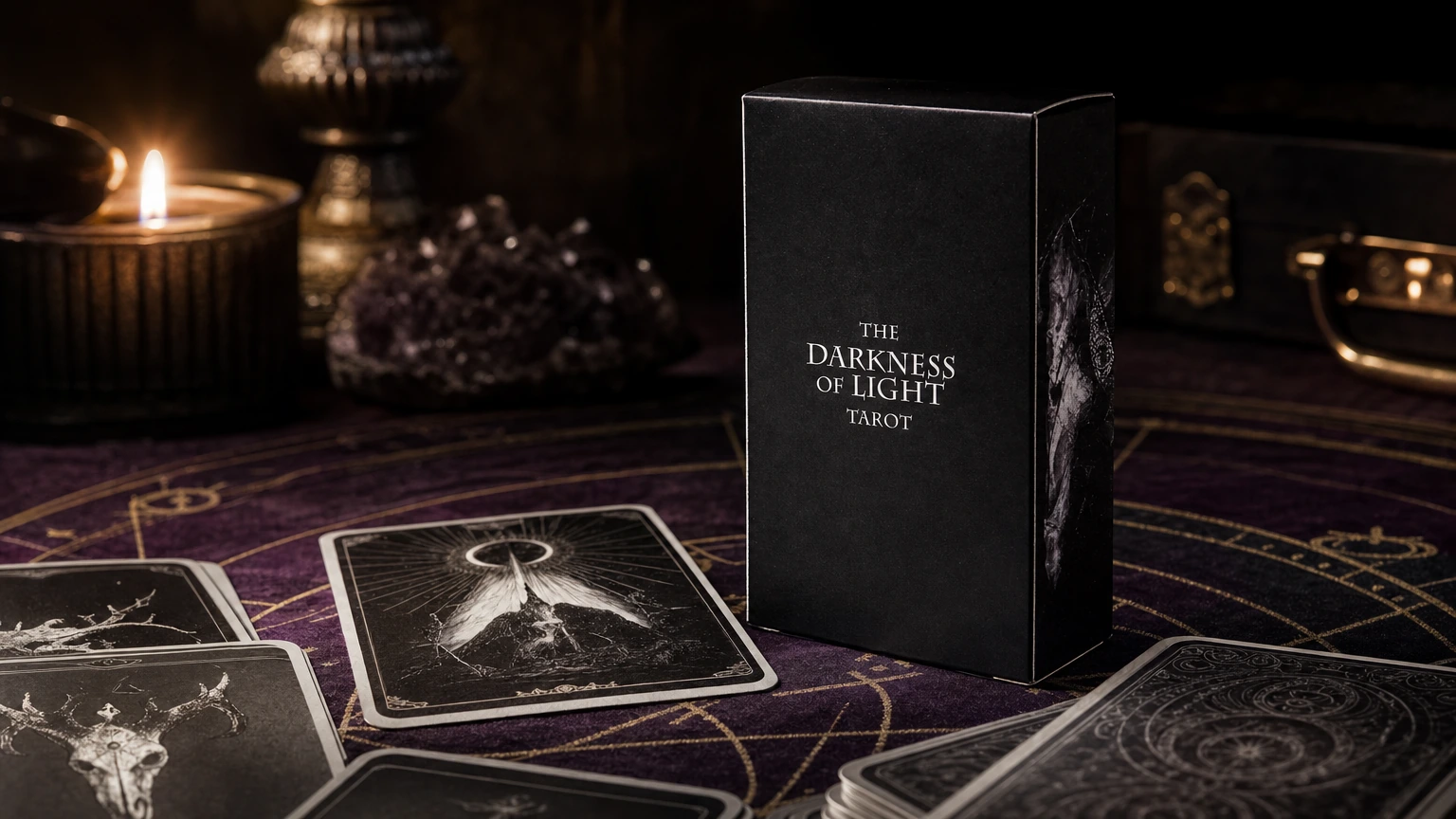
The Darkness of Light Tarot feels like a candle held inside a storm. Tony DiMauro’s artwork is moody, cinematic, and emotionally direct: pale faces, dark skies, lonely roads, veiled choices, and figures who seem caught at the exact moment before a truth becomes unavoidable. It is not a cheerful comfort deck, but it is a very readable deck if you like atmosphere.
This review keeps the gallery count honest. TarotFans currently has 70 recovered card fronts from the deck-specific source material, not the full 78. The missing cards are listed in the FAQ instead of being replaced with uncertain lookalikes. What is here still gives a strong picture of the deck’s voice: majors, courts, suit cards, grief cards, choice cards, and several strong emotional anchors.
How the deck reads
In readings, Darkness of Light Tarot is strongest when the question has weather inside it. It handles grief, hesitation, longing, secrecy, self-protection, and the strange moment when you know something has to change but cannot yet see the shape of the next life. The deck does not shout meanings at you. It asks you to look at posture, distance, light, and the small symbols around the figure.
That makes it especially useful for journaling and shadow-work spreads. I would not choose it for every breezy daily pull, but when I want a reading to feel serious and psychologically textured, it earns its place on the table.
Card study
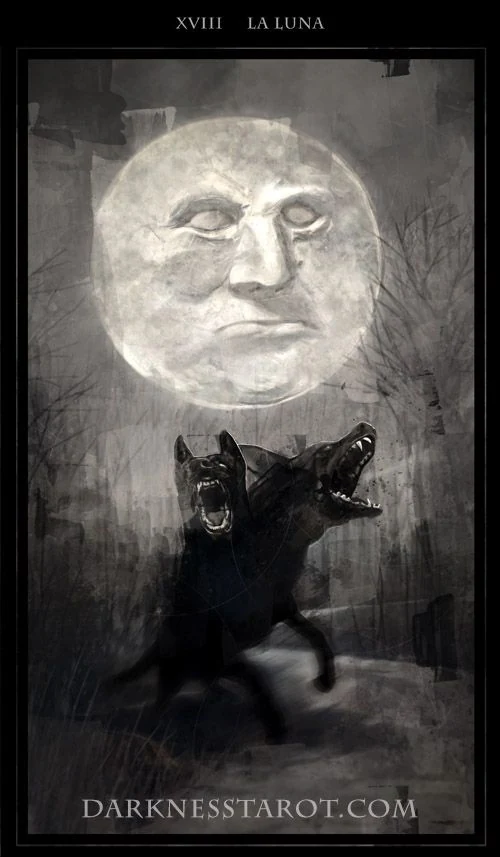
Moon: intuition when the path refuses to stay still
The Moon is one of the cleanest examples of why this deck works. The image makes uncertainty feel active rather than vague. You are not simply confused; you are walking through a landscape where fear, instinct, memory, and symbol are all speaking at once.
In a reading, I would use this card to slow down. It asks what your body already knows, what has been distorted by anxiety, and what information is still hidden. It is a beautiful card for dreams, secrets, and emotional weather.
Let that lunar uncertainty breathe for a moment before widening the lens. The next four cards show how this deck turns instinct into movement, choice, and consequence.
Four-card moment
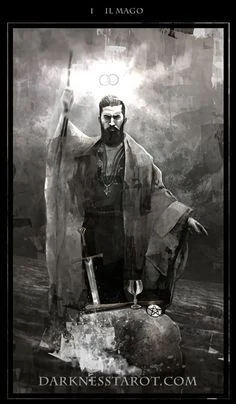
Entering the dim road with your tools
These four cards make the deck feel like an initiation: a first step, a set of tools, a hidden law, and a deep feminine intelligence watching from the dark.


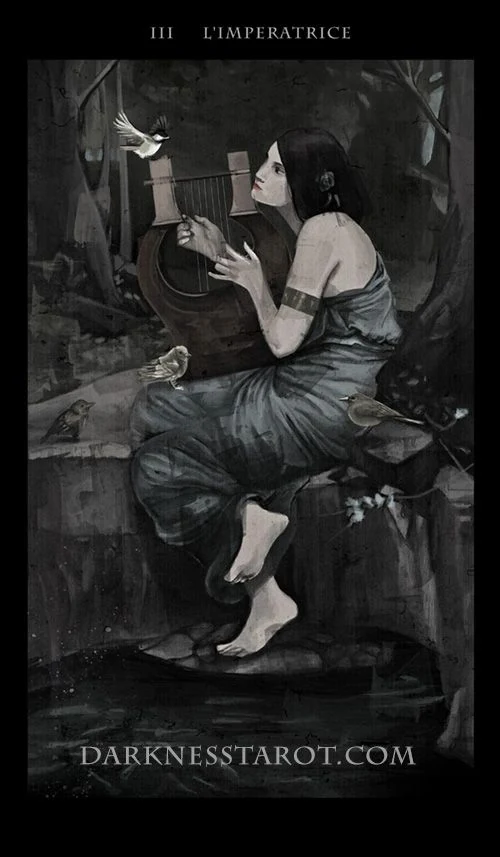
Artwork and mood
The palette is muted and dramatic: charcoal, mist, pale skin tones, cold blues, bruised pinks, and flashes of warmer light. Many cards feel like film stills from a gothic fairy tale, but the deck is not random darkness. The best images are composed around a clear emotional gesture: reaching, turning away, waiting, guarding, mourning, or standing in a threshold.
Because the deck leans so hard into mood, it rewards readers who enjoy visual storytelling. A beginner can read it, but the ideal reader is someone who already knows the skeleton of tarot and wants the image to complicate the answer.
Card study
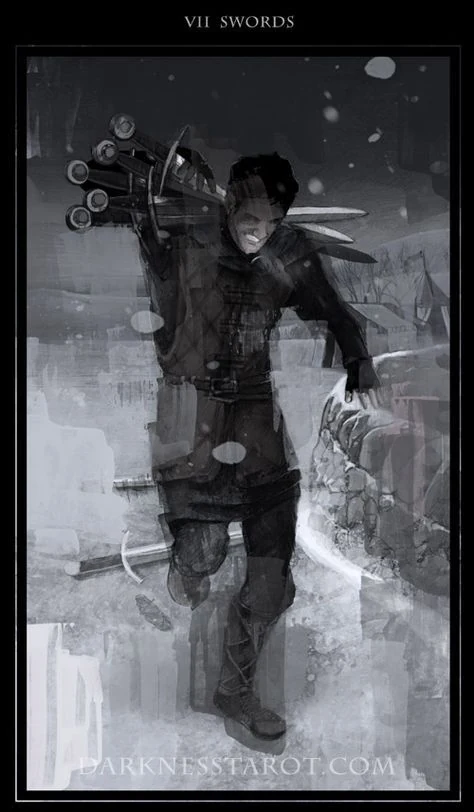
Seven of Swords: strategy in a cold landscape
The Seven of Swords feels tense here. It is not just a cartoon thief card. It carries the feeling of moving carefully through a situation where honesty may be costly and silence may be a form of self-defense.
That makes it useful for questions about privacy, avoidance, negotiation, and self-protection. The card asks whether you are being clever because you must be, or evasive because you are afraid to be seen.
The chill in this card becomes clearer when it meets other forms of pressure. In the next group, desire and disruption reveal what strategy is trying to protect.
Four-card moment
Choice, pressure, and consequence
This sequence has the heart of the deck: desire, disruption, strategy, and a choice that cannot be postponed forever.


Beginner friendliness and best uses
I would recommend Darkness of Light Tarot to an adventurous beginner, but not to someone who wants a very bright teaching deck. The titles and structure are familiar enough to learn from, yet the emotional tone can make simple cards feel heavy. That is a strength when you want nuance and a weakness when you want quick, cheerful clarity.
The deck is excellent for relationship undercurrents, grief, creative blocks, anxiety spirals, endings, choices, dream interpretation, and readings about what a person is not saying out loud. It also works beautifully as a writing prompt deck because each card feels like a scene with a before and after.

Card study
Four of Coins: protection, control, and the locked room
The Four of Coins is a useful card in this deck because it does not reduce holding on to simple greed. It feels like a locked room, a guarded heart, or a person who has learned that safety comes from keeping everything close.
In practical readings, it can still point to money and scarcity. Emotionally, though, it asks where control has become a substitute for trust, and what would actually make release feel safe.
That clenched stillness is only one part of the story. The following cards trace what happens when fear finally moves, breaks, and makes room for a slender line of hope.
Four-card moment
Fear, endings, and the thin line of hope
This moment moves from anxiety to collapse, then toward passage and light. It keeps the deck’s shadow work from becoming hopeless.


Pros and cons
| Pros | Cons |
|---|---|
| Beautiful gothic cinematic mood with strong emotional storytelling. | The TarotFans visual gallery is partial at 70/78 recovered cards. |
| Excellent for shadow work, grief, dreams, relationship patterns, and journaling. | Not ideal if you want a bright, simple, cheerful beginner deck. |
| Familiar tarot structure keeps the darker art readable. | Some subtle scenes ask for slower interpretation rather than quick keywords. |
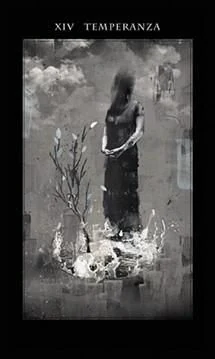
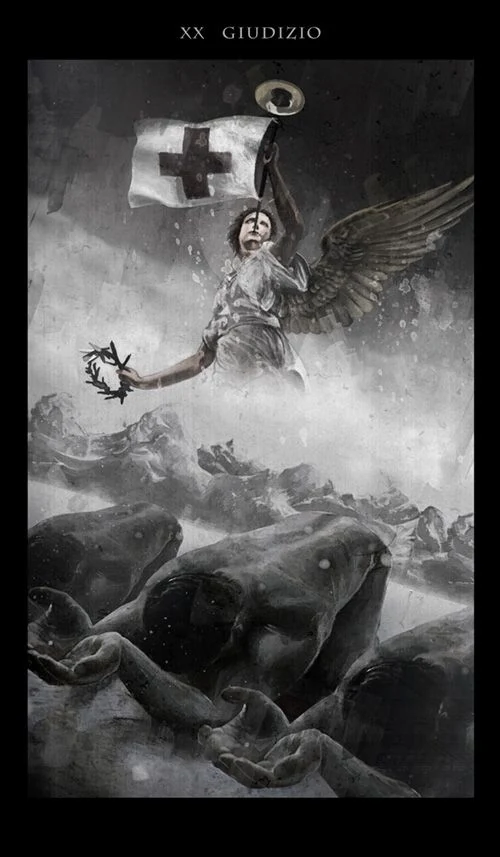
After weighing the deck’s strengths and sharper edges, these four cards gather its closing lesson: power becomes trustworthy when patience, self-knowledge, and honest judgment travel together.
Four-card moment
Power, patience, and the return of judgment
This group is useful for work and life-direction questions: structure, turning cycles, moderation, and the moment when an old story asks for an honest verdict.


Final Thoughts
Darkness of Light Tarot is a deck for readers who like their cards atmospheric, serious, and emotionally intelligent. It is dark, but not empty. Its best images turn shadow into information: what is hidden, what is guarded, what has ended, and what small light still remains.
If your tarot practice values mood, symbolism, body language, and honest inner work, this deck is worth a close look. If you want only cheerful daily affirmations, it may feel too stormy. For the right reader, that storm is exactly the point.
Darkness of Light Tarot FAQ
How many Darkness of Light Tarot cards are shown here?
This TarotFans gallery currently shows 70 verified Darkness of Light Tarot card images. The recovered source set is still missing Eight of Wands, Three of Swords, Queen of Swords, Three of Cups, Death, The Devil, The Star, and The World, so the page keeps the count honest.
Is Darkness of Light Tarot beginner friendly?
It is best for beginners who enjoy atmospheric art and are willing to read visually. If you want bright textbook scenes, pair it with a simple Rider-Waite-Smith reference while learning.
Who created the Darkness of Light Tarot?
The deck is by Tony DiMauro, and its signature appeal is the moody cinematic artwork: figures, weather, moonlight, shadow, and dramatic emotional scenes.
What readings does this deck suit best?
It shines for shadow work, grief, anxiety patterns, relationship undercurrents, creative blocks, dream journaling, and questions where atmosphere and body language matter as much as keywords.
Does it follow familiar tarot structure?
Yes. The deck stays close enough to familiar tarot titles and archetypes that Rider-Waite-Smith readers can use classic meanings while letting the darker art add nuance.
What should I notice first in a Darkness of Light Tarot reading?
Begin with the gesture, weather, or patch of light that catches your eye. Then connect that feeling to the card’s familiar tarot role and notice how the neighbouring cards soften, sharpen, or redirect it.


