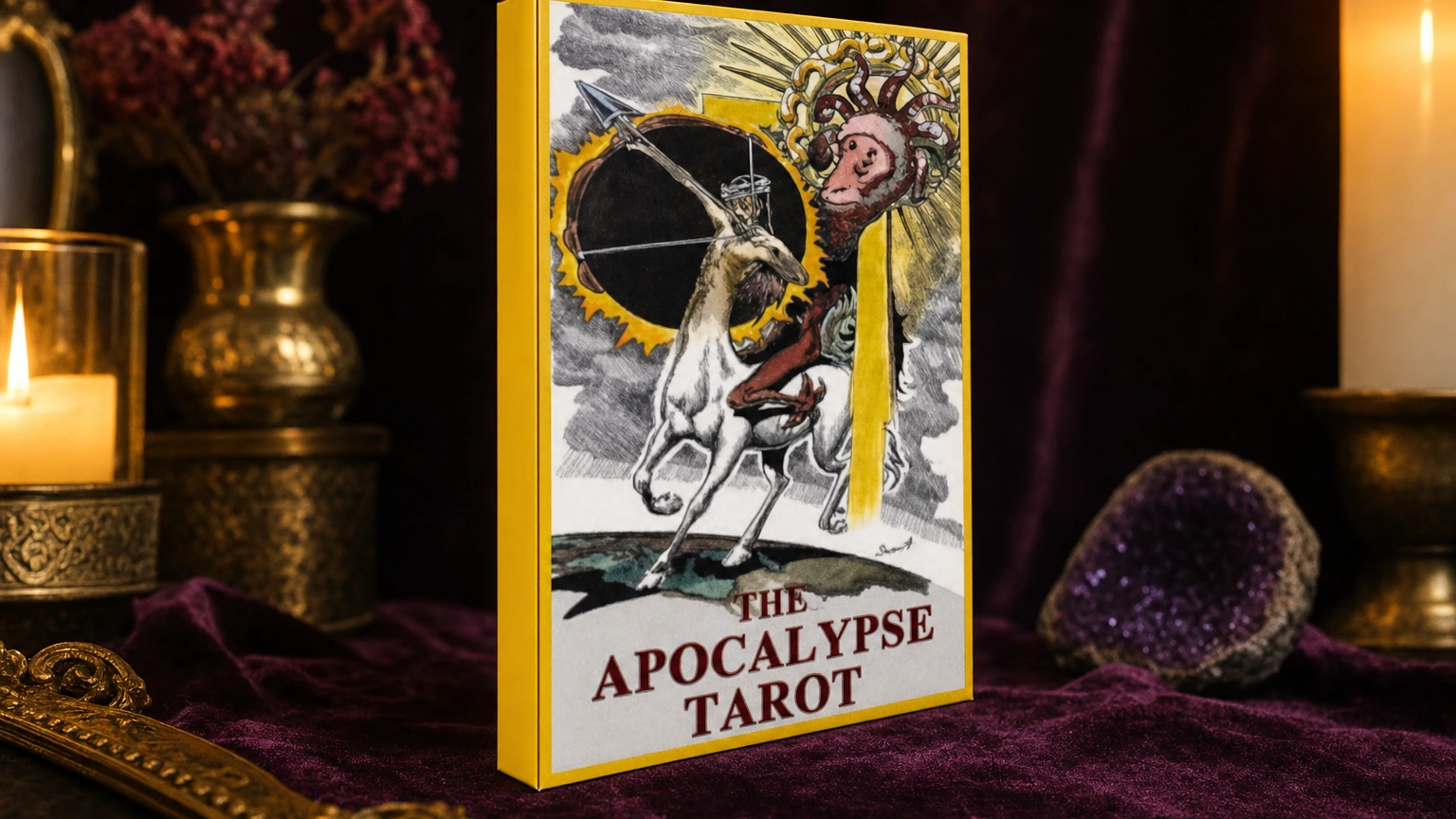
The Apocalypse Tarot is a dramatic deck about revelation, endings, pressure, and the courage to rebuild. The name sounds intense, but the useful tarot idea here is not doom. An apocalypse is an unveiling: a moment when the truth becomes visible and the next honest step can finally begin.
The Apocalypse Tarot Cards
Browse this verified partial archive by official group, then open any card in the larger accessible Lightbox. Missing cards are not padded or invented.
A note from Aurica
The Apocalypse Tarot feels like opening an illuminated manuscript just as a storm breaks over the page. Its saints, beasts, angels, rulers, and ordinary human figures carry old spiritual questions into scenes that are startlingly alive. I find the deck intense, but not hopeless: beneath its warnings, it keeps asking what can be understood, released, and rebuilt.
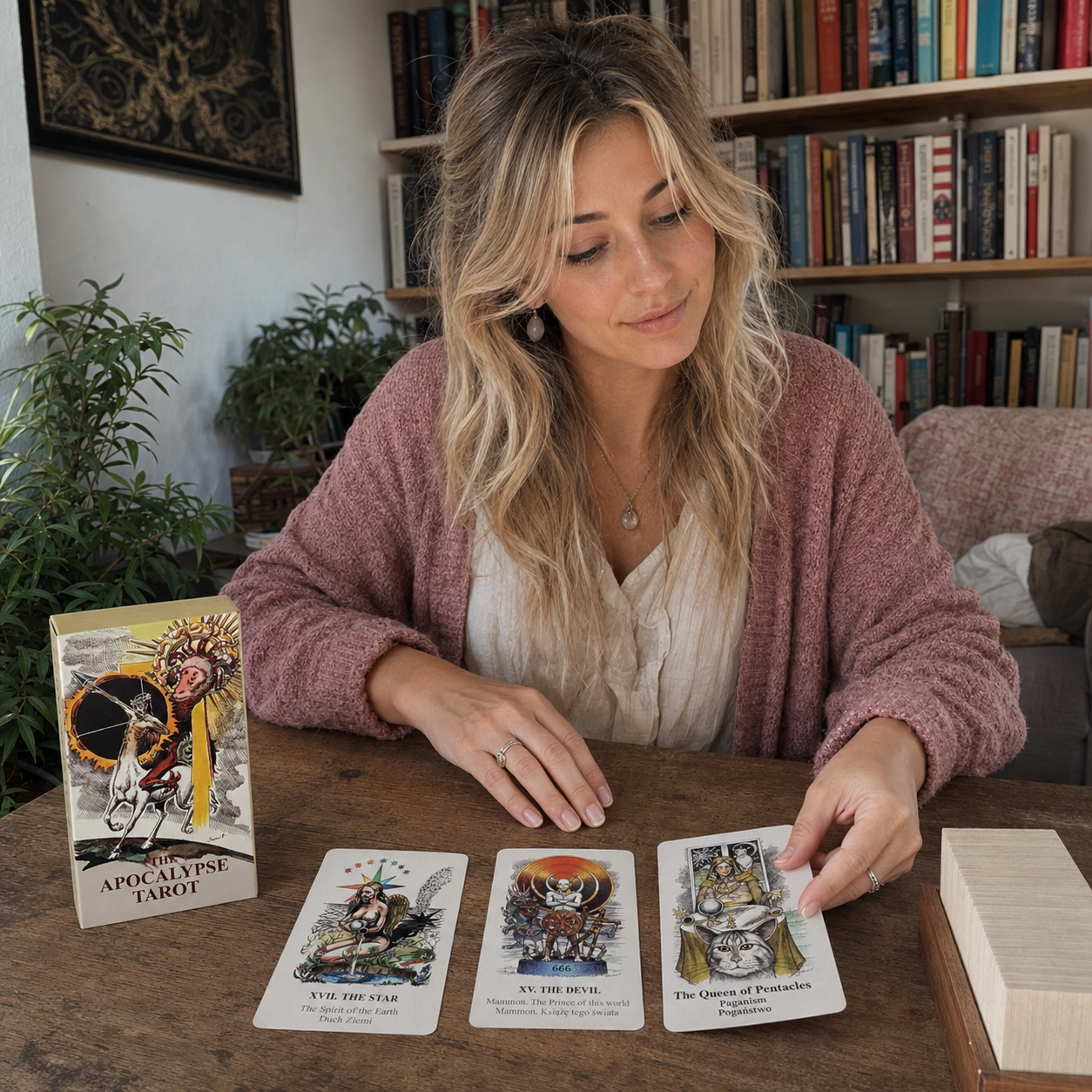
The Star draws me in first. Her strange, bright presence feels like a clean breath after upheaval, while The Devil gathers desire and fear into a much tighter circle. Then the Queen of Pentacles brings the reading back to the body, the home, and the care that makes survival possible. Together they remind me that revelation matters most when it changes how we live.
When I read with these cards, I begin with the figure who seems to meet my gaze—or refuses it. I notice where the image feels crowded, where a gesture creates distance, and where colour opens a small doorway. Then I return that first emotional response to the card’s familiar tarot role and ask how the surrounding cards deepen or challenge it.
This is a deck I would choose for brave questions rather than quick reassurance. It can speak clearly when a belief has cracked, a relationship has reached its truth, or an old structure no longer protects the person inside it. The bilingual captions and Christian-esoteric imagery slow me down, which is part of their gift: they invite reflection before certainty.
If a picture feels overwhelming, choose one face, one symbol, or one patch of colour and let that be your way into the reading. The Apocalypse Tarot may arrive with thunder, but its deepest promise is that honest seeing can clear a path toward wiser, kinder beginnings.
Quick take
This is not a soft morning-coffee deck. It is a deck for brave questions: what is collapsing, what is being revealed, what can be repaired, and what has to be released. The available TarotFans gallery is a verified partial set, so I keep the visual count honest while still giving you enough cards to feel the deck’s serious, sacred, transformation-focused mood.
If you like symbolic, philosophical, darkly spiritual tarot, The Apocalypse Tarot has a strong voice. If you want gentle pastel reassurance or a fully complete visual archive on this page, it may not be the easiest first choice.
What The Apocalypse Tarot feels like in readings
The Apocalypse Tarot reads best when the question already has emotional weather around it. It can be blunt, but not cruel. Its imagery works like a bell: something rings, something wakes up, and the reader has to look clearly instead of pretending everything is fine.
That makes the deck useful for shadow work, recovery after burnout, relationship truth-telling, major life transitions, and career questions where an old structure needs to be rethought. I would not use it to scare someone or predict disaster. The deck is strongest when it helps a person name what is true and choose one grounded next step.

Card study
The Star — hope after the alarm
The Star is one of the most important cards in this deck because it proves the apocalyptic mood is not only about endings. It feels like the first clean breath after a siren stops.
In a reading, I would ask: what still shines after the old plan is gone? The Star does not erase the hard part, but it gives the querent a point of light to move toward.
Artwork and symbolism
The artwork is intense, symbolic, and often heavy with sacred or apocalyptic imagery. You may see ruined structures, urgent skies, severe figures, and cards that feel like they belong to a mythic crisis. That seriousness is the identity of the deck.
The best way to read it is to let the image add tone to the traditional meaning. A card may not only say “change”; it may say “change that can no longer be delayed.” A Pentacles card may not only say “resources”; it may say “protect the basics while the world feels loud.”
Four-card moment
When everything feels too loud


Step back, breathe, and do not solve the whole future tonight. This sequence moves from shock to solitude, then hope, then one small real-world seed.
Beginner friendliness
Beginners can use The Apocalypse Tarot if they genuinely enjoy its dark symbolic style. Motivation matters. A deck you want to study will teach you faster than a technically simple deck you avoid.
Still, I would not call it the softest beginner deck. It works better if you have a simple tarot keyword list nearby and are comfortable asking reflective questions. Start with one-card pulls: name the card, write three visual clues, add two traditional keywords, then choose one practical action.

Card study
Ten of Swords — the honest end point
The Ten of Swords is intense here, and that is the point. It is the card for the moment when a story has already collapsed but the mind keeps trying to bargain with it.
Read gently, it can be freeing. Name what is finished, protect your nervous system, and choose one small next step instead of turning the ending into your whole identity.
Love, relationships, and shadow work
For love readings, this deck is best when the question is about truth, boundaries, patterns, or the courage to stop repeating an old cycle. It is not a sugary romance deck, but it can be very honest about attachment, avoidance, conflict, and healing.
For shadow work, The Apocalypse Tarot is even stronger. Ask questions like: what has been hidden, what am I afraid to admit, what pattern is ending, and what would rebuilding actually require? Keep the reading kind, practical, and consent-based. The goal is clarity, not panic.
Four-card moment
When an ending is already happening


A strong “stop feeding the loop” sequence: name the attachment, accept the ending, rest before reacting, and let practical care lead the rebuild.
Career, money, and rebuilding questions
The deck is surprisingly practical for career and money readings because it does not let vague plans hide forever. It asks where a system is failing, what work is real, what resources need protection, and what kind of structure can survive stress.
For money questions, keep the interpretation grounded. Pentacles still mean body, resources, time, work, and material stability. The apocalyptic tone does not mean the answer is negative; it means the basics deserve serious attention.
Card study
Queen of Pentacles — rebuilding with real care
The Queen of Pentacles gives this deck its grounding note. After all the revelation and pressure, she brings the reading back to food, money, shelter, body, and steady care.
In this deck she feels like the person who knows how to make a safe room after a storm. I read her as practical compassion: repair the basics first, then make meaning.
Pros and cons
| Pros | Cons |
|---|---|
|
|
Four-card moment
When work needs a new structure


Collaborate, practice, protect resources, and aim for a long-term structure instead of a dramatic quick fix.
Who will enjoy The Apocalypse Tarot?
This deck is for readers who want tarot to feel serious, mythic, and a little confrontational in a useful way. It suits people who are drawn to sacred art, philosophical questions, transformation work, and cards that can sit with hard moments without becoming hopeless.
Skip it if you want a cozy deck for light questions, or if apocalyptic language feels too intense for your current practice. The right reader will not experience this deck as doom. They will experience it as truth, pressure, and the chance to rebuild with clearer eyes.
Four-card moment
When truth changes a relationship


Desire and hope are present, but conflict must be named honestly. The Sun asks for clarity, not performance.
Final thoughts on The Apocalypse Tarot
The Apocalypse Tarot is worth exploring if you want a deck that treats endings as meaningful thresholds. It is dramatic, but its best use is not fear. Its best use is revelation: seeing what is real, choosing what can be saved, and letting the rest become part of the past.
Use the gallery above as your test. If the cards make you pause, breathe, and ask better questions, this deck may have exactly the kind of voice you need.
The Apocalypse Tarot FAQ
Is The Apocalypse Tarot a scary deck?
It can look intense, but I would not call it a fear deck. The apocalyptic theme works best as symbolism for endings, truth, pressure, and rebuilding.
Is The Apocalypse Tarot good for beginners?
It is best for beginners who like dramatic symbolic art and are willing to use a keyword list while learning. Readers who want very gentle scenes may prefer a softer first deck.
Does this page show every card?
No. The live TarotFans gallery uses a verified partial set of 48 card-front images. I keep that count honest instead of padding the gallery with uncertain images.
What readings fit this deck best?
It is strongest for shadow work, endings, burnout recovery, truth-telling, life transitions, and rebuilding plans after something changes.
How should I read the apocalyptic symbols?
Read them as mythic and psychological symbols, not doom predictions. Ask what is being revealed, released, forgiven, protected, or rebuilt.
Who will love The Apocalypse Tarot most?
Readers who enjoy dark sacred art, philosophical tarot, and serious transformation themes are most likely to connect with it.