Apophenia Tarot Cards
Tap any card to open a larger carousel view.
A note from Aurica
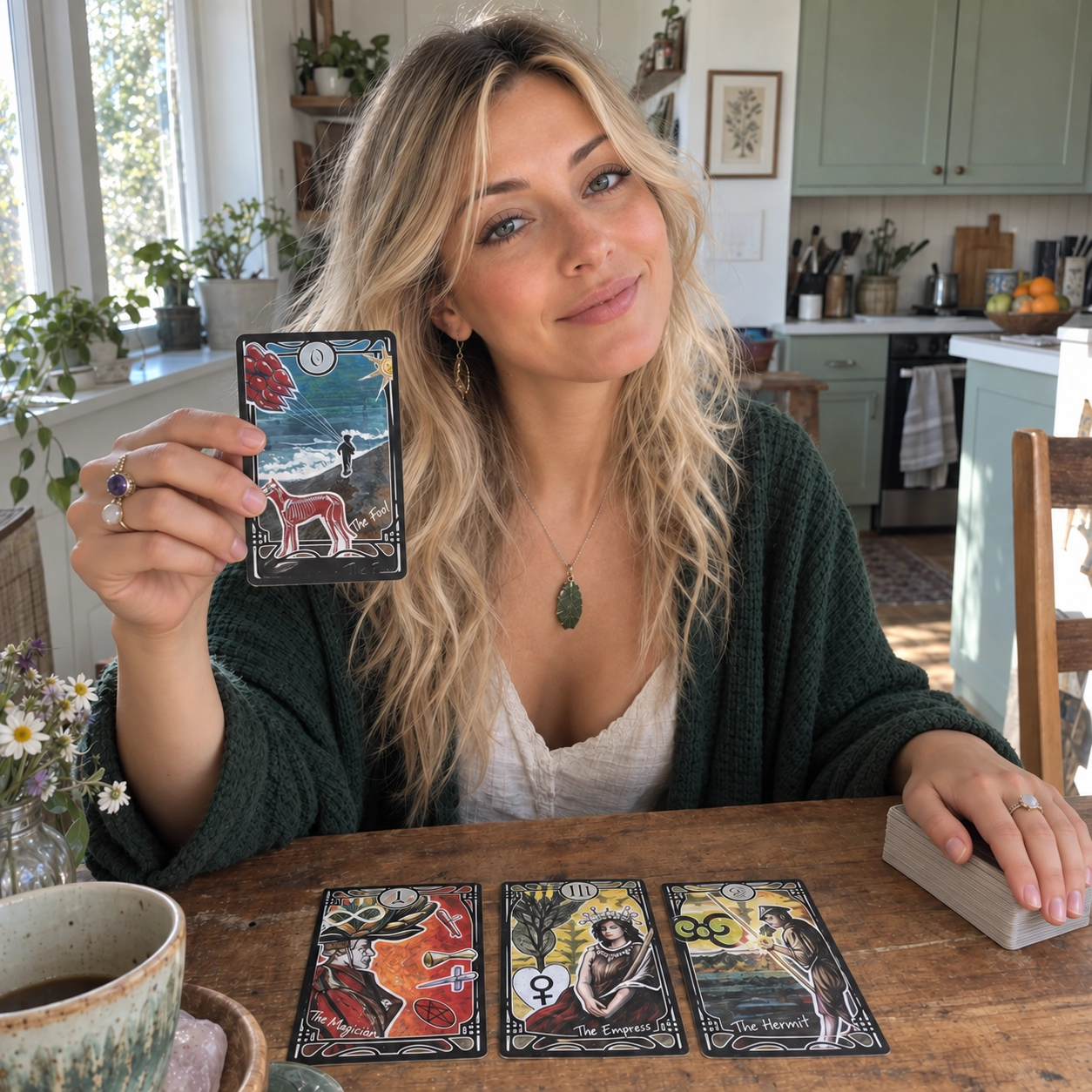
Apophenia Tarot feels like listening to a dream while it is still deciding what it means. I love the black hand-drawn frames, the flashes of red and yellow, and the way each collage leaves one detail humming after the rest of the picture has gone quiet. The Fool catches that feeling perfectly: a small figure moves through an enormous sky while a red animal waits below, as if instinct and possibility are calling from opposite edges of the same moment.
I read this deck by noticing the detail that will not let me look away. Then I bring that image back to the card’s traditional role and ask whether the surrounding cards support the first feeling or gently contradict it. That matters with a deck built around pattern-making. The art can open a dozen doors, but the spread still helps me choose the one that belongs to the question.
The Magician feels busy, bright, and alive with tools; the Empress carries creativity with a more rooted, listening presence; and the Hermit turns toward a quieter inner signal. Together they form a beautiful reading path: gather what is available, let it grow at its own pace, then step back far enough to hear your own wisdom. None of those stages needs to be rushed.
I would reach for Apophenia Tarot when a creative problem keeps returning, when a relationship contains mixed signals, or when a familiar story suddenly looks strange. A simple three-card spread—what I notice, what I may be projecting, and what remains true—gives the deck room to be imaginative without letting every coincidence become a conclusion.
What stays with me is the deck’s invitation to be curious without becoming lost in the pattern. Apophenia Tarot reminds you that your imagination is not a trap but a lantern, and you can carry its light with both wonder and steady feet.
Apophenia Tarot is a surreal, pattern-hunting tarot deck for readers who like strange symbols, psychological moods, and cards that ask you to slow down. The name comes from apophenia: the human habit of finding meaning and connection inside scattered details. That makes it a fitting deck for shadow work, creative spreads, dream journaling, and readings where the “message” is hidden in small visual clues.
Quick take
Apophenia Tarot is not a plain beginner flashcard deck. It is more like a cabinet of signs: faces, costumes, animals, numbers, gestures, and dreamlike scenes that feel connected even when they do not explain themselves immediately. If you enjoy intuitive reading, you may find it exciting. If you want every card to match Rider-Waite-Smith symbolism in an obvious way, it may feel too strange at first.
The TarotFans gallery is a verified partial view of this deck. I would use it as a feel test: if several cards make you pause and start asking questions, this deck is probably speaking your language.
What Apophenia Tarot feels like in readings
In readings, Apophenia Tarot works best when you treat the picture as evidence. Start with the traditional tarot meaning if you know it, then look for what the image adds: who is looking away, what object repeats, which color feels loud, what part of the card seems staged, and what detail feels out of place.
That method fits the deck’s theme beautifully. Apophenia is about connection-making, but a good tarot reading also needs grounding. The trick is to notice patterns without forcing them. Let the image suggest a question, then bring the reading back to one useful next step.

Card study
Ten of Pentacles — reading the moonlit clue
This card has a quiet, searching mood: a figure with light, a moonlit feeling, and the sense that something is being looked for rather than already known.
For a practical reading, I would ask: where do I need a smaller light instead of a perfect answer? Apophenia Tarot is strongest when it turns confusion into a careful question.
Artwork and symbolism
The artwork leans into collage-like mystery. Some cards feel theatrical, some feel occult, and some feel like fragments from a dream or a forgotten film. That can make the deck unusually good for readers who respond to atmosphere before keywords.
I read these cards by staying close to what is actually visible: figures, posture, animals, masks, tools, repeated shapes, and emotional tone. The deck rewards patient looking, especially when one small detail changes the whole mood of a spread.
Four-card moment
When the pattern is almost visible


Read this as a slow-noticing spread: first impression, hidden role, mirror, and body signal. Write what repeats before deciding what it means.
Beginner friendliness
Beginners can use Apophenia Tarot, but it is not the easiest first deck if you want direct textbook imagery. It is better for a beginner who already likes surreal art and is willing to journal. Keep a keyword list nearby, pull one card, and write three observations before checking a guidebook meaning.
A simple practice: name the card’s mood in one word, write the first detail your eye noticed, then ask what that detail changes about the traditional meaning. This keeps the reading from becoming too vague.

Card study
Six of Swords — passage through the strange weather
This image has a strong threshold feeling. The skeleton-like figure and held object make the card feel serious, but not automatically negative.
In a reading, it could point to the thing you are carrying through a change: a fear, a tool, a memory, or a decision that needs clearer handling.
Love, relationships, and shadow work
For love readings, Apophenia Tarot is best for patterns: repeated arguments, attraction to familiar dynamics, boundaries, avoidance, projection, and the stories people tell themselves about connection. It is less useful for simplistic “will they text me?” readings and more useful for “what am I noticing but not naming?”
For shadow work, the deck’s strange tone becomes a strength. Ask: what symbol keeps returning, what am I connecting too quickly, what evidence am I ignoring, and what would a kinder interpretation look like? The goal is insight, not paranoia.
Four-card moment
When a relationship feels like a puzzle


Look at roles, distance, performance, and reaction. This spread is useful when you need to separate real evidence from anxious pattern-making.
Career, money, and creative readings
For career questions, this deck shines when the issue is creative direction, signal versus noise, strange timing, or the feeling that unrelated pieces might belong together. It can help artists and builders notice connections between ideas that have not formed a plan yet.
For money readings, keep it practical. Pattern-seeking is useful only if it leads to a grounded action: track the number, check the habit, protect the resource, make the call, finish the task. Do not let a mysterious image replace basic financial sense.

Card study
Two of Cups — instinct, reflection, and watchfulness
The owl-like visual language gives this card a watchful, night-minded feeling. It suggests perception, patience, and seeing what others miss.
In practice, I would read it as a prompt to observe before acting. The pattern may be real, but the deck asks you to gather enough evidence first.
Pros and cons
| Pros | Cons |
|---|---|
|
|
Four-card moment
When a creative idea keeps returning


Use this as an artist’s check-in: signal, experiment, obstacle, and next small move. Do not over-explain it; make one thing and see what changes.
Who will enjoy Apophenia Tarot?
Apophenia Tarot suits readers who enjoy weird art, symbol-hunting, occult theater, dream logic, and decks that feel more like a conversation than a lesson plan. It is especially good for artists, writers, intuitive readers, and anyone who wants tarot to reveal patterns rather than hand over a neat answer.
Skip it if you want soft reassurance, a fully traditional teaching deck, or a gallery where every card can be confidently sorted into standard tarot order from the current source images. This deck is more experimental than that, and it works best when you respect its uncertainty.
Final Thoughts
Apophenia Tarot is fascinating because it makes the act of reading visible. You are not only asking what a card means; you are watching your own mind connect details, test stories, and decide which patterns are useful. That can be powerful when handled gently.
Use the verified gallery above as your first test. If the images make you curious in a grounded way, Apophenia Tarot may become a strong deck for reflective reading, creative insight, and shadow-work questions that need more nuance than a quick yes or no.

Apophenia Tarot FAQ
Is Apophenia Tarot good for beginners?
It can work for beginners who like surreal art and are willing to journal, but it is not the easiest first deck for readers who want obvious Rider-Waite-Smith scenes.
Does this page show every Apophenia Tarot card?
No. The TarotFans gallery is a verified partial view of the deck, and uncertain images are omitted rather than presented as confirmed cards.
What readings fit Apophenia Tarot best?
It is strongest for intuitive readings, journaling, creative questions, pattern work, shadow work, and situations where the hidden connection matters.
Is Apophenia Tarot scary?
It can feel strange, intense, or uncanny, but that does not make it a fear deck. Read the imagery as symbolic material for reflection, not as doom prediction.
How should I read the more confusing cards?
Start with three visual observations, then add one traditional tarot keyword, then choose one practical question. That keeps the reading grounded.
Who will like Apophenia Tarot most?
Readers who enjoy surreal art, occult symbolism, psychological spreads, and creative pattern-making are the most likely to connect with it.


