Explore the Serpentfire Tarot Cards.
Browse the verified early-edition cards in canonical deck order. Choose a group to filter the continuous Gallery, or select any card to open the full-size Lightbox.
Showing the selected card group.

A note from Aurica
I love how Serpentfire Tarot turns a reading into a night sky on the table. Coral, teal and violet flare against black backs and gilded edges, so I begin with the largest shape.
The Seven of Wands rises through fierce pink geometry like courage becoming a doorway. I ask what deserves protection, which pressure is truly mine, and whether a steadier stance would speak more clearly.
I reach for this deck when ordinary words feel too small but the answer must still touch real life. Follow one colour, one gesture and one honest next step; Serpentfire Tarot can brighten the inner compass you already carry.
A desert dream built from collage, geometry and the divine feminine
Serpentfire Tarot feels like a signal arriving from both an ancient temple and a distant future. Devany Wolfe layers bodies, planets, animals, desert horizons and hard geometric portals until each card becomes a little dream chamber. Warm coral, turquoise, violet and gold flare against black-and-white patterned frames.
The complete early bordered 78-card deck now appears in canonical order. Seventy-three stronger existing sources were retained, while the Six of Wands, Ace of Cups, King of Wands, Ten of Swords and Queen of Swords were recovered or improved from a verified same-edition walkthrough.
How the visual language speaks
I notice scale first. A moon can fill half the sky while a human figure becomes a small silhouette; a single eye may hover above a robe; mirrored animals can turn a meeting into ritual. These shifts make inner feelings feel enormous and give ordinary choices an archetypal charge.
Then I look for the card’s anchor: a doorway, gesture, planet, animal, flame or repeated line. The traditional title supplies the bones, but the visible anchor tells me where the living tension sits. That keeps a reading intuitive without letting it float away from evidence.

Card study
The Star — a small body beneath impossible light
A pale figure stands on a black hill beneath one brilliant white star. Below, a striped circular form and two patterned spheres turn the lower half into a field of vibration, while the sky opens in violet and midnight blue. The body is tiny beside the light, but it is upright and exposed rather than hidden.
I read this as hope that does not need to dominate the whole sky. Upright, The Star can be a clean signal after confusion: one honest wish, one source of renewal, one direction worth following. In shadow, the distant light may become an ideal that keeps ordinary healing out of reach. Ask what small action would let the star touch the ground.
How Serpentfire Tarot reads in practice
This is a vivid, associative deck. It reads beautifully when a question needs atmosphere, desire, creative direction or a hidden pattern brought to the surface. Its symmetry can reveal what is mirroring what; its portals often show where energy wants to cross from imagination into action.
Try three cards as the landscape, the threshold, the next embodiment. Describe the dominant colour and largest shape on each card before naming a meaning. If the answer still feels abstract, finish with one sentence that begins, “In ordinary life, this asks me to…”
Four-card constellation
Four thresholds into another state
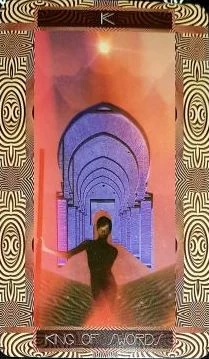
The Fool leaps above a blue architectural edge; The Chariot faces a molten horizon between two animal guardians; Five of Pentacles places a figure inside a sharp luminous doorway; and King of Swords walks toward repeating violet arches. Together they turn movement into a question of courage, direction, exclusion and clear-minded passage.



Beginner guidance and three useful questions
A beginner can use Serpentfire Tarot, but should not expect scene-for-scene Rider–Waite–Smith cues. Keep a compact meaning guide nearby and learn through small spreads. Let curiosity lead, then check your impression against the card title and surrounding cards.
Gentle
What colour or shape wants my attention today?
Deeper
Which threshold am I already standing beside?
Demanding
Where have I mistaken a beautiful vision for an embodied choice?

Card study
Five of Wands — pressure around the bright centre
A glowing orb hangs above a narrow staircase framed by pale drapery. Mirrored dark hands or branch-like forms reach inward from both sides, and a full moon rises behind the central light. The symmetry is beautiful, yet everything seems to press toward the same opening.
This card makes conflict feel like several forces competing for one passage. Upright, it can show lively friction, rehearsal or the effort required to earn a place; in shadow, every voice reaches for the centre and nobody listens. In a reading, name the shared goal before choosing a side. The next card can show whether the pressure needs structure, play or a firm boundary.
Reading conflict without feeding the spectacle
The deck can make pressure look gorgeous. That beauty is part of its power, but it can also tempt a reader to remain inside the picture. When a difficult card appears, separate what is dramatic from what is actionable. Ask who is moving, what is blocked, and where the composition leaves an opening.
In relationship readings, mirrored figures may show attraction, projection or a shared pattern. In creative work, competing lights can reveal several worthy ideas chasing the same centre. The surrounding cards decide whether the answer is collaboration, selection or release.
Four-card constellation
Four ways the sky enters a reading
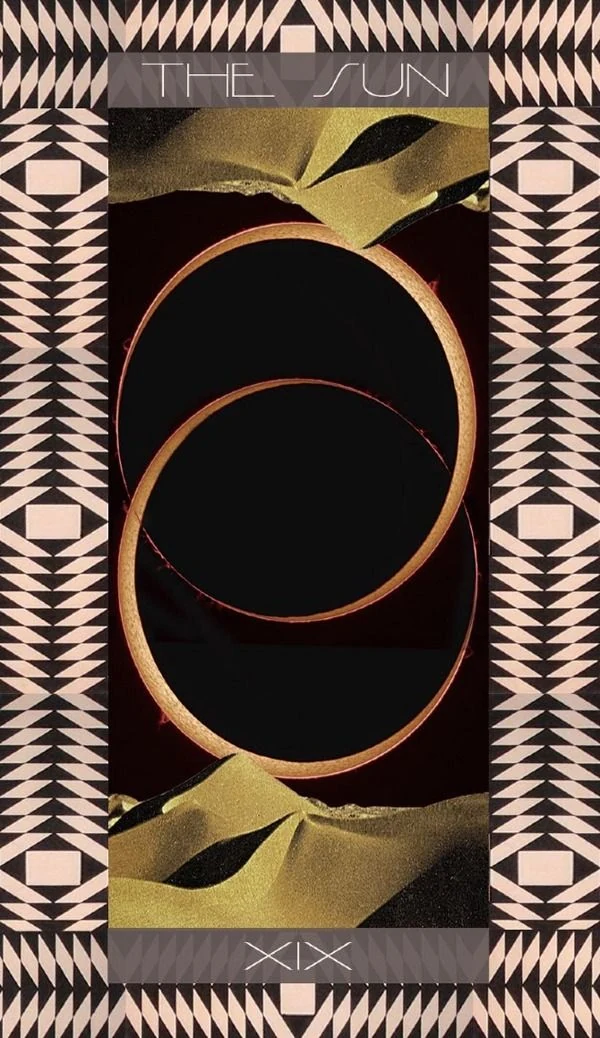
The Star offers a single radiant point; The Moon stacks coloured lunar phases like a living altar; The Sun reduces daylight to two elegant eclipsing circles; and Two of Swords balances a blue moon above a profile and a small golden ring. These cards ask whether the sky is guiding, reflecting, obscuring or dividing attention.


Who will feel at home with this deck?
Serpentfire Tarot may suit readers drawn to retro-futurist collage, divine-feminine imagery, cosmic symbolism, deserts, animals and intense colour. It is especially expressive for journaling, shadow work, transitions, creativity and questions where the mood beneath the words matters.
You may prefer another deck if you need everyday narrative scenes, a restrained palette, plain pip cards or close historical reproduction. Browse the Minor Arcana as carefully as the famous Majors; they reveal whether the deck’s symbolic language will remain useful after the first rush of wonder.
Serpentfire Tarot Pros & Cons
| Pros | Things to consider |
|---|---|
| Bold collage imagery gives intuitive readings an immediate emotional atmosphere. | Readers who rely on familiar scene-for-scene RWS cues may need more guidebook time. |
| The cosmic palette and strong geometry make patterns easy to notice across a spread. | Several editions differ in borders, packaging and production details, so buyers must check the listing carefully. |
| A complete, correctly ordered 78-card Gallery supports close visual comparison. | The Gallery shows the early bordered deck, while the verified retailer sells the borderless final 7th edition. |

Card study
Nine of Pentacles — self-possession in a wide desert
A dark-clad woman stands alone on golden dunes. A large striped disc rises behind her head, and the symbols of Virgo and Venus float to either side. Her arms stay close to her body while the empty landscape gives her silhouette extraordinary room.
The image turns material independence into presence rather than display. Upright, it may show skill, discernment and the quiet pleasure of inhabiting what you have made. In shadow, self-sufficiency can become isolation or a polished wall. Ask what abundance gives the figure more freedom, and what relationship would enrich the landscape without shrinking her.
Feminine presence without one fixed face
Women appear as crowned figures, guardians, silhouettes and living centres of geometric designs. The deck does not give feminine power one mood. It can be tender, watchful, solitary, ecstatic or fierce. That range helps a reader ask what kind of strength the moment actually needs.
When several court or Major figures appear, compare their posture before assigning personality. Who is open? Who is framed? Who stands beside an animal or beneath an eye? Those visible relationships often say more than a quick label such as “strong woman” or “intuitive person.”
Four-card constellation
Four portraits of embodied sovereignty
The Empress stands crowned inside a geometric shrine; Strength pairs a woman with leopard and desert stone; Queen of Cups holds Frida Kahlo within concentric halos; and Queen of Pentacles opens a patterned robe beneath an all-seeing eye. Together they describe nurture, courage, feeling and material care as different forms of feminine authority.




Buying guidance: match the edition, not only the title
The Gallery on this page documents the early bordered artwork associated with the self-published deck. Serpentfire Tarot later evolved through multiple editions. The verified direct product page is for the final 7th edition by Devany Amber Wolfe, with borderless cards and different production details.
No exact Amazon ASIN or current Etsy listing could be verified, so every gold product CTA uses the exact live retailer rather than an unrelated marketplace result. Check the edition number, borders, box, guidebook, seller, price and availability before ordering. The closing product scene is a generated editorial image grounded in the verified final-edition box; the Gallery remains the evidence for the earlier card artwork discussed above.
Aurica’s golden rule for Serpentfire Tarot
Let the largest shape name the feeling, then let the smallest figure choose the next step.
The cosmos can be enormous without making you powerless. Find the human-scale gesture inside the vision, and the card will give your intuition somewhere kind and practical to land.
Final Thoughts
Serpentfire Tarot is not shy. Its desert suns, stacked moons, mirrored creatures and electric portals turn a spread into a visionary landscape, yet the familiar card titles keep a thread tied to traditional tarot.
I recommend it to a reader who enjoys looking slowly and feeling the image before explaining it. Stay honest about which edition is in front of you, bring every cosmic insight back to one lived choice, and this deck can help your imagination become a bright, steady compass.

Serpentfire Tarot FAQ
Who created Serpentfire Tarot?
Artist Devany Wolfe created the collaged artwork and self-published the original deck in 2014. Later editions are also credited to Devany Amber Wolfe.
How many cards are in Serpentfire Tarot?
The deck has the standard 78-card tarot structure: 22 Major Arcana and 56 Minor Arcana across Wands, Cups, Swords and Pentacles.
Which edition does this Gallery show?
The Gallery documents the complete early bordered deck. The verified shop link leads to the later borderless final 7th edition, so packaging and production details differ.
Does Serpentfire Tarot follow Rider–Waite–Smith?
It keeps familiar card names and four suits, but its retro-futurist collage scenes do not copy Rider–Waite–Smith composition card for card. Let the title provide structure and the visible image shape the reading.
Is Serpentfire Tarot suitable for beginners?
It can suit a visual beginner who enjoys symbolism and is willing to use a guidebook. Begin with one-card draws, describe the picture before checking a meaning, and build up to three-card readings.
Is the current final edition identical to the cards reviewed here?
No. The reviewed Gallery documents an early self-published edition, while the shop link leads to the later final 7th edition. Packaging, borders and other production details may differ, so compare the edition description before ordering.