THE CARDS
Explore the Science Tarot Cards.
Browse the highest-resolution verified card fronts available for this edition. This is a partial archive that follows the deck’s own order and names each shown card by its tarot title and printed scientific concept; unavailable cards are omitted rather than fabricated.
Showing all available cards.
Aurica’s Quick Take
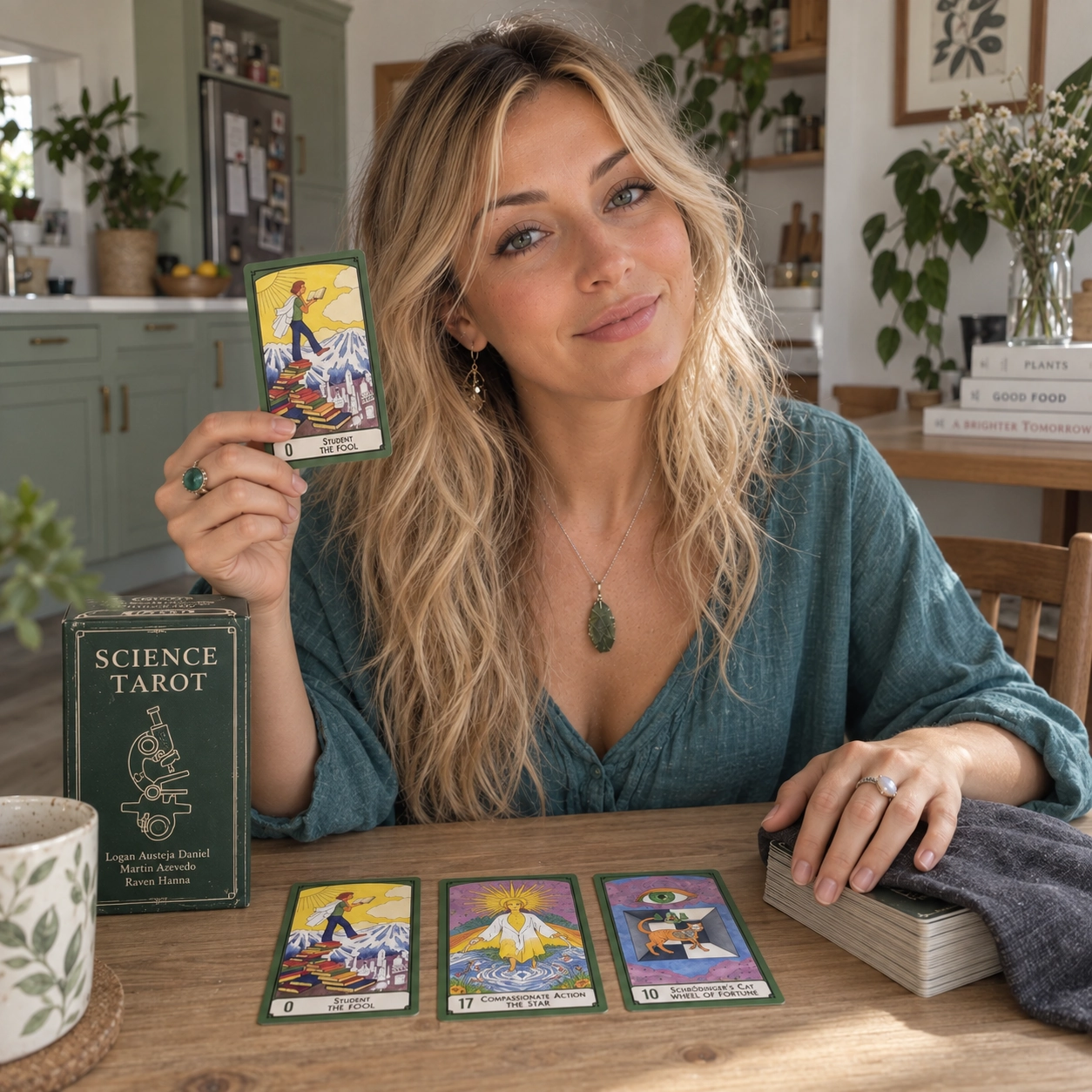
I love the spark here: a nebula, cocoon or microscope turns a familiar tarot question toward wonder. Science Tarot uses discovery as a lantern for what is forming and changing.
The shifting art gives each suit its own atmosphere. Start with the traditional meaning, then let the printed science concept add a new angle rather than replace the card beneath it. This keeps the reading grounded while leaving room for surprise.
Let science open the door, let intuition choose what matters, and notice the pattern that becomes visible today.
What makes Science Tarot different?
Science Tarot keeps the traditional tarot architecture, but its symbolic language comes from astronomy, biology, chemistry, physics and the people who changed how we see the world. The suits wear new tools: Bunsen burners for Wands, beakers for Cups, scalpels for Swords and magnifying glasses for Pentacles. The creators also adapt the Hero’s Journey so each numbered suit unfolds as a story rather than a row of isolated facts.
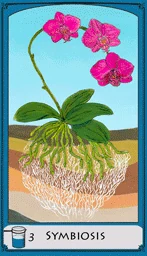
That structure gives readings an unusual pulse. The old archetype is still there, but the scientific concept adds motion. “Expansion” feels different from a stock definition of courage; “Phase Transition” makes transformation physical; “Symbiosis” lets relationship questions breathe through interdependence rather than simple harmony.

CARD STUDY
Wheel of Fortune: uncertainty held in one box
An open green eye watches over a boxed cat, laboratory glassware and a radiation symbol. The image is deliberately uneasy: observation itself changes what can be known. That makes the traditional turning wheel feel less like random luck and more like a moment whose meaning is still resolving.
Upright, I would read it as permission to stay alert while the outcome remains fluid. In shadow, it can show the exhausting urge to force certainty too soon. Ask what becomes possible when you stop pretending the box is already open.
How the deck reads in practice
Begin with the card’s ordinary tarot job, then look at the printed science concept. The first keeps the reading coherent; the second adds a fresh angle. A Swords card may still speak about thought or conflict, while its scientific image shows whether the mind is colliding, drifting, reducing or disappearing into a black hole.
I find the deck clearest when the question is specific: “What is changing?”, “What evidence am I overlooking?” or “Where does this relationship need a healthier exchange?” It can answer practical questions too, but it prefers curiosity over fortune-cookie certainty.
FOUR-CARD FIELD NOTE
Four-card reading: cosmic beginnings
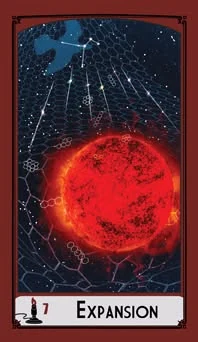
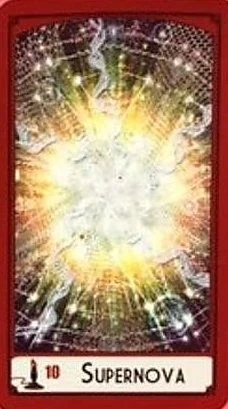
Read left to right as possibility, formation, expansion and release. These four Wands images ask where an idea sits in its life cycle—and whether it needs space, ignition, confidence or a graceful ending.


Is Science Tarot beginner-friendly?
Yes, for a beginner who enjoys learning and is willing to keep a standard tarot reference nearby. The familiar Major and suit framework offers a handrail, while the science keywords make memorable prompts. A complete beginner may need time with the renamed imagery because a nebula or meson does not automatically reveal the usual card meaning.
Start with three cards. Name one visible detail on each, say the conventional tarot function in plain language, then ask how the scientific process changes the emphasis. That small ritual prevents the clever concept from floating away from the actual reading.
CARD STUDY
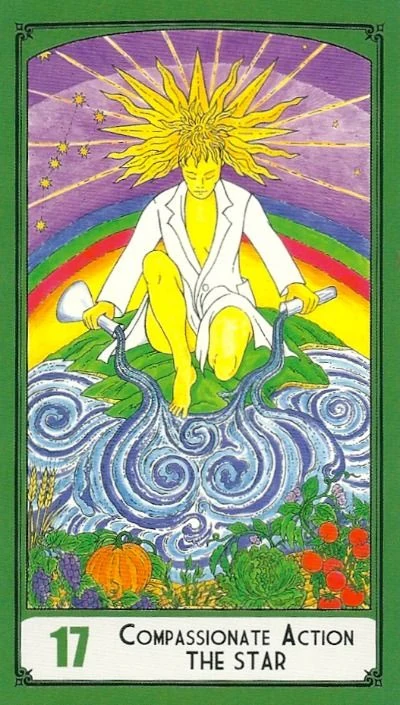
The Star: hope becomes something you do
A luminous figure in a white coat kneels between curling water and a garden of fruit and vegetables. A rainbow rises behind her, while a yellow burst radiates from her head. Hope here is bright, embodied and busy: it feeds, tends and restores.
Upright, the card turns inspiration into care that reaches another person or the wider world. In shadow, it warns against performing goodness while forgetting replenishment. In a reading, ask which small generous action would make hope tangible.
Three ways to study the deck
Easy: Observe
Draw one card and describe only what you can see. Then read its printed concept and name one everyday situation with the same pattern.
Medium: Compare
Place the card beside its traditional counterpart. Notice what the science metaphor sharpens, softens or makes newly uncomfortable.
Deep: Test a hypothesis
Ask a clear question, form one tentative interpretation, then use two supporting cards as evidence for or against it.
FOUR-CARD FIELD NOTE
Living systems
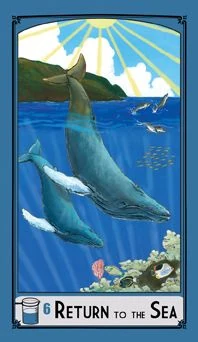
From a cell to orchids, migration and metamorphosis, these Cups cards tell a tender story about connection. Emotion is not sealed off; it survives through exchange, adaptation and the courage to change form.


Love, work and creative readings
For love, Cups such as Symbiosis invite a beautiful question: are both people being nourished, or is one organism quietly carrying the whole garden? In work, the court scientists can point to roles—explorer, innovator, storyteller and visionary—without reducing anyone to a personality label.
Creative readings are where this deck glows. Wands chart the birth and death of stars, so an idea can be a nursery, a collision, an expansion or a supernova. The language helps you feel where energy is gathering and where an old form may need to release its light.

CARD STUDY
King of Pentacles: vision with weight and consequence
Marie Curie stands in a dark dress beside laboratory vessels, a red-cross-marked container and a landscape cut through with layers and a winding path. The composition holds achievement beside the material world that makes it possible—and the risks that knowledge can carry.
As the grounded King, she suggests mastery earned through patience, exact work and endurance. In shadow, devotion can harden into overwork or make cost invisible. In a reading, let vision remain accountable to the body, the tools and the people touched by the result.
Who will love this deck?
Science communicators, curious readers, teachers, artists and anyone who likes a tarot deck with a strong conceptual hook are natural companions for it. It also suits readers who enjoy tracing a metaphor across a whole suit.
If you want lush occult ornament, one consistent illustrator or immediate Rider–Waite–Smith scene-for-scene recognition, the shifting art styles may feel demanding. That is not a flaw so much as a temperament check: this deck wants you to investigate.
FOUR-CARD FIELD NOTE
Matter under pressure
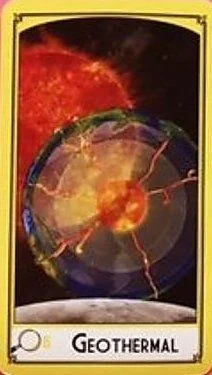
These cards move through attachment, crisis, exchange and deep time. Their yellow-framed Pentacles imagery makes the material world feel alive: unstable, generous, ancient and always asking what can be sustained.




CARD STUDY
The Sun: illumination has more than one nature
A radiant human figure rises through ribbons of water and coloured light. The image makes revelation feel alive rather than static: clarity can arrive as both wave and particle, intuition and evidence, warmth and exact observation.
Upright, it suggests confidence that can hold complexity without becoming vague. In shadow, it warns against calling one bright explanation the whole truth. Ask what becomes clearer when two apparently different descriptions are allowed to coexist.
FOUR-CARD FIELD NOTE
The mind as a moving system
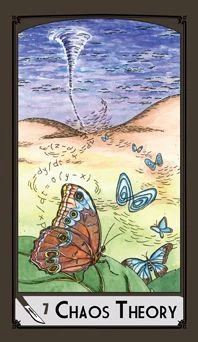
These four Swords cards trace an idea from reduction through structure, turbulence and gravitational pull. Use them to separate useful analysis from the moment thought begins to consume its own horizon.



What to know before buying
The official project describes the current second edition as having the same content as the first, with more vibrant colour, improved cardstock and local printing in California. The Exploratorium listing identifies a full traditional deck of original illustrations inspired by people, practices and discoveries in scientific history.
The gallery above is an honest partial archive. Images still unavailable at publication quality are The High Priestess, The Emperor, Justice, The World, Two of Cups, Page of Swords and Page of Pentacles. Their absence does not mean the physical deck is incomplete.
Science Tarot Pros & Cons
Pros
- Memorable scientific metaphors add a distinctive second layer to familiar tarot structure.
- Five artists give the Major Arcana and suits clear visual identities.
- The printed concepts reward study, journaling and focused four-card readings.
- Strong for creative work, transition questions and evidence-based reflection.
Cons
- The changing art styles may feel less seamless than a single-artist deck.
- Some scientific references need the booklet or extra research to fully open up.
- Readers seeking direct Rider–Waite–Smith scenes may face a learning curve.
- The conceptual system can feel dense when a simple, immediate answer is wanted.
Final Thoughts
Science Tarot is clever, but its best moments are not clever for cleverness’ sake. A black hole can name a mind caught in dread; a cocoon can make walking away feel like necessary transformation; a bright garden can turn hope into compassionate action. The deck keeps asking us to look more closely.
That makes it a thoughtful companion for readers who want knowledge and intuition at the same table. Follow the evidence, stay tender with uncertainty, and let every discovery widen the story rather than close it.

Science Tarot FAQ
Is Science Tarot good for beginners?
It can be, especially for curious beginners who use a standard tarot reference alongside it. The familiar tarot structure helps, while the scientific concepts add a second layer to learn.
Does Science Tarot follow traditional tarot meanings?
Yes. The official project says the cards can be laid out and read like traditional tarot, but each image reinterprets the archetype through a scientific story, process or person.
Who created Science Tarot?
Science Tarot was created by Logan Austeja Daniel, Martin Azevedo and Raven Hanna, with different artists assigned to the Major Arcana and each suit.
What do the four suits represent visually?
Wands use Bunsen burners, Cups use beakers, Swords use scalpels and Pentacles use magnifying glasses. The numbered cards also unfold through adapted Hero’s Journey stories.
Which readings suit Science Tarot best?
It is especially strong for creative work, learning, life transitions, relationship patterns and questions that benefit from observation, comparison and curiosity.
Is the gallery the complete physical deck?
No. The physical deck is complete, while this page publishes only card images that could be verified clearly. The unavailable images are named in the buying guidance above.


