Madhouse Tarot Cards
Browse the available Madhouse Tarot card images in a native TarotFans gallery. Tap any card to open a larger carousel view.
Aurica’s Quick Take
Madhouse Tarot feels like walking into a sepia theatre where every locked door, watchful creature and exposed figure has something urgent to confess. Eugene Vinitski and Elsa Khapatnukovski give familiar tarot bones a restless psychological skin, threading Hebrew letters, Kabbalistic paths and Goetic seals through scenes that seem to tighten around the people inside them. I find it dark, theatrical and impossible to skim.
I reach for this deck when a reading circles fear, alienation, creative obsession or a pattern that keeps repeating beneath the surface. It makes pressure visible, which can be wonderfully clarifying for shadow work and journaling. I would set it aside when I want a gentle everyday companion, because its psychiatric-horror atmosphere asks for attention rather than offering easy comfort.
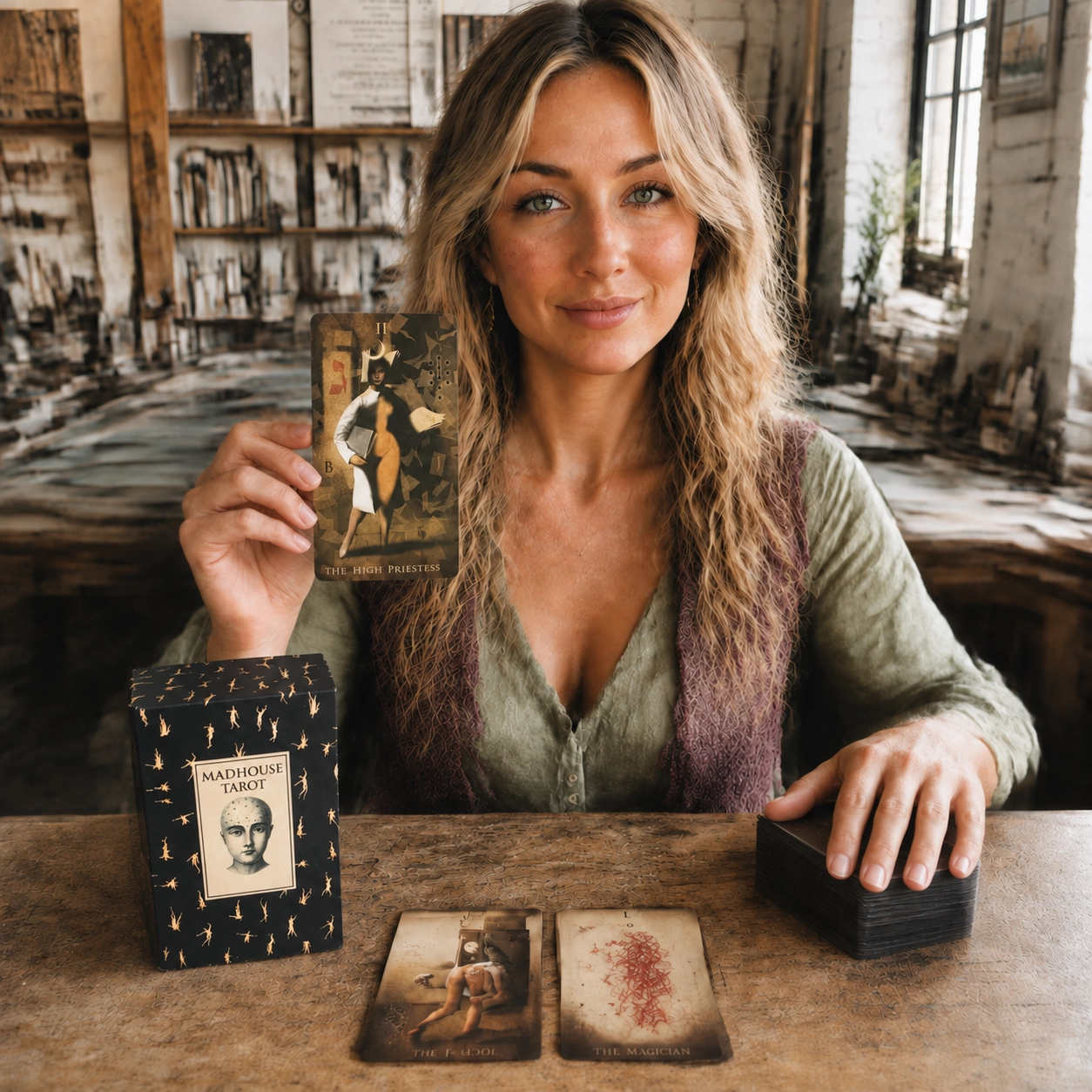
The High Priestess catches me first: one side of her appears lit and composed while the other slips into shadow and angular fragments. Beside The Fool’s vulnerable doorway and The Magician’s frantic red tangle, she reminds me that insight is not always serene; sometimes it arrives as the moment I can finally see the split I have been living around.
Before I reach for a keyword, I notice what the picture makes my body do—brace, recoil, lean closer or look away—then I test that response against the card’s traditional role and the story made by its neighbours. Madhouse Tarot does not ask me to glorify fear; it asks me to give fear a shape, find the open door, and remember that even the strangest inner room can hold a brave next step.
What makes Madhouse Tarot different?
The creators describe a conventional structure of Major and Minor Arcana, but the visual language is anything but conventional. Court cards use historical visionaries, the Major Arcana include paths from the Kabbalistic Tree of Life, and the Minor Arcana weave in Goetic seals. The result resembles a surreal case file: each image stages a mind under pressure rather than merely illustrating a memorized definition.

CARD STUDY
The Fool
A nearly naked figure bends forward through an open doorway, one hand holding a skull while an owl watches from the shoulder. A Hebrew letter, handwritten script and a dotted path surround the scene. The card makes beginnings feel exposed and awkward rather than carefree. Upright, it can be the vulnerable step into uncertainty; in shadow, the same threshold can become reckless flight or refusal to see what follows.
How the deck reads in practice
Start with the classic function of the card, then ask how the scene changes its temperature. Who is confined? What is watching? Where is the exit? Repeated doors, institutional rooms, harsh beams of light and distorted bodies make the deck especially good at showing coping strategies and hidden pressure. Keep interpretations grounded in behavior and choice; disturbing imagery should clarify a pattern, not turn a reading into a diagnosis.
FOUR PACK
Thresholds, rupture and release
These cards show the deck’s talent for turning transition into a physical event: entry, collapse, suspension and completion.


Beginner friendliness and reading prompts
The titles and familiar structure help, but this is not the gentlest first deck. New readers should pair the image with a simple reference and work one card at a time. Try three levels of prompt: easy—What is asking for my attention? medium—What defense is helping, and what is it costing? hard—Which part of this pattern feels safer than change?

CARD STUDY
The Moon
A bright moon casts a hard cone of light through an open doorway while a figure lies in the foreground with raised arms. Dark animal forms gather beyond the door, and the Hebrew letter Qoph appears near the top. The image turns uncertainty into a charged boundary between the lit room and what waits outside. Upright, it asks for patience with incomplete information; in shadow, fear can fill the doorway before facts arrive.
Love, work and creative readings
In relationship readings, ask what each person protects, projects or refuses to name. In career readings, the deck is strong on pressure, conformity, obsession and the cost of being different. For creative work, its collage-like symbolism can break a stale idea open. Avoid forcing a prediction from one shocking image; let supporting cards show whether the tension calls for action, rest, boundaries or help.
FOUR PACK
Watching, hiding and being seen
The Hermit, Moon, Seven of Swords and Nine of Swords trace a movement from guarded solitude into secrecy, exposure and mental strain.


Art style and personality
The palette moves through nicotine sepia, hospital green, black, bruised red and dirty gold. Human figures often appear isolated inside rooms or doorways while diagrams, letters and seals float like clinical annotations. It is macabre without relying only on gore: its strongest effect is the discomfort of being watched, categorized or unable to leave the frame.
CARD STUDY
9 of Swords
A seated figure twists away and covers the head in a narrow room. Scratched figures mark the wall; a large green eye watches from above, and two circular seals occupy the upper and lower right corners. The claustrophobic geometry gives anxiety nowhere to go. Upright, it can expose looping fear and sleepless pressure; in shadow, it warns against treating every watching eye as proof of danger.
Who is Madhouse Tarot for?
It suits experienced intuitive readers, collectors of independent art decks, therapists or coaches who already understand ethical projective work, and artists exploring the edge between reason and imagination. It is not ideal for children, highly sensitive clients, or anyone who wants cheerful reassurance. Ask permission before using it for another person; the imagery can feel confrontational even when the message is useful.
FOUR PACK
Instinct under pressure
Strength, Devil, Five of Wands and Ten of Wands show desire, conflict and endurance becoming visible in the body.


What to know before buying
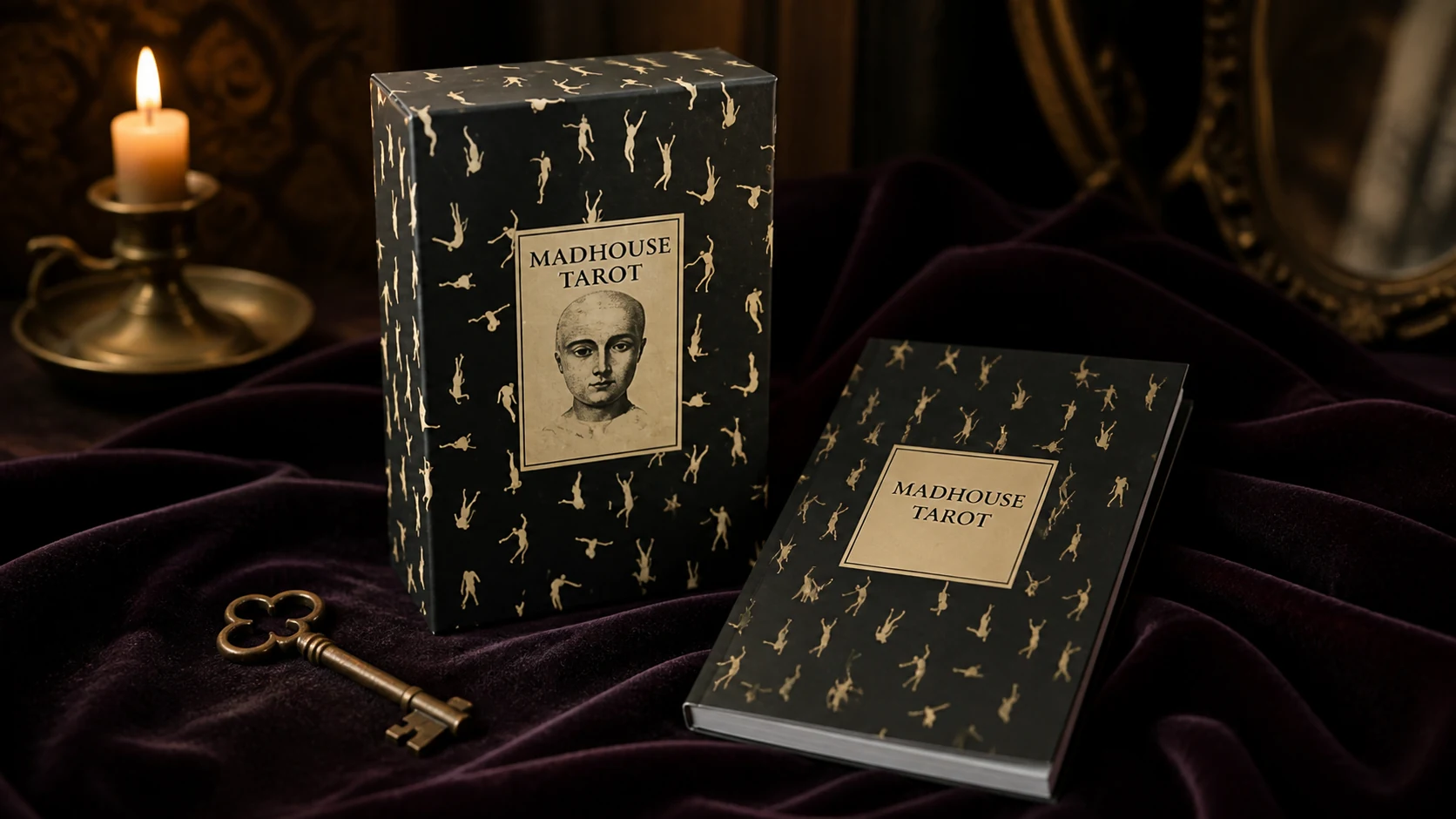
The direct product listing describes a black-gilded deck, a luxury box, a numbered certificate of authenticity and an English guidebook. It also warns that counterfeit editions exist. Buy from the creators’ Tarotmania store or another source you can verify, and check the edition, included book and card dimensions before ordering.
Golden rule: read the wound in the image, but do not turn the person receiving the reading into the diagnosis.
Final Thoughts
Madhouse Tarot is memorable because it refuses the safe distance of decorative occult art. Its best readings identify the mechanism beneath distress—avoidance, fixation, isolation, performance—then return the question to agency.
If that intensity attracts rather than repels you, this dark and exacting deck can become a brave companion for shadow work, creative inquiry, and the next honest step through the open door.
Madhouse Tarot FAQ
Who created Madhouse Tarot?
Madhouse Tarot was created by Eugene Vinitski and Elsa Khapatnukovski. The creators describe it as a hand-drawn exploration of behavior at the edges of a person’s mental state.
What system does Madhouse Tarot use?
It follows a conventional Major and Minor Arcana structure with Wands, Cups, Swords and Coins, while adding Golden Dawn, Kabbalistic and Goetic symbolism.
Is Madhouse Tarot good for beginners?
A motivated beginner can use it with a reference, but its dense occult symbolism and disturbing psychological imagery make it better suited to readers who already know basic tarot structure.
What readings suit Madhouse Tarot best?
It is strongest for shadow work, creative blocks, fear and avoidance patterns, identity, pressure, boundaries and questions where emotional atmosphere matters.
Is the imagery intense?
Yes. The deck includes confinement, exposed bodies, distressed figures and surreal institutional scenes. Preview the Gallery before using it with yourself or another person.
Where can I buy an authentic edition?
The creators’ Tarotmania product page provides the direct edition details. Check the box, guidebook, certificate and seller carefully because counterfeit versions have circulated.
More Tarot Decks to Discover
If Madhouse Tarot caught your eye, these dark, symbolic and psychologically rich deck reviews may help you find your next deck.


