The Lover’s Path Tarot Cards
Explore the verified card fronts in canonical deck order. Choose an official group or open any card for a larger, keyboard-friendly view.
Aurica’s Quick Take
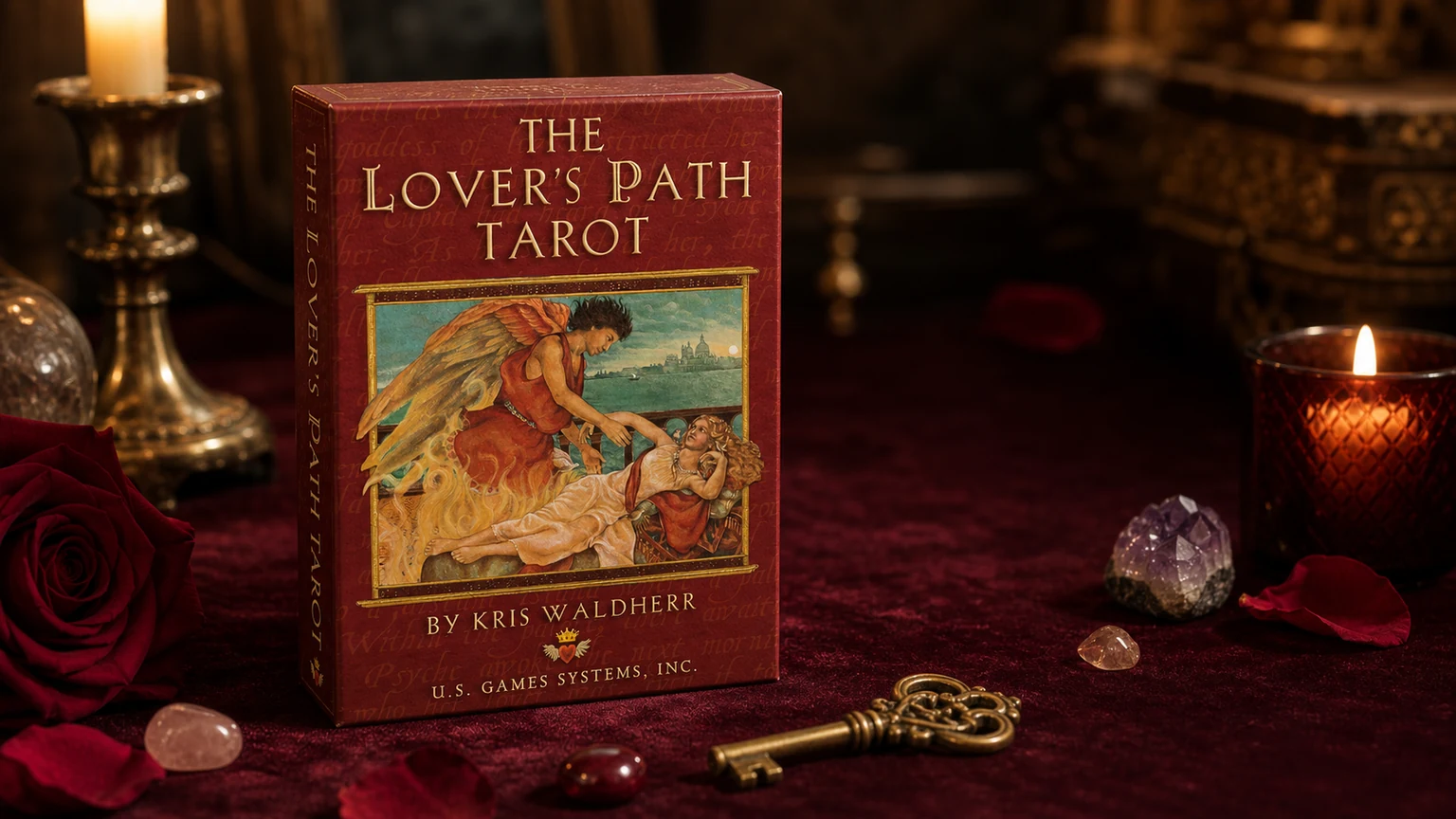
The Lover’s Path Tarot turns the traditional seventy-eight-card structure into a gallery of mythic relationships. Kris Waldherr draws on stories such as Shahrazade and Shahriyar, Persephone and Pluto, Tristan and Isolde, Psyche and Cupid, and the figures of Wagner’s Ring cycle.
The result is not simply a deck “for love readings.” It is a deck about what desire asks of us: trust, sacrifice, boundaries, consequence, memory, and the courage to choose. Its Renaissance-influenced frames and named characters slow the eye down, while the renamed Major Arcana make familiar tarot functions feel psychological and immediate.
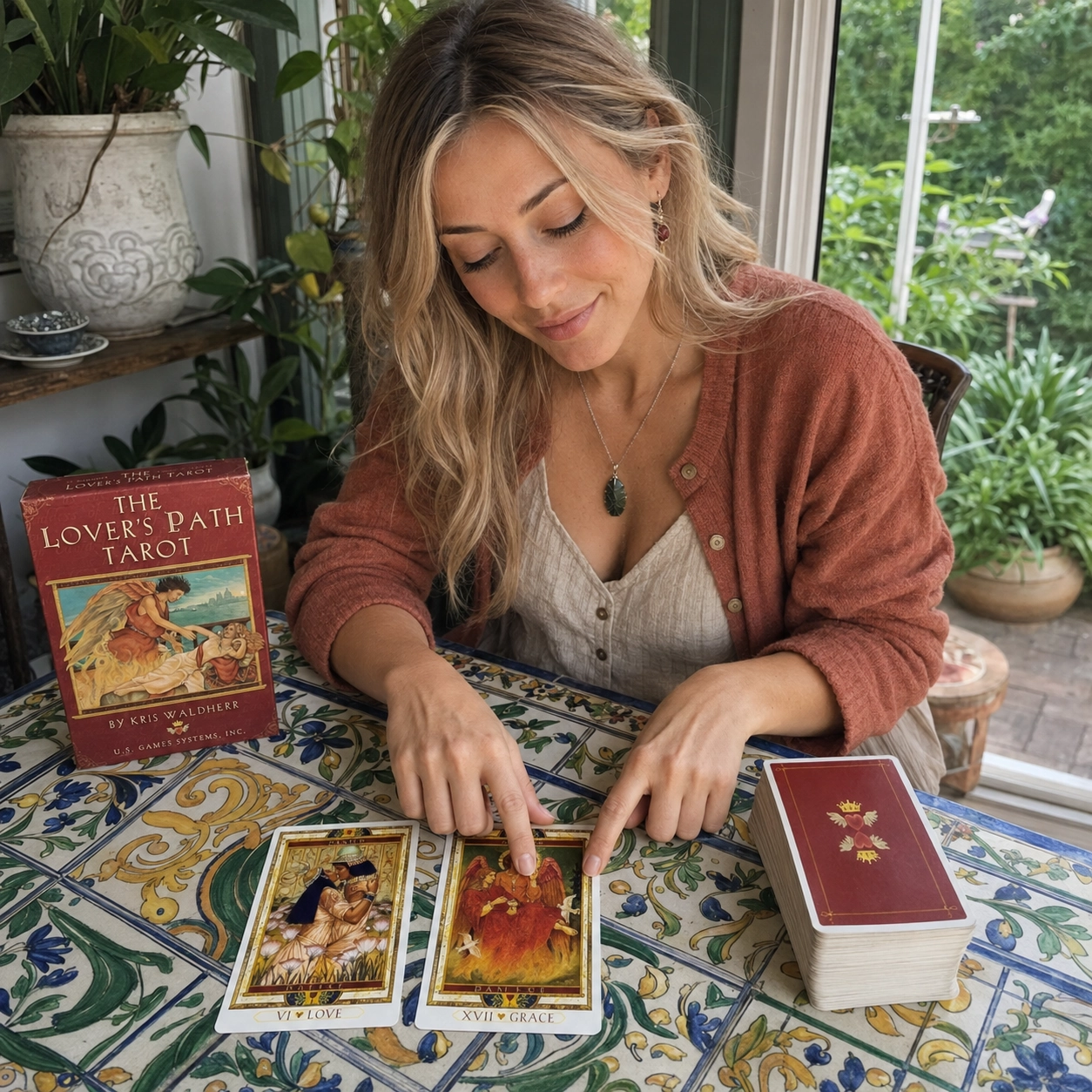
The deck is published by U.S. Games Systems and contains twenty-two Major Arcana plus fifty-six Minor Arcana. Its suits are Staves, Cups, Arrows, and Coins, aligned with Fire, Water, Air, and Earth. The Gallery preserves forty-five unique verified fronts rather than inventing the missing identities.
I reach for this deck when a question contains two truths at once—love and fear, attraction and autonomy, loyalty and change. The Lovers becomes Love; Death becomes Transformation; The Devil becomes Temptation. Those names feel like little lanterns along an emotional path: notice what draws your heart, honour the choice that is truly yours, and let the story remind you that love can be both tender and brave.
The Lover’s Path Tarot Review: myth, desire, and the choices that bind us
Deck-specific card study
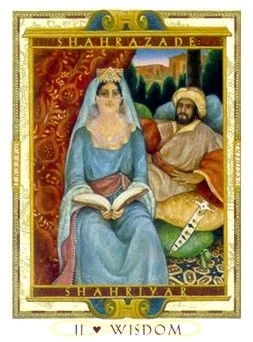
Wisdom II: the book is open, but the story is still being negotiated
Shahrazade sits at the front of a richly patterned interior, dressed in blue with a pale veil and an open book across her lap. Her gaze meets the viewer. Behind her, Shahriyar reclines against cushions, watching from a slight distance; a sheathed blade rests near his lower body. The gold frame names both figures, and the bottom border reads “II ♥ WISDOM.”
This is intuition made articulate. Wisdom is not portrayed as passive silence but as the ability to read the room, hold attention, and reveal truth at the right pace. Upright, the card can ask for listening, timing, and language that keeps complexity alive. In shadow, the blade and unequal positions warn against turning insight into performance for someone else’s approval. Ask: what do I know, and what conditions would let me say it safely?
What makes The Lover’s Path Tarot different?
Waldherr’s central idea is unusually disciplined: each Major Arcana is paired with a named love story, and each Minor Arcana suit develops a related mythic world. The characters are not decorative cameos. Their circumstances give the traditional tarot meaning emotional stakes. A reader can approach a card through its standard function, its printed title, the visible relationship, or the larger story—then notice where those layers agree or pull apart.
The Major Arcana preserve a Rider–Waite-style sequence, including Strength at VIII and Justice at XI, while renaming every archetype except Strength, Justice, and Judgment. The Minors keep familiar Ace-through-Ten ranks but use Arrows in place of Swords and Staves in place of Wands. Courts are explicitly printed as Princess and Prince rather than Page and Knight. That terminology matters when identifying the deck or checking whether a second-hand set is complete.
Visually, the cards use cream and gold architectural frames, jewel-toned story scenes, and small bands that identify the lovers associated with each Major. Waldherr describes the main scenes as oil glazes over watercolor underpainting, with gouache borders on handmade paper and digitally assembled elements inspired by Italian Renaissance art, architecture, books, and maps. They feel closer to illuminated theatre or a miniature Renaissance painting than to a modern cinematic deck. Even when a scene is painful, it is composed with formal beauty. That tension—beauty containing consequence—is one of the deck’s strongest reading tools.
Card moment: desire meets consequence
Love is shown as attraction, movement, temptation, and the work of balance
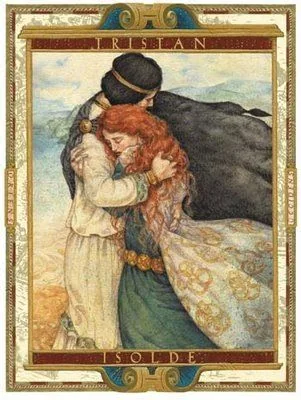
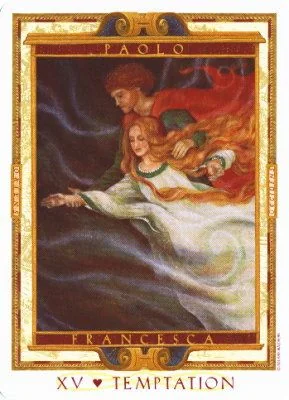
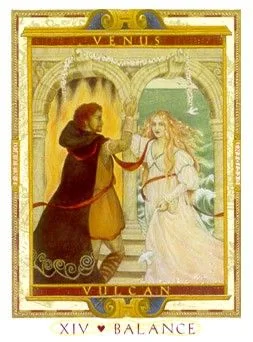
Read as a four-card sentence, this group refuses the idea that strong feeling is self-validating. Love names the bond; Desire shows what pulls it forward; Temptation exposes the place where appetite can overrule judgment; Balance asks what combination of care, restraint, and honesty can actually be sustained.
How this deck reads in practice
The Lover’s Path reads best when you separate attraction from agreement. A beautiful or intimate image can make the first interpretation feel obvious, but the characters’ posture, distance, gaze, and surrounding objects often tell a more complicated story. Begin with what each figure is doing. Who approaches? Who waits? Who looks away? Who holds an object, occupies the higher position, or controls the space?
Then translate the renamed title back into tarot structure. Transformation still performs the work of Death XIII; Illusion still occupies the Moon’s position; Awakening carries the solar function of XIX. The new word offers a doorway, not a replacement for the traditional architecture. Reading both layers keeps the deck emotionally vivid without making it vague.
For relationship readings, give every person agency. The cards can describe a bond, but they cannot grant access to another person’s private thoughts or remove the need for consent and direct conversation. For work, money, and creative questions, read “relationship” broadly: your relationship with authority, risk, ambition, collaboration, resources, and your own appetite for recognition.
Deck-specific card study
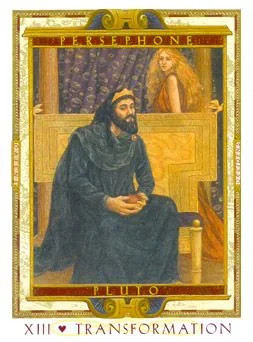
Transformation XIII: grief sits in the foreground while return remains possible
A dark-haired, bearded man in a heavy black robe sits forward with his hands clasped, his expression turned away from the viewer. A small lidded vessel stands beside him. Behind a gold architectural division, a woman in warm amber tones looks back over her shoulder. The upper band names Persephone; the lower band names Pluto; the bottom title reads “XIII ♥ TRANSFORMATION.”
The card makes change spatial. One figure is enclosed in the foreground of grief, while another occupies a separate, brighter plane. Upright, it can describe the painful interval in which an old arrangement has ended but a new relationship to the loss is not yet complete. In shadow, it can show attachment to the closed chamber—mistaking sorrow for the only remaining bond. Ask what must be honored, and what must be allowed to move between worlds.
Beginner friendliness
This can be a rewarding first deck for a beginner who learns through stories and is willing to use the booklet. The card numbers, suit ranks, and core structure are stable enough to study with a standard tarot reference. The renamed Majors can even make abstract archetypes easier to remember: Oppression communicates the Tower’s pressure; Grace gives the Star an emotional tone; Triumph makes the World feel achieved rather than merely complete.
The challenge is that a mythic scene can invite more certainty than the image supports. Knowing a story is helpful, but it should not become a script imposed on every question. A beginner should write down three layers separately: the traditional card function, one visible detail, and the personal response that detail creates. Only then combine them.
The cards are relatively large at approximately 3.5 × 4.75 inches, which gives the scenes room to breathe but may make overhand shuffling less comfortable for small hands. The official booklet supplies reversed meanings, although Waldherr also encourages readers to judge whether a card is strong or weak according to the question, spread position, and surrounding cards. That flexible approach fits the deck better than forcing every reversed card into a fixed negative definition.
The current standard deck-and-booklet edition includes seventy-eight cards and a thirty-six-page booklet. The Premier Edition also includes a large full-color spread sheet with five layouts. An original 2004 presentation set included a much longer full-color book, but it is a different and more collectible package. Kris Waldherr also released a digital official guidebook in 2024; it is a guidebook, not a new card edition.
Easy, medium, and hard readings with The Lover’s Path
Easy: “What quality would help this conversation?” Pull one card and name a single behavior rather than predicting an outcome. Wisdom might become careful timing; Balance might become a boundary both people can understand.
Medium: “What joins us, what separates us, and what choice remains mine?” Use three cards. Keep the third position firmly about your own action so the reading does not drift into mind-reading.
Hard: “Which part of this pattern is love, which part is fear, which part is habit, and what changes if I stop feeding the habit?” Four cards give the deck enough space to show contradiction. Read difficult cards as dynamics and choices, not verdicts about another person’s character.
Card moment: a relationship has more than one clock
Memory, reciprocity, emotional authority, and conflict do not move at the same speed
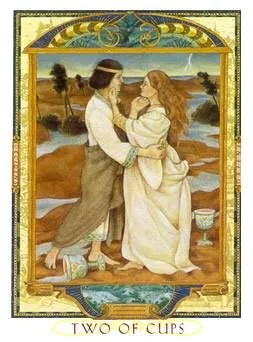

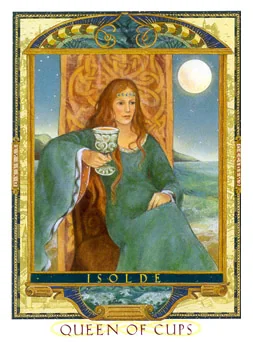
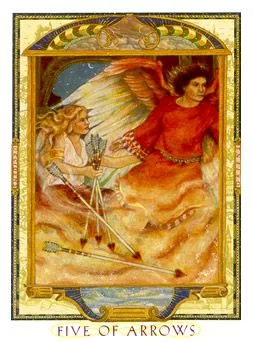
This sequence works as a useful diagnostic spread. The Two of Cups asks what is genuinely mutual. The Six of Cups introduces memory and the pull of an earlier emotional pattern. The Queen of Cups asks who can hold feeling without drowning in it. The Five of Arrows tests whether conflict is clarifying a boundary or merely producing a winner and a wound.
Art style and deck personality
The palette is burgundy, parchment, muted blue, moss green, gold, and warm flesh tones. Decorative borders make each scene feel staged inside a reliquary or palace window. Costumes and architecture carry a broad historical-European atmosphere rather than strict archaeological realism. The deck is romantic in the older sense of the word: heightened feeling, tragic choices, supernatural turns, devotion, exile, and return.
Despite the name, the personality is not relentlessly soft. Swords become Arrows, but conflict does not disappear. Temptation, Oppression, Sacrifice, Transformation, Five of Arrows, and the more difficult Coins still give the deck teeth. The beauty can make hard cards easier to approach, though it can also tempt a reader to aestheticize a situation that needs plain language.
Card faces have rounded white margins, ornate cream-and-gold frames, and printed titles. The reversible back is deep burgundy with a symmetrical crowned-winged-heart emblem. Across the official editions, the card artwork remains the same; the meaningful product differences are the box, booklet or book, and included spread sheet.
Deck-specific card study
Two of Cups: closeness does not erase vulnerability
A barefoot couple stands at the edge of water in a gold-framed landscape. The man is blindfolded; the woman faces him closely and lifts one hand toward his face while their other hands meet lower in the composition. A cup rests near each figure’s feet. Pale clothing makes the pair luminous against the blue water and brown shore.
The card emphasizes reciprocity without pretending both people hold identical information. The joined hands suggest willingness; the blindfold introduces trust, uncertainty, or a limit in perception. Upright, it can mark a meaningful exchange that deserves presence and honest terms. In shadow, it can warn that intimacy is being used to skip a necessary question. Ask what is shared freely, and what is currently being assumed.
Who will love this deck?
The Lover’s Path is a strong match for readers who enjoy mythology, literary love stories, Renaissance-inspired illustration, emotionally nuanced questions, relationship spreads, and decks with renamed Major Arcana. It also suits journalers who like comparing a familiar archetype with a story-specific title.
It may not suit readers who want contemporary everyday settings, minimal symbolism, diverse modern bodies and relationships, or a strictly scene-for-scene Rider–Waite–Smith clone. Its source stories largely come through a European literary and mythic lens. That specificity is part of the deck’s identity, but it should not be mistaken for a universal representation of how love looks.
What Orica likes most
What I like most is that the deck gives relationship questions a moral and psychological structure. Desire is not automatically love. Sacrifice is not automatically noble. Tradition can offer continuity or become a cage. Balance is an active practice. These distinctions are useful whether the question concerns romance, family, friendship, creative partnership, or work.
I also like the way the renamed Majors interrupt autopilot. An experienced reader may know the standard sequence so well that a card arrives already summarized. Seeing “Grace” instead of “The Star” or “Illusion” instead of “The Moon” creates a small pause. That pause is where a fresh reading can begin.
Card moment: four elements, four kinds of agency
Vision needs courage, clarity, and something durable enough to hold it

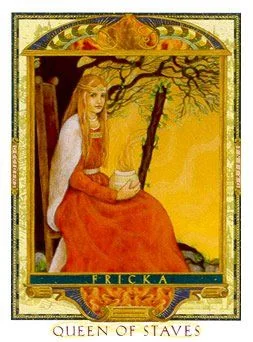


The Three of Staves looks beyond the present boundary; the Queen of Staves asks for embodied confidence; the Ace of Arrows cuts a clean line through ambiguity; and the King of Coins demands a result that can be maintained. Use them when inspiration is real but execution has not yet caught up.
Final Thoughts
The Lover’s Path Tarot succeeds because its theme is narrower than “all human experience” but deeper than “romance.” It understands relationship as a path: a sequence of attractions, agreements, sacrifices, temptations, endings, renewals, and consequences. Waldherr’s formal beauty draws you toward the cards; the stories keep asking whether beauty and devotion are enough.
For another myth-rich narrative deck, compare The Fairytale Tarot. Readers drawn to romantic fine art may enjoy the Art of Love Tarot, Pre-Raphaelite Tarot, Golden Botticelli Tarot, or Tarot Mucha.
The Lover’s Path Tarot FAQ
Who created The Lover’s Path Tarot?
Artist and author Kris Waldherr created the deck. U.S. Games Systems publishes its physical editions.
How many cards are in The Lover’s Path Tarot?
The complete deck has seventy-eight cards: twenty-two Major Arcana and fifty-six Minor Arcana divided into Staves, Cups, Arrows, and Coins.
Why do the Major Arcana have different names?
Waldherr renames the archetypes to emphasize their emotional function: The Fool becomes Innocence, The Lovers becomes Love, Death becomes Transformation, The Star becomes Grace, and so on. Their numbers and underlying tarot positions remain recognizable.
Is The Lover’s Path Tarot good for beginners?
Yes for beginners who enjoy story and are willing to use a reference. Its structure is stable, but the named myths add a second interpretive layer, so it rewards slower study rather than keyword-only reading.
Which edition should I buy?
The standard deck edition includes seventy-eight cards and a thirty-six-page booklet. The Premier Edition adds a large spread sheet. The original 2004 presentation set includes a much longer book and is primarily a collector’s item. Check the ISBN and contents before buying.
Why does the Gallery show 45 cards instead of all 78?
Across the three supplied image boards, forty-five unique card fronts could be verified. Duplicate pins and three cards from other decks were excluded, and the thirty-three unavailable cards were not fabricated.


