
The Fairytale Tarot Card Gallery
Browse the verified exact-edition cards in canonical order. Each card pairs a tarot correspondence with a named traditional tale. Choose a group, then open any card for a larger carousel view.
Aurica’s Quick Take
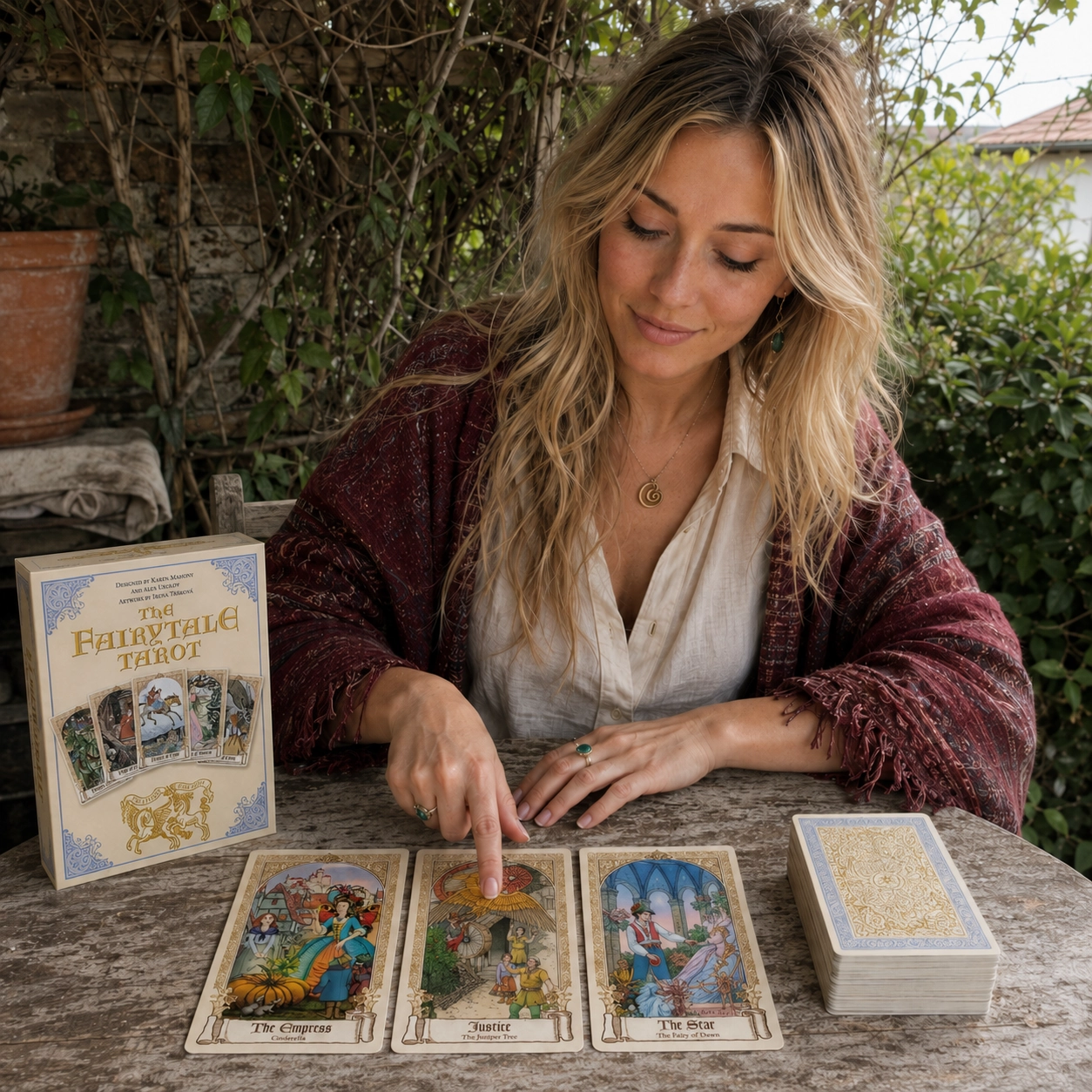
I open The Fairytale Tarot as I would an old storybook found at the back of a quiet shelf: expecting sweetness, then noticing the thorns between the pages. Karen Mahony and Alex Ukolov pair each tarot card with a named traditional tale, while Irena Triskova’s detailed scenes carry folklore from Europe, Asia, India and the Middle East into a Rider–Waite–Smith-shaped reading.
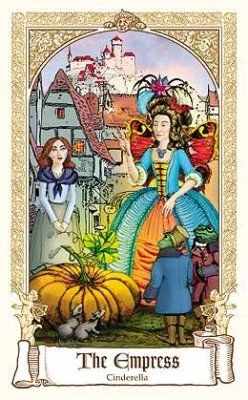
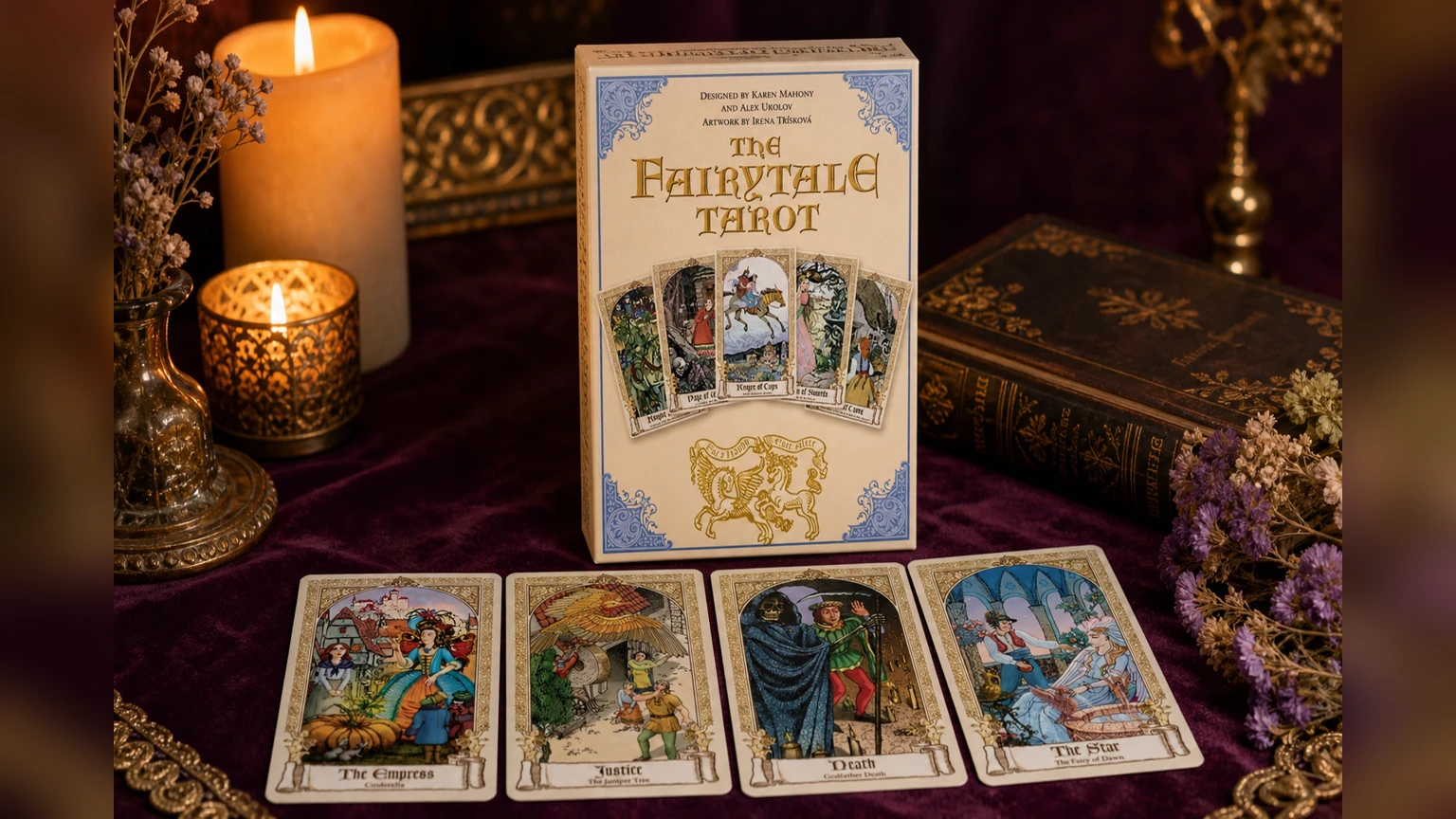
The Empress catches me first. Cinderella’s turquoise dress, the bright pumpkin and the distant castle make transformation feel physical rather than merely wished for. I begin with the familiar tarot role, then ask which moment of the tale is alive now: is something ripening, is help arriving, or is the reader being invited to step into a larger sense of worth?
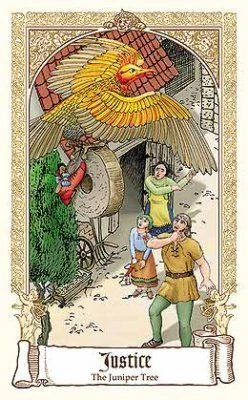
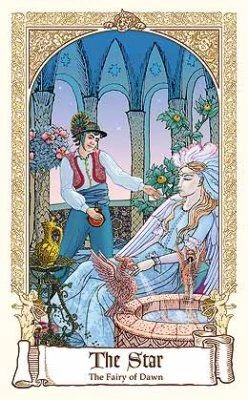
Justice and The Star show why the companion book matters. The great golden bird of The Juniper Tree carries consequence and restoration, while the blue arches of The Fairy of Dawn open a quieter path toward hope. When these cards sit together, I listen for what must be named honestly before healing can become more than a beautiful idea.
This is not the quickest deck for a beginner who wants familiar poses and obvious suit symbols, but it is wonderfully rich for journaling, creative work, shadow questions and family patterns. Give each image time, read the tale beside the tarot title, and let the surrounding cards tell you whether you are at the warning, the turning point or the return. Every spread can remind you that even an old story may still have a brave new page waiting for you.
Deck details at a glance
| Creators | Karen Mahony and Alex Ukolov |
|---|---|
| Artwork | Irena Triskova, with Alex Ukolov also credited |
| Publisher | Magic Realist Press / Baba Studio |
| First published | 2005; separate card-edition records also show early 2006 |
| Structure | 78 cards: 22 Majors and 56 Minors |
| Suits | Wands, Cups, Swords, and Coins |
| Card size | Approximately 78 × 128 mm |
| Availability | Out of print; mainly found through resale listings |
What makes this fairytale deck different?
The central idea is not simply to place Cinderella or Rapunzel on top of an ordinary tarot meaning. Mahony matched the themes and turning points of older tales to tarot correspondences, while Triskova’s scenes focus on the narrative moment itself. Every card therefore carries two titles: the tarot card and the tale.
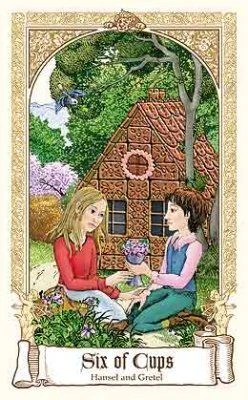
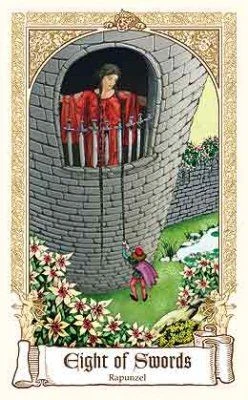
The Major Arcana includes The Snow Queen for The Chariot, Beauty and the Beast for Strength, The Juniper Tree for Justice, and Snow White for Judgement. The Minors range from Hansel and Gretel at the Six of Cups to Rapunzel at the Eight of Swords and The Emperor’s New Clothes at the Six of Wands.
Major Arcana card study
Cinderella as transformation, timing, and embodied value
The Empress shows Cinderella beside the tools and symbols of her changing condition. It is a strong example of how the deck uses a familiar story without reducing it to wish fulfilment.
In a reading, the card can ask what is ready to become visible, what support makes growth possible, and whether the querent is prepared to inhabit a larger role rather than merely dream about it.
Artwork: traditional, detailed, and unsanitized
The visual style is gentle Central European storybook illustration framed by cream scrolls and gold knotwork. Its influences sit closer to Ivan Bilibin, Arthur Rackham, Henry Justice Ford, and Harry Clarke than to contemporary digital fantasy. Colors can be bright, but the stories are not softened for children.
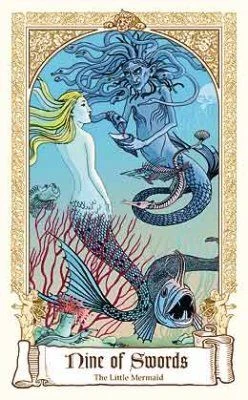
That matters. Godfather Death, The Red Shoes, The Juniper Tree, and the older ending of The Little Mermaid bring violence, mortality, obsession, and consequence into the reading. The deck looks like an illustrated book, yet its emotional range is unmistakably adult.
Four-card story arc
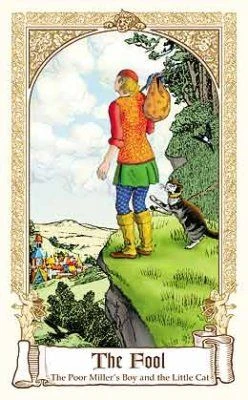
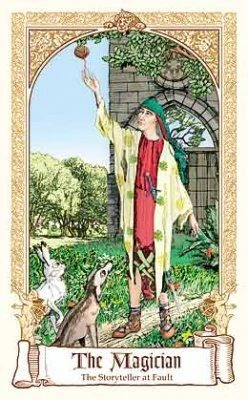
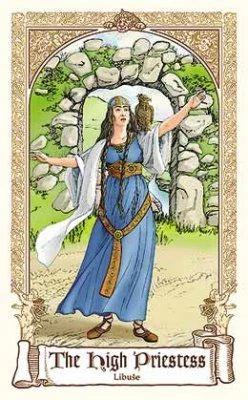
Leaving home and entering the tale
Read these four as a compact journey: innocence steps out, language shapes reality, hidden knowledge waits, and a new identity begins to take form.
How closely does it follow Rider–Waite–Smith?
The correspondence system is Rider–Waite–Smith-based, but the deck expects readers to follow narrative and archetype rather than copy Pamela Colman Smith’s composition card for card. The unnumbered Majors retain traditional names; the Minors use Wands, Cups, Swords, and Coins with Page, Knight, Queen, and King courts.
Some images echo familiar RWS dynamics immediately. Others deliberately depart from them. Astrology, Hebrew letters, Roman numerals, and repeated suit emblems are largely absent, so the tale title and pictured scene do more interpretive work.
Shadow card study
Justice is restoration after an unbearable truth
The Juniper Tree is one of the deck’s clearest warnings that “fairytale” does not mean harmless. Its bird, family scene, and moral reckoning give Justice a voice of exposure, consequence, and restoration after wrongdoing.
For a reading, ask what truth refuses to remain buried and what form of repair is actually proportional. This Justice is less interested in politeness than in restoring moral balance.
How the deck reads in practice
This deck reads like a cast of characters caught at decisive moments. Begin with the conventional tarot correspondence, then identify who has power, what promise or prohibition is active, and whether the story is before or after its turning point. Those questions keep the symbolism practical.
It is especially effective for relationship patterns, family stories, creative work, dream journaling, shadow exploration, and questions about repeated roles. It can answer everyday questions too, but the reader should translate its mythic language into one concrete next action.
Four-card emotional reading
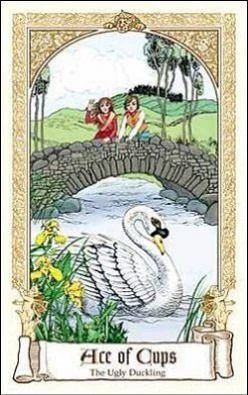
Comfort, memory, fear, and belonging
These Cups and Swords cards show the deck’s emotional range: an opening of feeling, the pull of childhood, the cost of a haunting story, and the possibility of a secure ending.

Is The Fairytale Tarot beginner-friendly?
A determined beginner can learn with it, but this is not the easiest first deck. Many stories will be unfamiliar, the images do not always reproduce RWS visual shorthand, and the companion material supplies context that the card alone cannot.
Three ways to read a card
1. Read the tarot title. Start with the known correspondence so the reading has a stable foundation.
2. Read the pictured moment. Notice action, setting, scale, animals, objects, and the direction each figure is facing.
3. Read the tale’s pattern. Ask whether the card depicts departure, prohibition, trial, helper, revelation, punishment, or return. The pattern often explains why this version of the card feels different.
Minor Arcana card study
Rapunzel makes mental confinement visible
The tower gives the Eight of Swords a literal structure of isolation. Yet the image also includes distance, access, and the possibility of another perspective—details that prevent the card from becoming a flat message of helplessness.
Ask what boundary is external, what boundary has been internalized, and what connection could change the available options.
The companion book is part of the experience
Karen Mahony’s companion text includes tale summaries, keywords, interpretations, reading guidance, spreads, and a folklore bibliography, with a foreword by Rachel Pollack. Sources disagree on the exact page count—roughly 208 to 232 pages depending on edition and counting method—so “approximately 220 pages” is the safest description.
The book also uses Aarne–Thompson tale classifications where available. That detail makes it more than a conventional keyword guide: it helps readers recognize recurring story structures across cultures.
Four-card transformation
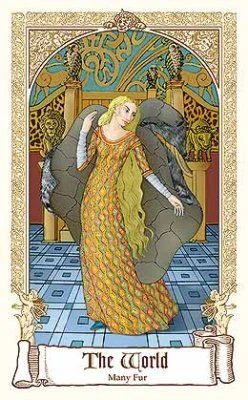
Reckoning, surrender, hope, and return
This sequence works as a shadow-to-integration spread. It begins with moral truth, passes through an ending, finds a guiding image, and closes with the return to wholeness.

Who will love this deck—and who may not?
Best for: folklore readers, narrative tarot practitioners, collectors of Baba Studio decks, writers, dream workers, and anyone who prefers layered archetypes to printed keywords.
Think twice if: you want a child-friendly deck, a close visual RWS clone, a budget daily reader, or a deck that works fully without its guidebook. Its out-of-print status and flexible specialist stock also make careful handling sensible.
Final Thoughts
The Fairytale Tarot succeeds because it treats stories as living structures rather than decorative themes. Its strongest readings emerge when traditional tarot knowledge meets plot, character, taboo, consequence, and transformation.
It is not the fastest or simplest deck, but it rewards attention. For readers willing to learn the tales and sit with unfamiliar images, it can turn a spread into a precise conversation about the story someone is living—and the part of that story that can still change.
The Fairytale Tarot FAQ
Who created The Fairytale Tarot?
Karen Mahony and Alex Ukolov created the deck. The archived official site credits Irena Triskova as principal artist, while Baba Studio also credits Alex Ukolov as an artist.
How many cards are in The Fairytale Tarot?
The reading deck has 78 cards: 22 Major Arcana and 56 Minor Arcana. Some copies may also contain title or decorative cards, but these are not additional tarot cards.
Is the deck suitable for children?
Not automatically. It draws on older, unsanitized fairy tales and includes violence, death, punishment, and dark psychological material. The storybook art should not be mistaken for child-oriented content.
Is The Fairytale Tarot out of print?
Yes. Baba Studio identifies it as out of print and unlikely to be reprinted. Marketplace listings are therefore availability- and condition-dependent.
Does the deck follow Rider–Waite–Smith?
It follows Rider–Waite–Smith correspondences with deliberate variations. Many scenes depart from familiar RWS compositions because the selected tale and narrative moment drive the image.
Is the complete 78-card gallery shown here?
Yes. The requested Pinterest board advertised 78 pins but exposed 75 unique originals. TarotFans recovered Ace of Cups and Seven of Swords from matching Pinterest pins and Six of Wands from the archived official FairytaleTarot.com gallery, producing a verified 78-card canonical sequence without duplicates.


