
Kabbalistic Visions Tarot Card Gallery
Explore the verified deck in its official sequence. Choose a family below, then select any card for an enlarged carousel view.

Aurica’s Quick Take
Kabbalistic Visions: The Marini-Scapini Tarot is an unusually ambitious study deck by author Marco Marini and illustrator Luigi Scapini. Its hand-painted scenes combine tarot archetypes with Hebrew letters, astrological marks, geometric forms, bodily imagery, myth, architecture, and the Kabbalistic Tree of Life. The result is not quiet or minimal. It is a dense visual workshop built for readers who enjoy discovering correspondences layer by layer.
I feel as though these cards have been painted on scraps of an illuminated dream. The Magician’s hot reds and sharp white shapes wake me up at once, while the Ace of Cups draws me inward through a little temple of doors and symbols. The Star feels crowded with movement rather than distant and serene, and The World opens into a night sky where every colour seems to be finding its place.
In a reading, I do not try to solve every symbol at once. I begin with the familiar tarot role, notice the colour or figure that holds my gaze, and then follow one correspondence into the surrounding cards. If the same shape, planet, Hebrew letter, or emotional gesture echoes across the spread, that repetition becomes my thread. It keeps the reading rooted while the artwork leads me somewhere unexpected.
I would reach for this deck when a question deserves patience, journaling, and a willingness to sit beside mystery instead of rushing it into a neat answer. Let one image speak first, let the next card answer it, and trust that this rich painted map can help you find a brave and meaningful path of your own.
Kabbalistic Visions Tarot review — a painted map through symbol, psyche, and the Tree of Life
Aurica’s verdict: choose this deck if you want a complete 78-card system that rewards study, journaling, pathworking, and slow symbolic reading. Think twice if you need instant visual simplicity or a strict Rider–Waite–Smith scene on every card. The paintings often behave more like dream diagrams than conventional narrative illustrations.
What makes Kabbalistic Visions Tarot different?
The deck treats tarot as a network rather than a list of separate meanings. The Major Arcana connect to the 22 Hebrew letters and the pathways of the Tree of Life; across the full deck, repeated letters, planets, signs, colors, bodies, buildings, vessels, spirals, and thresholds create echoes between cards. You are encouraged to notice how one image speaks to another.
Scapini’s paintings are unmistakably handmade. Figures can be theatrical, tender, grotesque, comic, sacred, or deliberately strange. Parchment-like borders and handwritten titles hold each scene together, while saturated reds, blues, greens, purples, and golds make the deck feel like an illuminated esoteric manuscript that has wandered into modern dream life.
Deck-specific card study
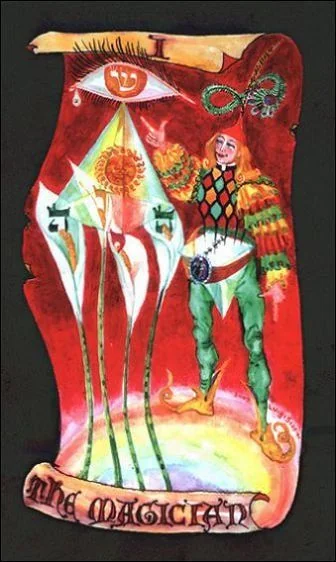
The Magician — power as a system of correspondences
A huge eye watches from the top of a deep red parchment field, with a Hebrew character glowing inside its orange iris. An infinity sign curls at the upper right. Below, a bright harlequin-like figure stands in green trousers, a diamond-patterned tunic, and a many-colored sleeve beside a pale angular form crossed by long vertical lines, small Hebrew characters, and sun- and plant-like emblems. Rainbow light pools under the figure’s feet.
This is not a Magician calmly arranging four tools on a table. Knowledge appears as a living diagram: eye, letter, infinity, color, gesture, and geometry all have to be held in relationship. Upright, the card favors disciplined attention—knowing which symbol, skill, or resource belongs to the work in front of you. Its shadow is performance without integration: collecting techniques and correspondences while never turning them into a clear act.
How the deck reads in practice
Begin with the traditional function of the card, but do not stop there. Name the first three visible details that pull your eye, then ask what connects them. A body may be crossed by planetary marks; a building may act like a state of mind; a spiral may turn desire into repetition. The most useful reading usually comes from the relationship between symbols, not from decoding each one in isolation.
In a spread, repeated colors and shapes matter. If circles, ladders, doors, wings, clocks, or mirrored figures recur, treat that repetition as the deck’s grammar. A reading may move from idea to embodiment, from secrecy to disclosure, or from fragmentation toward a more integrated pattern. This makes the deck particularly strong for spiritual study, creative blocks, psychological inquiry, life transitions, and questions about how a private belief becomes a real-world action.
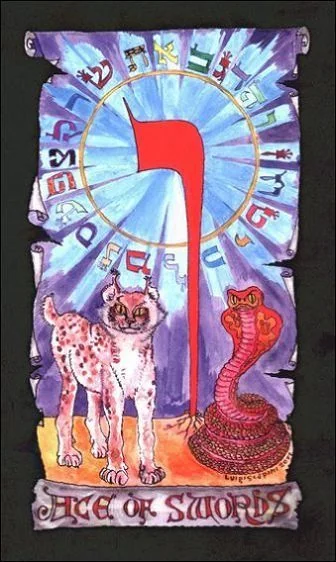
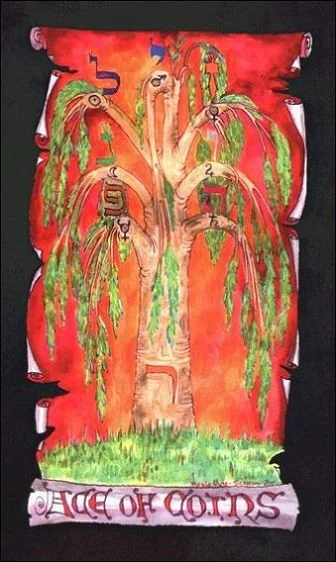
Four-card moment: elemental beginnings
Four Aces, four ways energy enters a life
These Aces make an excellent diagnostic spread: fire asks what wants to begin, water what wants to be received, air what must be named, and earth what can be built.


Is Kabbalistic Visions Tarot beginner-friendly?
It is beginner-usable, but not beginner-simple. The deck has a complete tarot structure, illustrated Minors, recognizable card titles, and a substantial companion book. Those are strong supports. The challenge is visual density: several symbolic systems may appear in one painting, and the deck does not always tell its story through a familiar Rider–Waite–Smith tableau.
A motivated beginner can learn with it by reading in layers. First record the card title and emotional tone. Next describe only what is visibly present. Then consult the guidebook for the Kabbalistic and divinatory correspondences. That order protects your own observation while still benefiting from Marini’s system. Readers already comfortable with tarot, astrology, Hermetic symbolism, or the Tree of Life will find the learning curve especially rewarding.
Deck-specific card study
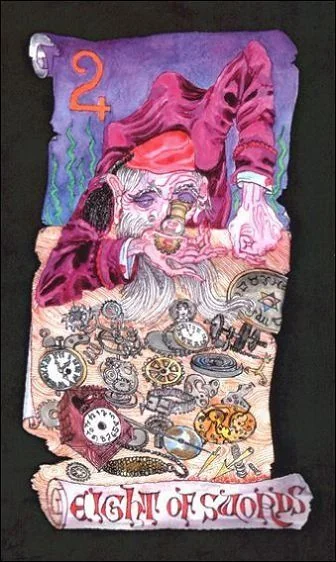
Eight of Swords — when analysis becomes a room with no exit
An elderly bearded figure bends over a crowded field of clocks, watches, gears, dials, and small mechanical parts. His purple-red clothing folds around the scene, while one large hand reaches down beside a round instrument. An orange planetary glyph hangs in the upper-left corner. Instead of literal swords forming a prison, timekeeping and measurement fill nearly every available space.
The image turns mental restriction into over-analysis. Every mechanism promises precision, yet the abundance of mechanisms creates confusion. Upright, it can show a mind trapped by deadlines, comparisons, systems, or the belief that one more calculation will remove uncertainty. Its useful expression is to choose the one measure that actually matters. Its shadow is mistaking constant monitoring for control.
Easy, medium, and hard readings with this deck
Easy — one symbol
What detail deserves my attention today? Pull one card, name the first object or color you notice, and connect it to one practical action. Do not decode the whole card.
Medium — three layers
What is happening in body, mind, and spirit? Read one card for each layer, then look for a repeated shape, color, number, or direction that links the three.
Hard — five pathways
What belief created this pattern, what desire sustains it, what consequence is visible, what correspondence have I missed, and what action integrates the lesson? This invites the deck to work as a connected symbolic system.
Four-card moment: paths of knowledge
Revelation is not the same as understanding
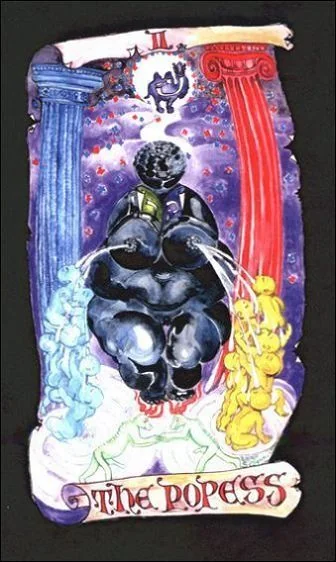
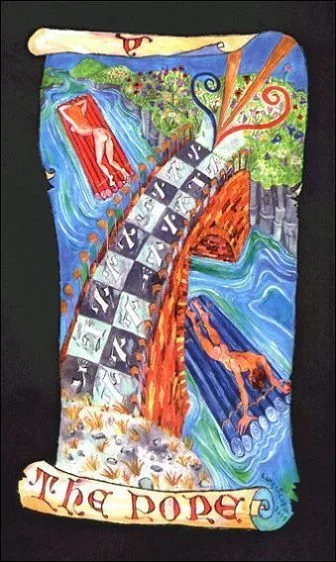
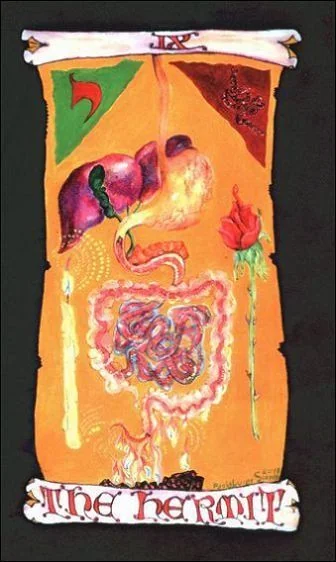
The Popess guards inward knowledge, the Pope organizes a teaching, the Hermit withdraws to digest it, and the World asks whether the lesson can become a whole way of living.

Art style and deck personality
Luigi Scapini’s style is theatrical, symbolic, and deliberately restless. The cards mix watercolor softness with sharp graphic emblems, medieval pageantry with modern machinery, and sacred architecture with vulnerable bodies. Some paintings feel comic or carnivalesque; others feel devotional, erotic, cosmic, or unsettling. That movement is part of the deck’s intelligence.
The visual personality is not neutral. A reading can feel like opening a dream journal annotated by an astrologer, an anatomist, and a stage designer. Readers who love polished digital symmetry may find the uneven lettering and eccentric anatomy challenging. Readers who value the evidence of the artist’s hand may experience those same qualities as warmth, movement, and depth.
Deck-specific card study
Princess of Coins — knowledge descending into the body
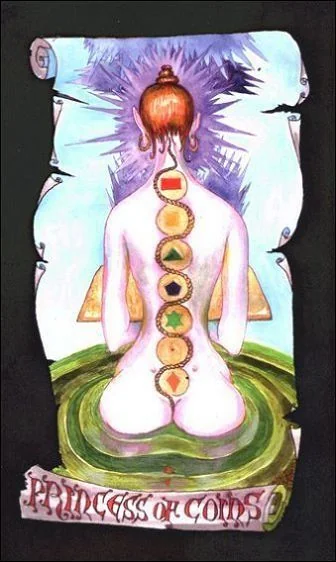
A pale figure is shown from behind, kneeling within concentric green rings. Her hair is gathered high, and a purple, wing-like burst radiates around her head. Seven colored discs descend along the center of her back, each holding a distinct geometric or elemental-looking mark. A warm triangle rises behind the torso while the rest of the field opens into cool blue-white space.
The card makes embodiment the lesson. Insight is not floating above the figure; it travels down the spine into posture, breath, weight, and ground. Upright, the Princess favors patient study, sensory learning, and the small repeated practice that turns an idea into skill. In shadow, she can signal spiritual concepts that never reach daily life—or a fixation on perfect alignment that prevents an imperfect first step.
Who will enjoy this deck — and who may not?
Best for: intermediate readers, ambitious beginners, students of Kabbalah or Hermetic tarot, visual journalers, artists, astrologically curious readers, collectors of Luigi Scapini’s work, and anyone who likes a deck to remain mysterious after the first reading.
Think twice if: you prefer minimalist cards, a uniform modern illustration style, short keyword meanings, or strict Rider–Waite–Smith scene matching. The cards are large at approximately 3¼ × 5¼ inches, so readers with smaller hands may prefer to shuffle in sections or use an overhand shuffle.
Four-card moment: elemental apprentices
One learner, four different disciplines
The four Princesses show initiation moving through passion, feeling, thought, and matter. Use them to ask which element comes naturally, which needs practice, and what a balanced apprenticeship would require.
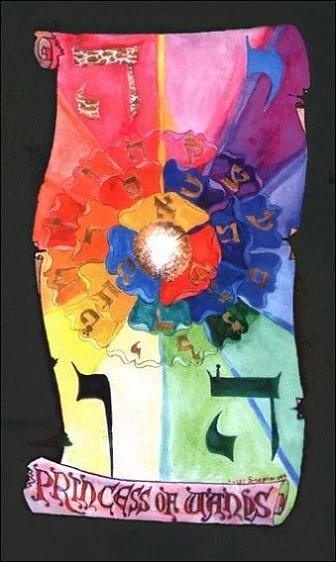
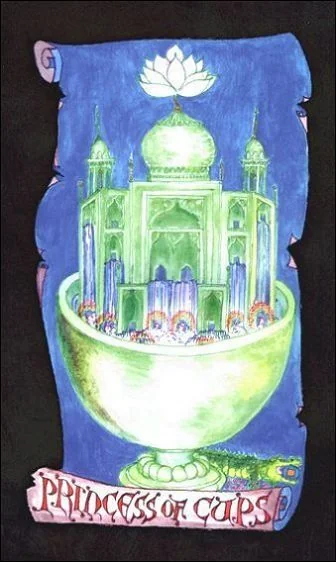
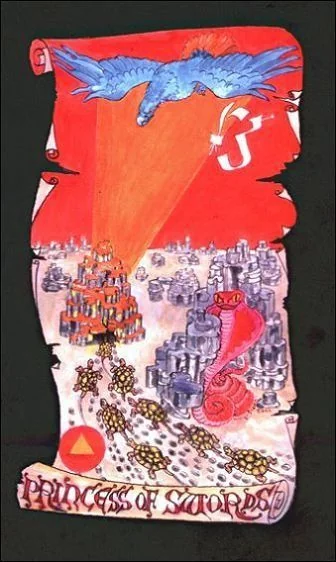
What Aurica likes most
I like that the deck never treats symbolism as decoration. A Hebrew letter, planetary glyph, clock, doorway, vessel, or spiral is not placed merely to make the painting look occult; it changes how the card thinks. The correspondences encourage comparison, and comparison turns a single pull into a longer conversation.
I also like its emotional range. The paintings can be humorous, uncomfortable, beautiful, bodily, and cosmic without smoothing those modes into one polished aesthetic. That makes the deck useful when a reading contains contradictions. It can hold the sacred and absurd in the same frame.
What to know before buying
The Schiffer boxed set is identified by ISBN-13 9780764346620 (ISBN-10 0764346628). The package includes 78 cards, a 256-page companion guide, and a Tree of Life map. The card dimensions are approximately 3¼ × 5¼ inches. Confirm those contents when comparing used listings, because cards-only copies do not provide the full study system.
The deck’s printed vocabulary matters. It uses The Popess and The Pope, calls the youthful court cards Princess, and names the earth suit Coins. Justice is VIII and Force is XI in this edition. Those choices are not errors to “correct”; they are part of the Marini–Scapini structure.
Aurica’s golden rule for Kabbalistic Visions Tarot
Follow the correspondence, then return to the question. Let the letters, colors, planets, bodies, and geometry widen the reading—but do not disappear inside the system. The best interpretation is the one that reconnects all that symbolism to a truthful next step.
Final Thoughts
Kabbalistic Visions is a deck for readers who want tarot to remain a field of study. Marco Marini supplies an organizing esoteric framework; Luigi Scapini gives that framework an eccentric, human, and memorable body. Together they create a set that can support divination, meditation, creative work, and years of comparative reading.
It is not the fastest deck to learn, and that is precisely its appeal. Each return reveals another pathway between image and idea. If you want a tarot that rewards patience more than instant familiarity, this boxed set is one of the richer choices in the Kabbalistic tradition.

Kabbalistic Visions Tarot FAQ
Who created Kabbalistic Visions Tarot?
Marco Marini wrote and structured the deck, and Luigi Scapini illustrated it. The boxed set is published by Schiffer.
How many cards are in Kabbalistic Visions Tarot?
The deck contains 78 cards: 22 Major Arcana and 56 Minor Arcana. The TarotFans gallery presents the complete verified card sequence.
What comes in the boxed set?
The Schiffer set includes 78 cards, a 256-page companion guidebook, and a Tree of Life map. The cards measure approximately 3¼ × 5¼ inches.
Is Kabbalistic Visions Tarot suitable for beginners?
Yes for a motivated beginner, although it is more demanding than a simple teaching deck. The complete structure and substantial guidebook help, but the paintings combine several symbolic systems and reward slow study.
Does it follow Rider–Waite–Smith tarot?
It uses a complete 78-card tarot structure and many recognizable divinatory functions, but it is not a strict Rider–Waite–Smith clone. Its visual and interpretive framework centers Kabbalistic, astrological, and archetypal correspondences.
Why does the deck use The Popess, The Pope, Princesses, and Coins?
Those are the edition’s printed titles. They reflect the Marini–Scapini deck’s chosen tarot vocabulary and should be preserved when studying or cataloging the cards.


