Ludy Lescot Tarot Cards
Browse the available card images from the Ludy Lescot Tarot deck. Tap any card to open a larger carousel view.
Ludy Lescot Tarot Review: Orica’s Quick Take
Ludy Lescot Tarot is a 78-card Lo Scarabeo deck designed by Patrizio Evangelisti around the notes, sketches and occult world of the fictional Ludy Lescot. Its misty streets, candlelit interiors, old-fashioned dress and women-centered scenes feel like a Gothic spiritualist novel set near the New Orleans French Quarter.
Quick answer: choose it if you want atmospheric, story-rich images for shadow work, relationship patterns and intuitive reading. Skip it if you need card titles printed in full or prefer a bright, neutral deck that never unsettles the room.
What makes Ludy Lescot Tarot different?
The deck’s premise is unusually specific. Ludy is presented as a shy young esoteric and art student whose advice affected influential people; Evangelisti then turns her observations into a complete tarot. That framing gives the cards a private-diary quality. Rather than clean symbolic diagrams, many scenes resemble fragments from a life: rooms, rivers, staircases, séances, secrets and emotionally charged encounters.
The 2011 edition is a standard 78-card tarot with 22 Major Arcana and 56 Minor Arcana. The cards do not print full English titles: the Majors rely on Roman numerals, while the Minors use suit emblems and numbers. That keeps the art immersive, but beginners may want a title list nearby until the sequence becomes familiar.
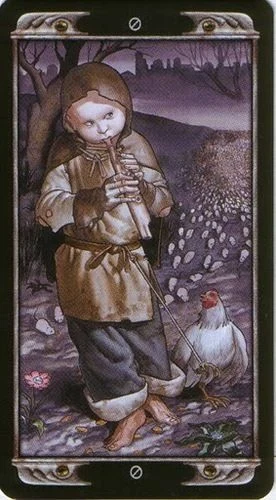
CARD STUDY
The Fool
A barefoot child in a brown hooded coat plays a small pipe while a white-and-red rooster walks close by. Pink flowers dot the ground, and a shadowed path disappears through bare trees. The image makes the beginning feel innocent but not empty: instinct and companionship are already present. Upright, it invites curiosity before certainty. In shadow, the lowered gaze can become absorption so complete that the road ahead goes unnoticed.
How the deck reads in practice
Begin with the familiar tarot function, then let the staging tell you how that energy behaves here. Notice who faces whom, whether the setting is open or enclosed, and which object carries the strongest light. The illustrations are especially good at revealing emotional distance: a figure may be physically near others yet psychologically isolated.
Because the cards often feel like scenes from a larger story, use supporting cards to establish cause and consequence. One card can describe the atmosphere, a second can show the hidden motive, and a third can identify the choice that changes the situation.
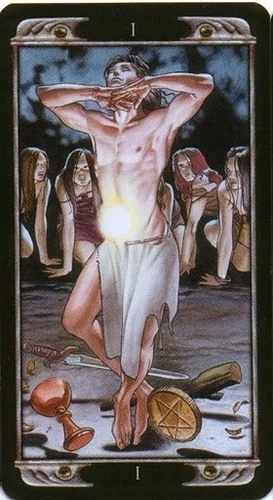
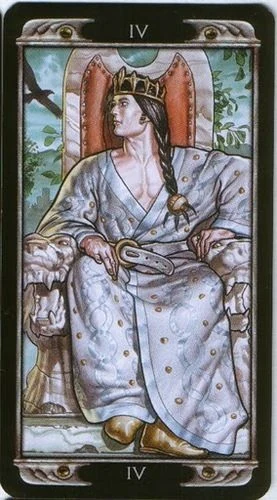
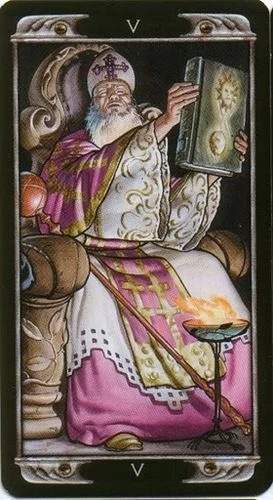
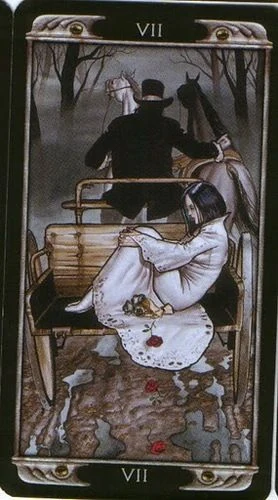
FOUR PACK
Ceremony, authority and private power
The Magician, Emperor, Hierophant and Chariot show four different ways influence moves: performance, position, doctrine and directed will.
Beginner friendliness and reading prompts
The familiar 78-card structure helps, but the missing printed titles make this a better second deck than first deck. A beginner who loves the imagery can still learn with it by matching Roman numerals and suit symbols to a reference sheet. Do not rush to explain every detail; identify the emotional center first.
Easy: Which figure or object holds the most attention?
Medium: What relationship or power dynamic is visible in the scene?
Hard: What secret keeps this scene stable—and what changes if it is spoken?
CARD STUDY
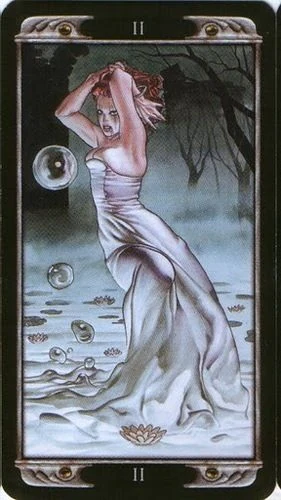
The High Priestess
A woman in a flowing white dress stands in shallow water with her arms raised into her hair. Pale spheres hover nearby, a dark tree leans over the scene, and small leaves or petals float across the surface. Instead of seated stillness, intuition appears physical and tidal. Upright, the card asks you to trust subtle information without forcing it into words. In shadow, fascination can replace discernment, leaving the reader captivated by a feeling that has not yet been tested.
Love, family and inner-life readings
Ludy Lescot Tarot is strongest when a question contains history. In relationship readings, its glances, distances and enclosed rooms can show who protects, pursues, waits or withholds. For family questions, look for inherited roles: the person who keeps peace, carries responsibility, performs competence or remains invisible.
The deck is also useful for dream journaling and creative work because its images do not close after one interpretation. Ask what the scene reminds you of, then separate memory from prediction. The cards can reveal a pattern without declaring that the past must repeat.
FOUR PACK
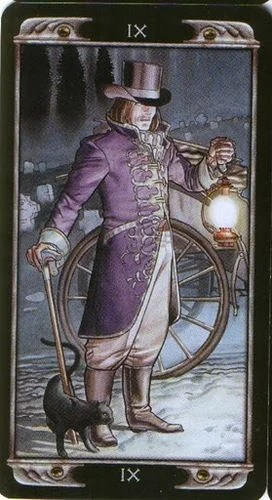
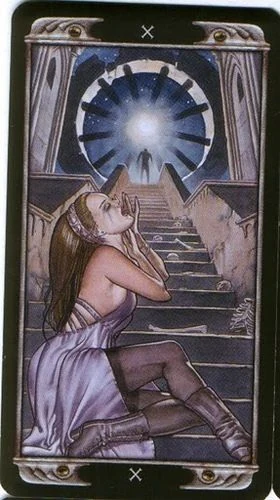
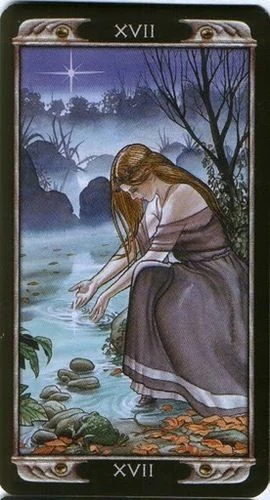
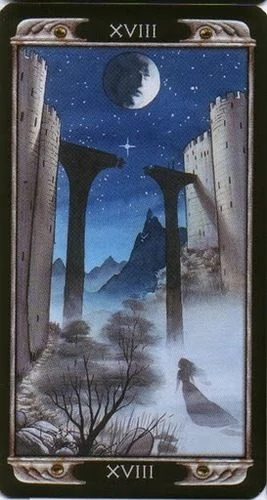
Thresholds after dark
The Hermit, Wheel of Fortune, Star and Moon move from solitary searching to an opening, a quiet act of renewal and a landscape shaped by uncertainty.
Art style and personality
The palette is soft but haunted: smoke blue, violet, worn cream, moss green and lamplight gold. Figures wear period clothing, and the backgrounds often use winter trees, stone interiors, dark water or receding architectural spaces. A silver-black ornamental border contains each scene without making it feel safe.
Animals and domestic objects keep the Gothic atmosphere human. A rooster, cat, lantern, cup, scales or chest can become the practical clue inside an otherwise mysterious image. This balance makes the deck expressive without depending only on spectacular occult symbols.
CARD STUDY
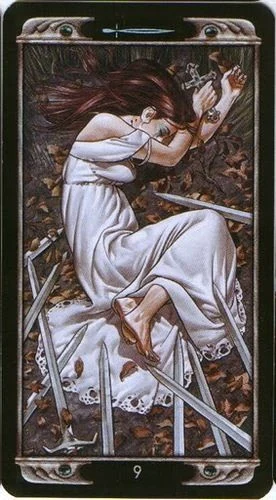
9 of Swords
A woman in a white nightdress sits folded inward with both hands covering her face. Pale swords rise around her like narrow rails, fallen leaves crowd the ground, and her hair streams sideways as if the air itself will not settle. Anxiety becomes enclosure: the body is trapped inside repeated lines. Upright, the card names mental pressure that needs witness and structure. In shadow, it warns that rehearsing every possible danger can become another set of bars.
Who will love this deck?
It suits readers who enjoy Gothic fiction, spiritualist history, psychologically expressive art and decks with a strong narrator. Collectors of older Lo Scarabeo releases may value how unlike a generic Rider-Waite-Smith repaint it feels. Its best readers are willing to sit with ambiguity and use the booklet or a title list when the numbering is not instantly familiar.
It is less suitable for public readings where clients expect bright reassurance, for readers who dislike Christian or Pagan imagery appearing side by side, or for anyone who wants large titles and keywords printed directly on every card.
FOUR PACK
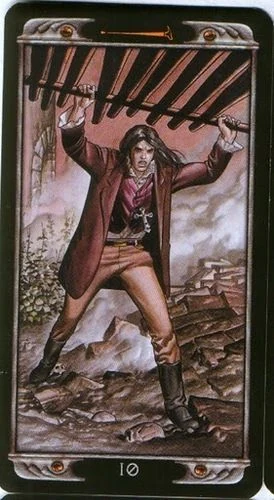
Pressure at the edge of completion
These four cards show burden, emotional containment, mental strain and material legacy—the point where carrying on is no longer the same as moving forward.
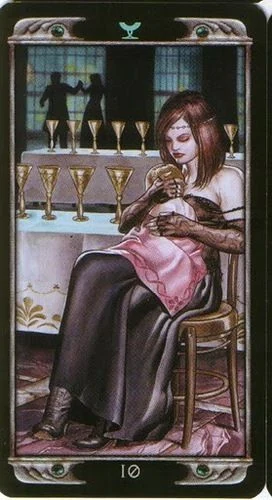
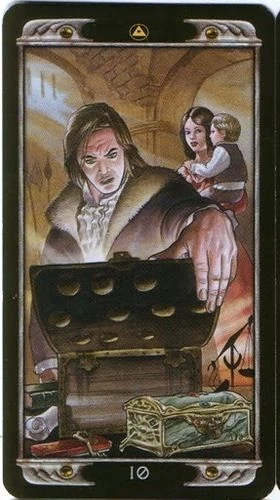
What to know before buying
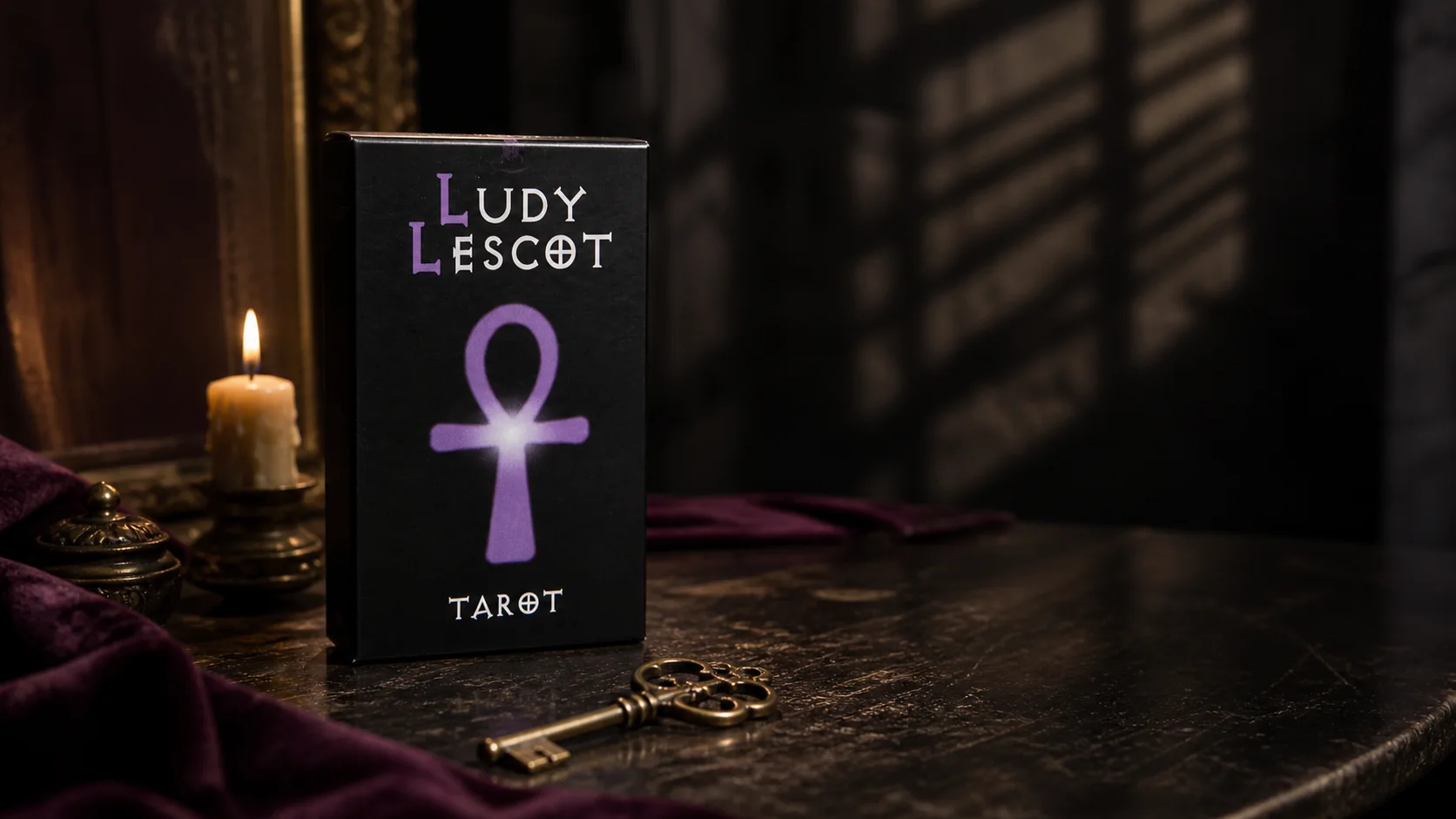
The deck was published by Lo Scarabeo in 2011, with Llewellyn distribution recorded for the English-market edition. The verified ISBN is 978-0-7387-3110-0, and product records describe 78 full-color cards with a multilingual instruction booklet. As an older release, availability may vary by seller, so check that the listing matches the black box with the lavender ankh and confirm the language and condition before ordering.
Golden rule: do not solve the mystery too quickly—first identify who benefits from the silence.
Final thoughts on Ludy Lescot Tarot
Ludy Lescot Tarot succeeds because its darkness has a point of view. The images are not merely Gothic decoration; they stage secrecy, influence, isolation, desire and the uneasy moment when private knowledge becomes action. If you want a deck that reads like an illustrated occult diary, it can become a memorable companion.
Its numbering and partial public image set mean it asks for a little patience, but the reward is a reading voice that feels intimate, theatrical and emotionally precise rather than interchangeable.
Ludy Lescot Tarot FAQ
Who created Ludy Lescot Tarot?
Patrizio Evangelisti designed the deck around the notes, sketches and fictional occult world of Ludy Lescot.
How many cards are in Ludy Lescot Tarot?
It is a standard 78-card tarot with 22 Major Arcana and 56 Minor Arcana.
Does the deck print card titles?
The cards emphasize numerals and suit symbols rather than full English titles, so new readers may want a title list nearby.
Is Ludy Lescot Tarot good for beginners?
A committed beginner can use it, but the unprinted titles and story-rich symbolism make it easier as a second deck.
What readings suit this deck best?
It is especially effective for relationship dynamics, family roles, shadow work, creative questions, dreams and situations where secrecy or emotional atmosphere matters.
Which edition should I look for?
Verified records identify the 2011 Lo Scarabeo deck and ISBN 9780738731100. Check for the black box with a lavender ankh and confirm seller, language and condition.
More Tarot Decks to Discover
If Ludy Lescot Tarot caught your eye, these dark, dreamlike and symbol-rich reviews offer other distinctive reading worlds.


