
The Secret Language of Birds Tarot Cards Revealed
Explore the clean exact-edition card fronts in this carefully preserved partial Gallery, arranged in official Tarot order. Choose a group or open any available card in the Lightbox. Unavailable cards remain omitted rather than guessed.
Showing all available cards

Aurica’s Quick Take
I enter this deck as if I have opened a window at first light and found the air already full of messages. Linda Sutton’s birds do not perch politely at the edge of the tarot; they lean into faces, cross the sky and carry the emotional weather from card to card. The silver-grey frames make each painted scene feel like a small old mirror.
I begin by noticing the bird’s behaviour before reaching for folklore. Is it nesting, hunting, warning, displaying, migrating or simply watching? Then I return to the card’s traditional job and the question on the table. That order matters, because a beautiful symbol should deepen the reading rather than float away from it.
The unusual Queen, King, God and Goddess courts may take a little time to learn, but they also give power and maturity more than one voice. Keep the guidebook nearby, stay curious about the gesture in front of you, and this deck can help your own quiet wisdom find its wings.
A tarot carried on wings
The Secret Language of Birds Tarot begins with an old human habit: looking up and wondering whether a movement across the sky means something. Adele Nozedar builds the deck around augury, folklore and the natural character of birds, while Linda Sutton paints figures and feathers into close, dreamlike encounters.
This page keeps the public Gallery deliberately partial and honest. It presents the established clean source set rather than filling its absences with lower-confidence copies. The title and controls make no promise of completeness; the official kit itself is a complete traditional tarot set.
Artwork that makes symbolism feel alive
These paintings rarely separate person from bird. A face turns toward a beak, wings interrupt the frame, and colour gathers around the moment like weather. That closeness gives each card an emotional pulse: the bird is messenger, mirror, instinct and sometimes the part of us that already knows which way the wind is moving.
Do not rush to identify every species. First notice size, direction, distance and action. A bird flying away says something different from one nesting close to the body; a sharp gaze changes a gentle scene. The guidebook can then add myth without silencing your own clear observation.

Card study
The High Priestess — a quiet messenger at the threshold
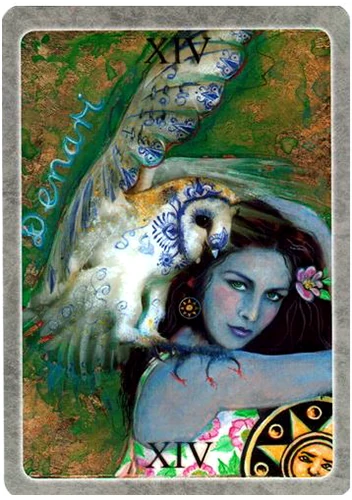
A pale figure and a watchful bird meet in a cool, dreamlike field. Their faces draw close while feathers, skin and soft blue-grey space create a hush around the encounter. The bird is not decoration here; it feels like the message itself, arriving before ordinary language has caught up.
Upright, I read this as receptive knowing: pause, notice, and let the first clear signal land. In shadow, intuition can become projection or secrecy. In a spread, compare the figure’s stillness with the movement in neighbouring cards, then ask which impression is supported by what you can actually see.
How the deck reads in a spread
This deck reads beautifully when the question involves timing, perspective, freedom, warning, migration or home. Lay three cards with room between them and watch where wings, faces and flight lines point. The eye often discovers a conversation before the mind has named it.
Keep that conversation grounded by ending with one practical sentence: “The message I can act on today is…” The imagery may soar, but a useful reading still needs somewhere to land.
Four-card story
Four cards that open the sky
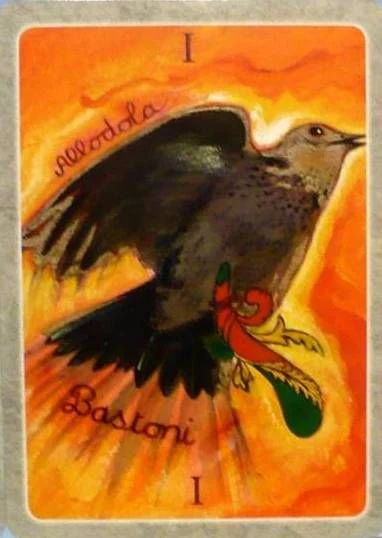
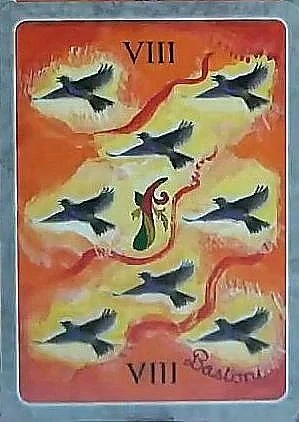
The Star offers a clear point of hope; Ace of Wands strikes the first bright spark; 3 of Wands watches possibility move beyond the familiar shore; and 8 of Wands gives the message wings. Together they tell a story of inspiration becoming direction, then motion.


Beginner guidance and three useful prompts
A curious beginner can learn with this deck, though the large cards and renamed court sequence deserve patience. Work with one suit at a time and keep both the guidebook and a traditional tarot reference nearby. Compare them, rather than forcing one voice to defeat the other.
Easy reading
What message deserves my attention today?
Medium reading
Where do I need a wider view before I decide?
Deep reading
Which old instinct protects me, and which one keeps me circling?

Card study
5 of Swords — the cost hidden inside a victory
The card’s tense grouping and blade imagery pull the eye toward conflict rather than celebration. Bodies, birds and sharp lines make the atmosphere feel unsettled, as though the argument has ended but its echo is still circling overhead.
Upright, this can name winning at too high a price, defensive speech or the lonely silence after a clash. Its shadow may be avoiding necessary truth because conflict feels frightening. Let surrounding Cups show the emotional cost and Coins show what can be repaired; then choose one honest sentence that does not need to wound.
Love, friendship and emotional weather
In relationship readings, the birds make distance wonderfully visible. Notice whether they gather, pair, compete, turn away or shelter one another. Then look at the human figure’s hands and gaze. The combination can reveal closeness that feels safe, attention that has wandered, or a truth waiting to be spoken gently.
Avoid treating every bird pair as romance. Connection can be friendship, kinship, mentorship, memory or the quiet loyalty of someone who stays nearby without taking over.
Four-card story
Four ways the heart learns to listen
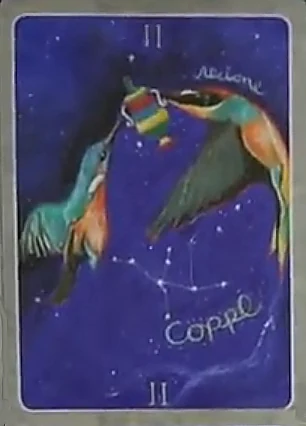
Ace of Cups opens feeling at its source; 2 of Cups recognises a meeting; 6 of Cups carries memory in its feathers; and 10 of Cups widens private affection into belonging. Read together, they show emotion as invitation, exchange, remembrance and shared shelter.



Audience fit: who will love it
This deck is a lovely match for bird lovers, folklore readers, artists, visual journalers and intuitive tarot readers who enjoy symbolism with texture. It also suits anyone who wants nature imagery without losing the human face of a reading.
It may feel less comfortable if you prefer pocket-size cards, minimalist pips, plain keywords or a strict familiar court system. The official cards are large, and Queen, King, God and Goddess create their own rhythm of maturity and power.

Card study
6 of Coins — an exchange that must stay balanced
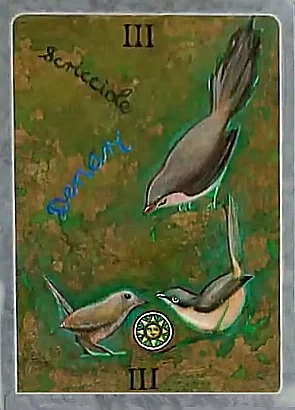
The composition gathers bird symbolism around the practical language of Coins, turning generosity into something alive and alert. The repeated forms feel like hands passing value from one place to another, while the card’s vertical movement asks who is giving, who is receiving, and who decides the terms.
Upright, I read fair support, useful resources and a gift that respects dignity. In shadow, help can carry strings or create dependence. In an actual reading, name the resource first—time, money, attention, skill—and then ask whether the exchange leaves both sides with room to breathe.
Work, money and creative direction
For practical questions, let the Coins bring the flight imagery back to earth. Ask what resource is nesting, what opportunity is ready to move, and what must be built before enthusiasm takes off. In work readings, a bird’s posture can show whether the moment calls for patience, a clear announcement or a change of vantage point.
Creative readers may enjoy drawing one card for the idea, one for its environment and one for the next piece of craft. The deck is strongest when inspiration becomes a small, visible action.
Four-card story
Four grounded forms of sacred care
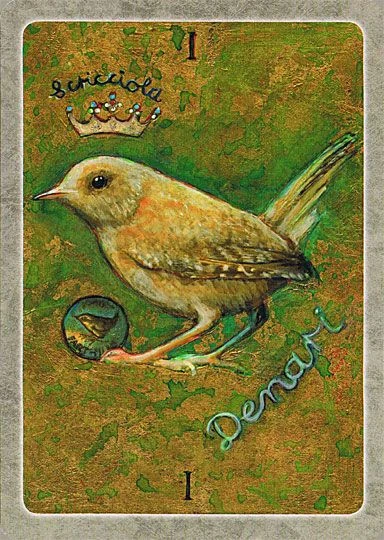
Ace of Coins places value in the hand; 3 of Coins asks for craft and cooperation; 6 of Coins weighs the flow of help; and Goddess of Coins lets abundance mature into stewardship. Their birds keep the earth suit from feeling heavy: resources are meant to move, nourish and return.
Buying guidance for the exact edition
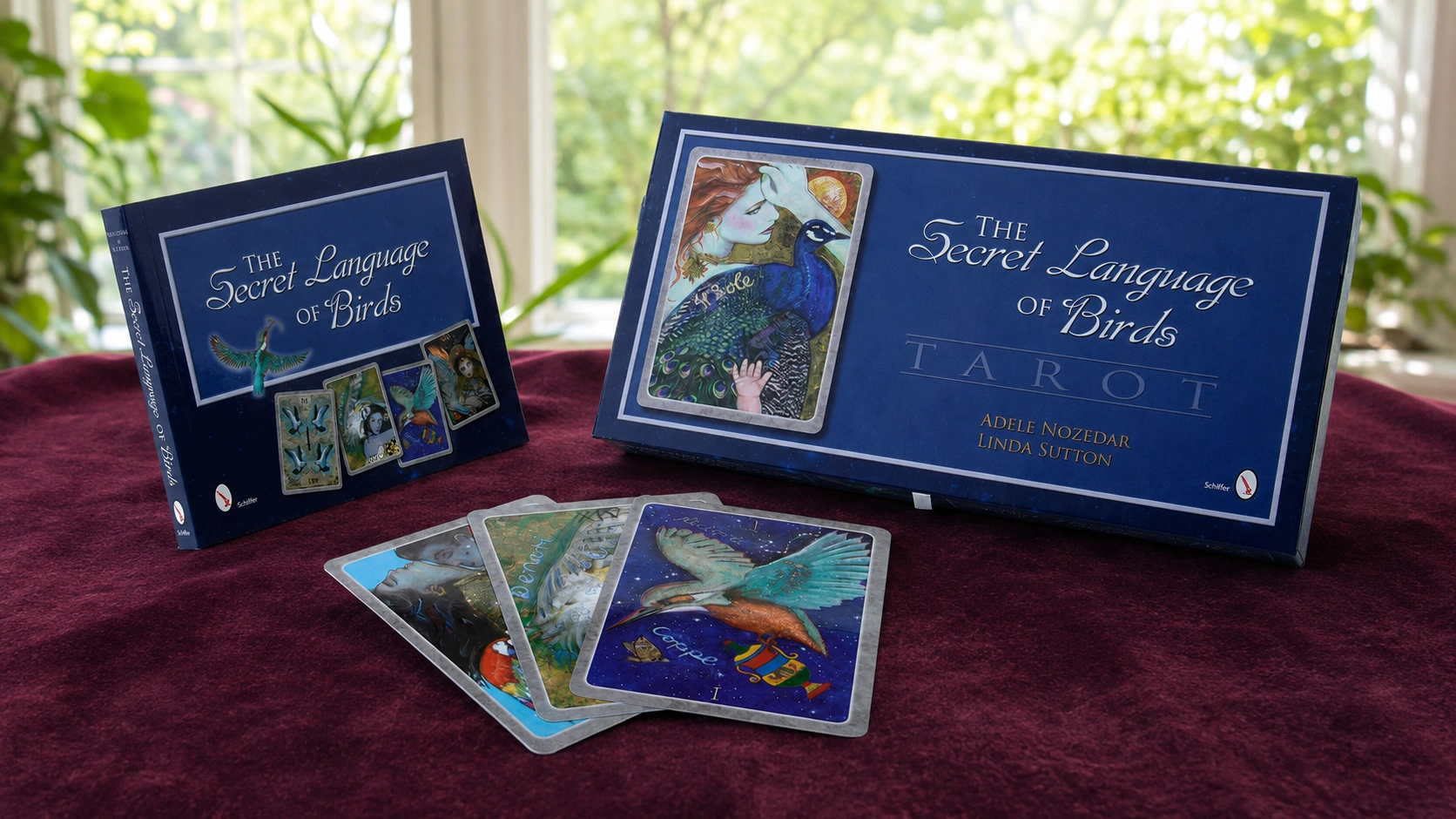
The exact reviewed kit is the 2011 Schiffer/REDFeather edition, EAN 9780764339004, credited to Adele Nozedar with paintings by Linda Sutton. Its deep navy landscape box carries an inset image of a woman and bird, silver framing and both creator names. Schiffer describes a complete traditional tarot set, a substantial guidebook and large 4 by 5.5 inch cards.
The buttons lead to Schiffer’s current exact-product page. Compare the EAN, navy box and creator credits before ordering from another seller, and check current price and availability at the destination rather than relying on an old listing.
Aurica’s golden rule for this deck
Watch the bird first; name the omen second.
Behaviour is the bridge between picture and meaning. Notice what the bird is actually doing, return to the card’s traditional task, and let folklore add depth only after the scene has spoken plainly.
Final thoughts
The Secret Language of Birds Tarot feels like a painted conversation between instinct and imagination. Its birds bring alertness to the Majors, motion to the suits and a strange tenderness to moments when a human face meets another kind of intelligence.
I recommend it to readers who want symbolism they can feel before they explain it. Approach each card with patience, listen for the quietest detail, and let the message you find become one kind step in the world below the sky.
 View The Secret Language of Birds Tarot at SchifferView The Secret Language of Birds Tarot at Schiffer
The Secret Language of Birds Tarot FAQ
Who created The Secret Language of Birds Tarot?
Adele Nozedar wrote the deck and guidebook, with paintings by British artist Linda Sutton. Schiffer published the kit in 2011.
What comes in the official kit?
Schiffer describes a complete traditional tarot set with a substantial illustrated guidebook. The listed card size is 4 by 5.5 inches, noticeably larger than many standard tarot cards.
Does it follow a traditional tarot structure?
Yes. It follows the familiar Major and Minor Arcana structure, with Cups, Wands, Swords and Coins. Its courts use Queen, King, God and Goddess, so readers should allow time for that hierarchy to become familiar.
Is it suitable for beginners?
It can be, especially for a beginner drawn to birds, folklore and visual symbolism. The large cards and unusual courts add a learning curve, so the guidebook and a simple traditional reference are helpful at first.
What readings suit this deck?
It feels especially alive in questions about messages, timing, transition, instinct, freedom, home and perspective. Start with the visible behaviour of the bird, then connect it to the card’s tarot role and surrounding spread.
What should I check before buying?
Match the listing to EAN 9780764339004 and the deep navy landscape box credited to Adele Nozedar and Linda Sutton. The official Schiffer page currently lists that exact kit, but price and availability can change.
Keep exploring
More Tarot Decks to Discover
Follow another path through feathers, forest and animal wisdom.


