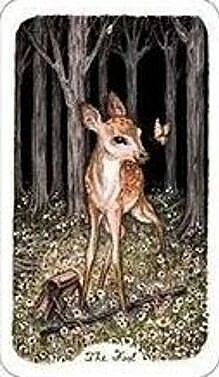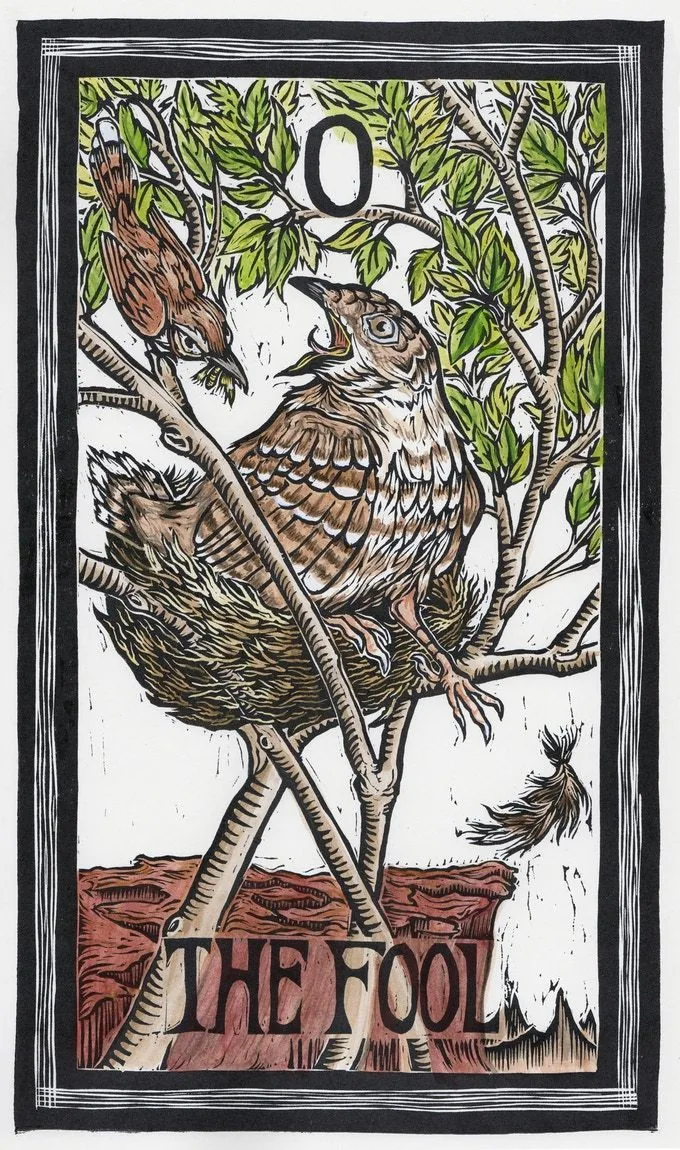
Explore the Pacific Northwest Tarot Cards
Explore Brendan Marnell’s wildlife and plant illustrations. Choose a suit or select a card for a closer look. This artwork archive includes early designs; borders, colours, and lettering can differ from the finished printed cards.
Showing the selected card group.

Aurica’s Quick Take
I love the way the Pacific Northwest Tarot lets small, living details carry such large feelings. The salmon in Strength comes close enough to make courage feel physical. The Hanged One offers a patterned chrysalis, still closed around its change. Then the Queen of Pentacles sits among gathered sticks, reminding me that tenderness can be practical, capable work.
Brendan Marnell’s colours give those encounters a lovely clarity: cool water, deep greens, and flashes of orange that seem to warm the whole picture. I would choose this deck for thoughtful questions about energy, patience, and the places where we belong. Its familiar tarot structure offers support, while the wildlife asks us to look beyond memorised scenes.
My favourite invitation here is to notice what a creature needs, not simply what it represents. Space? Shelter? A clear direction? That question can bring a reading gently back to everyday life. You do not have to grow all at once; there is wisdom in tending the little patch of possibility already within your reach.
A living landscape, rather than a cast in costume
The Pacific Northwest Tarot gives familiar tarot questions to creatures that swim, shelter, blossom, and take flight. Created, illustrated, and self-published by Brendan Marnell, the deck lets the natural world carry the story. Marnell drew its illustrations digitally in Procreate on an iPad Pro and hand-lettered the titles and numerals. A salmon becomes Strength; a chrysalis holds the stillness of The Hanged One. The connection is more thoughtful than simply replacing a person with an appealing animal.
I am drawn to the contrast between the clean outlines and the restless life inside them. Broad shapes of teal, violet, moss green, and warm orange make the subjects easy to notice, while delicate markings reward a closer look. Separate title panels give these busy little worlds room to breathe. The gallery preserves published artwork examples; some early designs have paler margins and different lettering from the finished physical cards, so it is not an exact preview of every printing.
Look first at what the subject is doing. Is it exposed, protected, moving, or waiting? That small observation keeps the beauty connected to a reading. The landscape becomes a way of asking about your own circumstances without needing every card to show a human face.
Strength — courage with a pulse
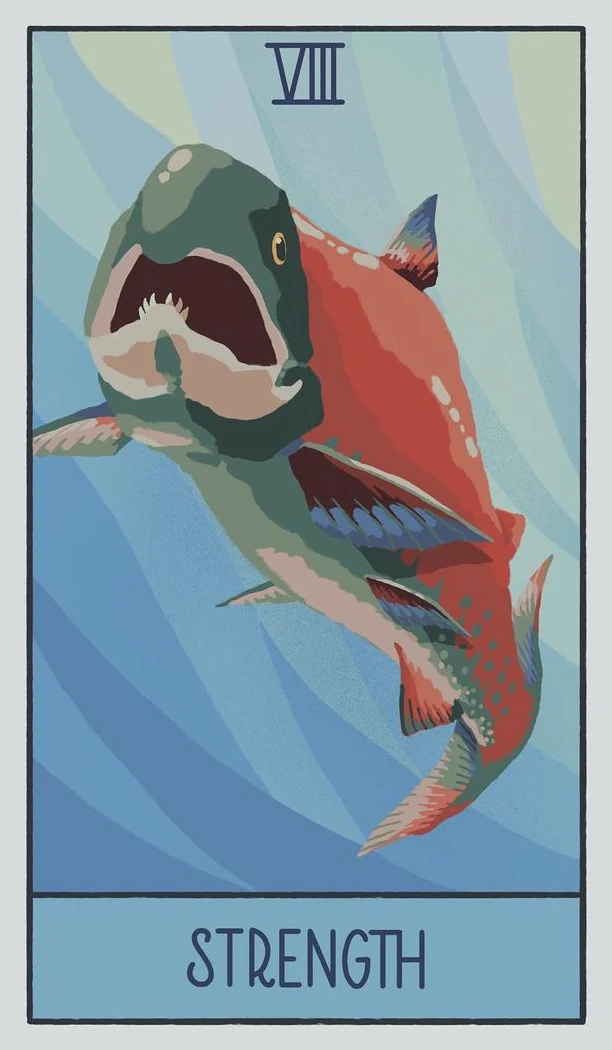
A salmon fills almost the whole picture, its open mouth turned towards us and its red-orange body curving through pale blue bands of water. Dark green shapes define the head; the fins introduce sharp flashes of blue. Above it, VIII confirms Strength’s familiar place in the Major Arcana.
There is nothing ornamental about this courage. The close viewpoint makes effort feel immediate and bodily. Rather than a human hand calming a lion, we meet a living creature in motion. I read that choice as an invitation to respect instinct without letting urgency make every decision.
At its most useful, Strength suggests endurance guided by self-command: staying present during a difficult conversation, or returning patiently to work that matters. Its shadow is the belief that being strong means pushing without pause. Ask, “What deserves my steady effort, and where am I merely fighting?” Beside The Hanged One, that question becomes especially revealing: courage may be the willingness to stop forcing an answer.
Familiar tarot bones, a different way of speaking
The original deck has 78 cards, with Wands, Cups, Swords, and Pentacles, alongside the Major Arcana. Strength is VIII and Justice XI. Two titles worth noticing are The Hanged One and Judgment, spelled with one “e.” The courts retain Page, Knight, Queen, and King, although their characters are expressed through animals rather than human royalty.
If you know Rider–Waite–Smith, that structure gives you a useful foothold. The pictures are not straightforward copies of its scenes, however. A flower, a diving bird, or a creature changing shelter asks you to translate an action into a human concern.
Keep the suit beside the image as you interpret: Wands for initiative, Cups for feeling and connection, Swords for thought and difficult choices, Pentacles for material care. An attractive animal is not automatically a cheerful answer. Its situation, the card’s traditional role, and your question all deserve a voice.
Four Aces — what wants to grow?
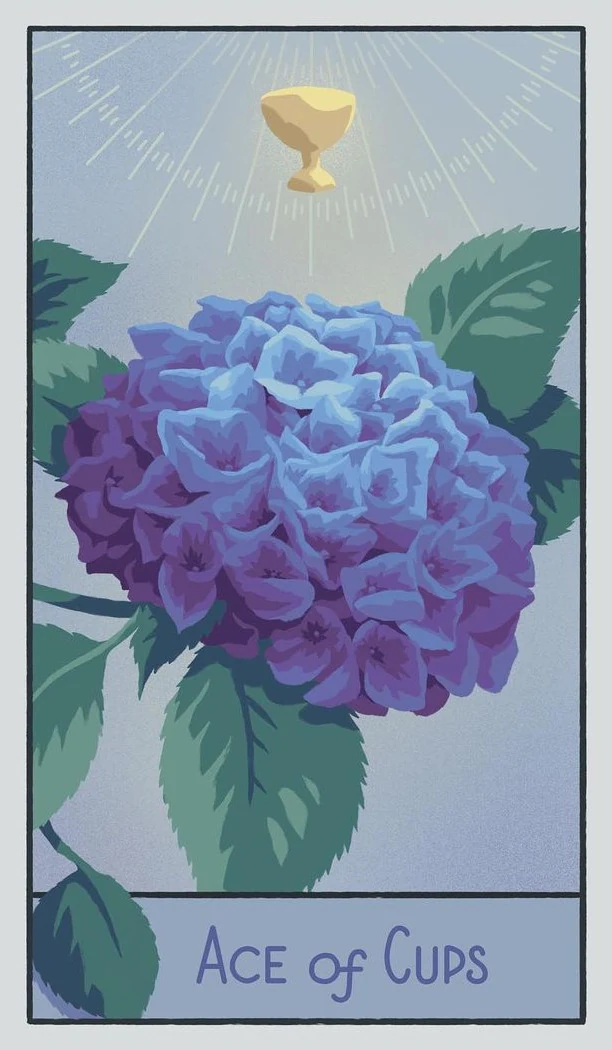
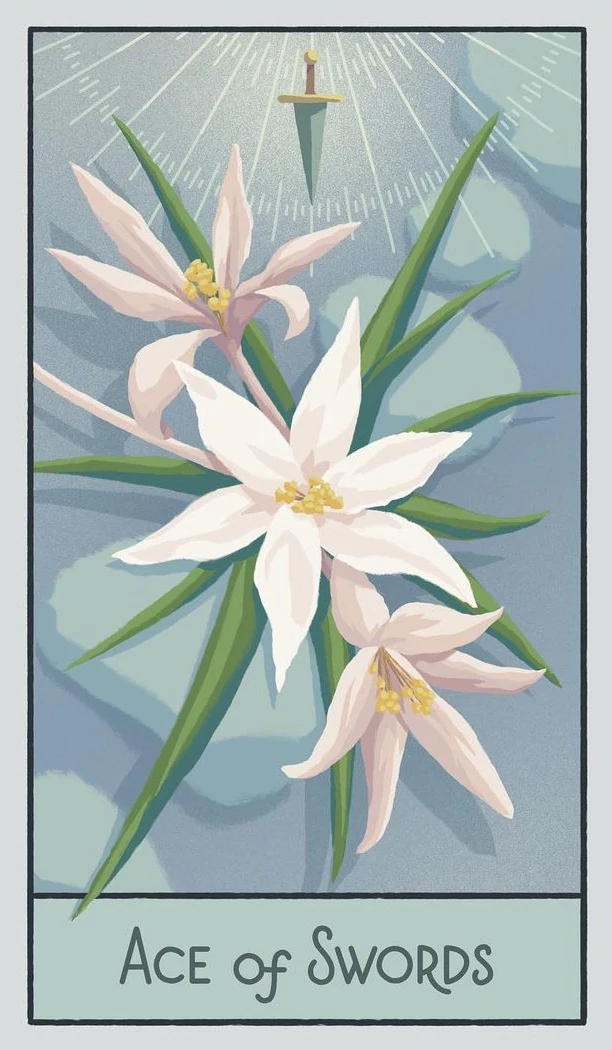
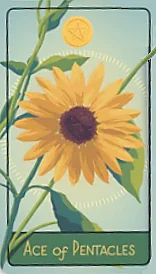
The Aces introduce their suits through flowers: an upright orange bloom, a blue-purple flower cluster, pale pointed blossoms, and a golden flower with a dark centre. Lay them out deliberately as four invitations. Ace of Wands: what sparks my interest? Ace of Cups: what feeling needs room? Ace of Swords: what needs to be named clearly? Ace of Pentacles: what practical beginning can I support? Their shared floral language makes possibility feel tender rather than guaranteed. Choose one small action from the four answers. An idea might need a first sketch; affection might need an honest message. Not every beginning asks for the same kind of attention.

Begin with observation, then let the meaning deepen
This is an inviting first nature-themed tarot, though not the simplest deck for learning every traditional scene by sight. Its creatures offer memorable anchors, but some associations need study. You do not need to identify every plant or bird to begin. Knowing what a subject is doing is often more useful than knowing its precise species.
Try a short journal entry with three parts: what I can see, the card’s established meaning, and how those two meet my question. Keeping them separate at first helps you notice when a beautiful personal association has wandered away from the actual card.
- Easy — What quality would help me today?
Draw one card and describe its clearest action in ordinary language: waiting, reaching, sheltering, moving. Connect that action to one manageable choice. If the subject is still, consider attentive rest before assuming that nothing is happening.
- Medium — What needs energy, and what needs care?
Draw two cards for those positions. Compare their movement and surroundings, then check the suits. Decide what you can begin and what you need to maintain. Those may be different responsibilities.
- Deep — Where am I confusing effort with readiness?
Draw three cards for the pressure you feel, the process already unfolding, and a helpful response. Look for tension between motion and stillness. End with a practical adjustment, not a prediction about when everything must change.

The Hanged One — a pause with something inside it
A pale blue-green chrysalis hangs from a sloping brown branch, patterned with dark marks and small golden-orange patches. A large veined leaf fills the upper left; the muted green background leaves the suspended form undisturbed. XII sits above it. There is no emerging butterfly in this picture, only the enclosed shape.
That last detail matters. The image offers no finished transformation to admire. It asks us to stay with the uncomfortable middle, when change may be real but cannot yet be displayed. The traditional themes of surrender, suspension, and a changed perspective feel unusually tangible here.
In a reading, this can support a deliberate pause: letting an idea develop, listening before replying, or admitting that more effort will not produce clarity today. Its shadow is waiting without examining what you are waiting for. Ask, “What needs time, and what needs a different view?” A useful pause can include a boundary or a date to reconsider. Stillness need not mean giving your agency away.
Beautiful does not always mean gentle
The deck’s jewel-like colours can feel welcoming, yet the artwork leaves room for appetite, vulnerability, and loss. The Tower’s burning tree and the exposed skull in the Ten of Swords interrupt any expectation of a purely comforting woodland world. Their presence gives the softer cards more weight.
I like that emotional range. A nature deck becomes more useful when it can hold a difficult ending as clearly as a flower opening. Rather than smoothing every image into reassurance, name its tension: what is at risk, what has ended, or what cannot continue in its present form?
Movement offers another good reading thread. A shared direction does not make two cards equivalent. Travelling together, seeking shelter, and diving towards a target can all look purposeful while asking very different things of you.
Moving forward without mistaking speed for direction
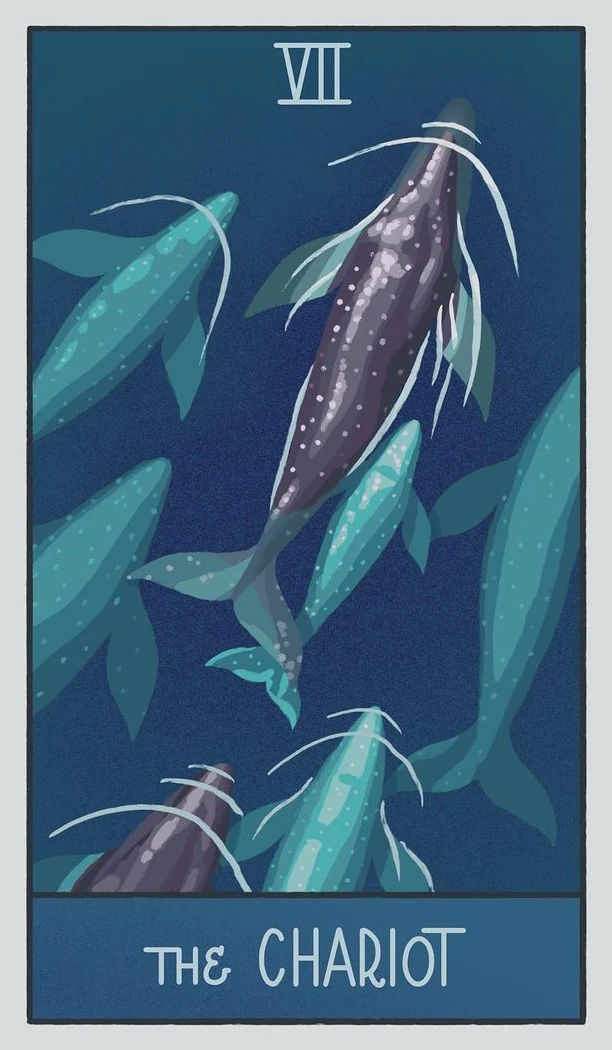
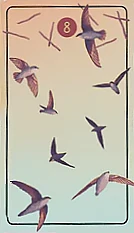
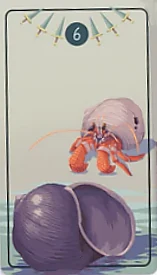
Swimming fish in The Chariot, birds crossing the Eight of Wands, a shell-bearing creature beside an empty shell in the Six of Swords, and the downward-diving bird of the Knight of Swords give movement four distinct moods. Use these cards as fixed prompts for direction, pace, transition, and urgency. Where am I steering? What is gathering speed? What would a safer passage require? Which thought is demanding immediate action? Together, they separate purposeful progress from sheer acceleration. The Six offers a useful interruption to the faster images: changing your circumstances may involve finding better support, not charging harder. Write down the destination before deciding how quickly to move.

Who will feel at home in this deck?
Readers who connect through animals, plants, and landscape have plenty to hold onto here. The deck is especially appealing for reflective journaling about energy, belonging, creative work, and the everyday effort of caring for a life. Its regional identity gives those questions a particular atmosphere rather than a generic nature backdrop.
It may be less comfortable if you rely on human expressions, recognisable relationship scenes, or close visual agreement with a standard learning deck. Animal courts also require a small shift: a Queen need not describe a woman, and a Knight need not identify a young man. Consider the role or behaviour before assigning a person.
What I appreciate most is the attention given to modest forms of power. Shelter, patience, and tending something are allowed to matter. The Queen of Pentacles brings that quality into especially warm focus: competence has a soft face, but there is substantial work beneath it.

Queen of Pentacles — care that builds a place to live
A golden-brown beaver sits upright on a dense arrangement of sticks, its forepaws raised close to its chest. Water and a low green treeline lie behind it, with another mound of branches to the left. A warm orange disc frames its head, while a separate pentacle hangs high in the yellow sky.
The halo-like circle gives ordinary creaturely life a quiet dignity. The sticks beneath the beaver make material care visible: this is not abundance floating free of effort. It has support, structure, and somewhere to rest.
As the Queen of Pentacles, the image speaks beautifully to resourcefulness, hospitality, and tending practical needs. In a reading about home or work, ask what would make daily life more liveable: a clearer routine, a useful repair, or care shared more fairly. The shadow appears when being dependable becomes being responsible for everything. “What supports the person doing the supporting?” is the question I would keep beside this Queen. Her warmth need not require endless availability.
Before buying, check which edition is coming home
This review explores Brendan Marnell’s Pacific Northwest Tarot through the artwork archive shown above. The creator’s dedicated deck site describes a 78-card set with standard 2.75 × 4.75-inch cards, 350 gsm cardstock, a smooth matte finish, painted edges, a 100-plus-page guidebook, and a magnetic-closure box. The guidebook uses short fiction to connect the species with their tarot archetypes and includes three spreads. Those are the creator’s listed specifications, not a claim that every printing is identical.
For purchasing, use the Pacific Northwest Tarot listing on Etsy. Check its current edition, stock, contents, and shipping before ordering; the creator’s historical publication story alone does not confirm availability today. If this will be your first tarot, useful guidance may matter more than decorative extras. Look for help connecting the wildlife imagery to the suits and numbered cards. If handling comfort matters, check the listed card dimensions too. Artwork can tell you whether you want to spend time with a deck; it cannot tell you how a particular printing will feel in your hands.
A home is more than a place to stand
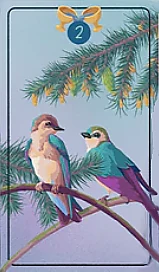
Two animals face one another in the Four of Wands; two birds share a branch in the Two of Cups; winged insects gather around a cellular nest in the Three of Pentacles; birds surround young in a tree hollow in the Ten of Cups. Lay these out for welcome, reciprocity, contribution, and shared wellbeing. What helps me feel welcome? Where does care move both ways? What can we build together? Who needs to be included in our idea of happiness? This sequence lets belonging grow beyond a lovely gathering into something maintained through attention and cooperation. Notice which position feels least supported; that is a good place for one honest conversation.



My golden rule: read the life, not just the likeness
Before deciding that a favourite creature brings a favourable message, ask what is happening around it. What is supporting it? What is it responding to? What does the card’s suit add? The salmon’s effort, the chrysalis’s suspension, and the beaver’s shelter do different work in a reading. Let those differences stay clear.
Final thoughts — wisdom close to the water
The Pacific Northwest Tarot is a lovely choice for readers who want familiar tarot structure expressed through a vivid, nonhuman world. Its strongest images make an established meaning newly tangible: courage has fins, surrender hangs from a branch, and care rests on a foundation of sticks.
Choose it for that thoughtful translation, not because every card promises comfort. There is room here for tenderness and difficulty together. Look closely, keep your question nearby, and let one small detail lead you towards a response you can actually live.

Pacific Northwest Tarot questions
Who created the Pacific Northwest Tarot?
Brendan Marnell created and illustrated the original, self-published Pacific Northwest Tarot. Its animals, plants, and landscapes carry the tarot meanings, rather than simply decorating familiar scenes with regional wildlife.
Is the Pacific Northwest Tarot suitable for beginners?
Yes, especially if nature imagery helps you remember ideas. The familiar suits and card structure offer a foothold, but the pictures need interpretation. Pair one visible action with the card’s established meaning, and keep a tarot reference nearby while you learn.
Does it follow the Rider–Waite–Smith system?
Its original 78-card structure is familiar to Rider–Waite–Smith readers: Wands, Cups, Swords, and Pentacles, with Strength VIII and Justice XI. The artwork reinterprets the meanings through nature instead of copying each scene. The Hanged One is the printed title, and Judgment has one “e.”
Do I need to recognise every animal and plant?
No. Begin with what you can see: movement, shelter, posture, colour, and relationships between subjects. Those observations can support a useful reading without a precise species name. Let reliable guidebook information enrich your interpretation rather than guessing at natural history.
What kinds of questions suit this deck?
Questions about effort, changing pace, belonging, creative beginnings, and everyday care connect naturally with these images. Try “What needs patient attention?” or “What would help me feel supported?” Specific questions give the wildlife symbolism somewhere useful to land.
What should I check before ordering?
Check the creator’s current edition, sample artwork, guidebook inclusion and format, card dimensions, and shipping details. This review discusses the original deck, so compare the listing carefully rather than assuming every printing includes the same physical features or extras.