Explore The Wild Unknown Tarot Cards
Move through Kim Krans’s complete verified deck in official tarot order. Filter by family, then open any card for a larger carousel view.
Aurica’s Quick Take
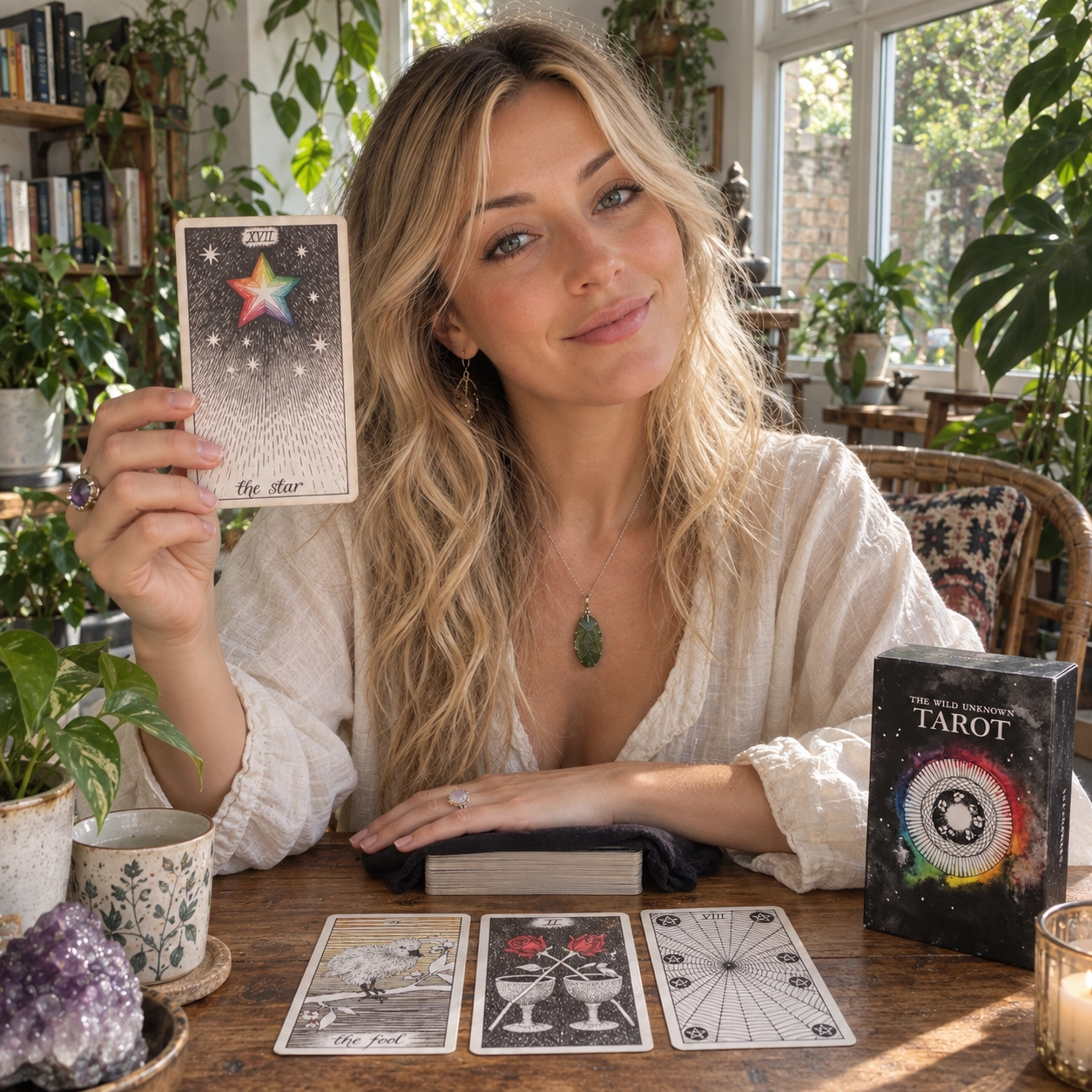
I feel this deck before I explain it. Black branches scratch across white space, animals hold their ground, and sudden rainbow colour feels like light finding a crack in the dark. The images are spare, but never empty; they leave enough silence for my own question to step forward.
The Star keeps calling me back. Its bright heart shines against a night of tiny marks, as if hope has survived without needing to shout. Beside The Fool, I read courage to begin; beside the Two of Cups, trust that can be shared. The picture opens the feeling, while the card’s familiar tarot role keeps the reading clear.
I read The Wild Unknown slowly: notice the animal, branch, shadow, or colour first, then return to the traditional meaning and ask what the surrounding cards change. That pause turns intuition into something useful. Even in its darkest lines, a feather, flame, root, or star shows where life is moving—an invitation to trust the next true step.
What Makes The Wild Unknown Tarot Different?
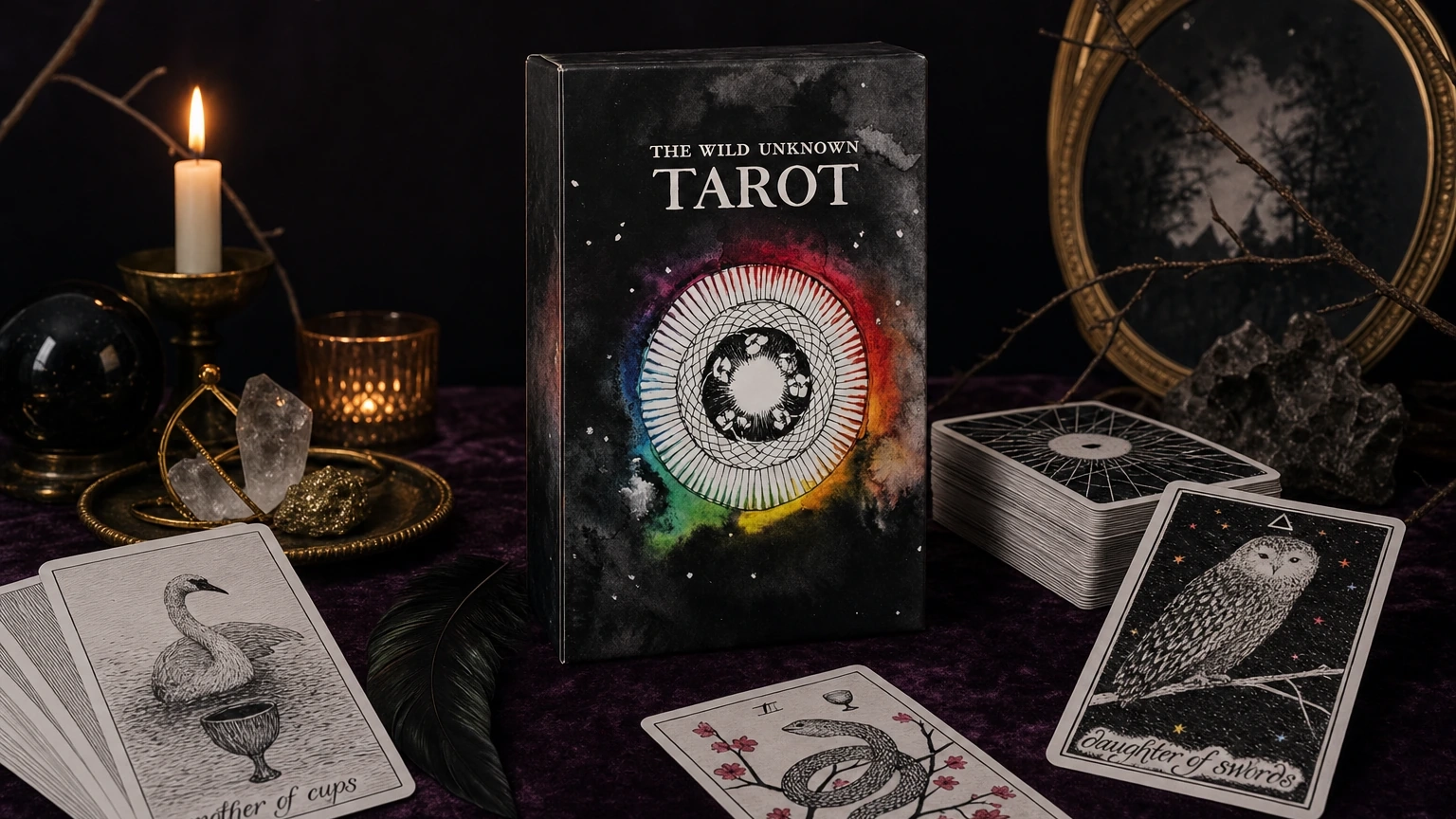
The Wild Unknown Tarot by Kim Krans strips each card to a few charged marks: feather, branch, fang, cup, blade, moon, flame. That restraint gives the deck its particular electricity. A single line can feel tense; one patch of colour can become the emotional centre of a reading.
The system remains familiar beneath the wildness: 22 Major Arcana, then Wands, Cups, Swords, and Pentacles. Daughter, Son, Mother, and Father replace the usual court titles, turning each suit into an animal family without losing its movement from learning to mastery.

The Fool: a small heart at the edge of the branch
A pale chick perches above open space, its body soft against the sharp black branch. The card looks vulnerable, but not frightened. That contrast makes the traditional leap of faith feel intimate rather than theatrical. Upright, I hear curiosity and a clean beginning; in shadow, innocence can become refusal to notice the drop. In a reading, I ask what the heart already wants to try and what one practical glance downward would make that first step wiser.
How The Wild Unknown Reads in Practice
I let the image speak before I reach for keywords. Where is the darkest mark? Which creature looks alert, hidden, tangled, or ready to move? Then I compare that first feeling with the card’s established function and the cards beside it. This keeps intuition alive without letting it float away from the question.
Three-card lines work beautifully because the white space gives each image room. Try what is instinct saying?, what fear is distorting it?, and what grounded action brings them back together?
An Instinctive New Beginning
The Fool opens the door, Ace of Wands supplies the first spark, The Magician gathers the tools, and The World shows the larger life that a brave beginning can grow toward.


Love, Boundaries, and Emotional Weather
In relationship readings, this deck rarely sweetens the mood. Cups can be tender, but bare branches and watchful animals also reveal distance, hunger, hesitation, and the moment a boundary needs a name. I find that honesty refreshing because it leaves room for affection without asking me to ignore tension.

Two of Cups: recognition with room to breathe
Two cups face each other beneath two rising forms, while the small colour accents warm an otherwise spare field. There is symmetry, but the two sides remain distinct. That makes mutual recognition the heart of the card: closeness without erasure. Upright, it can speak of reciprocity, repair, or an honest meeting. In shadow, apparent harmony may hide projection. In a reading, I ask what is genuinely being exchanged and whether both people are free to answer.
Career, Creativity, and Grounded Growth
Wands catch the pulse of an idea; Pentacles show whether it has roots. This makes the deck useful for creative work, habit-building, and money questions that are really questions about patience. The art does not hand me a detailed office scene. Instead, it asks me to notice rhythm, pressure, and whether energy is spreading or gathering.
Creative Fire Without Burning Out
Ace of Wands begins with clean heat, Eight of Wands releases momentum, Ten of Wands shows the cost of carrying too much, and Temperance restores a living rhythm.


Is The Wild Unknown Beginner-Friendly?
It can be, if its images make you curious enough to practise. An easy reading is one card plus one visible detail. A medium reading compares that detail with the traditional meaning. A deeper reading asks how colour, direction, number, and neighbouring cards change the story. Beginners who need illustrated human situations may prefer a more scenic deck first.

Eight of Pentacles: the beauty of repeated craft
Eight coins sit in a deliberate web, each point connected to the next. The image makes effort look less like punishment and more like pattern: one careful repetition strengthening the whole. Upright, it favours practice, apprenticeship, and patient improvement. In shadow, devotion can harden into perfectionism. In a reading, I ask which small action is worth repeating and which standard has become a cage.
Art, Symbolism, and the Deck’s Personality
Kim Krans’s hand-drawn lines feel alive because they are not perfectly smooth. Black ink creates bone, bark, fur, feather, and night; selective rainbow colour arrives like feeling breaking through thought. The animals do not perform human drama, so the reader meets a more elemental question: freeze, flee, climb, shed, protect, sing, or begin again?
Shadow, Clarity, and Coming Home
The Moon enters uncertainty, The Hermit protects a small inner lamp, Ace of Swords cuts a clean path, and The Star lets hope return without pretending the night never happened.


Who Will Connect With This Deck?
It suits readers who love animal symbolism, spare design, journaling, and emotionally direct readings. It can be especially strong for transitions, creative identity, boundaries, and patterns that are easier to feel than to name. Readers who want bright colour on every card or detailed human expressions may find its silence too demanding.
Buying Guidance and My Golden Rule
My golden rule is simple: name the visible thing before naming the meaning. Say owl, branch, red thread, dark centre first. Then connect that observation to the traditional card and the question. It keeps the reading honest and lets the deck’s wild poetry stay useful.
Final Thoughts
The Wild Unknown Tarot remains memorable because it has a real visual voice. It can be dark without becoming hopeless, minimal without becoming empty, and intuitive without abandoning tarot structure.
If its animals and spare lines make you stop, breathe, and look twice, the deck is already speaking in the way it reads best: quietly, directly, and close to instinct.
The Wild Unknown Tarot FAQ
Is The Wild Unknown Tarot good for beginners?
Yes, especially if animal and nature imagery makes you want to keep looking. The structure is familiar, but its minimal scenes ask a beginner to practise connecting image, feeling, and traditional meaning.
Does The Wild Unknown Tarot contain a complete tarot deck?
Yes. This edition contains the standard 78-card structure: 22 Major Arcana and four 14-card suits. Its court cards use Daughter, Son, Mother, and Father.
Does it follow Rider-Waite-Smith meanings?
The underlying structure is recognisable, but Kim Krans speaks through animals, branches, light, darkness, and selective colour instead of illustrated human scenes. I use the traditional meaning as a root and let those visual choices refine it.
What readings suit this deck best?
I like it for self-reflection, relationships, creative blocks, boundaries, transitions, and questions where the emotional atmosphere matters as much as the practical answer.
Why are the court cards called Daughter, Son, Mother, and Father?
Those family titles replace Page, Knight, Queen, and King. They keep the four-stage court progression while giving it a more organic, animal-family feeling.
What should I notice before buying?
The restrained palette and animal symbolism are the point of the deck. If several cards make you pause and feel curious, that is a good sign; if you need busy human scenes, another deck may speak more clearly.