Explore The Ocean Tarot Deck Cards
Browse clean verified card fronts from Taylor Hultquist-Todd’s original ocean-themed edition. Use the deck’s printed tarot groups to filter the continuous gallery, or select any card to open the full-size Lightbox.
Showing the selected card group.
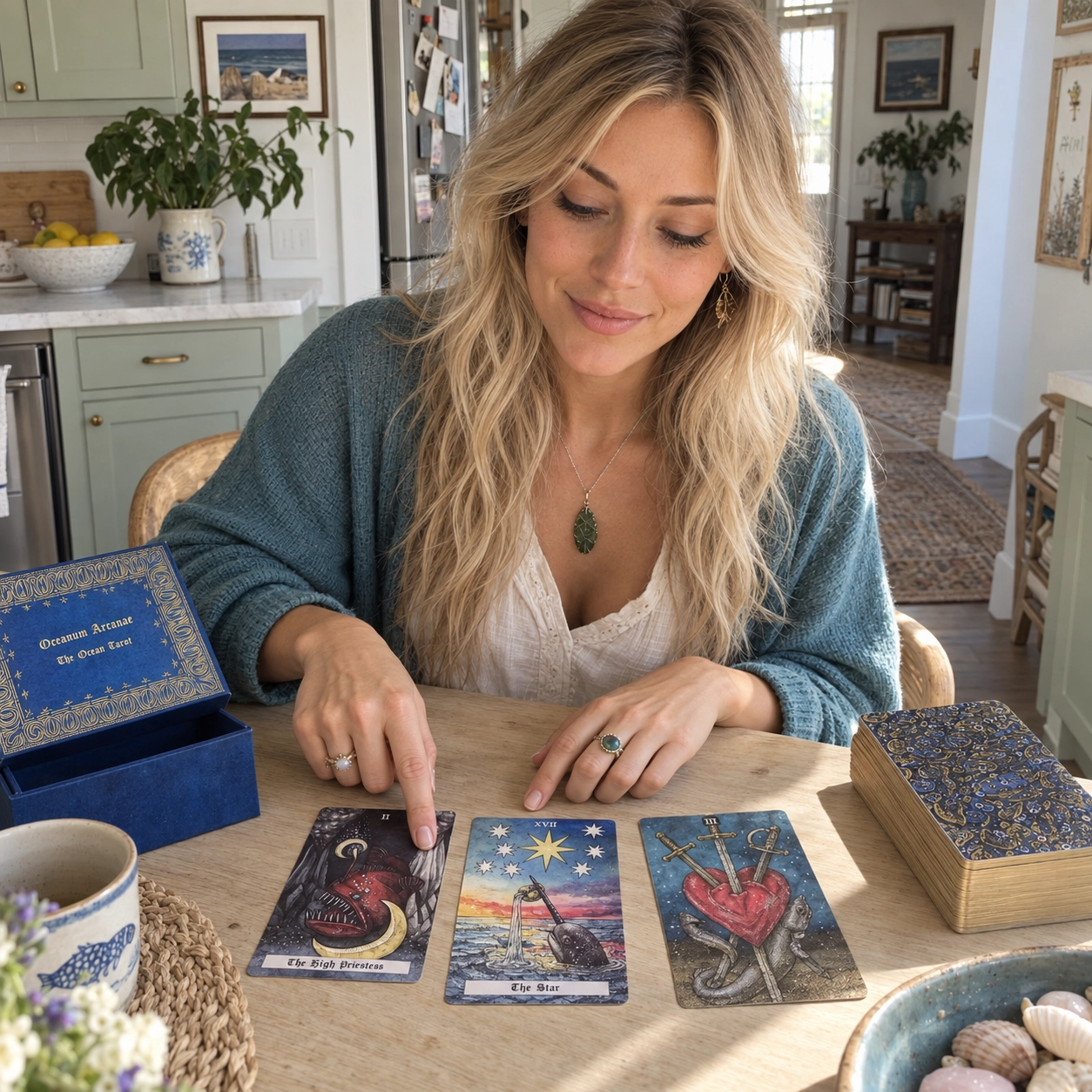
Aurica’s Quick Take
I feel this deck before I explain it. The blues move from bright shallows into velvet darkness, and every creature carries an old tarot truth shaped by current and pressure.
The animals act so clearly. The High Priestess holds one small light in a cavern; The Star pours brightness across open water; the sharks beneath Three of Swords make pain sharp and watchful.
I begin with that visible action, return to the traditional card, then listen for how its neighbors change the tide. I would choose this deck for journaling, creative questions, and honest transitions.
Even the deepest water holds a glimmer. You are always allowed to follow that light toward a kinder shore.
What makes The Ocean Tarot Deck different?
Oceanum Arcanae carries the full tarot into salt water. Taylor Hultquist-Todd replaces human drama with whales, squid, reef fish, sharks, seabirds, shells, and strange deep-sea life, yet the deck never feels like a simple animal swap. Scale, current, depth, and pressure become part of the meaning.
I love the way the ocean changes the emotional temperature of familiar cards. A bright scene can feel sun-warmed and generous; a dark trench can make one small source of light feel precious. The artwork is richly inked, washed in blue, green, rust, and gold, and finished with narrow blackletter title bands that give the deck an old field-journal charm.

Card study
The High Priestess — a light held in deep water
A red anglerfish fills the narrow passage between dark rock walls. Its small lure burns like a halo, while a gold crescent curves beneath the teeth. The image makes hidden knowledge feel less like a locked room and more like a careful light carried through uncertainty.
In a reading, I would treat that lure as the useful expression of the card: trust the clue that quietly keeps returning. The open jaws are its shadow, a reminder that intuition can become fear when every darkness is treated as danger. Let nearby cards show whether the message is a genuine warning, a private truth, or simply a mystery that needs more time.
How Ocean Tarot reads in practice
This deck reads best when you begin with what the creature is doing before reaching for a memorized keyword. Is it hiding, hunting, carrying, gathering, surfacing, or moving with a school? Then notice the water around it. Calm shallows, open ocean, cramped rock, and black depth all change how a familiar tarot function feels.
Traditional meanings still matter, but the marine behavior gives them texture. I would read the title first, name the visible action second, and let the surrounding cards decide whether that action is help, pressure, protection, or avoidance. The result is intuitive without becoming vague.
Four-card tide
Four ways the ocean moves you forward
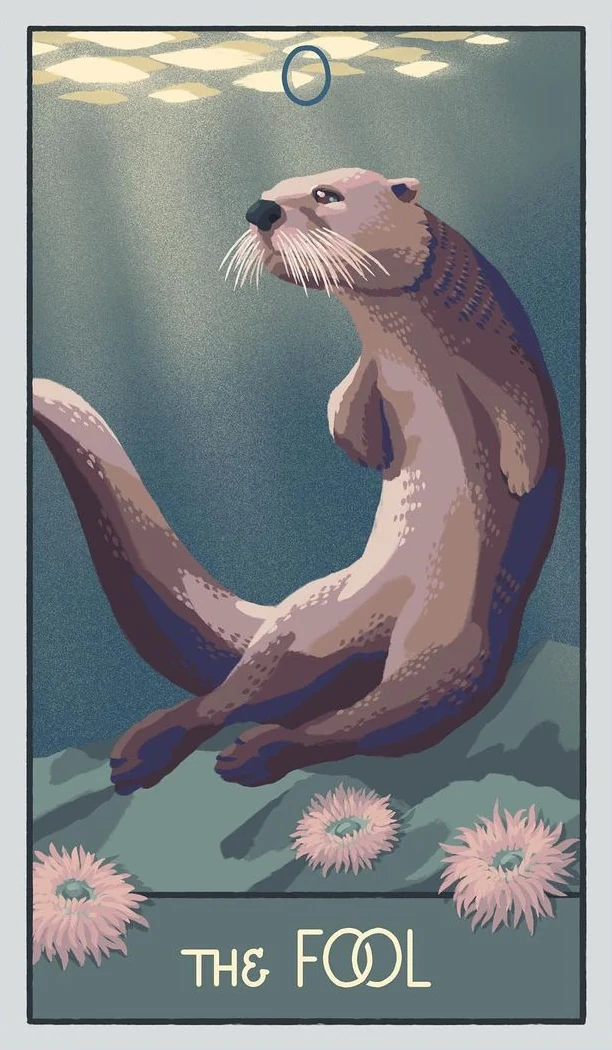
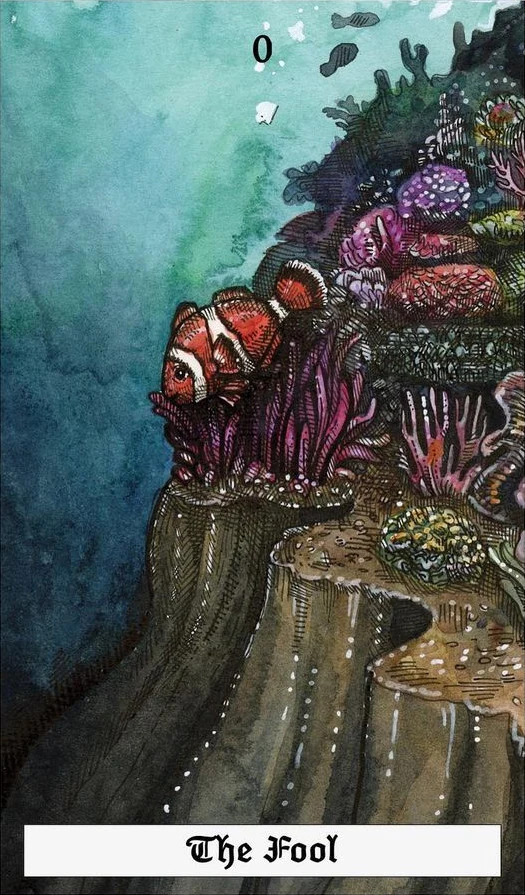
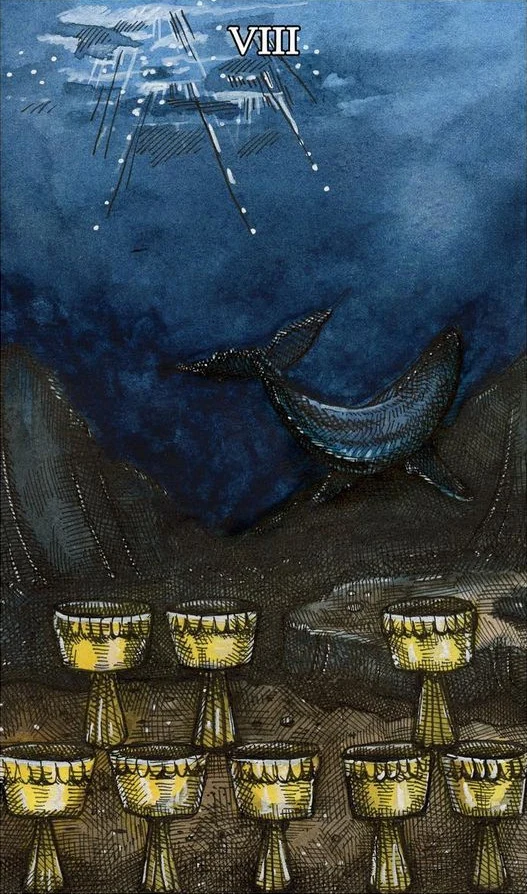
The Fool steps from a crowded reef into open blue; The Chariot plants a hermit crab firmly on the seabed; Six of Wands gathers several creatures into one upward-moving cluster; Eight of Cups turns toward a distant whale under descending light. Read together, they move from curiosity to direction, shared momentum, and the courage to leave a finished chapter behind.


Is Ocean Tarot beginner-friendly?
Yes—with a small caveat. The card names and suit structure are familiar, but many scenes do not repeat Rider–Waite–Smith staging. A new reader who wants exact visual memory cues may need the guidebook nearby. A reader who learns by mood, movement, and storytelling may find the animals surprisingly easy to remember.
Easy reading
Pull one card and ask: what is this creature doing, and what does that action suggest for today?
Medium reading
Use three cards for current, undertow, and next tide. Compare direction, depth, and whether each subject moves alone or with others.
Deep reading
Build a larger spread and track repeating species, colors, objects, and changes in water pressure or light.
Card study
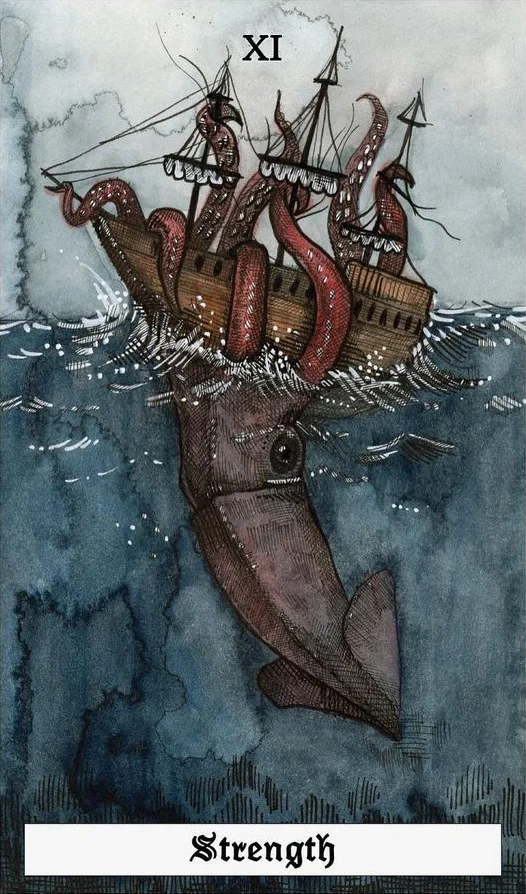
Strength — holding steady beneath the weight
A long dark sea creature rises vertically through rough water with a tiny red-sailed ship balanced above it. Spears and rigging point upward while the body below bears the whole scene. Nothing here looks effortless; the card feels strong because it continues under pressure.
That makes Strength practical rather than showy. Upright, it asks for calm endurance and a measured hand. In shadow, it can reveal the habit of carrying an entire voyage alone. When this card appears, ask what truly requires courage—and what could become lighter if the load were shared.
Love, friendship, and emotional readings
The Cups are naturally at home here, but the whole deck is emotionally articulate. Schools, pairs, solitary hunters, sheltering reefs, and creatures crossing wide water can speak beautifully about closeness and distance. Ask what feels reciprocal, what is protecting itself, and where emotion needs room to move rather than a rushed verdict.
For relationship questions, I would avoid reducing a striking animal to a fixed personality. Stay with the scene. A shark can signal focus in one card and vulnerability in another; an octopus can look defensive, clever, burdened, or beautifully adaptive depending on its posture and neighbors.
Four-card study
What pressure looks like underwater
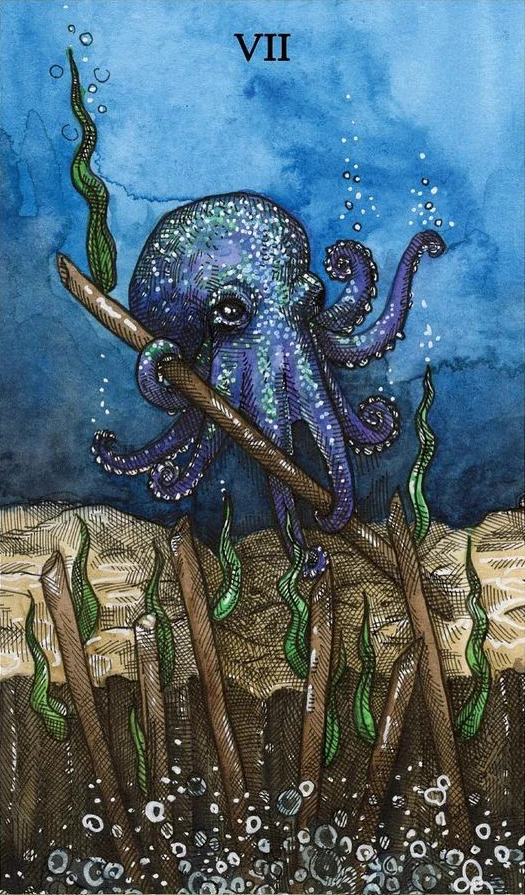
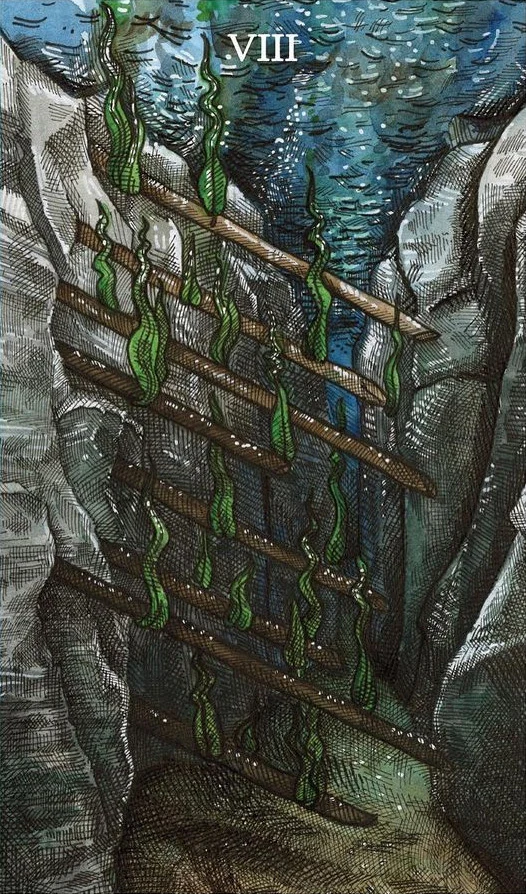
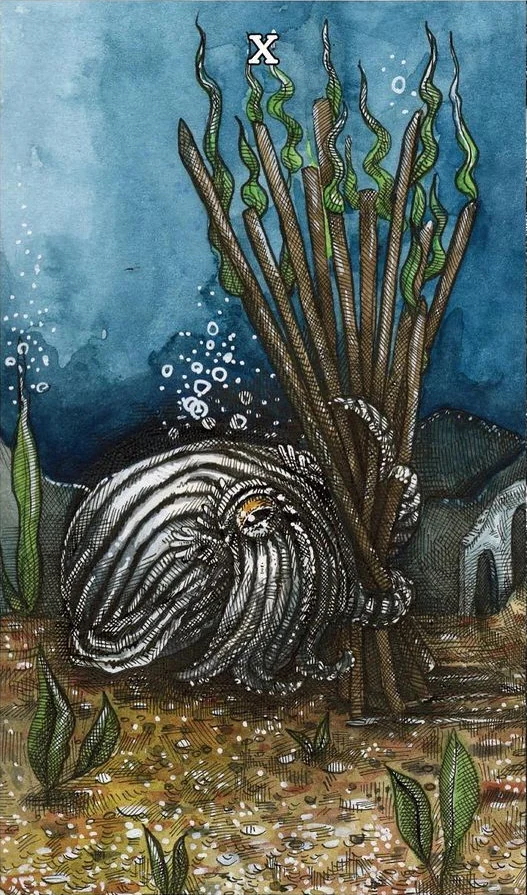
Seven through Ten of Wands tell a compact story of effort. An octopus braces one wand over a drop, a barrier of eight wands blocks a rocky channel, a bandaged squid holds its ground among nine poles, and a burdened shell carries ten. The sequence helps separate a challenge worth meeting from a weight that has simply become too much.

Artwork, symbolism, and the deck’s personality
The linework is dense enough to reward slow looking, while watercolor keeps the scenes alive. Gold cups and pentacles shine against blue water; red squid and coral create sudden warmth; pale bubbles and foam keep even difficult cards in motion. The deck feels curious, gothic, and tender at once.
Its strongest symbols are often physical rather than decorative: teeth, shells, currents, camouflage, migration, buoyancy, and the difference between surface light and the deep. That makes the deck especially good for journaling, creative questions, transitions, and readings about resilience.
Card study
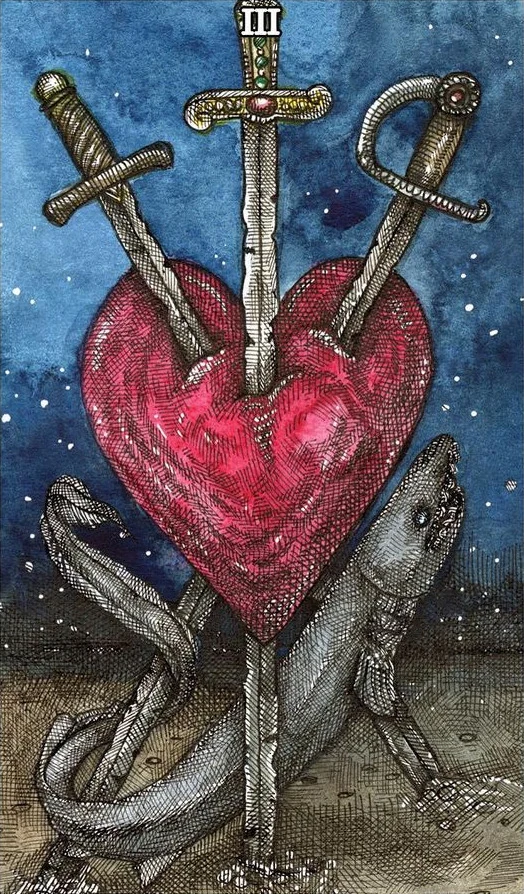
Three of Swords — heartbreak made impossible to ignore
Three swords pierce a bright red heart while two sharks rise beneath it, their noses almost touching the lower curve. The blue water keeps the scene cold and open; there is nowhere for the central wound to hide.
The card is direct about grief, disappointment, and truths that sting. Its useful side is honesty: name the hurt clearly enough to care for it. Its shadow is circling the wound until pain becomes the whole story. In a spread, look to the surrounding cards for what caused the rupture, what needs to be said, and where healing can begin.
Buying and edition guidance
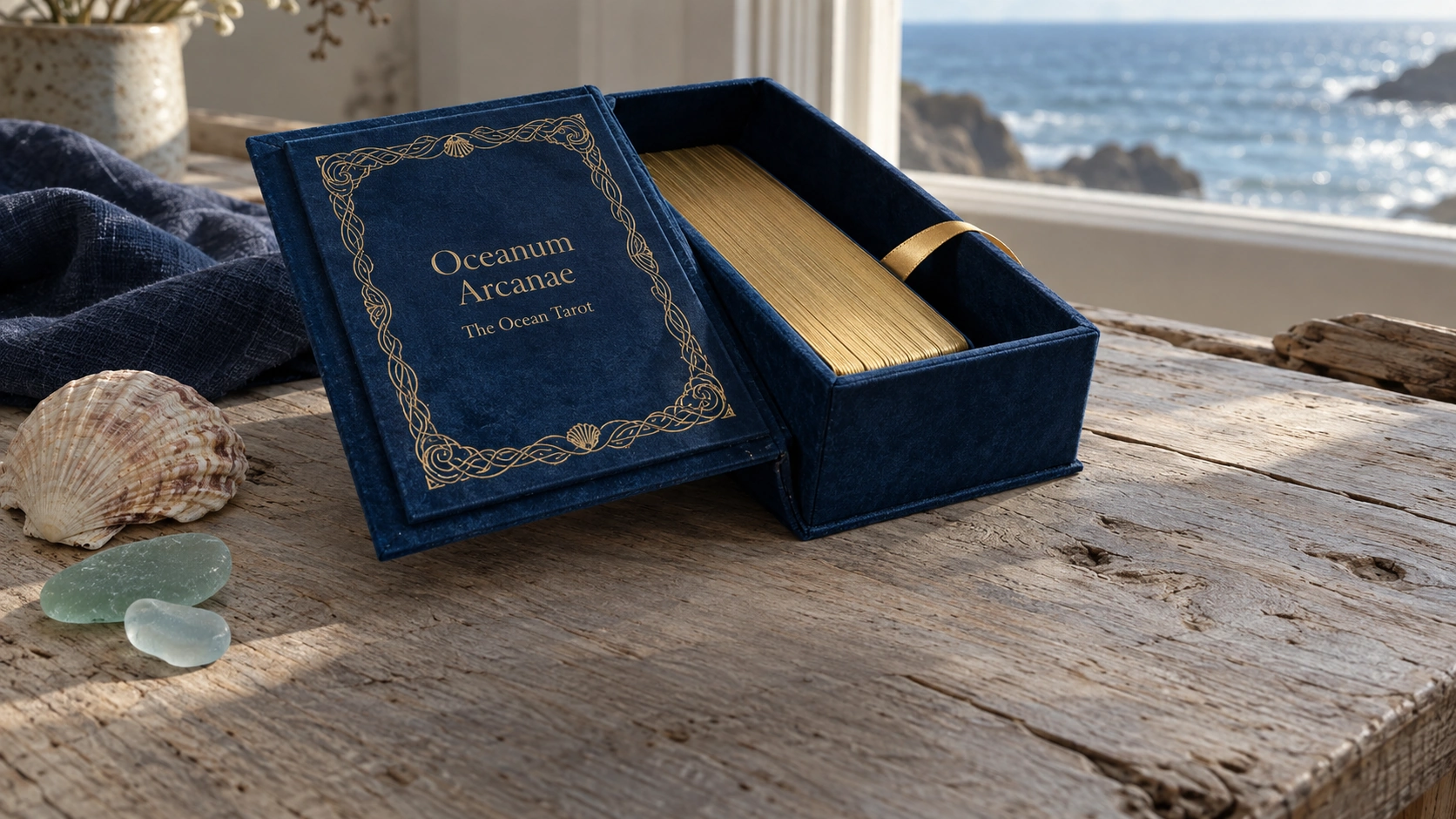
The creator’s product page describes a 78-card deck on 350gsm stock with a matte UV finish, 70 × 120 mm cards, metallic gold edges, a flocked gold-embossed hinged box, ribbon, and a small guidebook. The Gallery on this page matches that original illustrated edition and its printed tarot order.
This is a tactile, large-format indie deck rather than a plain mass-market pack. Choose it if marine life already sparks stories in you and you enjoy detailed art. If you prefer spare cards, conventional human scenes, or pocket-sized decks, study several Gallery rows before deciding.
Four-card spread
The emotional tide: receive, meet, grieve, return
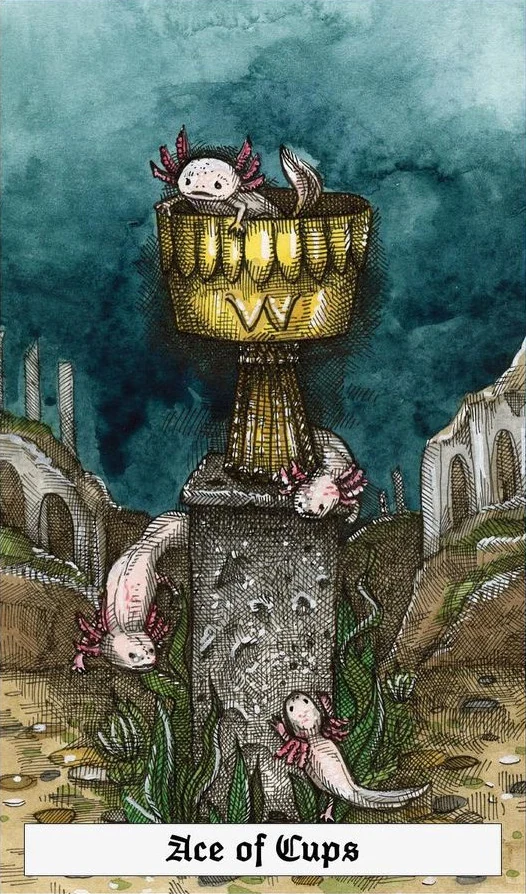
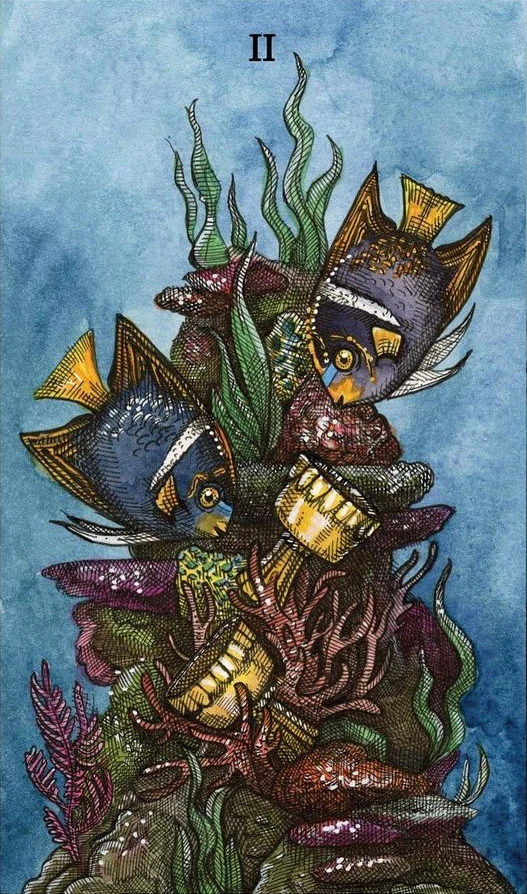
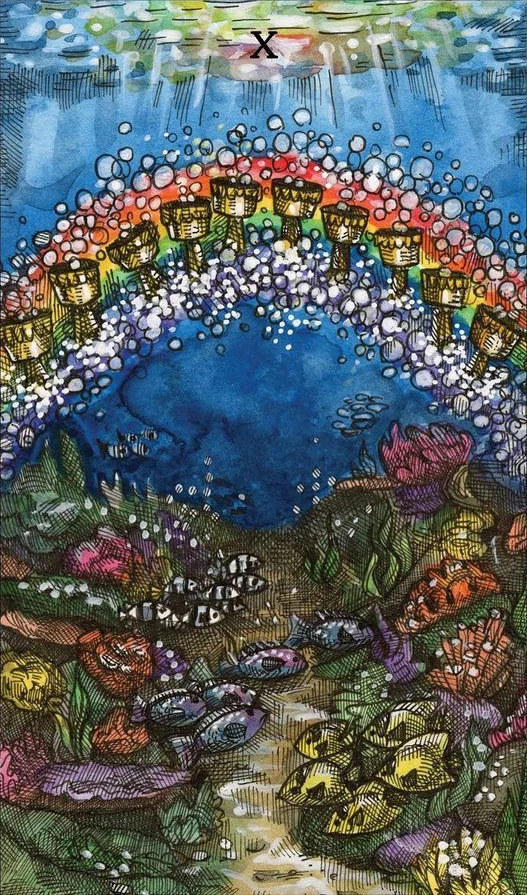
Ace, Two, Five, and Ten of Cups form a gentle emotional map. The first cup overflows into new life; two elaborate fish meet among paired vessels; spilled cups lie near a solitary fish; and ten cups arc over a vivid reef. Use the line as four positions: what is arriving, what wants reciprocity, what must be mourned, and what still belongs to your larger circle of care.

The golden rule for reading Ocean Tarot
Read the creature’s movement before you read the creature as a symbol. A species does not carry one fixed meaning across the deck. Posture, direction, depth, companions, and the card’s tarot role tell you what this particular animal is doing here.
Final thoughts
Ocean Tarot is most memorable when it lets an old tarot truth arrive through an unfamiliar body: a fish, a shell, a whale, or a many-armed creature making its way through pressure. It rewards readers who notice slowly and let the scene speak before forcing an answer.
If the Gallery makes you linger, that is the deck’s clearest invitation. Follow the card that catches your eye, name the motion you see, and let that small current lead you toward a reading that feels both imaginative and grounded.
Questions before you dive in
Ocean Tarot FAQ
Who created Oceanum Arcanae?
Illustrator Taylor Hultquist-Todd created the deck and originally funded it through Kickstarter in 2021. The creator’s shop now presents the same work under the Taylor Bryn name.
How many cards are in The Ocean Tarot Deck?
The deck has 78 cards: 22 Major Arcana and 56 Minor Arcana across Wands, Cups, Swords, and Pentacles. This page’s Gallery contains all 78 verified card fronts.
Does it follow a traditional tarot structure?
Yes. It keeps the familiar tarot titles and four suits, with Justice numbered VIII and Strength XI. The marine scenes reinterpret those roles rather than replacing the structure.
Is Ocean Tarot good for beginners?
It can be, especially for a beginner who enjoys close observation. Some scenes depart from familiar Rider–Waite–Smith compositions, so the included guidebook and a basic meaning reference are useful while the deck’s visual language becomes familiar.
What comes with the physical deck?
The creator describes 350gsm matte-UV cards measuring 70 × 120 mm, metallic gold edges, a flocked hinged box with gold embossing and ribbon, and a small guidebook with scene facts, interpretations, and a custom layout.
Where can I shop for Ocean Tarot?
The product buttons and Gallery Lightbox on this page lead to the selected Amazon listing. Availability can change, so check the Amazon page directly for the current offer.