The card gallery
Explore the Mutation Tarot Cards
Browse Mario Rosa’s deck in its original order. Filter by arcana or suit, then choose any card for a larger, keyboard-friendly view.
Showing all cards

Aurica’s Notes
The first thing I notice is how calmly these impossible bodies occupy their worlds. They are strange, certainly, but they are not visual riddles that need to be conquered. A colour, a posture, a familiar object or a clear horizon usually gives me somewhere honest to begin.
The Star is my favourite doorway into Mario Rosa’s deck. Its many-limbed figure pours water with complete concentration beneath a sky of luminous circles. I start with the recognisable action—pouring and replenishing—then let the unfamiliar anatomy ask where renewal might take a form I had not expected.
When a card feels intense, I keep the question practical and check my first impression against the Rider–Waite–Smith role and the surrounding cards. That keeps wonder from turning into certainty. Give these bright dream-creatures a little time; they have a wonderfully gentle way of helping your own imagination feel welcome.
The short review
A practical tarot deck wearing a dream-body
Mutation Tarot is a complete seventy-eight-card deck created and illustrated by Mario Rosa. Its people have become elegant insects, many-limbed beings, masked courtiers and creatures that seem to have walked out of a lucid dream. Yet the deck is not trying to abandon tarot’s shared language. Rosa’s own project statement says he wanted the images to remain practical for readings and kept most of them steeped in Rider–Waite tradition.
That balance is the deck’s real achievement. The scenes are strange enough to interrupt an automatic interpretation, but familiar enough to provide a handrail. A cliff still opens beneath The Fool. Water still pours in The Star. Lightning still tears through The Tower. Mutation changes the messenger without making the message inaccessible.
Card study
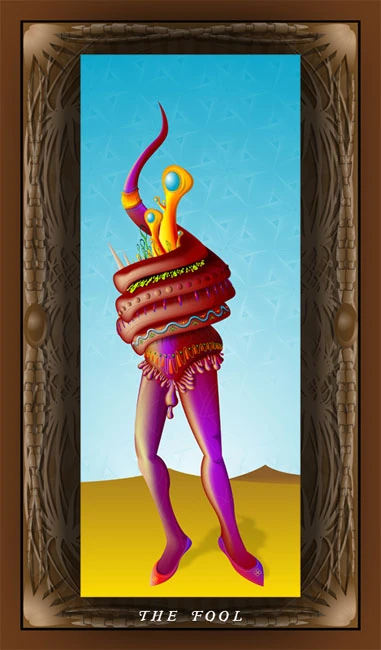
The Fool — movement before a face is found
A tall figure strides across a bare yellow landscape beneath an open blue sky. Its purple legs are recognisably human, but the torso is wrapped in layered red forms and the head rises into a curling pink-and-gold shape with a single circular blue detail.
The card feels exposed and forward-moving: there is no busy scenery to soften the step. In a reading, I would begin with willingness, inexperience and momentum, then ask what identity is still forming through action. The unfamiliar body makes “beginner’s mind” feel literal without removing the card’s traditional invitation to begin.
How to read the mutations without over-reading them
Begin with what you can verify in the picture. Name the action, the dominant colour, the direction of movement and the object that anchors the scene. Only then ask what the altered anatomy adds. A second face might suggest competing viewpoints; an insect form might sharpen your awareness of instinct or adaptation. Those are prompts, not fixed keywords.
This sequence matters because the artwork is unusually suggestive. If every horn, limb and mask receives a rigid meaning, a lively deck quickly becomes a private codebook. Let the established card role set the floor, let the visible scene set the tone, and let the mutation open one useful question.
Four-card reading
A Mutation check-in
Use these four positions when life feels unfamiliar but not necessarily wrong. The spread moves from the self you recognise toward the form your next step may need.


A deck built for visual readers
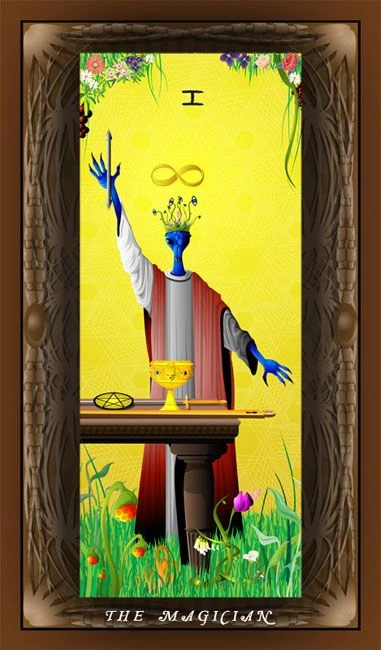
The saturated palette makes suit and mood shifts easy to feel across a spread. Blue skies and water create breathing room; red interiors and black storm fields tighten the atmosphere. The repeated brown organic frame also keeps the wildly different creatures in one coherent world.
Beginners can use standard Rider–Waite–Smith books alongside the deck, but it helps to learn by comparison rather than substitution. Pull the same card from a familiar deck and Mutation Tarot, list three shared actions or objects, then note the one emotional change created by Rosa’s version. That small exercise develops visual confidence quickly.

Card study
The Star — renewal in an unfamiliar shape
A pale, jointed figure kneels where green land meets blue water. Several arms rise or extend behind its shoulders while two lower arms pour streams from vessels. Above, a large white light is surrounded by smaller glowing circles in a clear blue sky.
The act of pouring is immediately readable even though the body is not. That contrast makes this Star especially useful after disruption: restoration does not have to return you to an earlier form. It can create a workable new one. Ask what can be replenished now, without demanding that it look like the past.
Relationships, work and creative change
In relationship readings, the deck is strongest when you ask about adaptation rather than prediction. Which part of the connection is changing shape? What remains recognisable beneath that change? Court cards can be read as people, roles or styles of response, while the more unfamiliar faces invite you to pause before projecting a simple motive.
For work and creative questions, the Wands are particularly direct. Tools, staffs and forward motion remain visible, but the beings using them rarely look ordinary. They can help separate a proven method from the form it used to take. The question becomes not “How do I get back to normal?” but “What function still matters, and what new form could carry it?”
Four-card moment
The anatomy of a turning point
Read from left to right as pressure, rupture, clearing and renewal. The sequence is dramatic, so keep each position tied to one observable situation rather than a sweeping prediction.


The physical editions and what to check
The creator’s current site describes a borderless “slim” edition measuring 2.5 by 6 inches. Archived creator material also documents an earlier standard edition and limited printing variations. If you are buying second-hand, compare the listing photographs with the burgundy Mutation Tarot box, the brown organic card frame and the elongated proportions shown here.
Because independent decks can appear in several print runs, ask the seller which size and border treatment you will receive. A listing should show the actual box and cards rather than only digital artwork. No exact current retail listing has been verified. The buttons open an archived copy of the creator’s deck page, not a shop; use it to compare the artwork and edition before considering any second-hand offer.
At a glance
Mutation Tarot Pros & Cons
| Pros · What works | Cons · What to know |
|---|---|
| Complete seventy-eight-card structure with familiar Rider–Waite foundations | The surreal bodies may feel intense if you prefer naturalistic human figures |
| Original dream-creature imagery that rewards slow visual reading | Different printings and sizes make listing photographs important |
| Clear colour, action and landscape cues beneath the surreal anatomy | The long slim cards may require more table space or smaller hands |
| Unusually distinctive slim format and memorable physical presentation | Readers who want fixed creature symbolism will need to build their own associations |
Let the Aces bring the reading back to earth
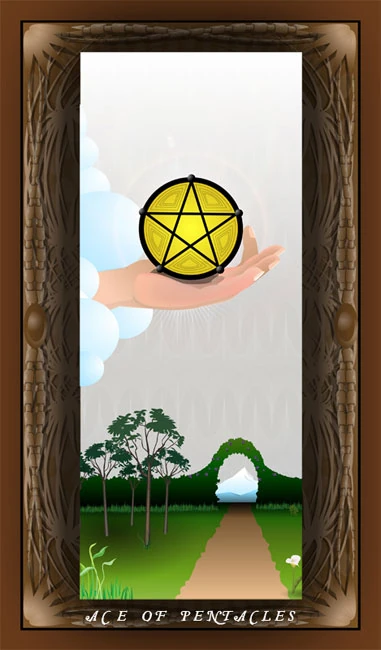
After the deck’s stranger turning points, the four Aces offer a clean way to reset your eye. Each one places a familiar elemental tool at the centre of the scene, so you can feel the difference between desire, emotion, thought and practical possibility before the mutated figure adds its own imaginative twist.
Four-card moment
Four elemental ways to begin
The Aces make a clean study set. Compare what each suit places in the foreground, then notice how the deck changes the hand, vessel or blade without hiding the element’s basic job.


Mutation Tarot is an independent, edition-sensitive deck, and no exact current retail listing has been verified. If its stranger figures have caught your imagination, explore the creator’s archived deck page and compare any second-hand seller’s photographs with the box, proportions and artwork shown here.
View Mutation Tarot creator archiveBest uses—and when to choose another deck
Mutation Tarot is an excellent choice for creative blocks, identity shifts, transitions, dream journaling and any question that has become stale through repetition. It changes the visual surface just enough to make you look again. Readers who enjoy Surrealism, science fiction or creature design will find plenty to explore without losing the tarot sequence beneath it.
Choose another deck when you need immediately familiar human expressions, quiet minimalism or compact cards for travel. For high-stakes health, legal or financial decisions, use tarot as a reflective prompt alongside qualified professional advice, not as a substitute for it.

Card study
Death — change moving through a crowded scene
A segmented, shell-like creature advances between smaller figures. It carries a black flag marked with a red flower, while a low sun glows near distant towers beneath a heavy grey sky. A crowned figure lies at the lower left and a pale robed figure faces the creature at the right.
Rosa preserves several recognisable anchors while replacing the familiar rider with a body that seems assembled for movement. The result is transformation that feels physical and unavoidable. Rather than treating the card as a literal forecast, ask which phase has already ended and what is now asking to be met directly.
The Mutation Tarot golden rule
Name the familiar action before interpreting the unfamiliar body. The card usually gives you a practical verb—step, pour, hold, cut, build, release. Start there. Once the action is clear, the mutation can widen the question without turning the reading into guesswork.
Final Thoughts
Mutation Tarot is memorable because its strangeness has structure. Mario Rosa does not use dream-creatures to make tarot obscure; he uses them to refresh actions and archetypes many readers already know by heart. The deck can be playful, eerie and unexpectedly tender in the same spread.
If the images make you pause without leaving you lost, that is the deck working at its best. Approach it with clear questions, grounded observation and room for surprise, and its unusual bodies can become remarkably practical reading companions.

Before you choose
Mutation Tarot FAQ
Who created Mutation Tarot?
Mario Rosa created and illustrated Mutation Tarot. His own project statement describes a lifelong interest in tarot and a goal of keeping the deck practical while translating familiar scenes into mutated creatures from his dreams.
Is Mutation Tarot a complete deck?
Yes. It contains the traditional seventy-eight cards: twenty-two Major Arcana and fifty-six Minor Arcana across Wands, Cups, Swords and Pentacles.
Does it follow Rider–Waite–Smith?
The imagery is original, but the creator says most scenes are steeped in Rider–Waite tradition so the deck remains practical in readings. Standard meanings are a useful foundation; the mutations add visual questions rather than replacing the structure.
What size are the cards?
The creator’s current deck page describes the borderless slim edition as 2.5 by 6 inches. Earlier standard and limited editions also existed, so confirm the exact size and border treatment in any second-hand listing.
Is Mutation Tarot good for beginners?
It can be, especially for visually curious beginners who are willing to compare the cards with a standard Rider–Waite–Smith reference. Readers who need familiar human expressions may prefer to learn the basics with a more conventional deck first.
Where can I buy Mutation Tarot?
No exact current retail listing has been verified. The links open the creator’s archived deck page for reference, not a retail checkout. If you find a second-hand copy, compare seller photographs carefully with the physical box, elongated cards and brown-framed artwork shown here.


