Explore The Moonchild Tarot Cards
This is a partial gallery of Danielle Noel’s verified original-edition card fronts. The standard Tarot and the deck’s extra cards remain separately filterable, and unavailable identities are not guessed or replaced with collage crops.
Showing all verified cards
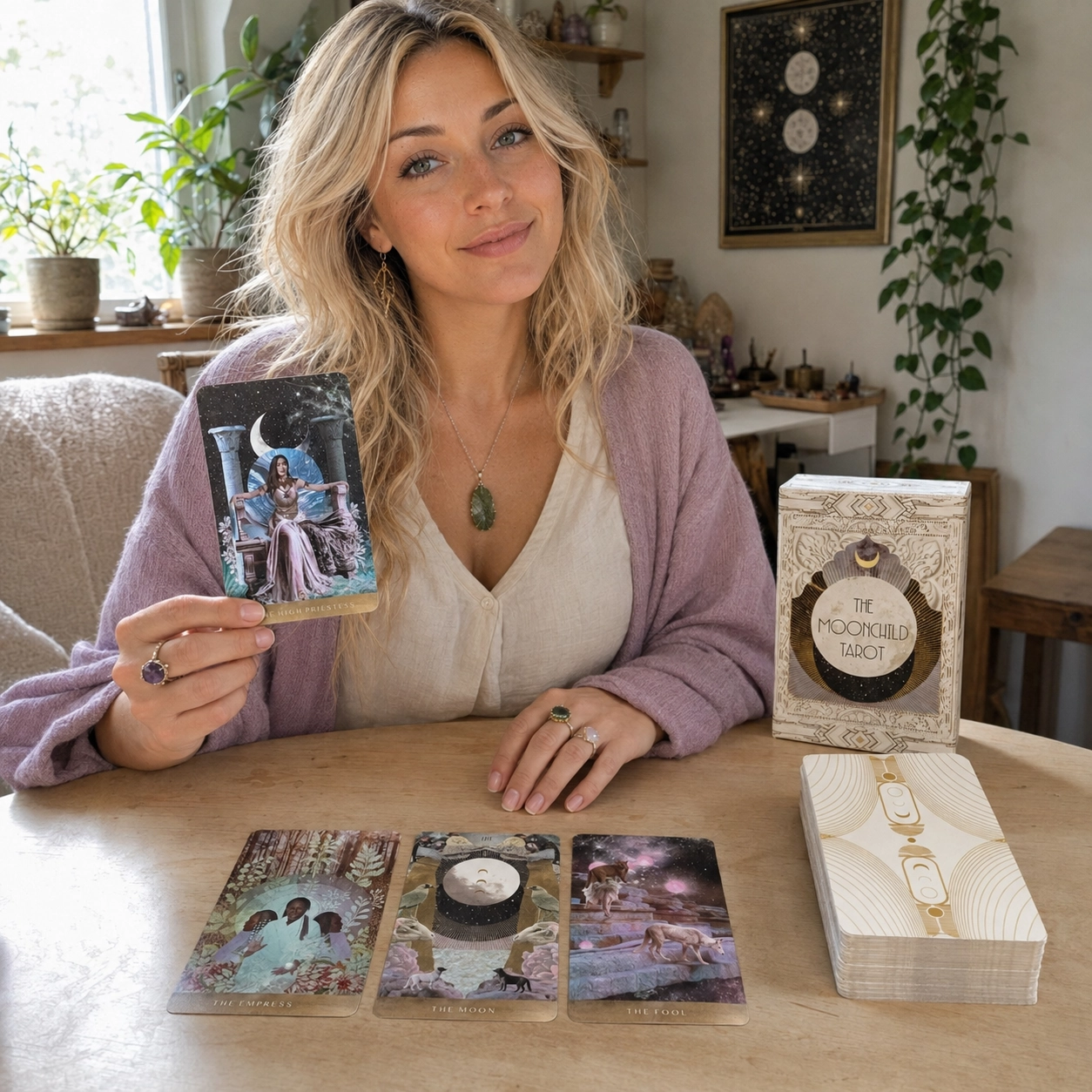
Aurica’s Quick Take
Moonchild Tarot is a reflective tarot with spiritual mood, soft symbolism, and space for intuitive interpretation. It is best for daily-pull readers, journalers, gentle spiritual readers, and people who like contemplative cards.
I love how these collages feel like small moonlit rooms. The High Priestess holds her silence without turning cold, while The Empress seems rooted in leaf, body, and memory. I begin with the detail that catches my eye, then let the traditional card meaning steady the feeling so the reading stays clear.
Choose Moonchild Tarot if the artwork makes you curious and the deck’s gentle, inward mood fits the questions you usually ask. Skip it if you want hard-edged gothic art or a deck that feels purely technical.
I start with the card images and my first reaction. If several cards make me pause, compare details, or imagine a reading, I know the deck has something worth exploring. Moonchild is at its best when the imagery helps a quiet question become clearer, kinder, and easier to carry into the next step.
What is Moonchild Tarot?
Danielle Noel’s Moonchild Tarot combines portraiture, cosmic landscapes, antique textures and luminous geometry. This gallery contains 74 verified original-edition card fronts, including two oracle-like bonus cards; seven unavailable identities are left unguessed rather than filled with collage crops.
The images reward a slow first look. Notice where a figure faces, which shape holds the composition together, and whether the horizon feels near or unreachable before assigning a familiar tarot meaning.
CARD STUDY
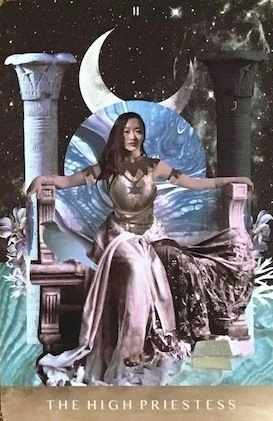
The High Priestess: stillness between stone and moon
A seated woman in silver-grey clothing looks directly outward from a carved chair. Two pale columns frame a large crescent and a dark starry sky, while blue water, white flowers and layered stone textures surround the lower half of the collage.
In a reading, begin with her steady gaze and the contrast between the rigid columns and fluid water. Ask what can be held quietly without becoming passive, and what feeling becomes clearer when the surrounding noise is allowed to settle.
FOUR-CARD STUDY
Four cards across a cosmic threshold
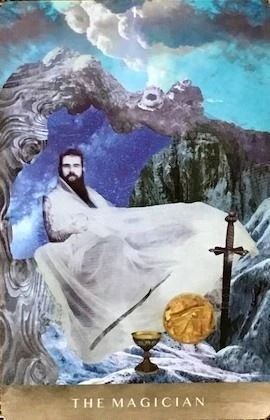
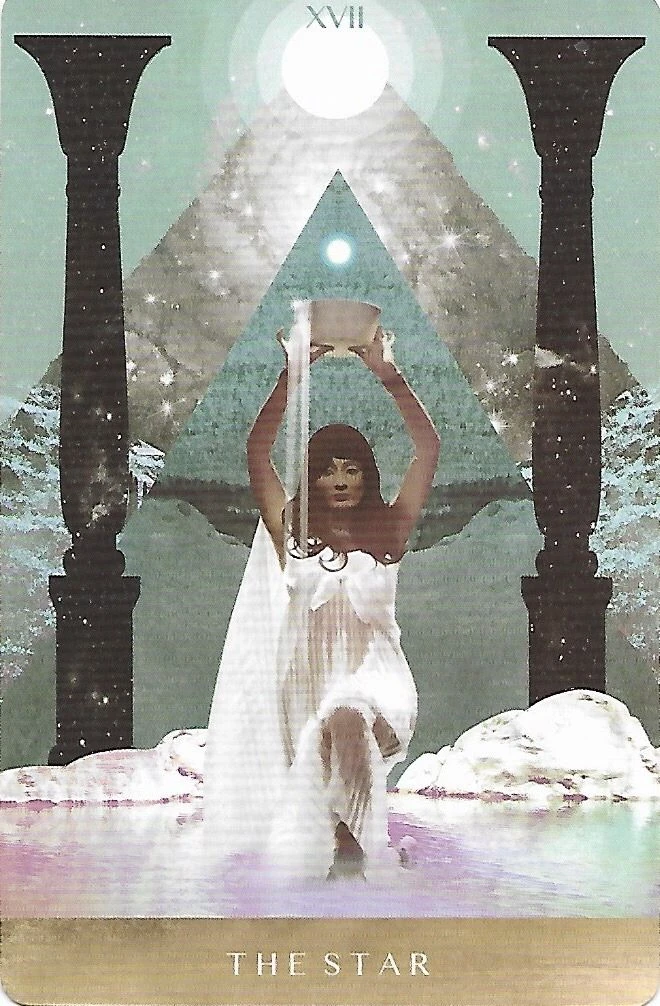
The Fool steps through a pink-black sky, The Magician reclines among mountains and ritual objects, The Star raises a vessel inside an architectural triangle, and The Universe holds a glowing sphere against a vast pastel cosmos. Use the sequence when a question moves from first step to skilled attention, openness and a wider view.


Artwork and first impression
The deck’s collage language makes scale deliberately unstable. A face can become a landscape, a coin can hover like a sun, and a triangle can feel like both doorway and mountain. Those shifts make inner questions look expansive without losing the human figure.
Repeated moons, reflective water, flowers and stone give the deck visual continuity. Across a spread, look for a repeated color or geometric form before searching for a verbal theme.
CARD STUDY
Death: movement through a living collage
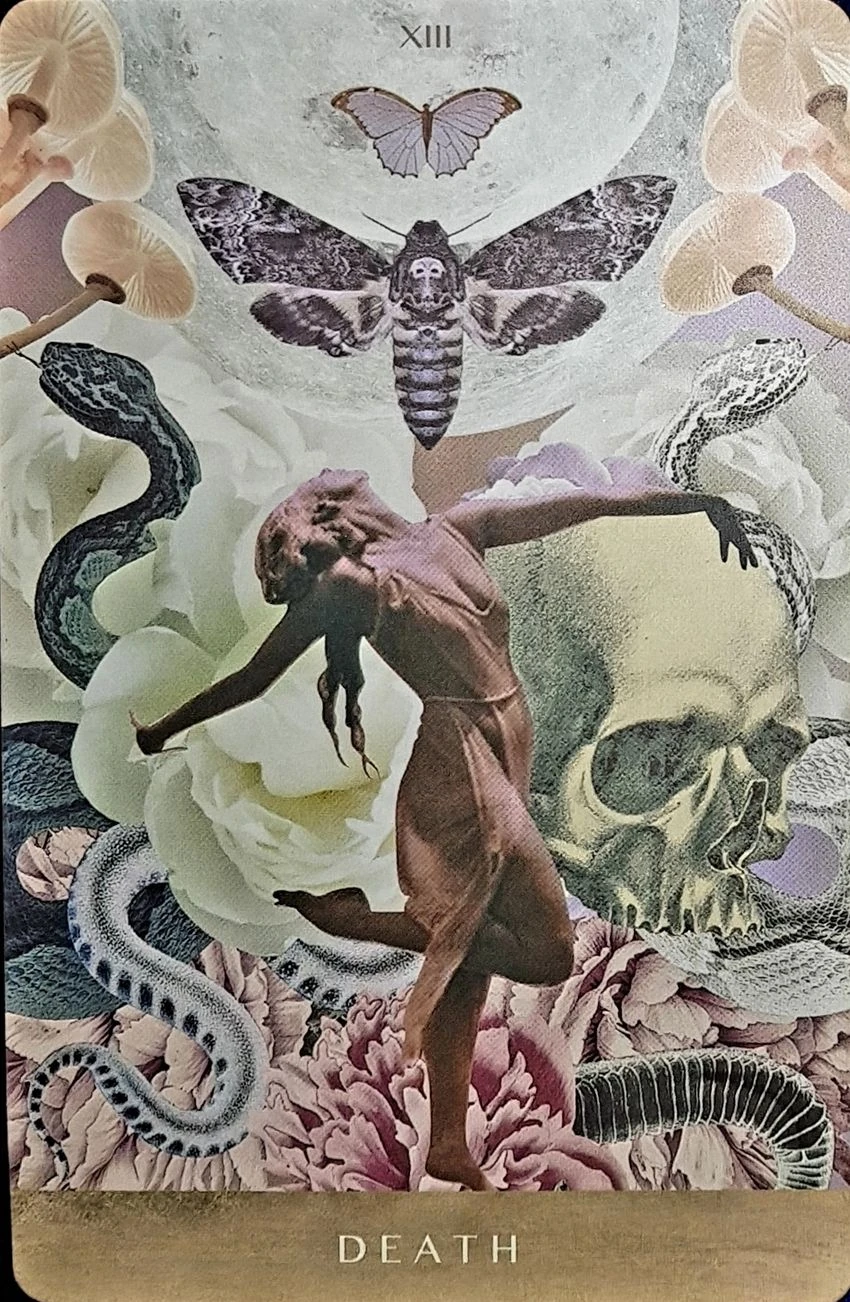
A pale-clothed figure arches backwards across a dense field of moths, snakes, flowers and a large skull. A round moonlike disc anchors the upper centre while cream, green, black and dusty pink elements overlap in a carefully layered collage.
The body’s sweeping curve keeps this crowded image from feeling static. Ask what is already in motion, which old form remains visible, and what living detail is growing beside it. Nearby cards can show whether change needs release, protection or patience.
FOUR-CARD STUDY
Four cards for grounded value
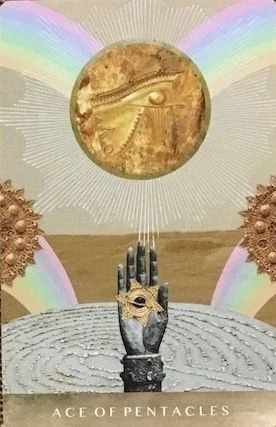
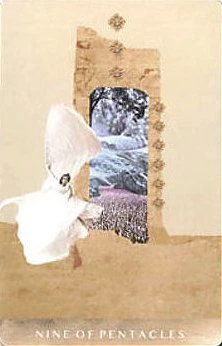
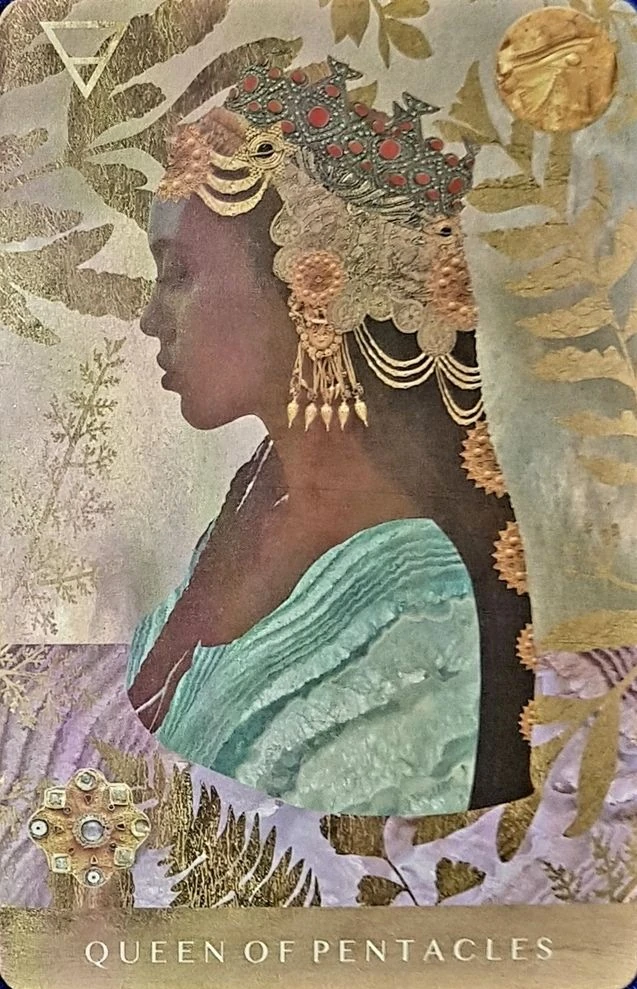
A large radiant coin hovers over a maze in the Ace, the Four centres a face beneath small ornate discs, the Nine places a pale moth beside a textured doorway, and the Queen wears an elaborate botanical headdress. Together they ask how value is received, embodied, cultivated and carried.

How it reads in practice
Moonchild is strongest when a reading needs reflection rather than rapid-fire keywords. Portrait cards can show presence and self-concept; landscapes can show distance, direction and atmosphere. The deck’s softer palette does not remove difficult material, but it gives that material room to be approached in stages.
For a practical spread, name one visible fact from every card, then turn each fact into a question. This keeps the reading anchored in the exact artwork while allowing intuition to build naturally.
CARD STUDY
Divine Wisdom: a profile held by layered history
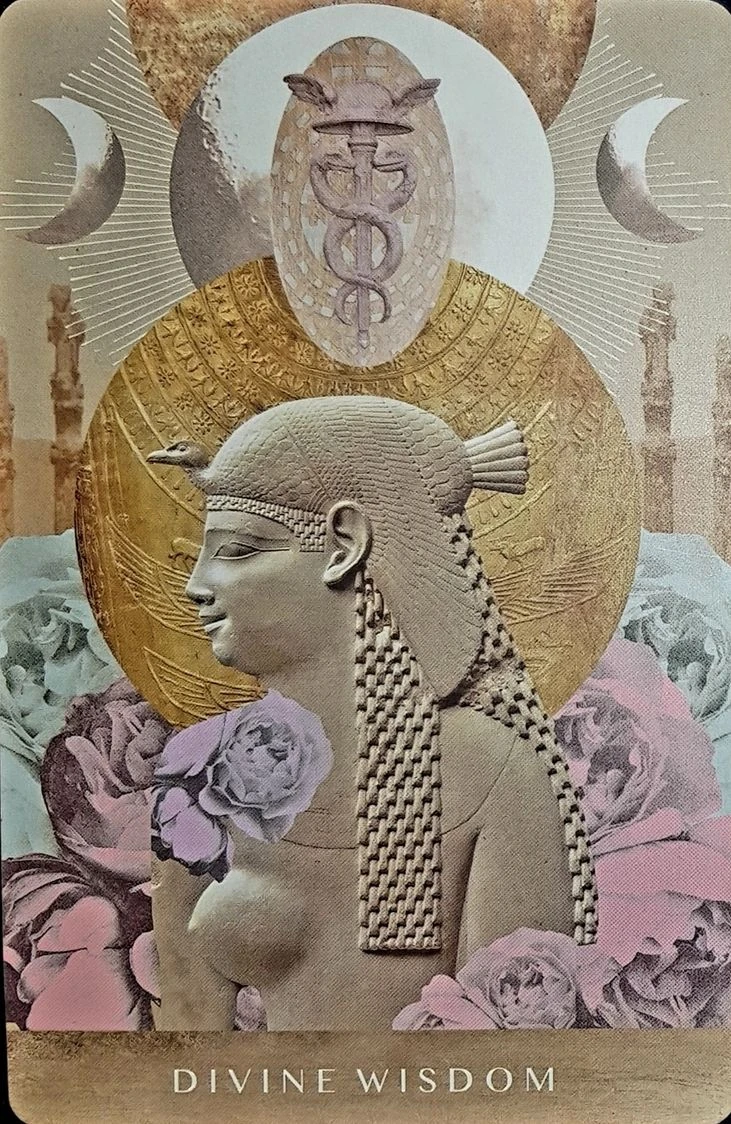
A stone-toned profile faces left beneath a gold circular halo and a tall winged emblem. Braided hair, pink roses, feathers and two pale crescent shapes fill the symmetrical collage, while gold and parchment textures dominate the background.
This extra card can invite a wider source of perspective without demanding certainty. Ask which inherited image, remembered voice or repeated pattern is present, and which part of it genuinely helps. Its side-facing gaze suggests consideration before response.
FOUR-CARD STUDY
Four cards for connection and distance
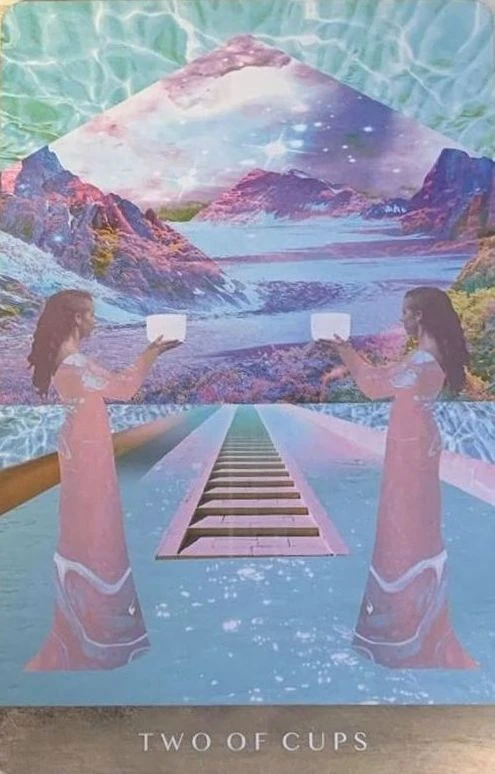
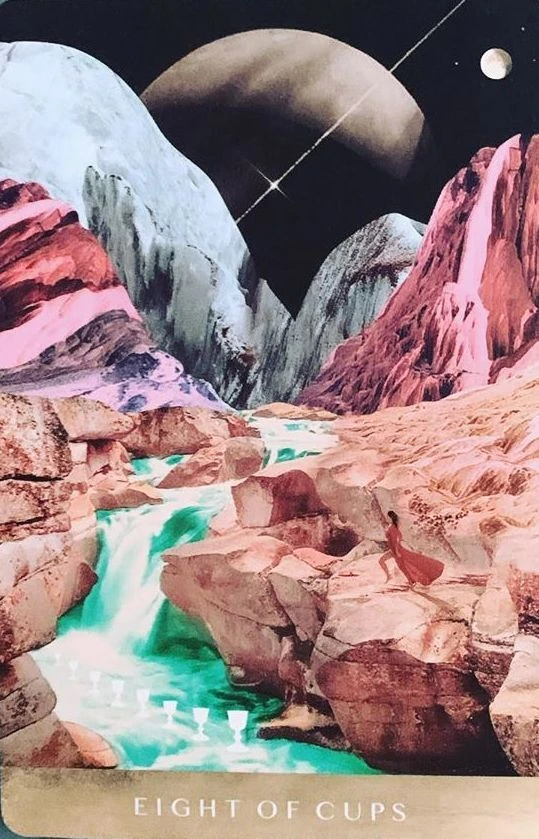
The Lovers encloses a dark embracing silhouette in a crystal-like form, the Two mirrors two figures across water and steps, the Eight opens onto a remote planetary canyon, and the Queen offers a composed floral profile. Read them as distinct ways of approaching closeness, space and emotional perspective.


Who will enjoy Moonchild Tarot?
This deck suits journalers, visual readers and anyone drawn to celestial collage, meditative portraiture and roomy compositions. Beginners may appreciate its strong emotional atmosphere, while experienced readers can explore how the added cards and nonliteral spaces complicate familiar structures.
Its gift is a gentle kind of depth: not a promise that every answer will arrive immediately, but an invitation to stay with the image until a useful question appears.

Moonchild Tarot FAQ
Is Moonchild Tarot good for beginners?
It can be beginner-friendly if the artwork feels clear to you. New readers should keep a simple tarot keyword list nearby while learning.
What kind of readings is Moonchild Tarot best for?
It is best for daily pulls, journaling, emotional check-ins, creative questions, and readings where image and mood matter.
Does Moonchild Tarot follow traditional tarot meanings?
It uses tarot structure, but the deck theme gives those meanings its own flavor. Read both the card title and the picture.
Who should skip Moonchild Tarot?
Skip it if you want hard-edged gothic art or a deck that feels purely technical.
How do I compare Moonchild Tarot with other tarot decks?
Look at several major arcana, minor arcana, and court cards. The minor cards are especially important because they show how the deck handles everyday life.
Can Moonchild Tarot be used for serious readings?
Yes. A themed or unusual tarot deck can still give serious guidance when the question is clear and the interpretation is grounded.