Santa Muerte Tarot Review
TAROT CARDS REVEALED12 MIN READ
As an Amazon Associate, TarotFans earns from qualifying purchases.
Explore the Santa Muerte Tarot Cards
A selection of Fabio Listrani’s vivid card artwork. Choose a card for a closer look, or explore the suits below.
Showing the available card selection.
A note from Aurica
I notice the flowers before I notice the bones. Red petals, yellow blooms and green leaves keep finding their way into Fabio Listrani’s world, as though life has quietly decided it will not be left outside. That makes Santa Muerte feel less like a warning and more like an invitation to look honestly at what is changing.
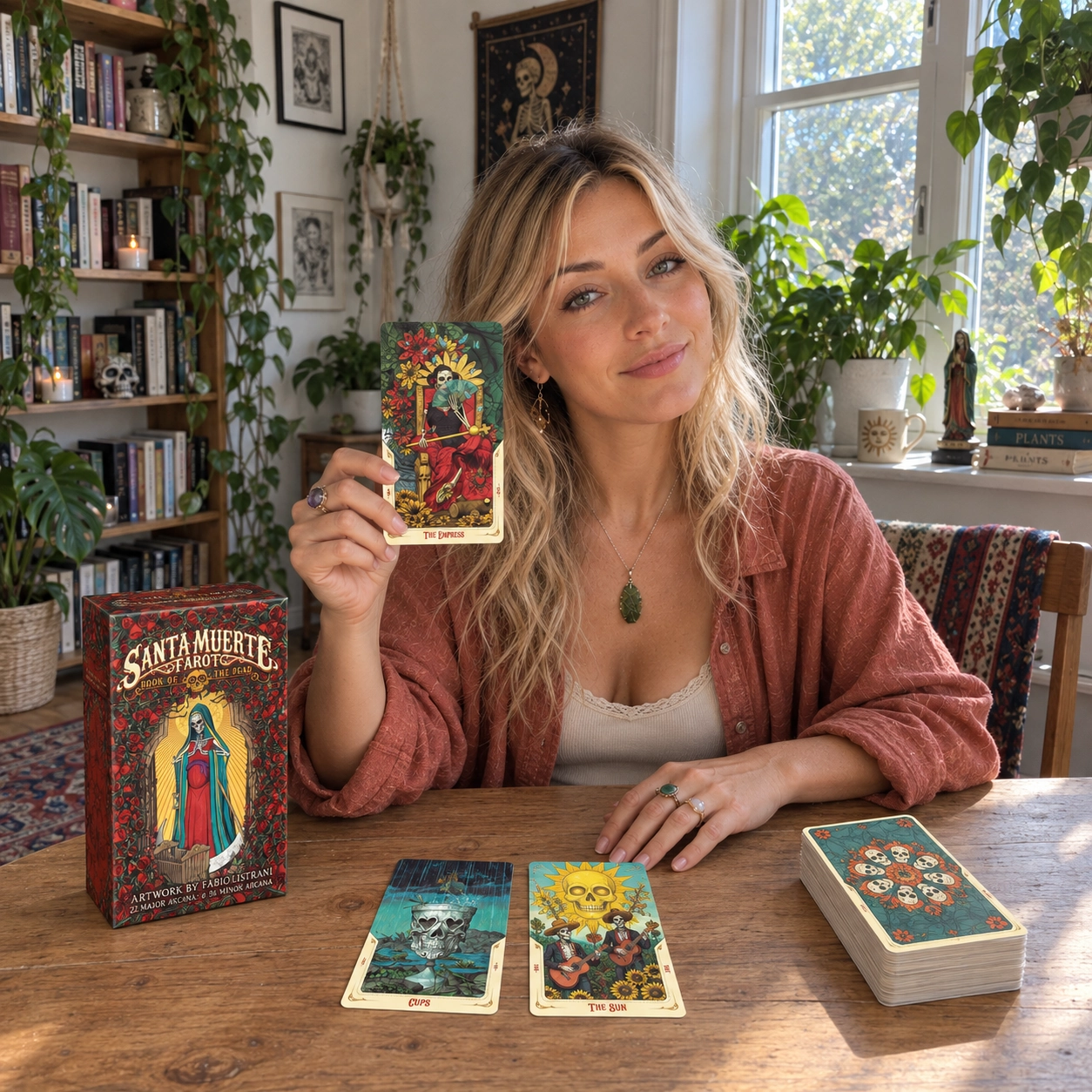
The Empress is the card that draws me closer. Her green fan keeps something private, while the flowers around her are wonderfully generous. I would begin a reading by asking what wants care, then look at the surrounding cards for the shape that care needs to take: patience, a conversation, or a small practical kindness.
I like the way this deck lets tenderness and courage sit at the same table. You do not have to turn every skull into a dark prediction. Follow the colour, notice the gesture, and let these bright little gardens remind you that something beautiful can still take root.
Flowers growing through the dark
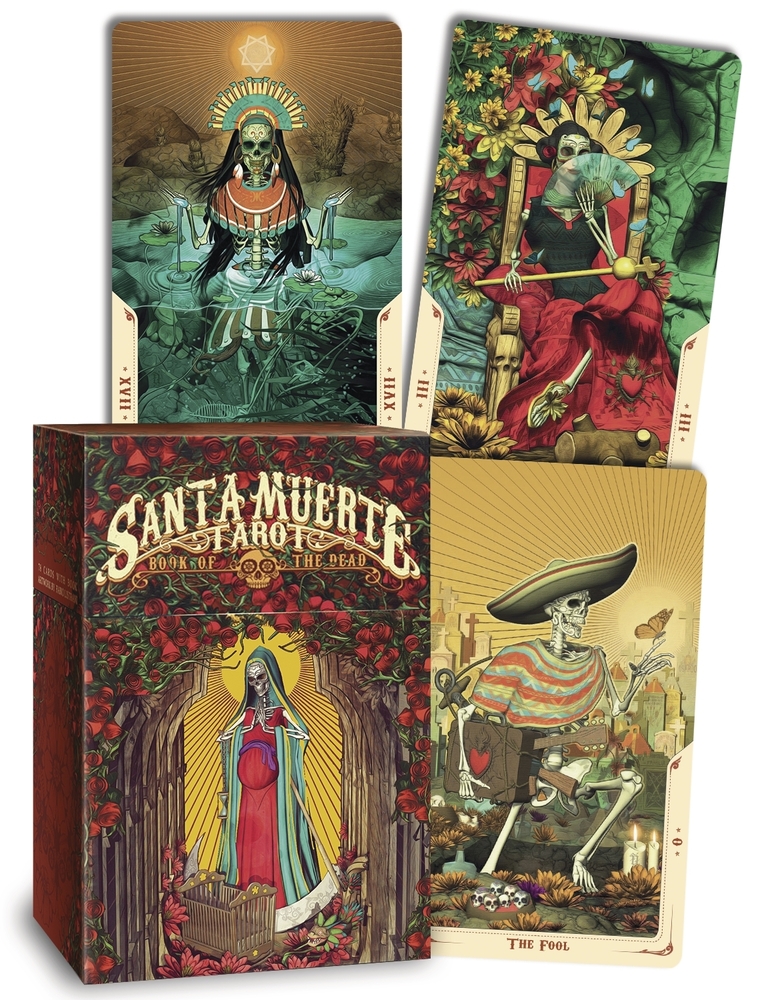
Santa Muerte Tarot is a 78-card deck by Fabio Listrani, published by Lo Scarabeo. Its skeletal figures live among roses, marigold-coloured flowers, tangled greenery and luminous skies. I find that contrast more interesting than the skulls alone. A face without flesh can still look watchful, playful, exhausted or tender because the body, clothing and surrounding objects carry the feeling.
The familiar Major Arcana and four suits give the reading a recognisable structure, but these are not simply Rider–Waite–Smith scenes with different costumes. Some cards ask you to pause and look again. I would keep the card’s traditional function nearby, then let Listrani’s particular image add its own question. What is being protected? What is still growing? Where has a habit become a cage?
The publisher connects the artwork with Santa Muerte and the imagery of the Day of the Dead. I would approach those references with curiosity and respect rather than treating them as interchangeable spooky decorations. This is an artist’s tarot deck; its pictures are a starting point for reflection, not a complete introduction to either living tradition.

Card study
The Empress — generosity with a private heart
A seated skeleton wears a sweeping red skirt, surrounded by yellow flowers and deep green leaves. A green fan rises across the lower part of her face. The warm colour invites us closer, yet the fan keeps a little distance. I love that mixture: she is abundant without giving every part of herself away.
The Empress usually asks what can be nourished into life. Here, the flourishing plants make that meaning visible, while the skeleton quietly reminds me that care has a rhythm and a limit. In a creative reading, this could be the invitation to feed a promising idea before asking it to perform. In a relationship spread, it may ask whether affection is being offered freely or squeezed out through duty.
The shadow is not a lack of warmth so much as the belief that love means endless availability. I would ask, ‘What can I tend wholeheartedly, and what needs a boundary so that tending remains joyful?’ The surrounding suit cards can make that answer wonderfully concrete.
How I would begin a reading
I would start with one card and describe it before interpreting it. ‘A figure turns away’ is an observation; ‘this person will leave me’ is a much larger leap. Santa Muerte’s dramatic pictures make that distinction especially useful. Give the image room to speak without making it responsible for a conclusion it has not earned.
Then I would connect the picture with the question. A sword may sharpen a conversation, a cup may hold an attachment, and a flowering pentacle may bring attention back to daily care. Finally, I would look across the spread for a change in posture or colour. Does a guarded card open into something generous? Does a bright card sit beside a difficult truth? That small movement often gives the reading its story.
Four cards, one conversation
A gentle heart, a clear boundary
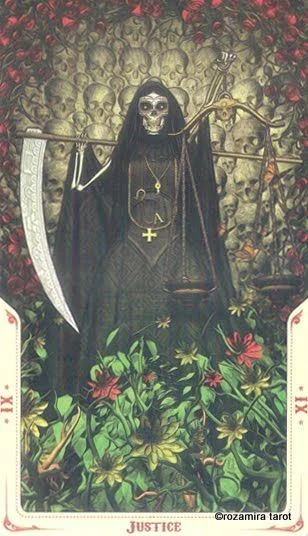
These four cards let closeness and honesty belong together. The 2 of Cups opens the conversation; Strength asks for steadiness rather than force; Justice brings fairness into view; and the Queen of Swords leaves room for a clear answer. I would read them as a sequence of choices, not a verdict on somebody’s character. What can be said kindly without making it less true?



Can a beginner find their way here?
Yes, with a little patience. The English names and familiar suits offer useful signposts, and the colour makes individual cards memorable. The harder part is resisting the urge to make every skeletal figure mean an ending. There are beginnings, celebrations, working days and moments of affection here too.
For a first deck, I would pair small readings with the included guidebook and a simple account of the traditional meanings. You do not need to decode every decorative detail on your first visit. Choose one visible feature, connect it to the question, and write down one possible action. Confidence grows more naturally from that than from trying to sound certain about everything.
Easy
Draw one card: what deserves a little more care today? Name one visible detail before you answer.
Medium
Draw three cards for what I am holding, what is changing, and what can support the next step. Look for movement between the pictures.
Deep
Explore a repeating pattern with four cards: its comfort, its cost, the boundary it needs, and a kinder alternative. Keep each answer connected to the question.
Card study
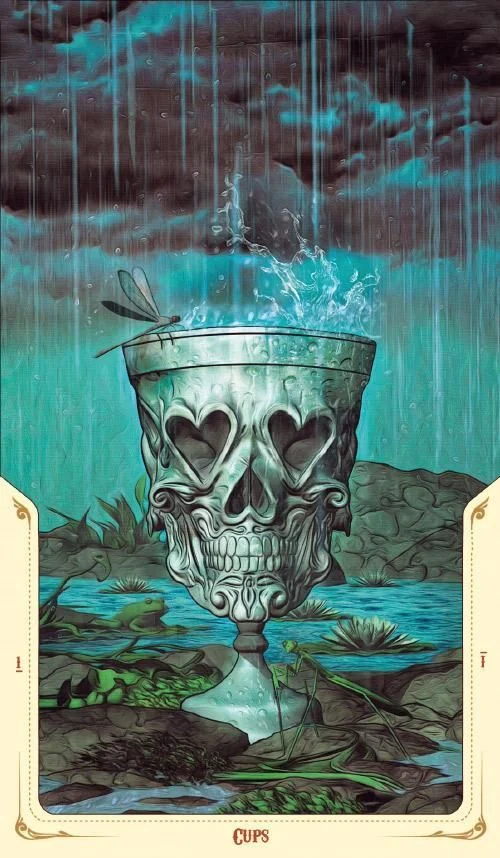
Ace of Cups — a vessel with room for feeling
A silver skull-shaped chalice rises above a pond scattered with lily pads and flowers. Its eye openings form hearts, and rain streaks the blue-green sky. The image is unusual, but the feeling is direct: a vessel is waiting to receive something. The skull is not the whole message; the water and the open cup matter just as much.
I read an Ace as a beginning or an invitation rather than a finished promise. Here, the heart-shaped openings soften the metal, while the rainy setting gives emotion somewhere to move. In a question about creativity, this could be the first honest feeling that makes a piece of work possible. In a relationship reading, it may suggest willingness to listen before deciding what the bond must become.
Its tension is the temptation to confuse emotional openness with an obligation to absorb everything. I would ask what is genuinely arriving, and whether there is room to receive it. A gentle first step might be naming a feeling without rushing to explain it away.
Letting change arrive at a human pace
This deck’s title can make change sound enormous. In a reading, I would often bring it back to something smaller: a conversation you keep postponing, an old expectation that no longer fits, or a routine that once helped but has become too tight. A little honesty can be more useful than a grand declaration of transformation.
I would also pay attention to the cards that soften the difficult ones. The Star does not erase the ache of leaving, and The Sun does not demand a cheerful face. They can show what remains available alongside discomfort: a glimpse of direction, a moment of companionship, the ordinary pleasure of being outside. That is a gentler way to read renewal than pretending the past disappears.
Four cards, one conversation
From pause to a little daylight
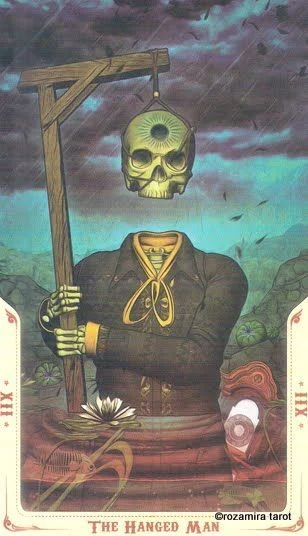
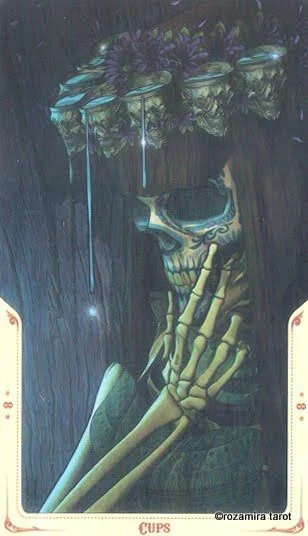
The Hanged Man gives the story a pause; the 8 of Cups makes space for a departure; The Star offers a direction to lean towards; and The Sun brings warmth back into the picture. I would ask which part of that movement is happening now. You do not need to force the final bright card before the earlier questions have been heard.


The beauty of a deck that is not always comfortable
What I like most is the range of feeling beneath the shared skeletal faces. Listrani uses saturated colour and decorative detail without making every card feel equally busy or equally joyful. A closed posture can make a lush scene feel guarded; a flower beside a skull can turn a severe image unexpectedly tender.
That intensity will not suit every reader or every moment. If you want very spare pictures or a close visual match to familiar Rider–Waite–Smith scenes, another deck may feel easier to reach for. Here, I would leave a little more time to look. The reward is a reading that notices contradiction instead of smoothing it away.
Card study
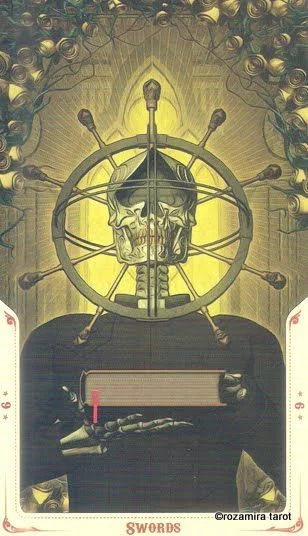
9 of Swords — when thought becomes a cage
A skull sits inside a circular metal structure, crossed by bars and ringed with blade-like spokes. Yellow light glows behind it, but the enclosed head remains the centre of attention. A closed book, a small red candle and scattered bones occupy the dark foreground. The image feels still, tense and difficult to look away from.
For me, that is a vivid way to approach the 9 of Swords: thought turning around the same painful point until it begins to feel like the only world there is. The circle does not prove that a feared event will happen. It shows the shape of confinement. In a reading, I would separate the fact of a worry from the story that worry keeps repeating.
A useful question is, ‘What do I know, what am I imagining, and what small thing would let some air into this?’ Beside a practical Pentacles card, the answer may be an ordinary task that restores a little steadiness. Beside a Cups card, it may be finding words for a feeling. The aim is not to scold the frightened part of ourselves, but to give it a wider view.
Bringing the reading back to daily life
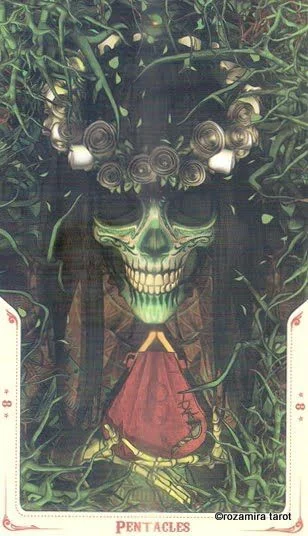
The Pentacles are a welcome change of texture after the sharpness of the Swords. I would use them to ask what support can be made visible: time protected for a skill, a useful contribution from somebody else, a home routine, or a resource shared with care. A beautiful reading becomes more helpful when it can land somewhere in the day.
For work or money questions, I would keep the interpretation close to choices that can actually be checked. What needs practice? What is being held too tightly? What would fair exchange look like? The cards can suggest a thoughtful question without supplying a price, a guarantee or a timetable. I like that modest scale; it leaves room for judgement and real information.
Four cards, one conversation
The quiet work of making things grow
I see a practical thread here: contribution, patient craft, what can be sustained, and the care that helps it last. Read the four together when an idea needs more than enthusiasm. Which part is ready for collaboration? What needs repetition? What are you hoping to leave in good condition for the people who come after you?



Before choosing your edition
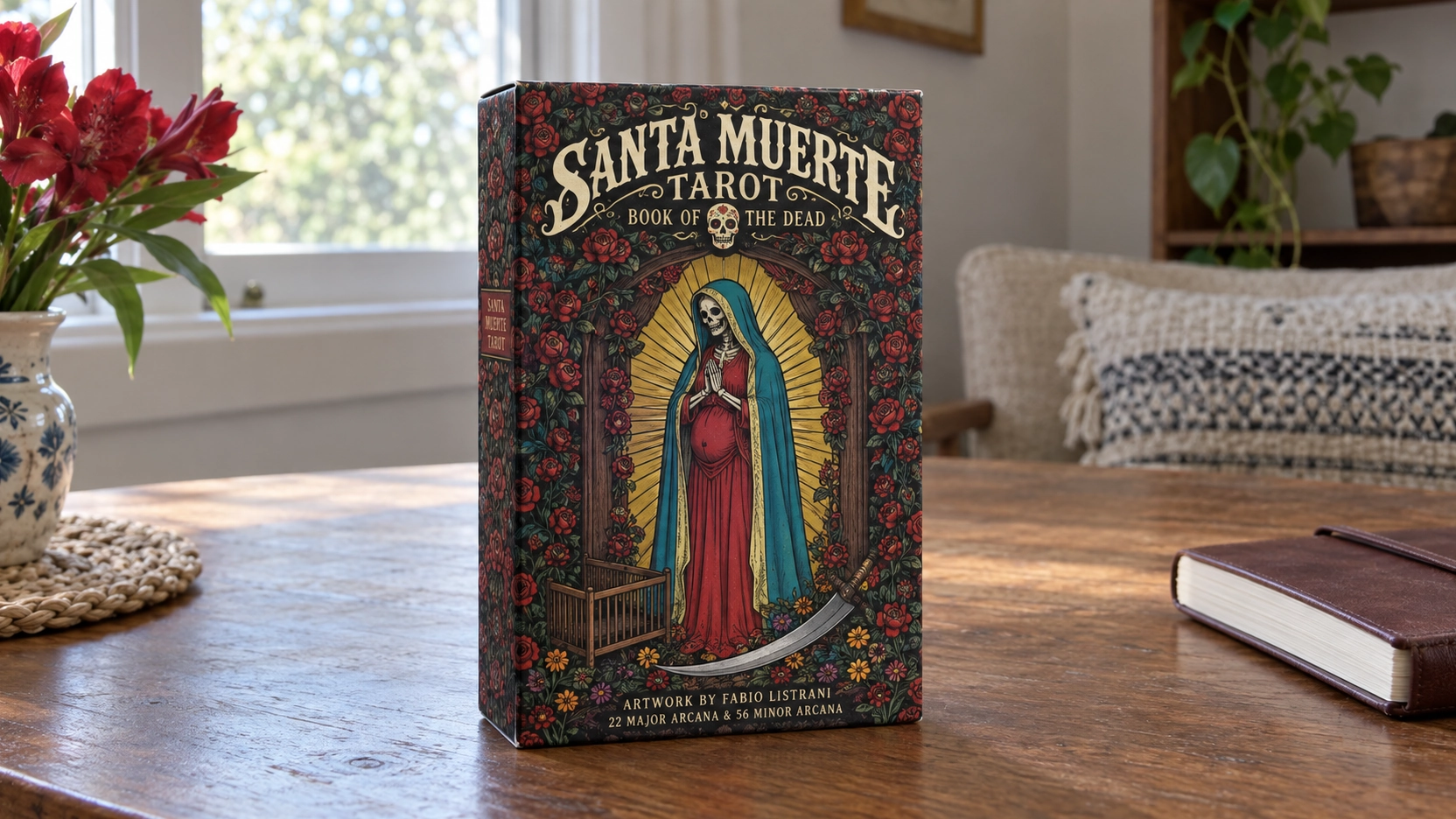
The edition discussed here is the standard Santa Muerte Tarot, not Santa Muerte Oracle and not the smaller Mini deck. Lo Scarabeo lists the standard cards at 70 × 120 mm. Fabio Listrani’s artwork, the rose-covered Book of the Dead box and the familiar four suits are the useful details to check when comparing a listing.
The linked Amazon product is Santa Muerte Tarot Deck: Book of the Dead, ISBN 9780738754383. Check the seller’s current description for language, included guidebook and the exact item being supplied; photographs of a different format are not a substitute for that detail. I would choose this deck for its vivid emotional range, not because a dramatic title promises a more powerful reading.
The Gallery above is a selection of available card images rather than the whole deck. It gives you a good look at the visual language, while the video offers another way to see the cards. Original image markings are retained. The lifestyle scenes are generated editorial illustrations, separate from the card images used for the review.
My golden rule for Santa Muerte
Read the living detail as carefully as the skeleton. Look for the flower, the hand, the direction of the gaze, the object being offered or guarded. Then connect it to the card’s function and the question in front of you. That keeps the reading from becoming a string of dark predictions and lets the full colour of this deck come through.
Final Thoughts
Santa Muerte Tarot makes room for beauty without pretending everything is easy. I am drawn to the way its flowers keep blooming beside its bones: not as a denial of change, but as a reminder that care still matters while change is happening. It is a strong choice for a reader who enjoys vivid symbolism and does not mind sitting with a complicated feeling.
If its imagery speaks to you, begin gently. Let one card ask one useful question, and give yourself time to answer. There is warmth among these roses, and you do not have to hurry past the shadows to find it.
Santa Muerte Tarot FAQ
Who created Santa Muerte Tarot?
Fabio Listrani created the artwork for Santa Muerte Tarot, published by Lo Scarabeo. Its full title on the standard box is Santa Muerte Tarot: Book of the Dead.
Is this the tarot deck or Santa Muerte Oracle?
This review covers the standard 78-card Santa Muerte Tarot. Santa Muerte Oracle is a separate deck, and the Mini tarot is a smaller format. I would check the full product name before choosing a copy.
Is Santa Muerte Tarot suitable for beginners?
It can be, especially if the pictures draw you in. The familiar suits and named Major Arcana provide signposts, but some scenes differ from common Rider–Waite–Smith imagery. I would begin with small spreads and keep the guidebook nearby.
Does the Gallery show the complete deck?
No. It shows a selection of verified card images. Use it to explore the artwork, and watch the accompanying deck video for another view rather than assuming every card is pictured here.
Are all the readings about death or endings?
No. I would read each card through its imagery, traditional function and place in the spread. The skeletons are part of the deck’s visual language; affection, creativity, work, celebration and renewal are here too.
What size are the standard cards?
Lo Scarabeo lists the standard cards at 70 × 120 mm. The Mini edition is a different size, so check which format a seller is offering.
More Tarot Decks to Discover
For another shade of symbolism, explore these distinctive illustrated worlds.