THE CARD GALLERY
Explore the Magic Gate Tarot Cards
Move through the deck in canonical order. Select any card to open the full-size Lightbox and continue with the arrow controls.
Artwork by Vera Petruk. The supplied source collection includes both color and monochrome presentations of the deck.
Aurica’s Quick Take
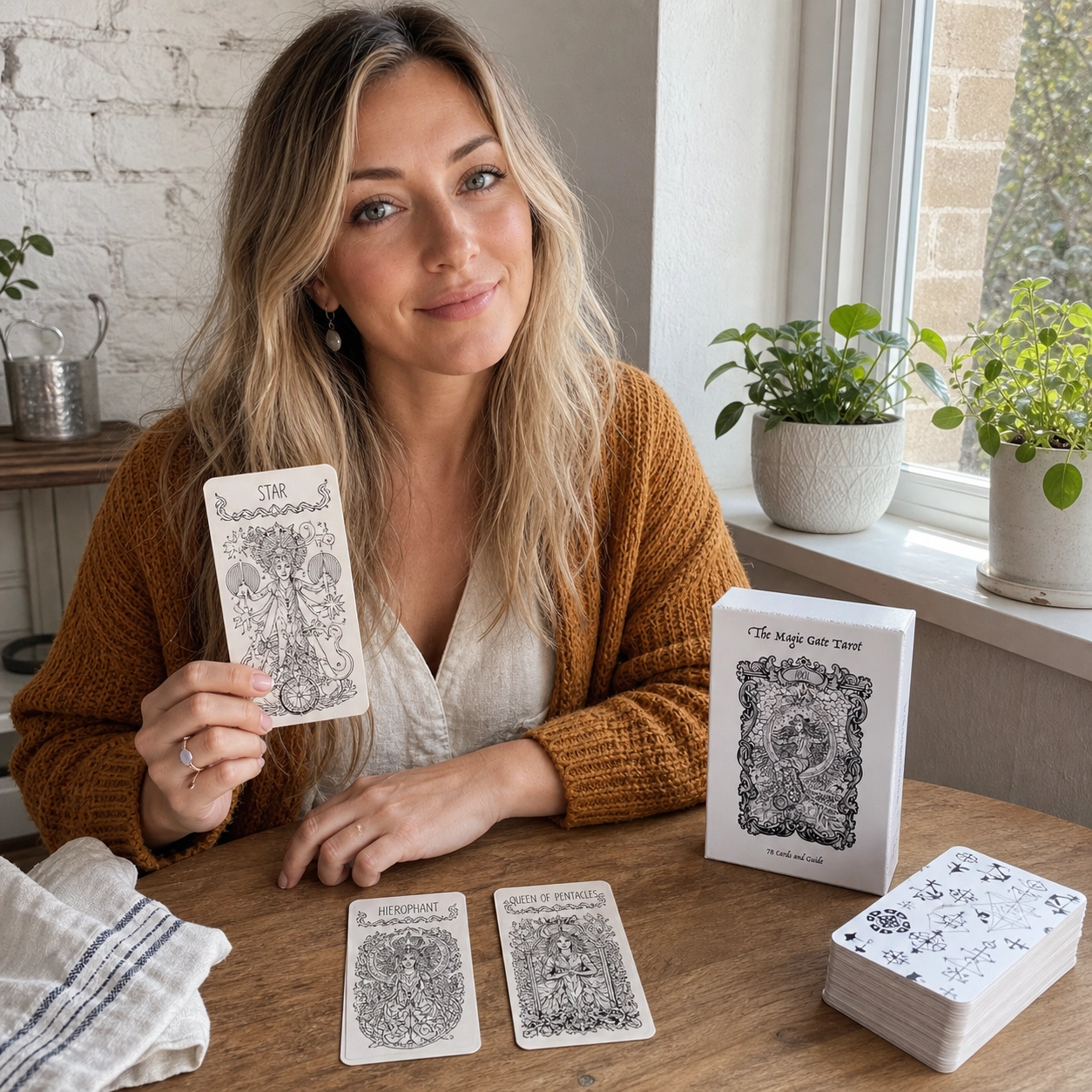
Magic Gate Tarot turns every card into a dense threshold. Vera Petruk’s imagery fills the familiar tarot structure with creatures, tools, flowers, masks, geometric forms and decorative frames. I find the pictures reward close observation, though they can feel busy when I want one clear cinematic scene.
I would choose it for journaling, shadow work and readings where the question needs several layers. I would not make it my first recommendation for a reader who wants uncluttered Rider–Waite–Smith scenes or large, instantly legible facial expressions.
When The Star rises in this deck, I notice how hope is carried by a whole gathering of marks rather than a single shining gesture. The Hierophant and Queen of Pentacles deepen that feeling: wisdom here has roots, texture and a quiet weight. I begin with the detail that tugs at me, then test it against the card’s traditional role and the story made by its neighbours.
This is a deck that asks me to look twice, breathe, and let one living symbol open the gate at a time. Trust the image that quietly finds you first, and The Magic Gate Tarot can lead you toward a reading that feels vivid, grounded and full of possibility.
What makes Magic Gate Tarot different?
The deck keeps the standard 78-card tarot skeleton—Major Arcana followed by Wands, Cups, Swords and Pentacles—but its surface language is unmistakably its own. Ornate borders hold together images that move between engraved black linework and saturated color. Trees carry pip symbols, court cards become elaborate portraits, and the Majors often read like compact cabinets of curiosities.
That density changes the reading rhythm. A first glance supplies the card title and broad archetype; a second glance reveals the object, creature or directional detail that makes the card specific to the question. The deck is strongest when you let one visible element lead instead of trying to decode everything at once.
CARD STUDY
The Fool: movement held inside a circle
A long-haired figure in green sits within a large reddish ring, one blue-booted leg dropping toward a cluster of circular, gear-like forms. Curving branches, leaves, clouds and small black marks crowd the pale yellow field. The figure looks sideways rather than directly out, while the ring gives the scene both motion and containment.
The card makes a beginning feel less like an empty road and more like entry into an already active system. In a reading, its useful expression is curious participation: step in, notice what responds, and accept that you will learn by moving. Its shadow is fascination without direction—circling possibility while never choosing where the first step lands.

How the deck reads in practice
Start with the title, then name the first three things you can actually see. Choose the detail with the strongest visual pull and ask what action, pressure or relationship it introduces. Only after that should you add a memorized tarot meaning.
This method keeps the artwork from becoming decoration and prevents the density from turning into a symbol checklist. Magic Gate Tarot works especially well for questions about transformation, creative blocks, personal power, hidden resources and the moment when reflection needs to become action.
FOUR-CARD MOMENT
Four ways a cycle can turn
The Fool enters a living ring, Wheel of Fortune fixes a winged figure inside a radiant mechanism, Death compresses skull, tools, rose and serpentine movement into one dense transformation, and The World encloses a hare within another complete circle. Together they move from entry to pattern, irreversible change and integration.


Is Magic Gate Tarot beginner-friendly?
It can be, for a patient visual learner. The card titles and standard structure give a beginner a familiar map, while the images offer plenty to describe before consulting a guidebook. The challenge is deciding which detail matters; the deck rarely gives you only one thing to look at.
For the first week, use one card at a time. Write the title, the first visible object, the mood it creates and one practical sentence. That small discipline is more useful than trying to master every occult-looking mark on day one.
CARD STUDY
Death: transformation as assembled machinery
A large skull occupies the centre beneath a winged green structure and red flame-like forms. Coiled red serpents cross metal tubes, a blue eye-like disk and a black ankh. Below, a compass or gauge, bundled rods, a red rose and curling foliage overlap in a tightly assembled mass.
Nothing in the image is empty or still; endings are shown as material being reorganised. In a reading, the constructive expression is deliberate dismantling—recognising which component has completed its work so the system can change. The shadow is compulsive intervention: pulling everything apart because stillness feels intolerable.
Art style, mood and audience fit
Petruk’s line is decorative, crowded and tactile. The monochrome cards emphasise engraving-like detail and cream paper; the color presentation pushes turquoise, scarlet, yellow, violet and leaf green against dark frames. Even simple pip cards are staged inside branching trees or ornamental arrangements rather than left as plain number cards.
The deck suits readers who enjoy marginalia, symbolic collage, creatures and ritual atmosphere. It may frustrate readers who depend on clean human storytelling, minimal compositions or very large visual cues during fast client readings.
FOUR-CARD MOMENT
Faces of knowledge and command
The High Priestess, Emperor, Queen of Swords and King of Pentacles show authority through four different visual languages: inward attention, concentrated force, sharpened discernment and material guardianship. Use the set to ask what kind of authority the situation actually needs.


What to know before buying
- Structure: 78 cards in the familiar Major and Minor Arcana framework.
- Creator: artwork by Vera Petruk; the documented direct edition is published by Vieux Monde Express.
- Documented edition: guidebook included, approximately 3.5 × 2.5 inches, 300 GSM card stock and printed in the USA.
- Edition check: color, monochrome, oversized and updated presentations may differ, so confirm the exact box and card finish before ordering.
The buttons on this page go to the eBay listing supplied for this review. Check the current item condition, included contents, shipping and availability on the listing itself; TarotFans does not make live stock or price claims.
ORICA’S GOLDEN RULE
Choose the symbol that moves the card
Do not explain every mark. Find the one object, creature or line of movement that changes the scene, then let the traditional meaning answer to it. One active symbol will usually reveal more than a catalogue of twenty.
Final Thoughts
Magic Gate Tarot earns its name by making each card feel like an entrance into a densely furnished world. Its standard structure keeps the deck usable, while Petruk’s distinctive visual language prevents it from feeling generic.
It is best for readers who enjoy looking twice. If you want a deck that keeps offering new details for journals, meditations and slow readings, it has real staying power. If you want instant simplicity, the same abundance may become visual noise.
 View Magic Gate Tarot on eBay
Magic Gate Tarot FAQ
Who created Magic Gate Tarot?
The artwork is by Vera Petruk. A documented direct edition is published by the Nashville-based small press Vieux Monde Express.
How many cards are in Magic Gate Tarot?
It is a standard 78-card tarot with 22 Major Arcana and 56 Minor Arcana across Wands, Cups, Swords and Pentacles.
Is Magic Gate Tarot suitable for beginners?
Yes for a patient visual learner. The familiar card titles help, but the dense imagery can be more demanding than a simple Rider–Waite–Smith deck.
What kinds of readings suit it best?
It works especially well for journaling, transformation, creative blocks, personal power, hidden resources and questions that benefit from several symbolic layers.
Are there different editions?
The deck has appeared in monochrome and color presentations, and listings may vary in size, finish, box and guidebook. Confirm the exact edition before ordering.
What comes with the documented Vieux Monde edition?
The direct listing describes 78 cards, a guidebook, 3.5 × 2.5 inch cards, 300 GSM stock and printing in the USA. Current listing details can change, so verify them with the seller.
KEEP EXPLORING