
Food Fortunes Tarot Card Gallery
Browse the complete verified Food Fortunes deck in its official dinner-divination order. Choose an official family, then open any card for a larger view and product link.
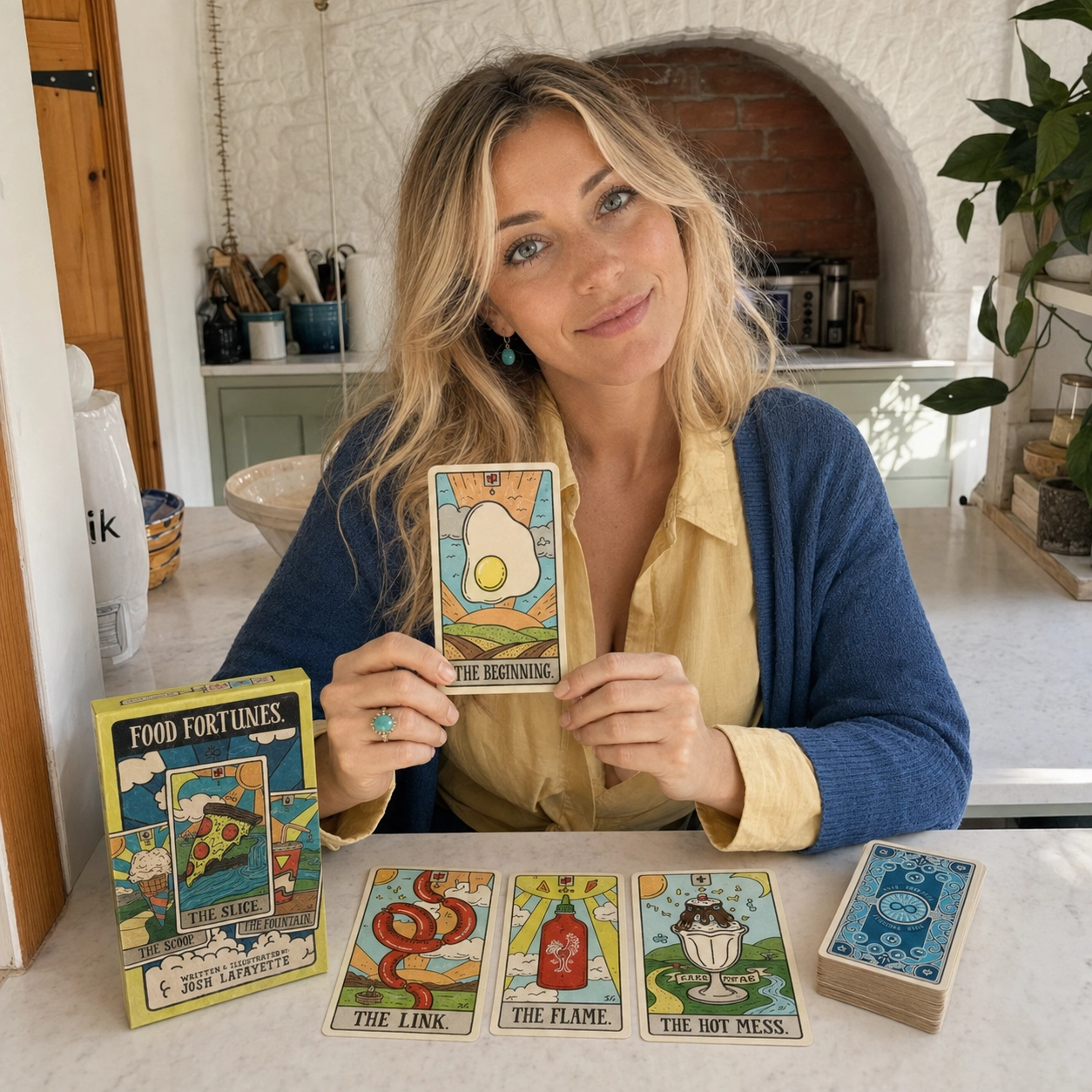
Aurica’s Quick Take
Food Fortunes is witty, bright, and far stranger than a novelty deck has any right to be. Josh Lafayette turns pizza, tacos, dumplings, hot sauce, ice cream, and coffee into a working symbolic system. It is best for intuitive readers, collectors of unconventional decks, and anyone who finds everyday objects easier to read than distant occult scenery.
Read the appetite before the archetype. Your first reaction—comfort, craving, excess, disgust, nostalgia—is often the most honest message this deck gives. I love letting that bodily flicker speak first, then testing it against the question and the cards nearby.
I see The Beginning as a bright fried egg rising over open fields, simple and hopeful, while The Link twists into a knot that asks whether a bond is nourishing or merely hard to untangle. The Flame brings heat and nerve; The Hot Mess spills sweetness in every direction. The renamed suits reward curiosity more than memorised rules, so beginners can start with what they genuinely notice.
I take Food Fortunes as a reminder that wisdom does not always arrive in solemn robes; sometimes it comes with toast, hot sauce, and the courage to try a new flavour. Trust the card that makes you feel something first, and let its lively little feast help you choose your next step with warmth and confidence.
Food Fortunes Tarot Review: dinner-table divination with a comic-book bite
What kind of tarot is Food Fortunes?
Published by Chronicle Books and written and illustrated by Josh Lafayette, Food Fortunes is a 78-card deck built as “dinner divination.” Its structure is complete but deliberately renamed: twenty-eight Major Food Arcana are followed by eight Mains and fourteen cards each in Sides, Sweets, and Drinks.
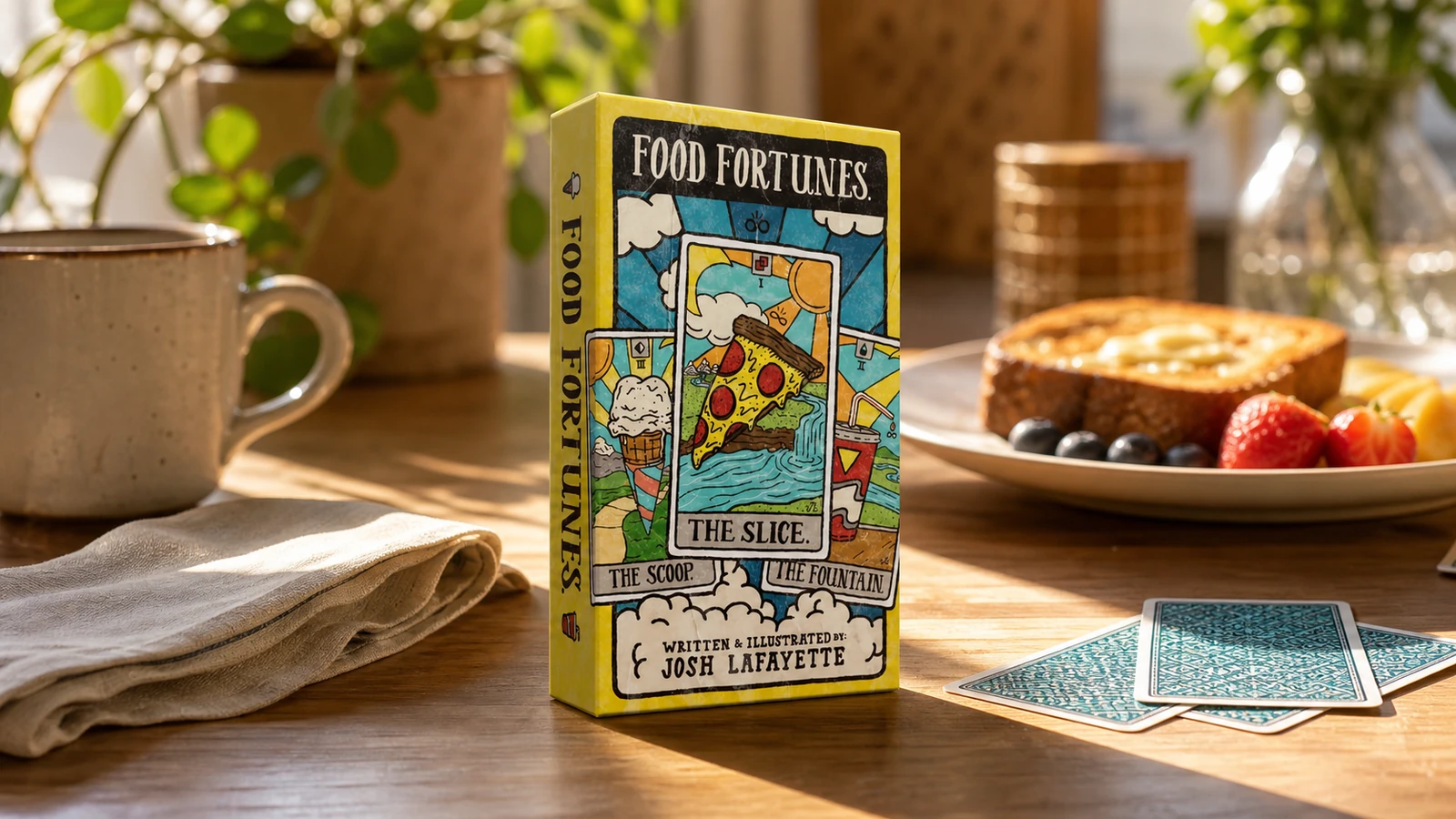
The visual grammar is remarkably consistent. Thick ink lines, turquoise skies, mustard-yellow rays, tomato red, and cream-colored borders make every dish feel like an emblem. A taco can stand in a landscape like a traveler; a bottle of hot sauce can become a beacon; a cup of coffee can sit with the authority of a court card. The jokes are immediate, but the repeated horizons, pathways, clouds, and suit marks give readings enough structure to move beyond the punchline.

The Beginning: one egg, one sunrise, one clean start
A fried egg floats above rolling fields while yellow rays break around it. The yolk is a compact sun inside the larger sunrise, so the image doubles down on beginnings without clutter. The card feels simple, open, and slightly absurd—the exact emotional mix of stepping into something before you know how it will turn out.
In a reading, start with what is available rather than waiting for a perfect recipe. Upright, The Beginning favors curiosity, first attempts, and uncomplicated action. In shadow, it can describe optimism without preparation or the temptation to mistake novelty for nourishment.
How the deck reads in practice
Food Fortunes works fastest when you read in three passes. First, name the literal food and your bodily reaction to it. Second, notice the card’s landscape, direction, quantity, and condition: whole or split, fresh or preserved, solitary or shared. Only then connect the image to its position in the deck.
This order matters because the renamed cards are not flashcards for Rider–Waite–Smith meanings. The title may nudge you toward a pun, while the picture carries the emotional temperature. A meal can suggest resources and support; a side dish can reveal what is being minimized; sweets can show reward or overindulgence; drinks can point to mood, flow, and social exchange.
Comfort food becomes a journey
The Beginning opens the appetite, The Folded One makes the path portable, The Slice asks for a clean choice, and The Burger gathers many layers into one commitment.


Beginner friendliness
The pictures are approachable, but the system is not a direct beginner clone. New readers can begin immediately with one-card pulls because the food titles provoke strong associations. For larger spreads, keep the guidebook nearby until the Major Food Arcana and four food families become familiar.
Easy: “What would nourish me today?” or “What deserves a simple first step?” Medium: compare what is central with what is merely a side. Hard: read a five-card spread using only appetite, preparation, quantity, and sharing before consulting any traditional correspondence.

The Link: connection that can feed or entangle
Red sausage links loop through a radiant orange sky, twisting from a small dish at the bottom toward a cloud at the top. The repeating curves make the eye follow connection after connection; there is no obvious beginning once the chain starts moving.
In a reading, The Link asks what binds the situation together. It can be cooperation, ancestry, habit, supply, or obligation. Its useful expression is continuity and mutual support. Its shadow is a chain maintained only because nobody has paused to ask whether it still nourishes anyone.
Art style and deck personality
Lafayette’s hand-drawn style is part diner sign, part underground comic, and part storybook landscape. Scratches, uneven color, and visible texture keep the food from becoming slick advertising. Every object has personality without needing a face.
The deck’s humor is generous rather than cynical. It can lighten a tense reading, but it does not force every answer into a joke. The best readings let the title make the first opening and then stay with the image long enough for a more personal association to surface.
Heat, substance, balance, and growth
The Flame brings urgency, Ace of Mains asks what will truly sustain you, Ace of Sides shows the support around the center, and The Seed returns the question to potential.


Who will enjoy Food Fortunes most?
This deck suits intuitive readers, food lovers, illustrators, collectors of unusual tarot systems, and people who want a friendly icebreaker for group readings. It is especially useful for questions about energy, resources, routines, pleasure, creative appetite, and the balance between essentials and extras.
Readers who want solemn ceremonial imagery, instantly recognizable RWS scenes, or a deck that disappears behind memorized keywords may find it too specific. The food theme is not decoration; it is the entire language.
What Aurica likes most
The strongest idea is the deck’s ability to make hierarchy tangible. Mains and Sides create an immediate conversation about priorities. Sweets ask what is reward and what is compensation. Drinks reveal flow, temperature, mood, and what passes between people. Those are practical distinctions that translate surprisingly well into daily readings.

The Hot Mess: when every direction comes with toppings
A towering sundae melts over a signpost whose arrows point toward competing destinations. Small marks and toppings scatter through the air while the dish itself stays centered. The image is funny because it is also accurate: excess can be delicious and disorienting at the same time.
In a reading, The Hot Mess can validate complexity without romanticizing chaos. Its useful expression is creative abundance and permission to be imperfect. Its shadow is overload—too many choices, too much decoration, and no decision about where to go next.
What to know before buying
Food Fortunes is an older Chronicle Books release, so edition, condition, packaging, and seller availability may vary. Check the listing details rather than assuming every offer is a new sealed copy. The unusual titles also mean that readers who prefer standard correspondences should expect a short learning period.
What you gain is a complete visual world with a consistent vocabulary. If several cards in the gallery immediately trigger memories, cravings, jokes, or strong reactions, that is better evidence of fit than the deck’s novelty label.
Treat, overflow, refresh, and command
The Scoop offers pleasure, The Hot Mess shows pleasure without limits, Ace of Drinks clears the glass, and King of Drinks asks for mature control of mood and flow.


Aurica’s golden rule for Food Fortunes
Do not translate the food away too quickly. Stay with taste, texture, temperature, portion, preparation, and who is invited to the table. The deck becomes generic the moment every dish is reduced to a standard keyword; it becomes precise when the food itself is allowed to answer.
Final Thoughts
Food Fortunes succeeds because the joke has structure. Its seventy-eight cards form a coherent system, its palette makes a spread feel unified, and its everyday symbols invite honest reactions. It will not replace a traditional learning deck for everyone, but it can become a sharp, affectionate reader for practical life.
If you want another playful deck, compare it with the Gummy Bear Tarot. For retro domestic wit, explore the Housewives Tarot.
Food Fortunes Tarot FAQ
Is Food Fortunes a real 78-card tarot deck?
Yes. It contains twenty-eight Major Food Arcana, eight Mains, and fourteen cards each in Sides, Sweets, and Drinks.
Is Food Fortunes good for beginners?
It is easy to approach intuitively, but its renamed system is not a direct RWS teaching deck. Beginners should use the guidebook while learning the food families and court structure.
What readings suit this deck best?
It is especially good for daily guidance, resources, routines, relationships, creative appetite, pleasure, priorities, and questions about what truly feels nourishing.
Does the deck follow traditional tarot meanings?
It keeps a full tarot-sized structure but translates it into its own food language. Read the printed title and visible dish first, then connect that response to the card’s place in the system.
Who created Food Fortunes?
Food Fortunes was written and illustrated by Josh Lafayette and published by Chronicle Books.
Can a funny food deck handle serious questions?
Yes, if the question is grounded and the humor is not used to avoid the answer. Familiar food can reveal comfort, scarcity, excess, memory, and social dynamics with surprising directness.
More Tarot Decks to Discover
 Housewives TarotRetro domestic witRead the review →
 Gummy Bear TarotBright, playful traditionRead the review →
 Ferret TarotAnimal charm and characterRead the review →
 Everyday Witch TarotApproachable everyday magicRead the review →
 Light Seers TarotModern intuitive symbolismRead the review →
 Elemental Wisdom TarotBright elemental guidanceRead the review →