Feng Shui Tarot Cards
Browse the verified Feng Shui Tarot artwork in one continuous partial gallery. Every recovered thumbnail opens in a larger carousel view, while unavailable cards remain honestly unclaimed.

A note from Aurica
I love the way Feng Shui Tarot makes a reading feel like stepping into a room and sensing where the air has gone still. The Green Dragon curls through bamboo and water with such restless life that I can almost hear the leaves shake. Beside it, Transition waits behind a sliding screen, half revealed and half protected. Before I reach for a keyword, I ask where the picture seems to breathe and where it seems to hold its breath.
That is the thread I follow through this deck. Justice carries her many-coloured umbrella through a busy scene, so balance here does not feel cold or fixed; it feels like moving carefully while several pressures pull at once. Transition brings the question to a threshold, while the Ace of Green Dragon supplies the first green surge of courage. I read the traditional card role first, then let the animal, direction, colour, and movement show me how that role wants to live today.
In a relationship spread, I notice whether the figures turn toward one another or guard their own space. In creative work, I watch for Dragon energy that wants room to grow. When a reading feels tangled, the four animal families help me name the missing quality: warmth, truth, steadiness, or forward motion. The neighbouring cards decide whether the answer is to act, speak, soften, or wait.
I would choose Feng Shui Tarot when I want a reading with atmosphere and a strong elemental pulse, especially for questions about change, boundaries, home, or creative direction. Its unusual structure rewards patience, so I let the image speak before trying to make it fit a familiar system. Each time the Dragon rises or Transition opens its quiet screen, the deck reminds me that a small, well-placed shift can invite fresh energy—and that hopeful movement is already within reach.
Feng Shui Tarot Review: elemental tarot with an Eastern-inspired map
Feng Shui Tarot by Eileen Connolly and Peter Paul Connolly is a bold, unusual tarot deck that translates tarot ideas through feng shui symbolism, directional animals, color, movement, and environmental energy. It does not feel like a quiet Rider-Waite clone. It feels more like stepping into a symbolic room where every direction has a mood, every creature has a job, and every card asks, “Where is the energy moving?”
The deck is especially interesting because it uses a 72-card structure rather than the standard 78-card tarot format. That means the familiar tarot skeleton is present, but the language is different. Instead of only thinking in classic suits, you meet White Tiger, Green Dragon, Red Phoenix, and Black Tortoise imagery. For some readers that will feel instantly alive; for others, it will take a little patience. Either way, this is a deck for looking closely.
Quick take: choose Feng Shui Tarot if you enjoy symbolic decks, elemental reading, intuitive spreads, and artwork that gives you atmosphere before keywords. Skip it if you want a simple first deck with standard titles, predictable scenes, and a full 78-card learning system.
What makes the Feng Shui Tarot different?
The biggest difference is that Feng Shui Tarot treats a reading like a living space. A normal tarot question might ask, “What does this card mean?” This deck often asks, “What is protected, blocked, rising, cooling, draining, or growing here?” That shift can be very useful for relationship readings, home-and-family questions, work decisions, creative projects, and personal energy check-ins.
The cards also reward visual reading. Notice the direction of the figures, the creature on the card, the color temperature, and whether the image feels open, guarded, fiery, watery, rooted, or sharp. If you are used to reading tarot through keywords only, this deck will stretch you. If you like reading by mood and pattern, it gives you a lot to work with.

Deck-specific card study
Transition: change as movement through a threshold
Transition is one of the clearest cards for understanding the deck’s personality. It does not present change as a neat before-and-after moment. It feels more like crossing a doorway while the room behind you is still echoing and the room ahead is not fully arranged yet.
In a reading, this card can point to a real shift that needs space. It may be a job change, emotional release, spiritual reorientation, or the slow process of letting an old identity fall away. The helpful question is not “How do I rush this?” but “What energy needs to come with me, and what should stay behind?”
The four animals and how they map to tarot suits
The most helpful way to begin with Feng Shui Tarot is to treat its directional animals as suit languages. The deck’s naming can look strange at first, but it becomes friendlier when you connect each animal to a familiar tarot suit. In this TarotFans gallery, Green Dragon works like Wands, Red Phoenix works like Cups, White Tiger works like Swords, and Black Tortoise works like Pentacles.
Green Dragon / Wands is growth, motion, creative life force, initiative, and the energy that wants to push upward. Dragon cards often feel like momentum, ambition, courage, and the living spark of a plan. If a Green Dragon card appears, ask where life is trying to grow and what action would help that growth become real.
Red Phoenix / Cups is emotion, renewal, desire, heart energy, imagination, and the way feelings rise, burn, dissolve, and return. Phoenix cards are not only “soft” cards. They can be passionate, dramatic, cleansing, and transformative. If a Red Phoenix card appears, ask what your heart is trying to process or rebirth.
Card moment: the four elemental voices
Dragon, Phoenix, Tiger, and Tortoise as tarot suits


These four cards are a simple doorway into the system: Dragon carries Wands energy, Phoenix carries Cups energy, Tiger carries Swords energy, and Tortoise carries Pentacles energy. Once you see that pattern, the deck becomes much easier to read.
White Tiger / Swords is clarity, boundaries, courage, conflict, protection, and the clean cut of truth. Tiger cards can feel intense because Swords are mental and verbal, but the tiger adds a guardian quality. These cards ask what must be named, defended, corrected, or released from confusion.
Black Tortoise / Pentacles is stability, resources, the body, patience, safety, money, work, and long-term grounding. Tortoise cards usually slow the reading down. They ask what can be built, protected, repaired, saved, or made sustainable. When life feels scattered, this suit brings the reading back to the floor beneath your feet.
How the majors read in this deck
The major arcana cards in Feng Shui Tarot often feel like large energetic weather systems. Justice is not only law or fairness; it becomes the correction of imbalance. The Magician is not only skill; it is the ability to direct forces in the room. The World is not only completion; it is the feeling of all directions finally being integrated.
This makes the majors useful when a question is bigger than one event. They can describe the whole atmosphere around a situation: whether something is completing, realigning, opening, resisting, or asking for discipline. If you pull a major from this deck, give yourself time to study the composition before jumping to a memorized meaning.

Deck-specific card study
Justice: balance as energetic correction
Justice in this deck feels less like a courtroom and more like a field of energy trying to return to balance. It is a strong card for choices, agreements, boundaries, and situations where someone’s action has affected the whole room.
The card is helpful because it does not only ask who is right. It asks what would restore harmony. In practical readings, Justice can point to apology, accountability, clear terms, a better decision, or the moment when you stop pretending an imbalance is harmless.
How this deck reads in practice
Feng Shui Tarot is strongest in readings where the question has atmosphere: “Why does this situation feel blocked?” “Where is the relationship out of balance?” “What energy do I need to protect?” “What is ready to grow?” It may be less direct for yes-or-no questions, but it is excellent for understanding the shape of a problem.
A useful way to read with it is to name the element first, then the tarot meaning. For example, an 8 of Wands / Green Dragon card can suggest fast movement, messages, and creative force. A 3 of Swords / White Tiger card may show painful truth, but also the courage to face it cleanly. A 9 of Pentacles / Black Tortoise card can point to self-sufficiency, comfort, and resources that need patient care.
Card moment: movement, emotion, truth, and grounding
Four practical reading tones in one spread


This set shows the deck’s range: Dragon moves, Phoenix feels, Tiger clarifies, and Tortoise stabilizes. A reading with all four energies can describe a full cycle from spark to emotion, truth, and material follow-through.
Beginner friendliness
Feng Shui Tarot can work for beginners who are comfortable reading visually, but it is not the easiest first deck if you are trying to learn classic tarot in a textbook order. The 72-card structure and animal naming mean you will sometimes need to translate the image back into familiar tarot language.
That said, the deck can be a wonderful second or study deck. If you already know that Wands are action, Cups are emotion, Swords are thought, and Pentacles are material life, then the Dragon/Phoenix/Tiger/Tortoise system becomes a memorable teaching tool. It can help younger or newer readers understand the suits as living energies instead of abstract categories.
For daily pulls, keep the question simple. Try: “What energy needs care today?” “What part of the room is out of balance?” or “What should I protect, grow, release, or ground?” These questions match the deck’s language better than forcing it to answer like a very traditional tarot pack.
Easy, medium, and hard readings with Feng Shui Tarot
Easy reading: Pull one card and name the animal or element first. Is it Dragon growth, Phoenix feeling, Tiger truth, or Tortoise stability? Then add the card number or rank. This gives you a quick but useful message.
Medium reading: Use a four-direction spread. Place one card for what protects you, one for what is growing, one for what wants expression, and one for what needs grounding. This works beautifully with the deck’s feng shui feeling.
Hard reading: Ask, “Where am I fighting the natural flow?” This can bring up uncomfortable but helpful cards. Tiger may show a truth you are avoiding. Tortoise may show where you are rushing. Phoenix may show emotions that need to burn cleanly rather than be buried.
Deck-specific card study
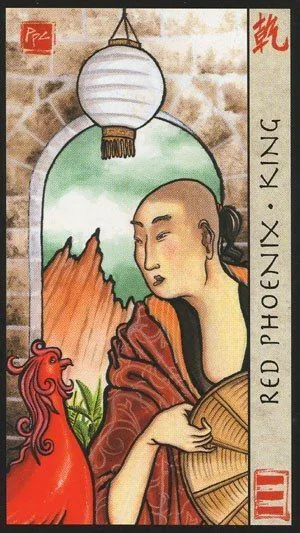
King of Cups / Red Phoenix: emotional leadership after the fire
The Red Phoenix suit adds heat and rebirth to the Cups family. In the King of Cups, that makes emotional maturity feel active rather than passive. This is not only calmness; it is the ability to hold feeling without letting it burn the whole house down.
In a reading, this card can speak to a person who has learned from emotional intensity, or to a situation that needs compassionate leadership. The Phoenix reminds us that feelings can transform. The King reminds us that transformation needs steadiness, not drama for its own sake.
Artwork and symbolism
The artwork uses strong reds, yellows, blues, greens, and blacks, with a mythic stage-like quality. Many cards feel ceremonial. A figure, creature, object, or symbolic action is placed in a way that suggests a larger pattern. The result is bold rather than soft, and symbolic rather than casual.
Because the imagery is so specific, the deck can be especially helpful for journaling. Instead of writing only “this card means conflict,” you can write, “Where is the Tiger asking me to be honest?” Instead of “this card means money,” you can write, “Where does the Tortoise want me to slow down and protect my resources?” That kind of question makes the reading practical.
Card moment: confidence, care, clarity, and resources
Court and numbered cards with personality


These cards show how the deck gives each suit a different body language: Dragon is expressive, Phoenix is emotionally alive, Tiger is precise and protective, and Tortoise is grounded in authority and resources.
Who will enjoy this deck?
You may enjoy Feng Shui Tarot if you like decks with a strong system, unusual symbolism, elemental correspondences, and images that invite slow study. It is especially good for intuitive readers, collectors, journalers, and people who enjoy tarot as a symbolic language rather than only a fortune-telling tool.
You may not love it if you prefer soft pastel art, minimalism, fully traditional tarot scenes, or a guidebook path that lines up perfectly with every beginner tarot course. This deck has its own accent. That is part of the charm, but it also means you should meet it on its own terms.
Pros and cons
| Pros | Cons |
|---|---|
| Distinctive visual language that feels unlike most tarot decks. | The 72-card structure may surprise readers expecting a standard 78-card tarot. |
| Excellent for elemental, intuitive, and atmosphere-based readings. | Some suit names need translation before they feel natural. |
| Strong journaling prompts through Dragon, Phoenix, Tiger, and Tortoise symbolism. | Not the easiest first deck for learning classic Rider-Waite-Smith imagery. |
| Bold color and creature symbolism make cards memorable. | The dramatic style may feel intense for readers who prefer gentle artwork. |
Final thoughts
Feng Shui Tarot is a niche deck, but that is exactly why it is worth exploring. It turns tarot into a map of movement, balance, protection, feeling, growth, and grounded stability. The more you understand the four animal suits, the easier it becomes to read the deck with confidence.
If you already have a basic tarot foundation, start with the gallery and look at the cards by group. Study the majors first, then compare the four suits. Ask how Dragon differs from Phoenix, how Tiger differs from Tortoise, and how each animal changes the mood of familiar tarot ideas. This deck is not trying to be every reader’s everyday classic. It is a symbolic, energetic deck for readers who like tarot to feel alive with direction and atmosphere.
If you are comparing deck personalities, keep exploring the TarotFans deck reviews for more full-card galleries and friendly buying guidance.

Frequently Asked Questions
Is Feng Shui Tarot a standard 78-card tarot deck?
Yes. The published Feng Shui Tarot is a 78-card deck with its own feng-shui-inspired symbolic structure. This page presents a carefully verified partial gallery rather than implying complete visual coverage.
What do the animals mean in Feng Shui Tarot?
Green Dragon connects well with Wands, Red Phoenix with Cups, White Tiger with Swords, and Black Tortoise with Pentacles.
Is Feng Shui Tarot good for beginners?
It can be used by visual beginners, but it is easier if you already know basic tarot suits and meanings.
What kind of readings is this deck best for?
It is especially good for energy check-ins, transition questions, relationship balance, home atmosphere, journaling, and spreads about what is blocked or ready to grow.
Does the deck follow Rider-Waite-Smith imagery?
Not closely. It borrows from tarot ideas but speaks through feng shui, directional animals, color, and symbolic scenes.