El Dios De Los Tres Tarot Cards — 69 Available Images
Browse the available 69 El Dios De Los Tres Tarot card-front images recovered from the exact deck-specific Pinterest source linked from the original TarotFans review. This partial gallery keeps the count honest and excludes backs, covers, duplicates, and missing cards. Tap any card to open a larger carousel view.
El Dios De Los Tres Tarot review: color, movement, and sacred mischief
Orica’s quick take: Tarot de El Dios de los Tres by Spanish artist Javier Navarro is one of those decks that changes the temperature of a reading as soon as it reaches the table. The palette is electric, the compositions are crowded with symbols, and the figures can feel playful, devotional, confrontational, or all three at once. I would recommend it to visual readers who enjoy finding a second and third story inside a familiar tarot archetype.
The official Llewellyn listing describes it as a lively Rider-Waite-Smith-style deck and confirms a 78-card deck with an instructional booklet. TarotFans has 69 verified card-front images from the same deck available here. The gallery is intentionally labeled as partial: nine cards are not represented, and no unrelated images have been used to pad the count.
This is not a muted shadow deck. Even its difficult cards pulse with saturated yellow, turquoise, pink, green, and violet. Navarro’s visual language mixes symmetry, masks, animals, botanical forms, theatrical gestures, and devotional imagery. That abundance makes the deck exciting, but it also rewards slow looking.
Card study
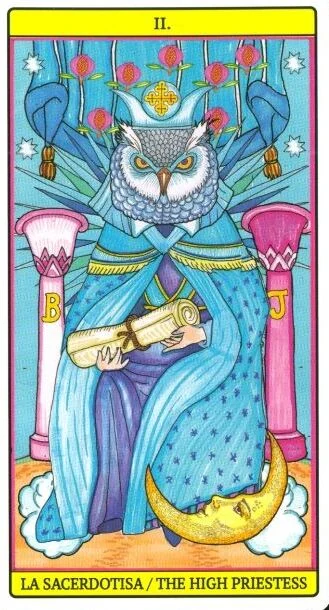
The High Priestess guards knowledge with owl eyes
The card is built around cool blues and strict symmetry. A white owl faces us from the center, framed by layered blue robes or wings. Behind it rise pomegranate-like red blossoms; eight-pointed white stars punctuate the blue field. The familiar pillars marked B and J stand at either side, while a rolled scroll rests across the lap and a gold crescent moon curves at the feet.
Those details turn silence into active attention. The owl is not asleep or withdrawn: its gaze is direct. The scroll suggests knowledge that can be held without being displayed, and the crescent keeps the card tied to cycles, intuition, and what grows in partial light. Upright, I read it as observation, privacy, and inner certainty. In shadow, it can warn against using mystery as avoidance. In a spread, ask: What do I already know, and why am I waiting for someone else to say it?
How the deck reads in practice
Begin with the traditional card function, then let the artwork modify the volume. The deck is still readable through Rider-Waite-Smith structure, but the picture may make a message more ecstatic, more theatrical, or more unsettling than a textbook keyword suggests. Notice the first face, animal, color, or repeated shape that catches your eye; that detail is often the doorway into the reading.
The deck is especially good for identity work, creative decisions, spiritual crossroads, relationship dynamics, and questions that contain mixed feelings. It is less suited to rushed yes-or-no readings. The pictures want time, and a large spread can become noisy if every symbol is treated as equally important.
Four pack
The early Majors turn choice into theatre
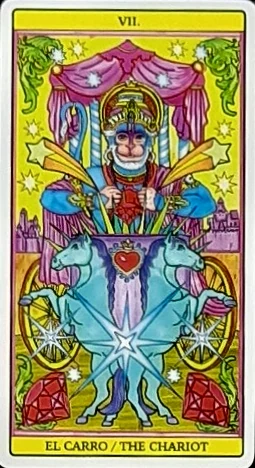
The Fool, Magician, Emperor, and Chariot show how this deck makes an archetype feel public and kinetic. Beginnings, will, authority, and forward motion arrive through strong silhouettes, bright contrasts, and deliberate poses rather than quiet realism.


Is El Dios De Los Tres Tarot beginner friendly?
Yes—with one condition. A beginner who loves the art will find plenty of emotional and symbolic cues, and the familiar 78-card structure provides a dependable map. However, the density of the pictures can distract from learning the core card function. Pair the deck with a concise Rider-Waite-Smith reference until the basic sequence and suit logic feel natural.
For a daily draw, name only three things: the traditional card meaning, the dominant emotion, and one visible symbol. That simple limit prevents a vivid image from turning into an interpretation of everything at once.

Card study
The Tower makes chaos impossible to romanticize
A multicolored stone tower leans under attack from yellow lightning and open flames. A large green serpent coils around the structure while a horned blue face looms above, eyes wide and tongue extended. Smoke, fire, scattered dice, and jagged marks crowd the scene. The composition is unstable even before we interpret it.
The card’s many shocks point toward systems failing at once: structure, certainty, control, and luck. Yet the tower remains visible as a structure, not a vague cloud of disaster. Upright, it can mark revelation, rupture, or a necessary collapse. In shadow, it can describe dramatizing every disruption or refusing to leave a structure that is already burning. In a reading, ask what has actually fallen—and what fear is merely making the moment look larger.
Easy, medium, and hard readings with this deck
Easy: “What quality wants to move through me today?” Draw one card and describe its strongest color before opening the booklet.
Medium: “What part of this situation am I performing, and what part is true?” Use two cards. The deck’s masks, gestures, and direct gazes make it excellent for separating presentation from motive.
Hard: “Which belief has become a structure I am afraid to outgrow?” Use three cards for the inherited story, the present disruption, and the freer response. Keep the spread small so the imagery remains readable.
Four pack
The Wands show effort becoming direction
The Ace, Six, Nine, and King of Wands move from ignition to visibility, endurance, and mature command. Together they are useful for tracing whether creative fire needs a beginning, an audience, protection, or leadership.


Art style and personality
Navarro’s linework feels graphic and mural-like. Bright yellow borders frame scenes packed with turquoise, magenta, violet, acid green, and coral. Faces are expressive, bodies are stylized, and symmetry often holds together imagery that would otherwise feel chaotic. The result is celebratory without being simple.
The deck also has a mischievous relationship with seriousness. Sacred and archetypal subjects are presented with tongues, teeth, masks, serpents, flowers, and bold theatrical expressions. If you need tarot to look solemn before you trust it, the deck may feel irreverent. If you believe humor and spirit can share the same card, its personality is a strength.
Card study
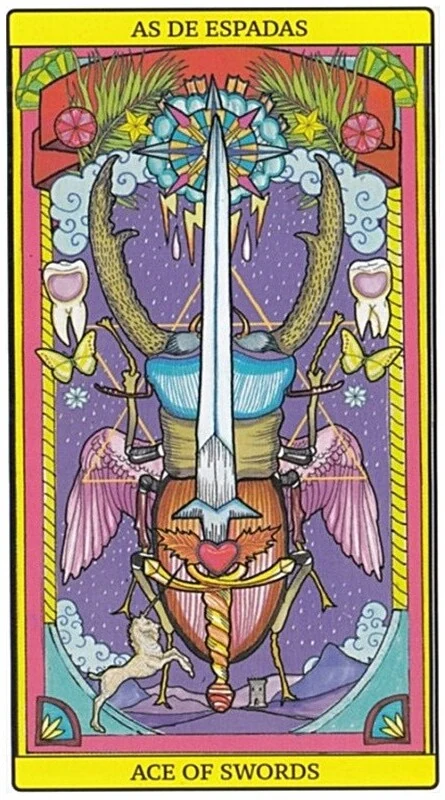
The Ace of Swords is clarity held under pressure
A long upright sword divides the card precisely down the middle. Around it, the composition mirrors itself: clouds and lightning, star-like shapes, teeth, butterflies, suspended scales, pale wing forms, and two long reptilian jaws curving inward. Near the lower center, a red heart sits within a small winged or feathered form. The symmetry makes the blade feel less like a weapon in motion and more like an axis.
That axis is the card’s gift: one clean line through an abundance of competing signals. Upright, it favors definition, evidence, a boundary, or the sentence that makes action possible. In shadow, the same sharpness can become rigidity or a need to win every argument. In a reading, identify the decision that would simplify the whole picture—then check whether your certainty is supported by facts.
Who will love this deck—and who may not
This deck suits readers who enjoy maximalist art, saturated color, multicultural visual references, expressive figures, and intuitive symbol work. It is particularly rewarding for artists, journalers, and readers who like to revisit a card and notice something new.
It may not suit readers who prefer soft minimalism, historically restrained imagery, or cards that deliver a single uncluttered scene. The little booklet is useful, but the artwork invites more study than a compact guide can provide. Build your own symbol journal rather than expecting every detail to be decoded for you.
Four pack
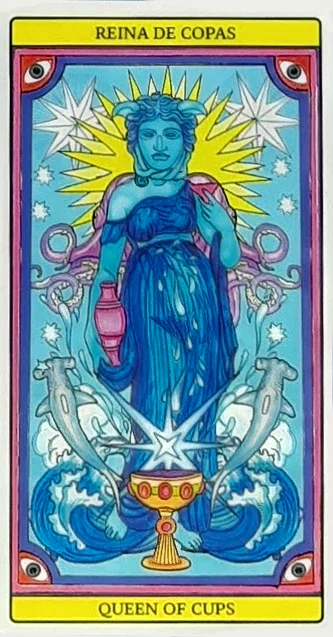
The Cups move from opening to emotional authority
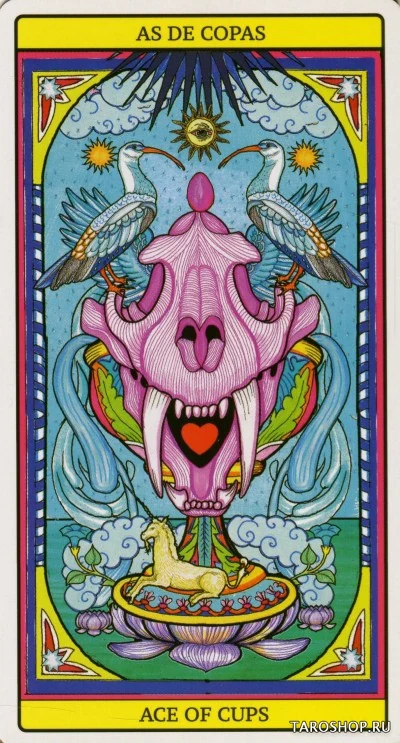
The Ace, Five, Nine, and Queen of Cups hold four different relationships with feeling: receptivity, grief, satisfaction, and mature care. Read together, they help distinguish what the heart is receiving, mourning, enjoying, or responsibly tending.


What to know before buying
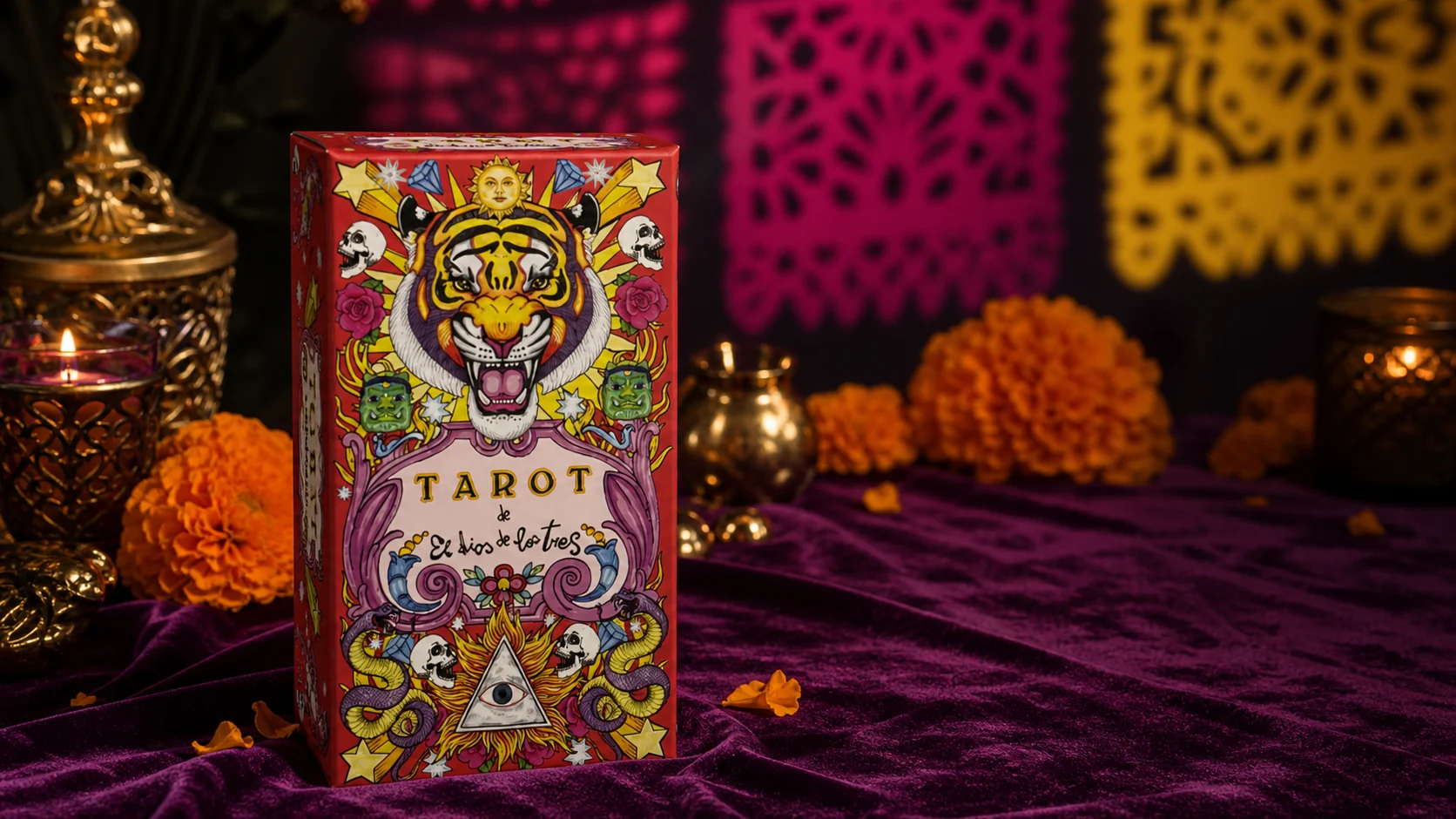
The official English-language boxed edition was published in May 2021 and contains 78 cards plus an instructional booklet. Listings and availability can change, so use the product page to confirm the edition, language, seller, and current delivery details before ordering. TarotFans does not make a live stock or price claim here.
The art is the reason to buy this deck. If the gallery makes you want to pause, zoom in, and compare symbols, the physical deck is likely to reward you. If the gallery feels visually exhausting, that reaction is useful buying guidance too.
Orica’s golden rule for El Dios De Los Tres Tarot
Choose the symbol that is speaking loudest; do not make every symbol speak at once. The deck’s abundance is an invitation, not an instruction to decode the entire card in one sitting. Let one face, animal, object, or color lead. The remaining details can wait for the next reading.
Final thoughts
Tarot de El Dios de los Tres is vivid, energetic, and unmistakably itself. It keeps a recognizable tarot structure while giving every archetype a stage full of movement, humor, beauty, and pressure. The deck asks for attention, but it pays that attention back.
For readers who love bright maximalism and layered visual storytelling, this is an exciting working deck rather than a novelty. Use the video walkthrough and the honest 69-image gallery to decide whether Navarro’s visual language feels like a conversation you want to continue.
El Dios De Los Tres Tarot FAQ
How many cards are in Tarot de El Dios de los Tres?
The official deck contains 78 cards and an instructional booklet. The TarotFans gallery currently shows 69 verified card-front images, so it is clearly presented as a partial gallery.
Who created El Dios De Los Tres Tarot?
Spanish artist Javier Navarro created the deck. The English-language boxed edition is listed by Llewellyn under Lo Scarabeo.
Is the deck based on Rider-Waite-Smith?
Yes. The publisher describes it as Rider-Waite-Smith-style, so readers will recognize the standard 78-card structure and familiar tarot functions, even though Navarro’s visual language is highly distinctive.
Is El Dios De Los Tres Tarot good for beginners?
It can be, especially for visually oriented beginners. The imagery offers many intuitive cues, but its density can be distracting. Pair it with a concise traditional reference while learning the basic sequence.
What readings suit this deck best?
It works particularly well for identity, creativity, relationships, spiritual crossroads, shadow work, and questions involving mixed motives or strong emotions. Small spreads help keep the visual detail manageable.
Why are nine cards missing from this gallery?
The recovered same-deck source supplied 69 usable card fronts. TarotFans excludes missing, duplicate, cover, and card-back images instead of presenting uncertain artwork as a complete 78-card set.


