TAROT CARDS REVEALED
Explore Lucifer’s Tarot
Move through the deck’s verified continuous sequence in its intended order. Choose an official family or select any card to open the larger Lightbox.
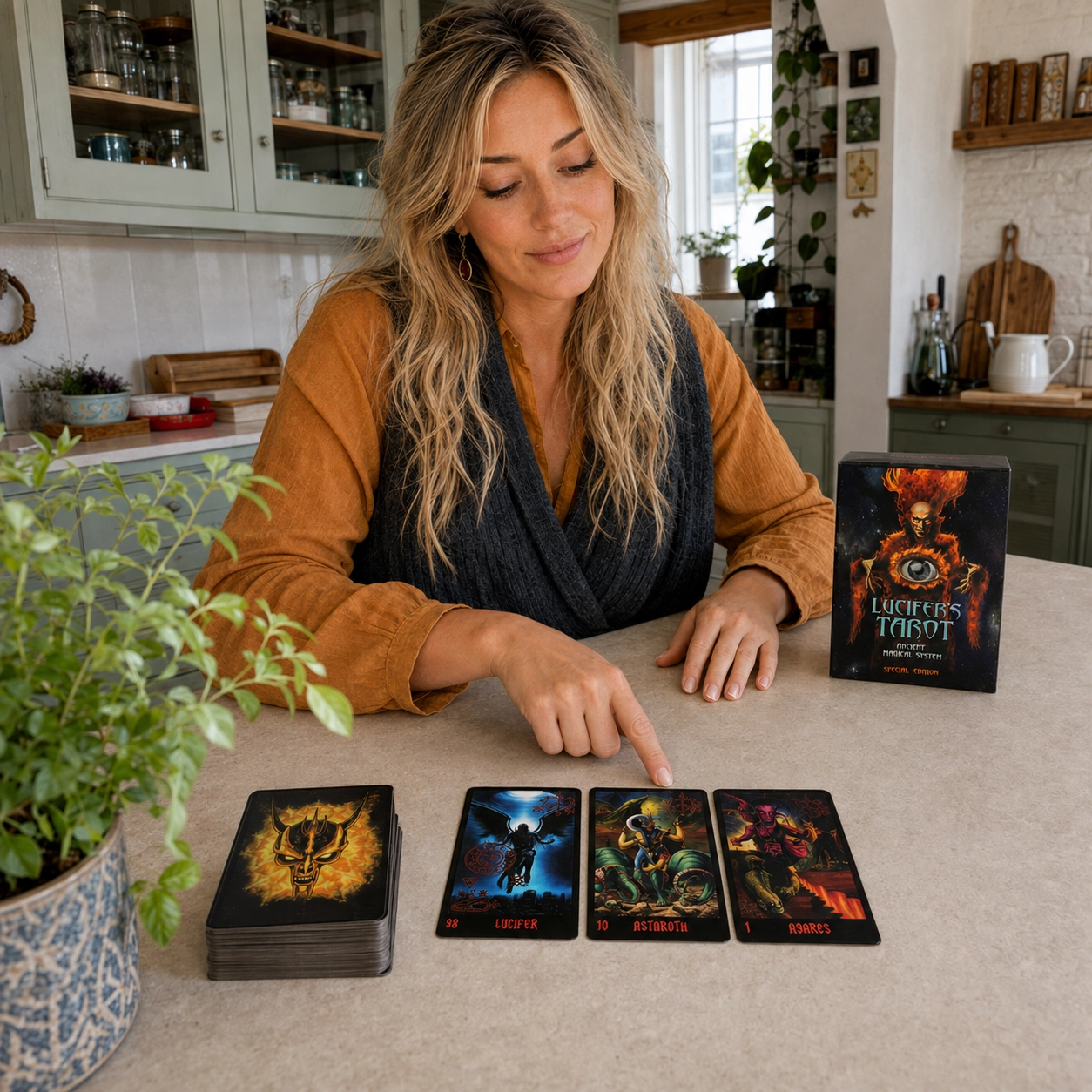
Aurica’s Quick Take
A dark, demanding deck with its own map. Lucifer’s Tarot is not a renamed Rider–Waite–Smith deck. Ingvar and Amanar built a continuous magical sequence around the Dukes of Darkness, the Princes of Qliphoth, Hosts of Demons and concluding Archdemons, while S. V. Krivenchenko gives the system a saturated, theatrical visual language.
I reach for it when a reading needs hierarchy, pressure, consequence and an uncompromising atmosphere. I would not hand it to someone who wants familiar suits, gentle reassurance or meanings that can be lifted straight from a standard tarot handbook.
What catches me is the way darkness behaves like a stage curtain. Lucifer rises beneath a cold blue opening, Astaroth coils among creatures and emblems, and Agares burns red against the black. I notice where the light lands, which figure commands the scene and what my body wants to avoid looking at; those reactions often reveal the question hiding beneath the question.
When I read with these cards, I begin with the printed number and the deck’s own hierarchy, then test my first feeling against posture, scale, colour and the cards nearby. A frightening image does not automatically mean danger, just as a crowned figure does not automatically deserve trust. The useful message appears when atmosphere and structure agree.
This is a deck for patient, prepared readers who can hold intensity without letting it become theatre for its own sake. Approach its shadows with clear boundaries and honest curiosity, and Lucifer’s Tarot can help you carry one bright, courageous choice back into daylight.
What makes Lucifer’s Tarot different?
The deck contains a single numbered sequence rather than Major Arcana, four suits and courts. That structural choice changes the reading experience: position and internal relationships matter, and the guidebook is part of the method rather than an optional glossary.
The art repeats a recognisable grammar—dark grounds, red sigils, concentrated pools of blue or firelight, monumental figures and scenes staged like visions. The result is visually consistent without being visually quiet.
CARD STUDY
Lucifer: power shown as silhouette and light
A winged figure rises in near-black silhouette over a low city skyline. A white-blue opening above the head pours light down the centre, while electric blue gathers in both outstretched hands. Large black wings widen beyond the body and red diagrammatic marks sit across the upper right and lower half of the image.
The card’s force comes from contrast: the central body is withheld while the surrounding light becomes almost tangible. In a reading I would treat that composition as a question about influence, visibility and control—what is being revealed by the light, and what is still deliberately unreadable? Its useful expression is focused agency; its shadow is power made impressive enough to discourage scrutiny.

How the deck reads in practice
Lucifer’s Tarot tends to speak in systems rather than isolated keywords. I begin with the printed number and the deck’s own hierarchy, then look at posture, scale, direction of movement and repeated colour. Only after that do I connect the image to the actual question.
This makes the deck especially strong for readings about power dynamics, boundaries, hidden incentives, spiritual practice and the consequences of a chosen path. It is less natural for breezy daily pulls unless the reader already knows the sequence.
FOUR-CARD MOMENT
From named powers to the final ascent
Beelzebuth, Lucifer, Kemetiel and Atiel show how radically the deck can shift scale: serpentine confrontation, a winged silhouette, an armoured towering form and a final insect-like figure against open sky.


Is Lucifer’s Tarot beginner-friendly?
Not as a first tarot deck. A beginner can study it, but should expect to learn its own architecture and historical vocabulary instead of relying on standard suit and court meanings. The visual scenes are direct enough to prompt observation, yet the names and sequence need context.
A practical entry is to work with three cards at a time: describe only what is visible, note where each card sits in the sequence, consult the companion material, and write one sentence about how the three images alter one another.
CARD STUDY
Andrealphus: study interrupted by spectacle
A seated reader in red bends over an open book in a wall-to-wall library. A large red, orange and black bird stands on the table with wings fully extended, its long tail cutting diagonally across the foreground. The warm bird glows against the dark shelves; the human figure looks outward rather than down at the page.
The image sets concentrated study beside an impossible interruption. In a reading, that tension can ask whether knowledge is being deepened or merely performed—whether the dramatic messenger clarifies the work or distracts from it. Its constructive side is inspired intelligence; its shadow is fascination that overwhelms method.

Art style, mood and audience fit
Krivenchenko’s illustrations favour high-contrast fantasy painting over minimalist symbolism. Bodies, animals, weapons, books, flames and sigils are arranged in dense scenes; reds and acid blues recur against black. The deck feels ceremonial, confrontational and deliberately adult.
It best suits readers who enjoy goetic or Qliphothic frameworks, are comfortable researching unfamiliar names, and want a deck that resists generic interpretation. Readers seeking soft self-care language, traditional pip structure or a portable beginner deck should look elsewhere.
FOUR-CARD MOMENT
Crowns, mounts and visible authority
Bael, Beleth, Belfegor and Adrameleh all place authority at the centre, but stage it differently: a seated crowned figure, a mounted ruler, a standing robed figure holding flame and blade, and an elder enthroned beneath a luminous sky.


What to know before buying
- System: one continuous sequence, not conventional tarot suits and courts.
- Study load: the companion text is essential if you want more than free visual reading.
- Tone: intense occult imagery, including nudity, violence and demonic figures.
- Edition: confirm language, card size and booklet format with the seller before ordering.
The available listing is a specialist marketplace offer rather than an Amazon product page. Check the seller’s current terms, shipping region and edition details directly; TarotFans does not make stock or price claims.
ORICA’S GOLDEN RULE
Read the hierarchy before the horror
Do not let the most dramatic figure become the whole meaning. Start with the card’s place in the sequence, then read the visible relationship between figure, setting and symbol. The method keeps intensity from turning into projection.
Final Thoughts
Lucifer’s Tarot succeeds because it commits fully to its own world. The sequence, names and artwork reinforce one another, producing a deck that feels more like a specialised magical atlas than a conventional tarot variation.
That specificity is both its strength and its boundary. For the prepared reader it can support serious, layered work; for someone wanting familiar tarot fluency, it asks for more context than it gives away. Meet its shadows patiently, and the deck can sharpen the courage to name what is real and choose the next honest step.
 See the current Lucifer’s Tarot listing
Lucifer’s Tarot FAQ
How many cards are in Lucifer’s Tarot?
This edition has 105 numbered Arcana arranged in one continuous sequence.
Does it follow Rider–Waite–Smith meanings?
No. It does not use the standard Major Arcana, four suits and court-card structure. Its own sequence and companion system should lead the interpretation.
Is Lucifer’s Tarot suitable for beginners?
It is possible to learn as a dedicated study deck, but it is not the easiest first tarot deck. Beginners should expect substantial guidebook work.
What kinds of readings suit it best?
It is strongest for questions about power, boundaries, hidden incentives, spiritual practice, shadow work and consequences.
Who created Lucifer’s Tarot?
The system is credited to Ingvar and Amanar—Igor S. Bombushkar and Andrey A. Balaban—with artwork by S. V. Krivenchenko.
What should I confirm before ordering?
Confirm the edition, language, card dimensions, booklet format, seller terms and delivery region directly on the current listing.


