
Explore The Fairy Tale Tarot Cards
Browse Lisa Hunt’s storybook tarot artwork in canonical deck order. Each card uses the largest original opened from the supplied Pinterest board. Tap any card for the full-size, keyboard-friendly view.

Aurica’s Quick Take
I meet Lisa Hunt’s The Fairy Tale Tarot as I would an old story told beside a window: softly at first, then with the feeling that every branch, doorway and animal is quietly asking me to look again. Its pictures let symbols arrive through scenes rather than plain keywords, so the reading feels intimate, strange and wonderfully alive.
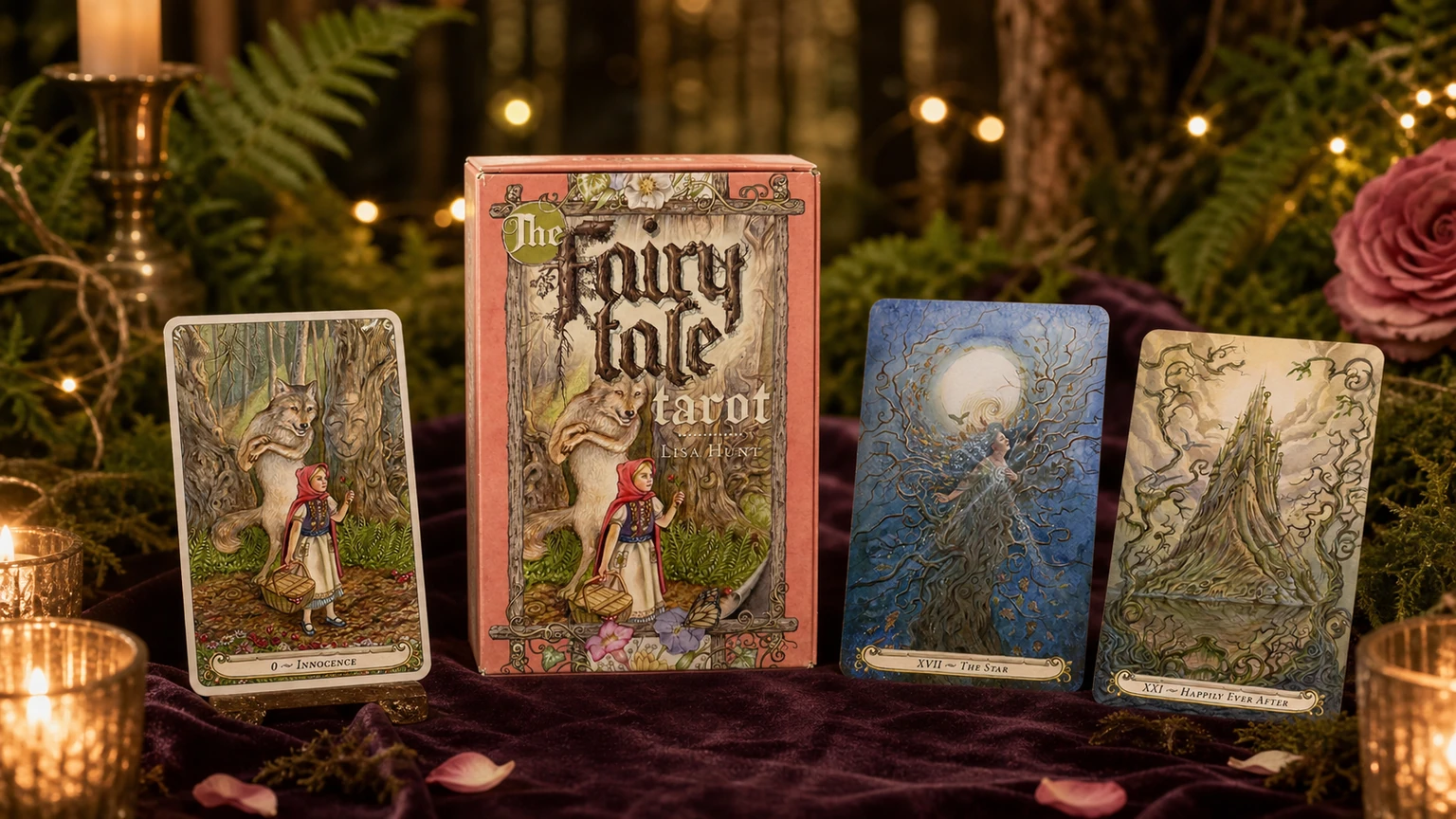
Innocence catches me with Little Red Riding Hood walking beside the wolf. Before I reach for a fixed meaning, I notice their distance, her calm step and the watchful trees. In a spread, that first emotional clue helps me ask whether trust is opening a path, hiding a warning, or inviting wiser curiosity about what waits ahead.
The Sorceress, The Star and Happily Ever After deepen that storybook rhythm. One stands in enchanted water, one rises beneath a bright moon, and one turns a distant castle into a promise on the horizon. I compare the image that draws my eye with the card’s familiar role, then listen to its neighbours: are they describing a spell of possibility, a hope worth tending, or the patient work between wishing and arrival?
This is the deck I would choose for journaling, dream work, creative questions and tender situations that need metaphor more than a blunt command. Readers who want bold modern graphics may prefer something sharper, but anyone willing to linger can find practical truth inside the wonder. Let these fairy tales remind you that your next brave step can be small, luminous and entirely your own.
The reading voice: gentle, symbolic, and slightly uncanny
This deck does not shout. It works more like an old story told by candlelight: a child at a window, a creature in the woods, a figure crossing a threshold, a tower, a bridge, a promise, a warning. That makes it especially good for questions where the feeling is complicated and the answer needs metaphor.
I find its gentleness most useful when the obvious answer feels too flat. The pictures slow the eye down, then reward attention with a glance, an animal, a doorway or a change in light that gives the traditional meaning a more personal voice.
Storybook card study
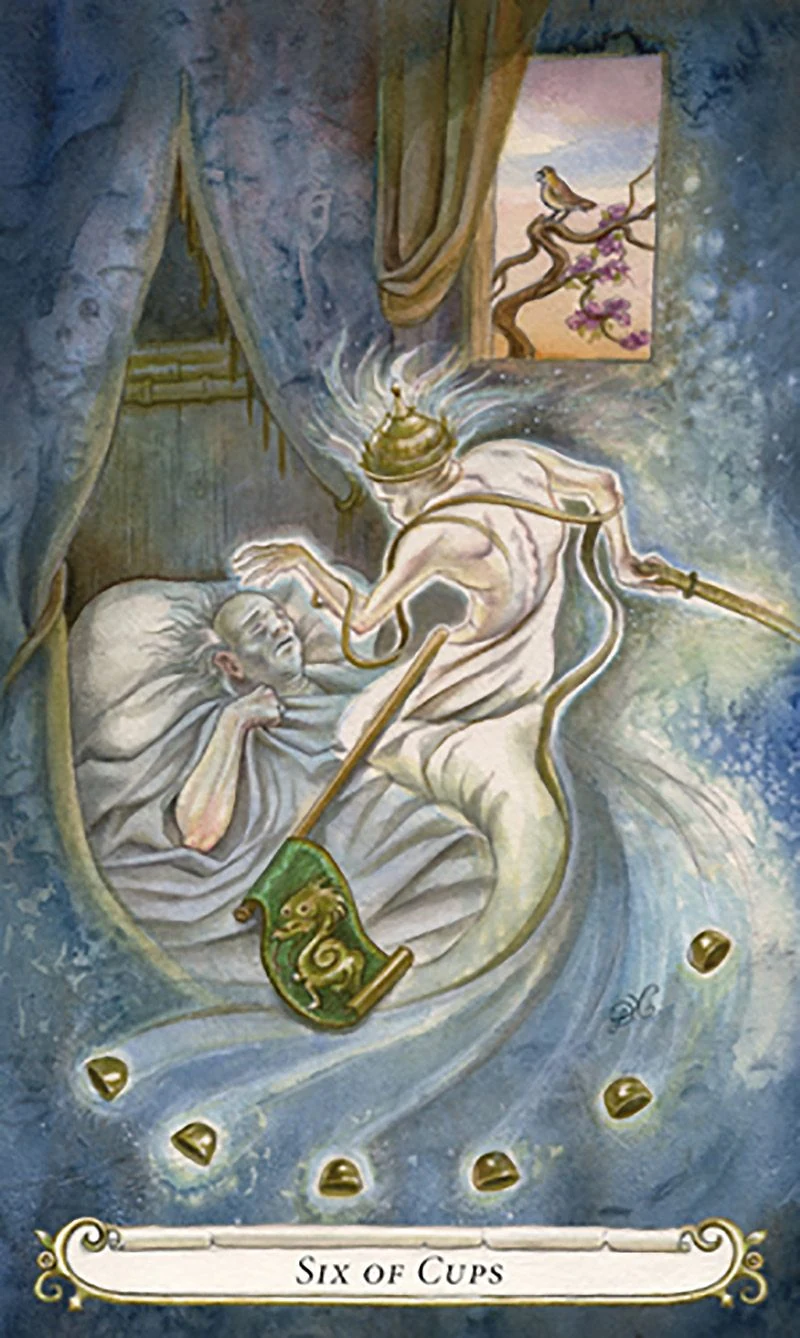
Six of Cups: the visitor at the bedside
A pale, quick-footed visitor bends over a sleeping elder in a blue stone room. Six small golden cups curve through the lower scene, while a bird rests on a flowering branch beyond the open window. The visitor’s backward glance and streaming hair bring motion into a room that otherwise feels hushed and still.
That contrast gives the Six of Cups its tender pull toward memory without making the past look entirely safe. Upright, it can be kindness returning, an old bond asking to be seen, or a forgotten gift coming back into reach. In shadow, nostalgia may be interrupting the present. I would ask: is this memory here to comfort you, or to wake you?
How to follow the story in a spread
Begin with the detail that carries the most feeling, then compare it with the card’s familiar role. If a helper appears, notice whether the figure welcomes that help; if a path opens, look for what still guards it. Nearby cards tell you whether the scene is an invitation, a warning, or both at once.
Four-card moment
Opening the tale without rushing
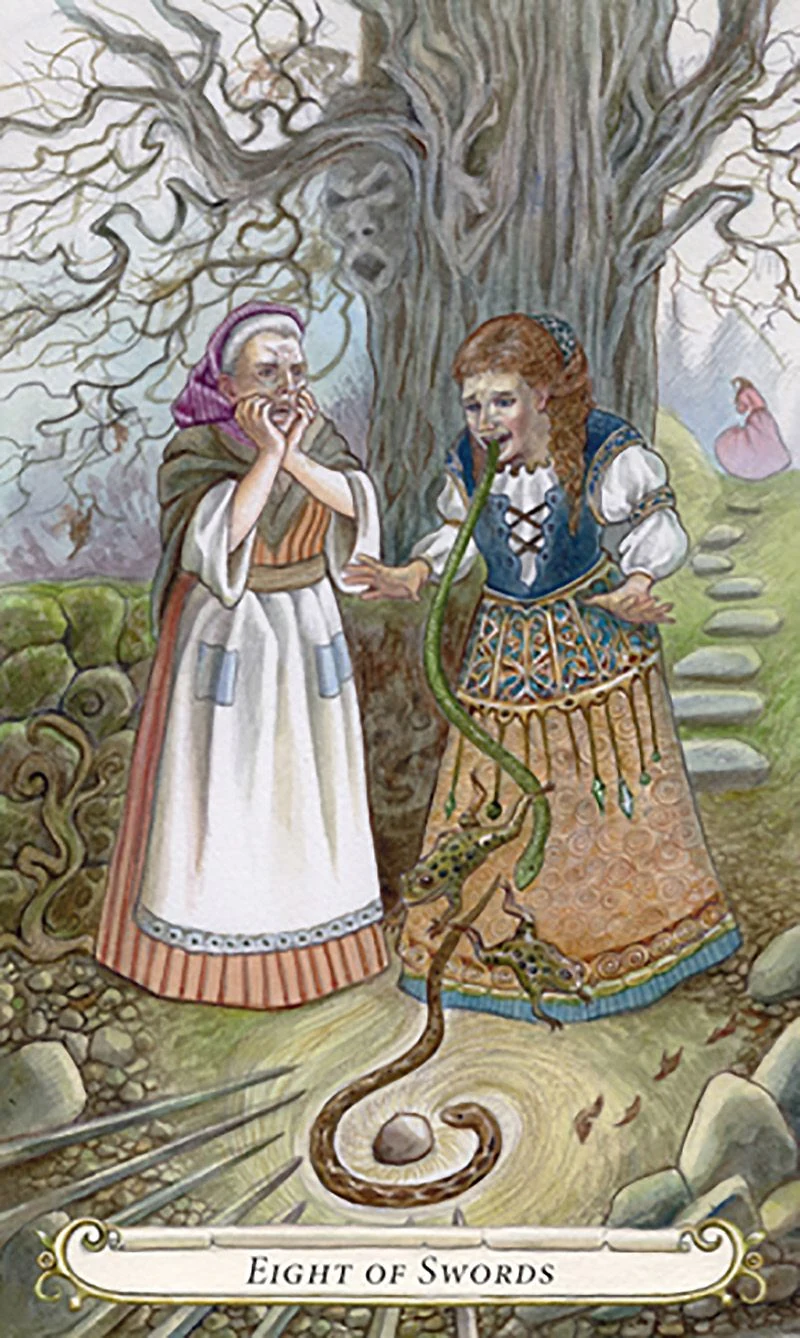
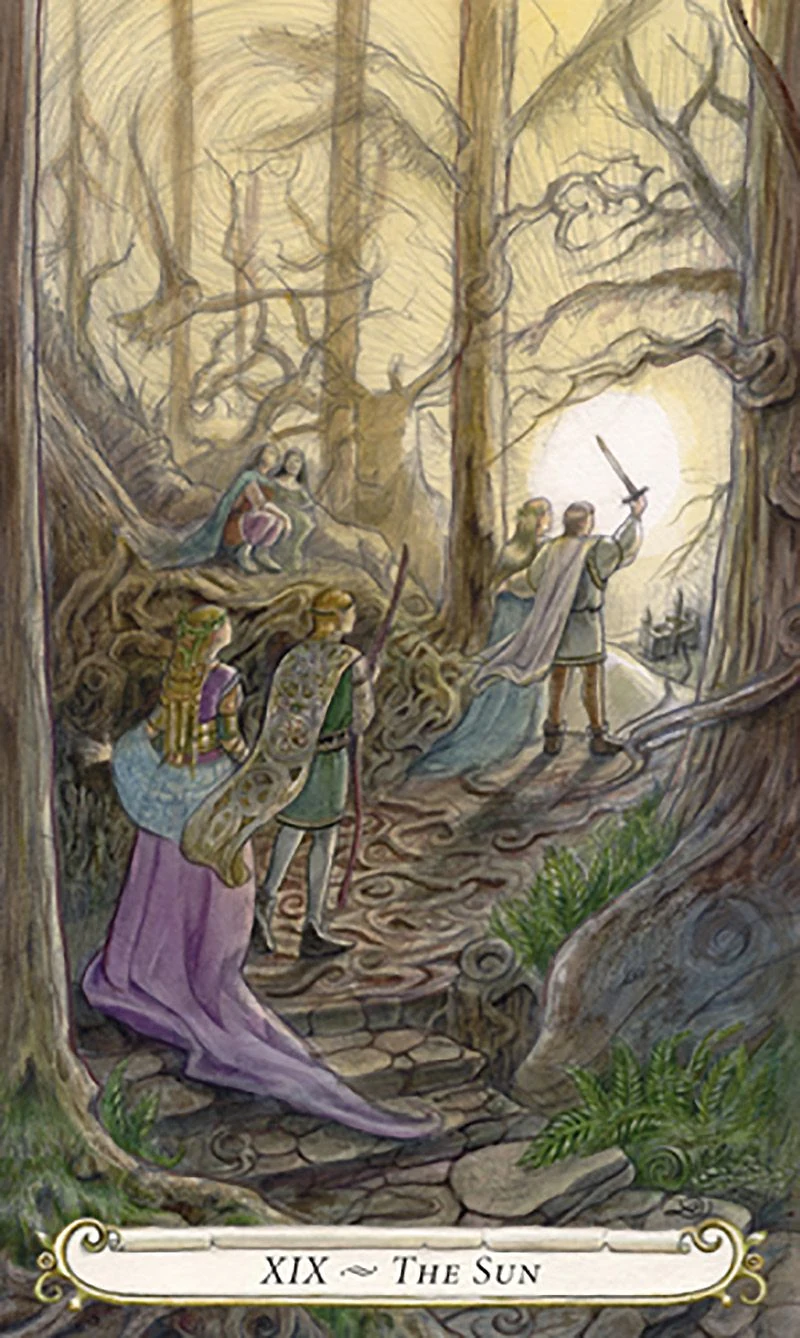
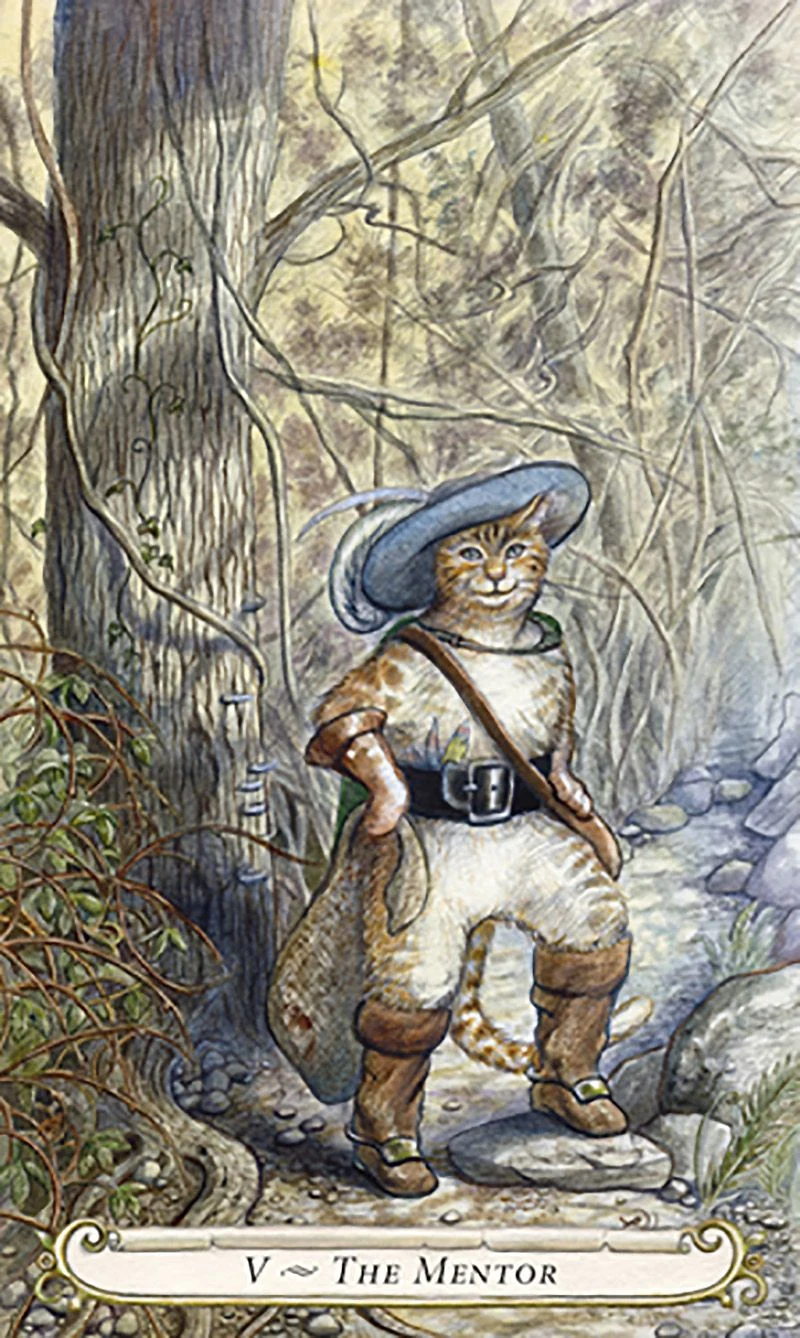
These early cards show why the deck works best when you slow down. Look at posture, setting, and distance between figures before you jump to a fixed meaning.
Artwork and first impression
The artwork has a pale, old-book feeling: muted skies, delicate figures, forest edges, castles, animals, and small magical objects. It is gentle, but it is not empty. Many cards carry a little tension, as if the story is asking whether you will notice the warning before the next scene.
That visual personality makes the deck useful for intuitive readers. You can read the traditional card idea, then ask how the picture changes the voice. Does the scene make the message kinder, more cautious, more mysterious, or more urgent?
Court-card study
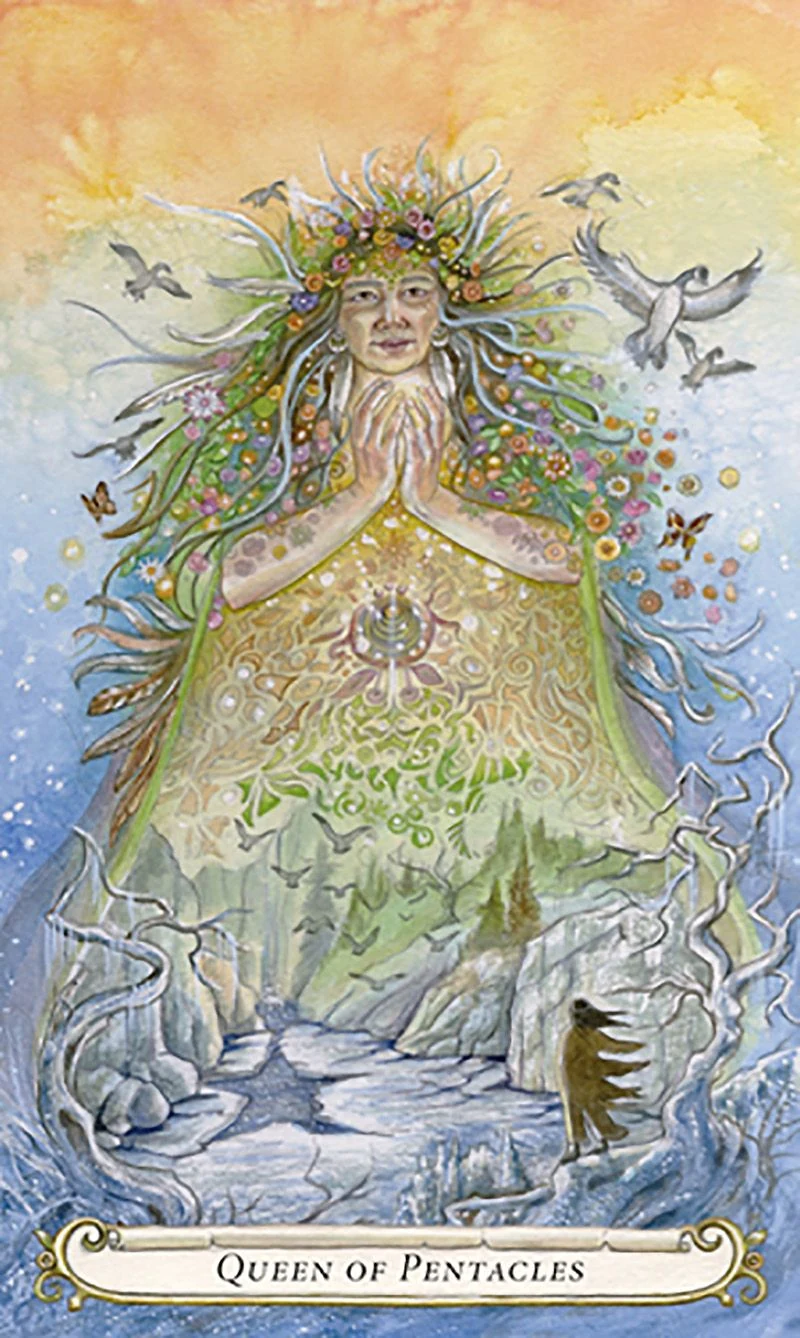
Queen of Pentacles: a living landscape
The Queen meets our gaze with her hands gathered beneath her chin. Flowers, berries and green tendrils pour through her hair; birds and butterflies move around her, while her patterned gown opens into a rocky valley with trees and a winding river below. She is not merely standing in nature—the landscape seems to live through her.
Upright, she joins practical care with abundance that can be felt and shared: a safe home, nourished work, a body of knowledge patiently tended. In shadow, giving may have become so constant that the giver disappears into the needs around her. In a reading, I would ask what deserves care now, and what would help that care remain sustainable.
From comfort to a clear choice
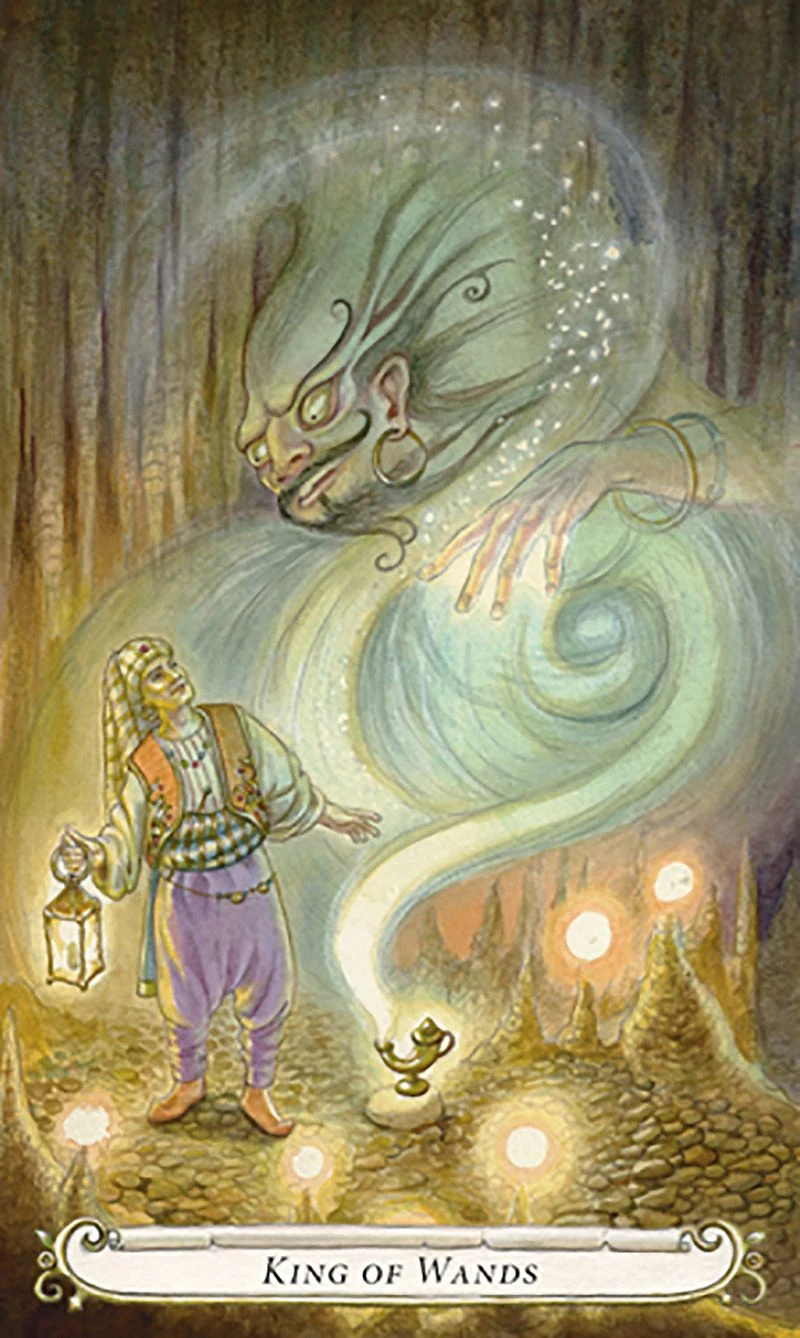
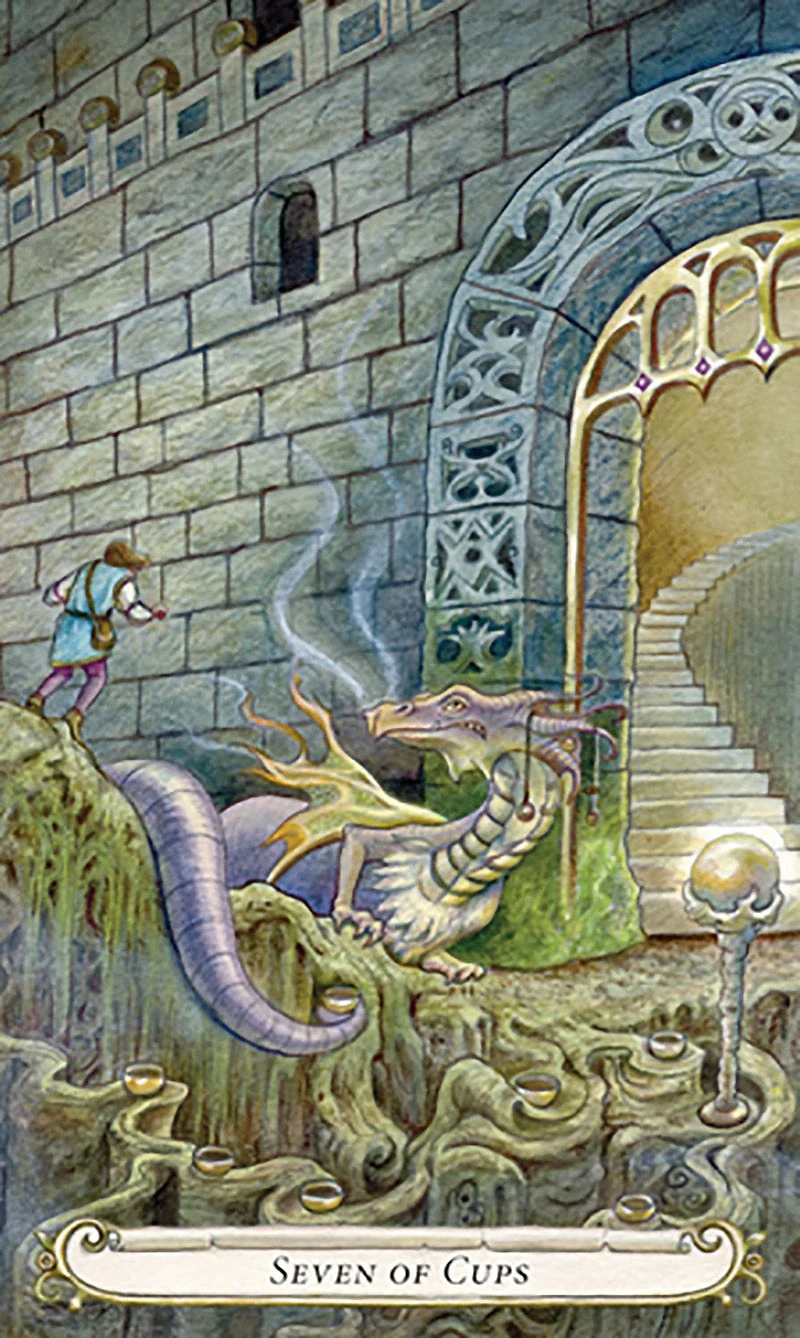
Fairy tales often tempt a character with several beautiful possibilities before revealing which one has roots. When Cups or Pentacles gather around a question, notice what is flourishing and what is only glittering in the distance. The deck is sweetest when it helps desire become a choice you can actually tend.
Four-card moment
Choices, wishes, and emotional weather
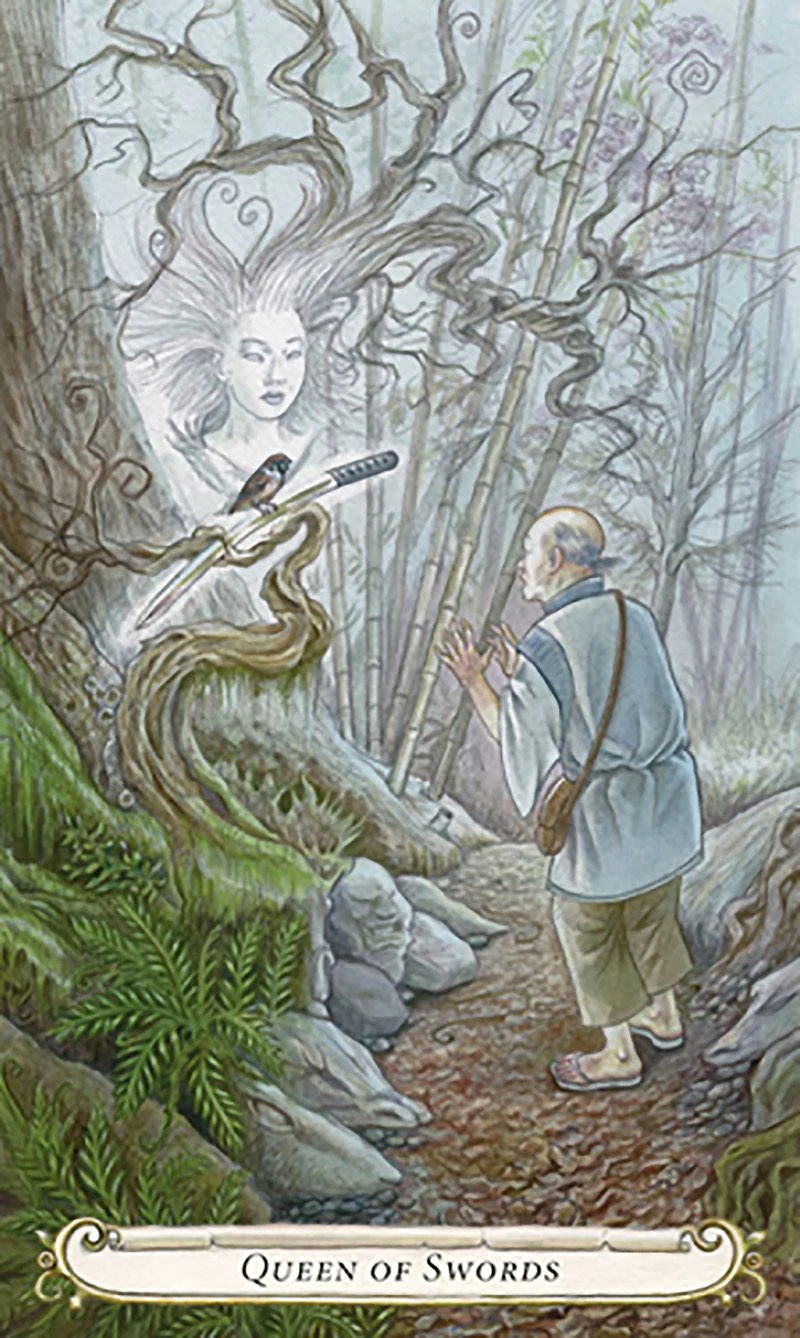
This set moves from active will into comfort, temptation, and feeling. It is a good mini-spread for asking what desire is useful and what desire is only a distraction.
Best uses for the deck
The Fairy Tale Tarot by Lisa Hunt is strongest for journaling, dream work, creative projects, love patterns, family stories, and “what is the lesson inside this situation?” readings. It is also a good deck for teens or sensitive readers because the imagery invites reflection without feeling harsh.
For career and money readings, keep the question practical. Ask what role you are playing, what helper or obstacle is present, and what one real-world step would move the story forward. That keeps the deck grounded instead of drifting into pretty symbolism.
Journey card study
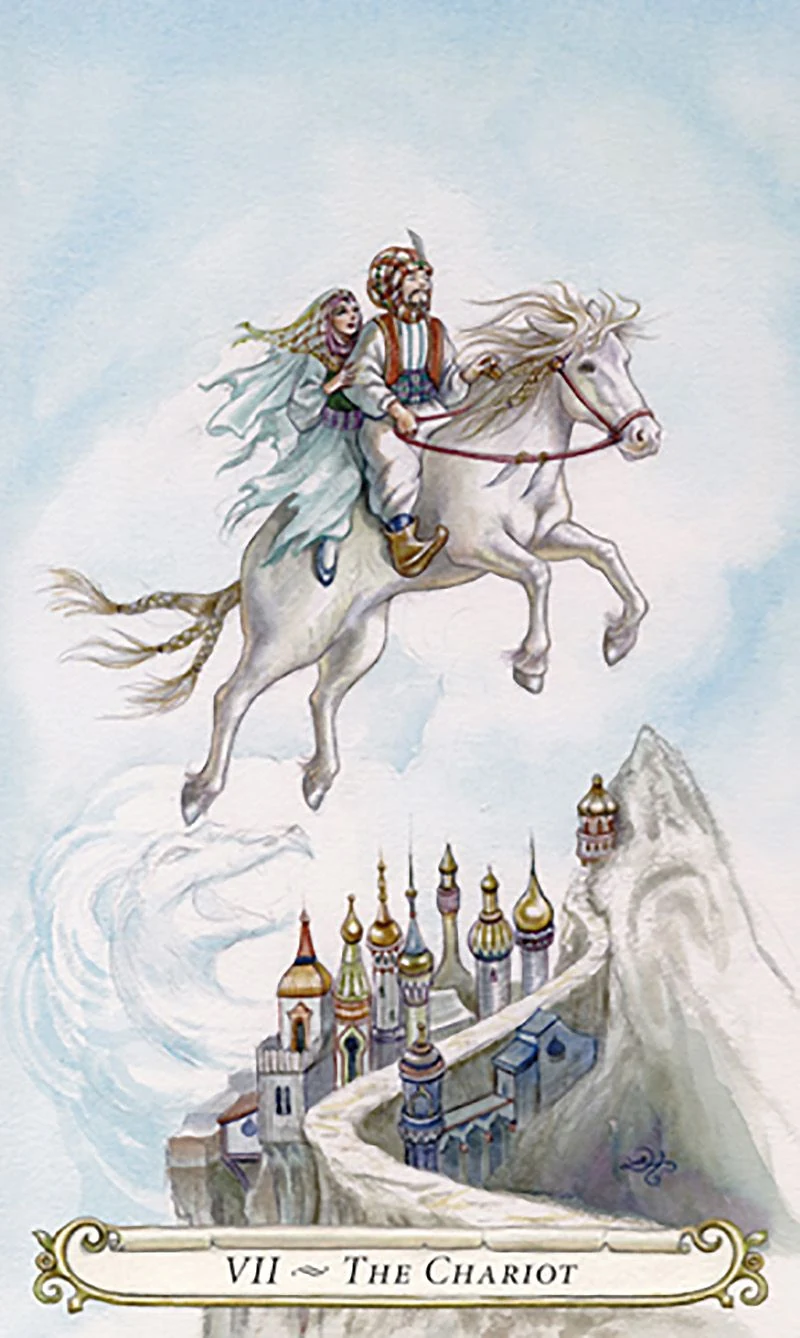
The Chariot: carrying courage forward
A white horse leaps through a pale sky above a many-towered city. The rider holds the reins firmly while a second figure clings close behind, their clothes and the horse’s mane streaming with the speed of the ascent. The city wall curves away below them, making the journey feel both daring and irreversible.
Upright, this Chariot is directed momentum: courage has chosen a destination and gathered another person into the ride. In shadow, urgency can make the passenger’s fear—or the needs of those left below—easy to miss. In a reading, I would ask whether everyone is moving toward the same place, and whether the reins are being held with purpose rather than panic.
When the path leaves the ground
Some turning points cannot be solved by waiting for perfect certainty. This deck still asks for a destination, a willing grip and awareness of who travels with you. Let the next cards show whether the leap is supported, premature or exactly the brave movement the story needs.
Four-card moment
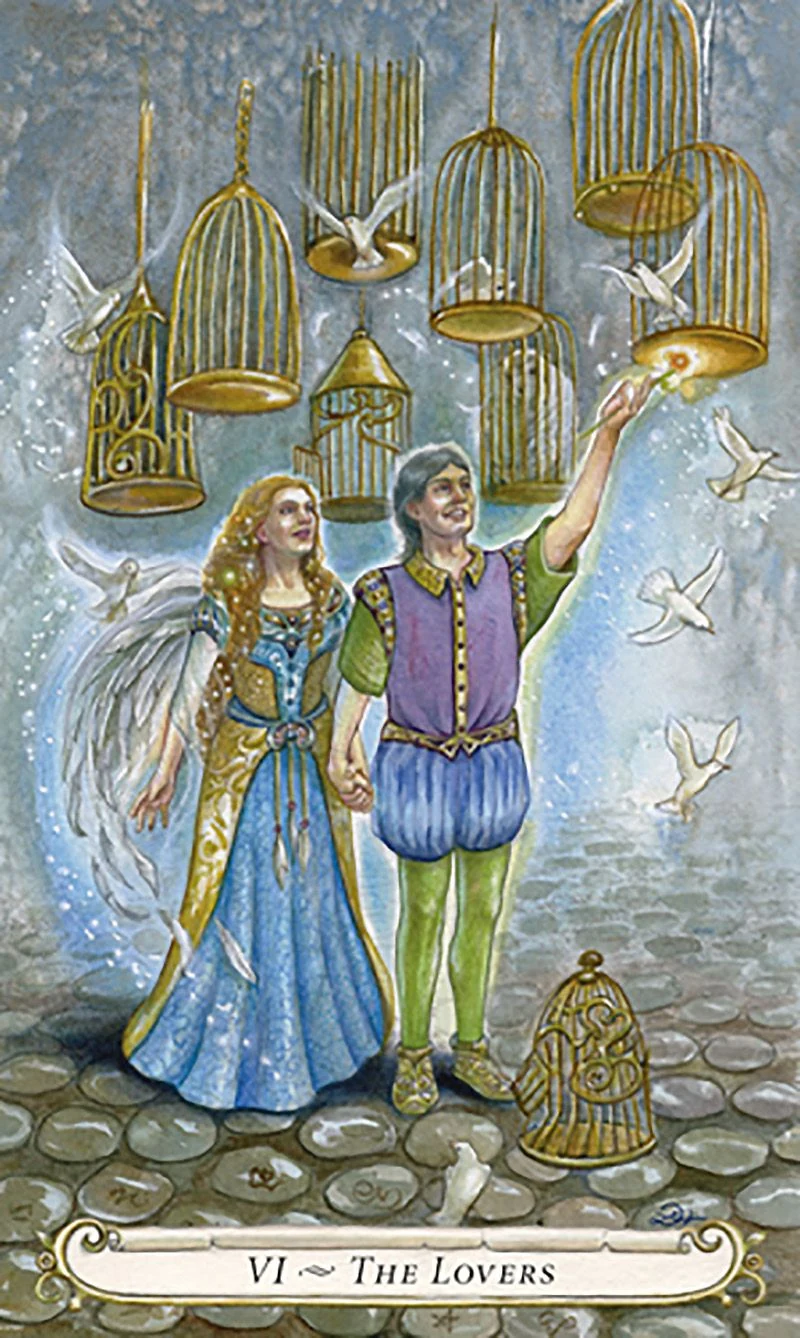
Thresholds, helpers, and the turn of the story
These four cards feel like a fairytale middle chapter. A choice has consequences, help appears in odd forms, and the path becomes clearer only after the character commits.


Final Thoughts
This restored Fairy Tale Tarot review is a visual preview and practical guide to Lisa Hunt’s rare, story-rich deck. The gallery uses verified full-size Pinterest originals for every tarot card front and keeps the separate deck-cover pin out of the card sequence.
If you want a tarot deck that feels like stepping into a quiet illustrated tale, this one is worth exploring. If you want direct slogans and modern clarity, pair it with a simpler daily deck and use Fairy Tale Tarot when the question needs symbol, patience, and imagination.
Fairy Tale Tarot FAQ
Is the complete tarot deck represented in the gallery?
Yes. Every tarot card front is represented from the supplied Pinterest board. The board’s additional final pin is the deck cover, so it is retained as source evidence rather than mislabeled as a tarot card.
Is The Fairy Tale Tarot by Lisa Hunt beginner friendly?
Yes, if you learn well through pictures and story clues. The deck rewards careful looking, simple keywords, and a short journal note after each pull.
What readings suit this deck best?
It suits self-reflection, love patterns, creative blocks, family stories, dream journaling, and questions where a fairytale symbol can make the message easier to understand.
Does it read like a classic Rider-Waite-Smith deck?
It keeps a tarot structure, but the fairytale scenes add their own emotional weather. Use the classic meaning as the base, then let the image show the tone.
Who should skip this deck?
Skip it if you want crisp modern keywords, a fully neutral art style, or a deck that never asks you to interpret mood, setting, and character details.


