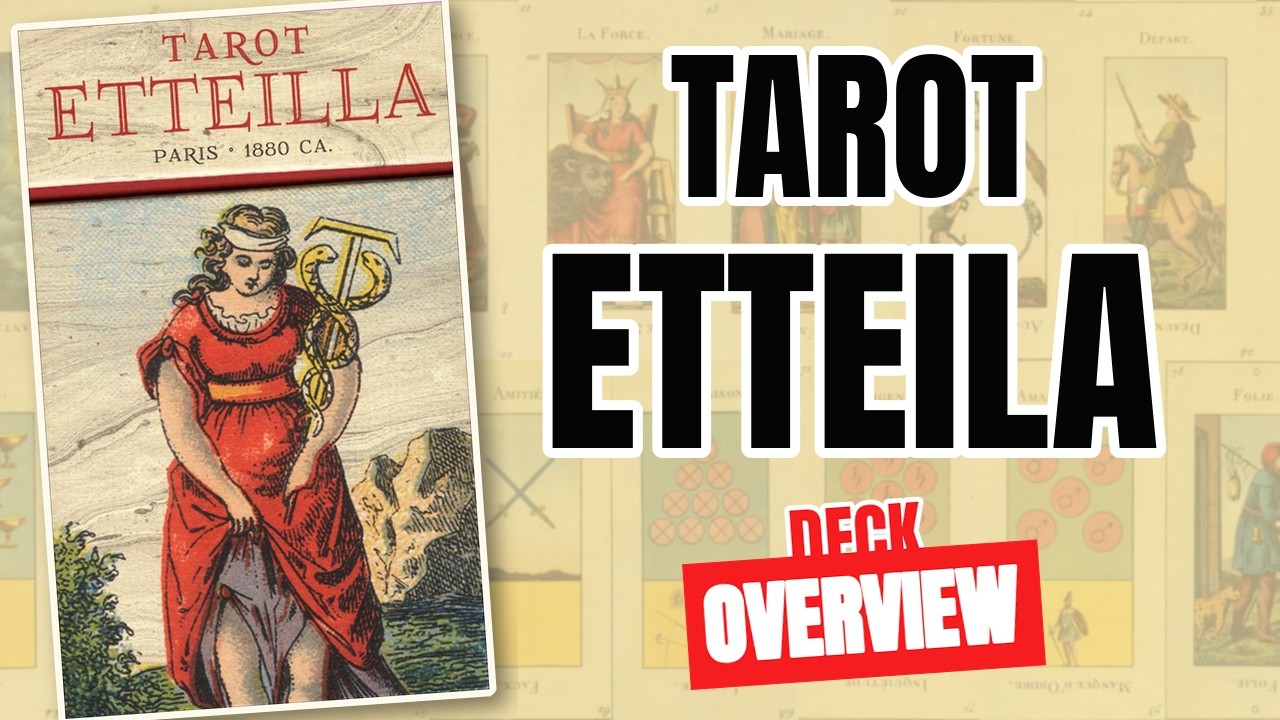
Tarot Deck By Etteilla
TAROT CARDS REVEALED 18 MIN READ
Tarot Etteilla Card Gallery
Explore the verified Tarot Etteilla card fronts in printed number order. This is an evidence-limited partial archive; unavailable source cards are omitted rather than guessed. Choose a group or open any card in the full-size Lightbox.
Showing all cards

Aurica’s Quick Take
A deck that speaks in scenes, not borrowed keywords
Tarot Etteilla feels like opening old letters whose ink still carries a pulse. Its numbered scenes move through weather, departures, money and longing. I let the French titles and recurring human situations lead instead of pressing modern keywords onto them.
The colours are gentle, but the voice is direct. Etteilla breaks through cloud like a thought that cannot stay hidden; La Tempérance makes balance by hand; Folie walks away while looking back. Across a spread, those movements become an emotional sentence.
I name what each scene is doing, then listen to the surrounding cards. That keeps the reading rooted in this deck’s grammar and helps each answer feel clear without becoming rigid.
Even when Tarot Etteilla names a difficult turn, its old scenes remind me that every story is still moving—and there is always another honest, hopeful step waiting to be taken.
What is Tarot Etteilla?
Tarot Etteilla is a 78-card historical divination system associated with Jean-Baptiste Alliette, who published under the name Etteilla. The linked Tarot Etteilla: Anima Antiqua edition is published by Lo Scarabeo and distributed in North America by Llewellyn. Its product description identifies it as a philological reproduction of a deck designed by Etteilla, preserving French titles, numbered cards, restrained colours and paired upright and reversed expressions printed at opposite ends.
This review follows the actual imagery in our Gallery. We have 76 verified card fronts from the 78-card sequence; source records for cards 4 and 70 were unavailable, so the Gallery remains deliberately honest rather than filling those spaces with another edition or an invented match.

Card study
Etteilla: illumination before interpretation
A single golden sun expands against layered blue-grey cloud. There is no person to soften the encounter, only radiance pressing through weather. The card feels like a lamp suddenly lit inside a question: what was hazy becomes visible, but visibility can be exposing as well as comforting.
In a reading, I would use this image as a call to name the central fact before building a story around it. Its shadow is certainty that becomes glare. The practical move is simple: ask what is genuinely illuminated, what remains clouded, and whether the truth needs action or merely acknowledgement.
How the Etteilla cards want to be read
Begin with the printed title and the scene in front of you. Then notice movement: who approaches, who withdraws, what is held, what is crossed, and where the eye meets an empty field. The lower inverted title is not decoration; it reminds us that each card carries another current when its energy is obstructed, delayed or turned inward.
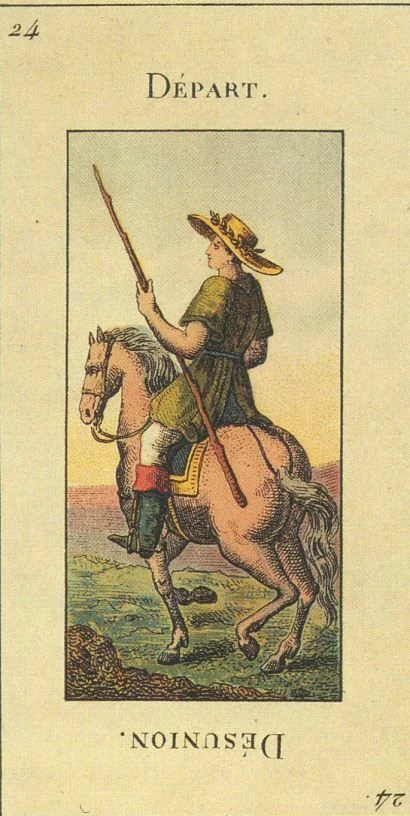
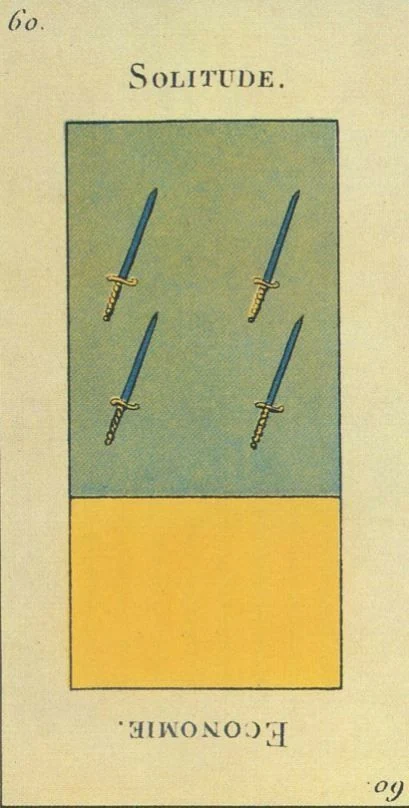
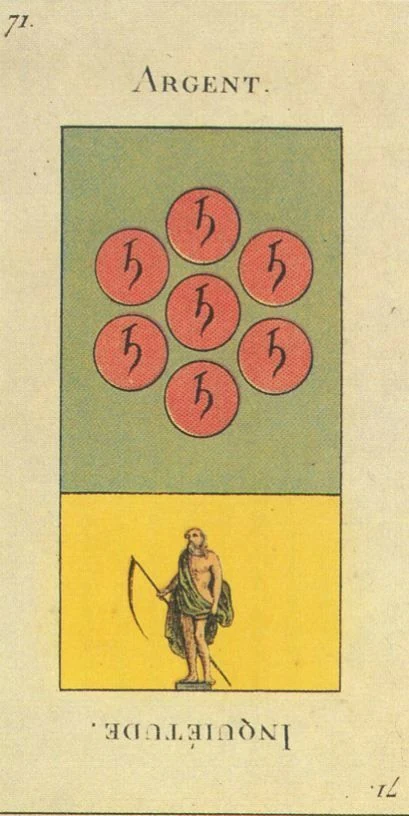
I find this deck strongest when several cards form a sentence. A mounted traveller beside Naissance may show a departure that creates a new life. Argent beside Solitude can ask whether financial independence is freedom, distance, or both. Let the images speak to one another before reaching for a fixed list.
Four-card story
The moment life begins to move
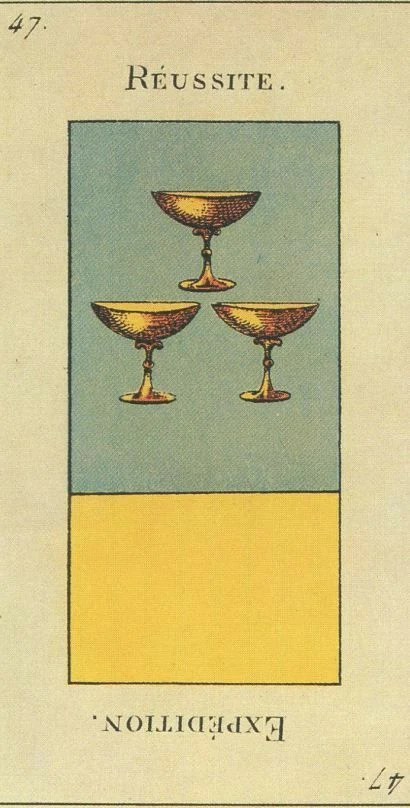
Départ, Naissance, Réussite and Espérance turn change into a sequence: leaving, beginning, gaining ground and protecting the bright thread that carries you forward.


A different emotional rhythm from modern tarot
Many modern decks place one archetypal figure at the centre of every card. Tarot Etteilla often feels more like a sequence of social and practical omens. A branch, a cluster of cups, crossed swords or patterned coins can carry as much weight as a human face. This shifts the reading from “Who am I becoming?” toward “What is happening, between whom, and with what consequence?”
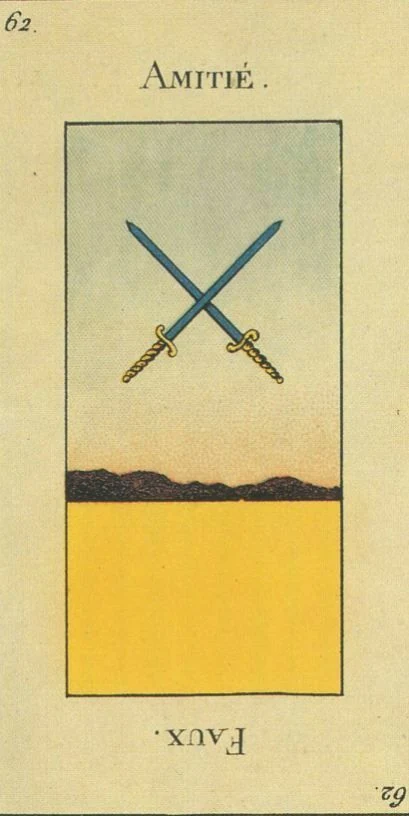
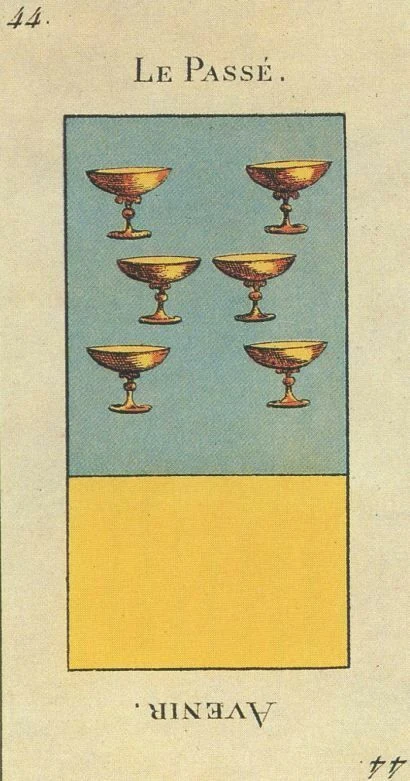
That does not make the deck cold. Quite the opposite. Because the titles are so plain, emotion arrives without costume. Le Passé gathers six cups like memories arranged on a shelf. Amitié crosses two blades, suggesting that friendship may include honesty, friction and the courage to meet as equals.

Card study
La Tempérance: balance as a living act
A winged figure in a long red robe stands outdoors, one foot grounded beside a small block while the body turns through a careful exchange between vessels. A bright point at the forehead echoes the gold at the figure’s belt and cups. Nothing here is passive: balance is being made by hand.
For me, this card asks where two forces can be blended without either being erased. Upright, it favours measured adjustment and emotional proportion. In shadow, the poised exchange can become endless self-monitoring. In a real reading, look for the mixture that restores movement rather than the compromise that merely keeps everyone quiet.
Relationships, loyalty and the shape of home
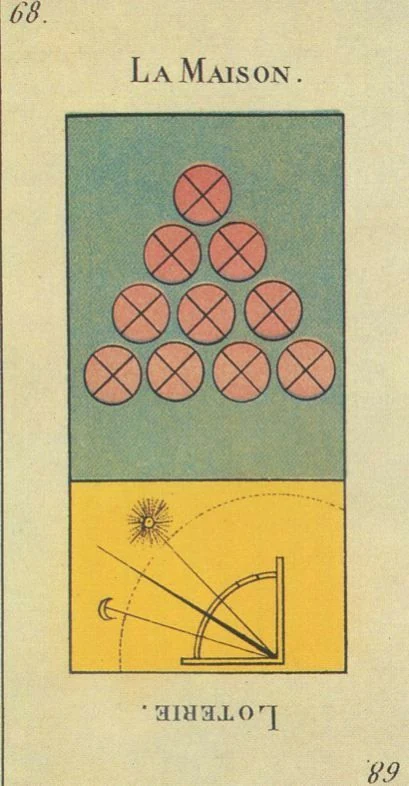
Tarot Etteilla is unusually candid about the social fabric around a question. Love is not treated as a single romantic ideal. It appears through desire, friendship, partnership and the material structure of a household. These cards can show warmth, but they can also show the agreements and boundaries that make closeness possible.
When relationship cards appear, I would ask what kind of bond is actually present. Is this attraction, mutual aid, chosen family, habit, shelter or a public promise? The deck becomes clearer when we resist folding every connection into romance.
Four-card story
Four faces of belonging
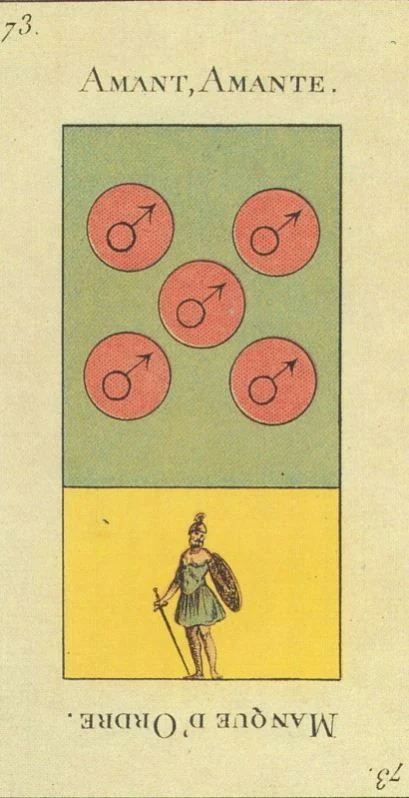
Amour, Amitié, La Maison and Amant, Amante separate the spark of feeling from friendship, shared structure and the charged pairing of lovers.

Is Tarot Etteilla beginner-friendly?
It can be, provided the beginner wants to learn this system rather than force familiar Rider–Waite–Smith meanings onto it. The French titles are often wonderfully concrete, and the scenes are readable. The challenge is the larger historical vocabulary: numbered sequences, paired meanings and correspondences that reward a proper guidebook and patient notes.
I would start with three cards and one grounded question. Say each visible title aloud, describe the image without interpretation, then connect the three as beginning, development and consequence. Keep reversals aside until the upright language feels natural. This deck grows through attention, not speed.

Card study
Folie: motion without a settled destination
A traveller in a red cap and blue coat steps away from a dark doorway while a spotted dog presses close behind. A small bundle hangs from a raised stick; the other hand grips a pale staff. The body moves right, yet the head turns back toward the animal, creating a tug between departure and distraction.
This is not the bright cliff-edge innocence of a borrowed modern Fool. Here, folly can be restlessness, poor attention or movement made before the situation is understood. Its useful expression is freedom from stale rules; its tension is leaving without seeing what follows. Ask what you are carrying, what is nipping at your heels, and whether your next step is chosen or merely reactive.
Money, memory and the cost of independence
The deck’s practical cards are one of its loveliest strengths. They allow money, property, reputation and solitude to sit beside feeling without pretending that material life is spiritually beneath us. A reading can therefore hold both the heart and the household.
When these cards gather, check the exchange underneath the obvious event. What is being counted? What is inherited from the past? What does security purchase, and what distance does it create? Tarot Etteilla is often at its sharpest when it shows that every gain has a setting and every choice has a social weather.
Four-card story
What remains, what costs, what protects
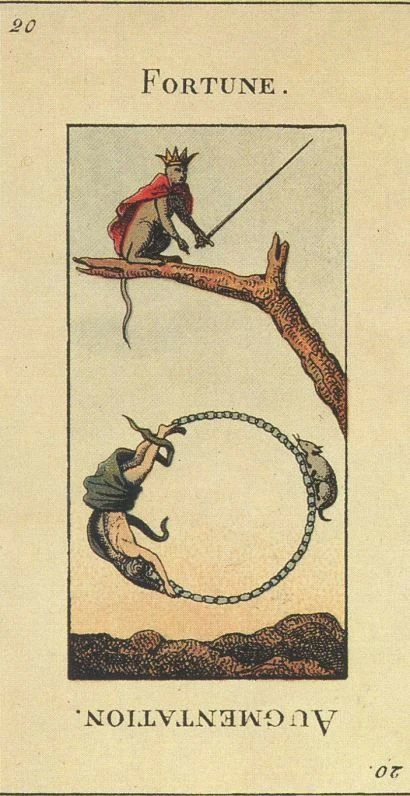
Fortune, Le Passé, Solitude and Argent make a grounded spread for resources: opportunity, memory, separation and the value we can actually count.
Who will love this deck?
Tarot historians, Marseille readers, collectors of French cartomantic traditions and intuitive readers who enjoy building meaning from repeated visual motifs will find a great deal to explore. It also suits questions about timing, social dynamics, money, movement and concrete outcomes.
It may frustrate someone looking for a modern self-care oracle or a deck that mirrors Rider–Waite–Smith scene for scene. The antique titles are direct, sometimes severe, and the historical structure asks for study. That is not a flaw; it is the deck’s personality.
My golden rule for Tarot Etteilla
Read the title, then the direction of travel. Notice what the card names, then watch how the image moves—toward, away, together, apart, upward or back. That small discipline keeps the reading rooted in this deck’s own voice and stops familiar modern meanings from drowning it out.
Final thoughts
Tarot Etteilla is not shy. It names hope, departure, money, love, grief and folly as if each were a visitor arriving at the door. The artwork has the softness of an old print, yet the messages can be startlingly immediate. I especially love the way symbolic cards and human scenes alternate: the deck can move from a blazing sun to a mounted traveller, then to cups, blades or coins without losing its thread.
Choose it if you want a historical system with a distinct vocabulary and are willing to meet it slowly. Use the Gallery above as a study table, compare recurring colours and gestures, and let the cards teach you how they wish to speak.

Tarot Etteilla FAQ
Is Tarot Etteilla the same as the Thoth Tarot?
No. Tarot Etteilla belongs to the historical Etteilla cartomantic tradition. Aleister Crowley and Lady Frieda Harris’s Thoth Tarot is a different deck with different artwork, titles and esoteric structure.
How many cards are in Tarot Etteilla?
The deck has 78 cards. Our Gallery contains 76 verified fronts because source cards numbered 4 and 70 were unavailable; we did not replace them with guesses or another edition.
Who is credited on this Tarot Etteilla edition?
The linked Anima Antiqua edition is published by Lo Scarabeo and distributed in North America by Llewellyn. Its historical deck design is associated with Jean-Baptiste Alliette, known as Etteilla.
Can a beginner read Tarot Etteilla?
Yes, if the beginner is willing to learn its own titles and structure. Start with small upright spreads and a dedicated guide rather than translating every card into Rider–Waite–Smith meanings.
Does Tarot Etteilla use reversals?
The cards visibly print paired meanings at opposite ends, so orientation is part of the deck’s design. Learn the upright visual language first, then add the inverse meanings gradually.
Where can I see the Tarot Etteilla cards?
Use the verified Gallery near the top of this review. Its filters and Lightbox let you inspect 76 distinct card fronts in printed number order.