Explore the Silver Era Tarot Cards
Browse the verified exact-edition card set recovered from the supplied sources, arranged in official Rider–Waite–Smith order. Choose a group to filter the continuous gallery, or select any card to open the full-size Lightbox.
78 cards shown.
Silver Era Tarot at a glance
Silver Era Tarot is a complete 78-card deck built from black-and-white photographic collage with carefully isolated colour. Aunia Kahn created the artwork, Russell J. Moon wrote the companion text, and Schiffer published the boxed set. The official listing identifies ISBN 978-0-7643-3438-2 and pairs the cards with a 96-page illustrated book.
Its visual method is immediate: most of the world recedes into silver, charcoal and soft grey, then one purple flower, red heart, blue pool or green coin carries the pulse. Familiar card names and suits keep the system legible, but the figures and objects feel like found fragments from a strange private archive.
Artwork built from memory, weather and one living colour
Kahn’s collages place posed figures beside open sky, old architecture, water, blades and symbolic objects. Texture matters as much as narrative. Grain, cloud and shadow give the images age, while restrained accents refuse the flatness of pure monochrome.
I begin each card with three observations: where the figure looks, what the hands are doing, and where colour appears. Only then do I bring in the traditional card role. That order keeps intuition close to visible evidence and lets the deck’s unusual composition do real interpretive work.
Card study
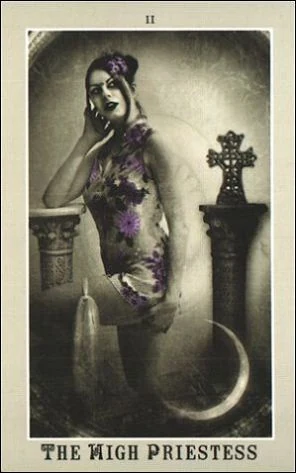
The High Priestess — violet knowledge at the threshold
A woman stands between architectural fragments, one hand near her face and the other close to a carved pedestal. Purple flowers gather across her dress and hair, while a large pale crescent curls near her feet and a dark cross-like ornament rises behind her.
Her gaze is direct but guarded. Upright, I read this as knowledge held close until the question deserves it; in shadow, privacy can harden into withholding. Ask what the violet detail protects, and whether the next card calls for patience, a boundary or one precise disclosure.
How Silver Era Tarot reads in practice
The deck reads with emotional clarity. Its open skies and sparse interiors leave room around a question, yet cards such as The Tower and Three of Swords do not soften disruption. Because one accent often becomes the visual centre, readings quickly reveal the object, feeling or relationship that needs attention.
Try a three-card spread called grey field, living colour, next gesture. The first card names the wider atmosphere; the second shows the detail carrying energy; the third turns that energy into an action. Describe the pictures aloud before opening the book.
Four-card story
Four lights in a silver world
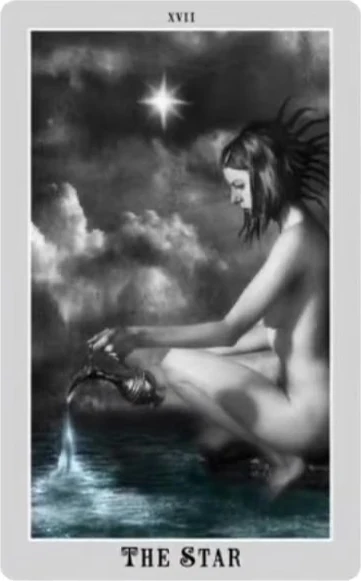
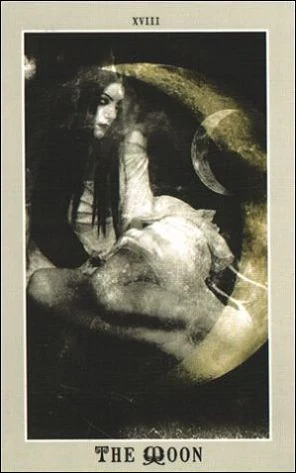
The High Priestess carries violet at the edge of silence; The Star cools the dark with blue water; The Moon holds a yellow-green crescent beside a listening figure; and The Sun becomes a concentrated green-gold orb. Together they ask where intuition, renewal, uncertainty and clarity place the reading’s one meaningful light.

Beginner guidance and better questions
A beginner can work with Silver Era Tarot because the names, 22/56 division and four suits are familiar. The collages are not scene-for-scene Rider–Waite–Smith copies, so use the companion book as a bridge and keep early readings small. One card a day will teach this visual language faster than memorising a long list in advance.
Gentle
What small point of colour can I follow today?
Deeper
What feeling has my attention even when I look away?
Demanding
Which truth would become useful if I stopped decorating it?
Card study
The Star — hope poured into dark water
A seated nude figure bends toward a dark pool beneath a single white star. Water streams from a small vessel, and the cool blue surface supplies the image’s strongest colour. Her attention stays with the simple act rather than the sky.
The card makes renewal practical. Upright, The Star can be trust rebuilt through one sustaining gesture; in shadow, longing may remain beautiful but ungrounded. I ask what can be poured, washed, replenished or repeated today, not someday.
Reading conflict without flattening it
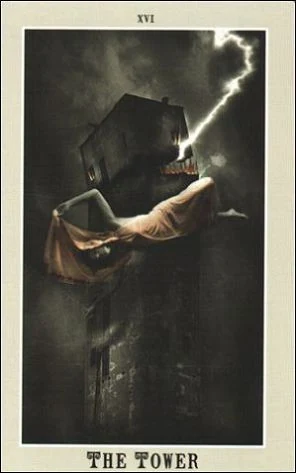
Silver Era Tarot distinguishes several kinds of difficulty. Lightning is not the same as crossed wills; mourning is not the same as the first clean recognition of pain. That distinction is valuable in relationship, work and transition readings because it prevents one dramatic card from swallowing the entire story.
When a hard sequence appears, ask what happened, what is still being contested, what deserves grief, and what now needs an honest name. The imagery supports compassion without asking the reader to pretend that every rupture is secretly pleasant.
Four-card story
Four shapes of conflict and grief
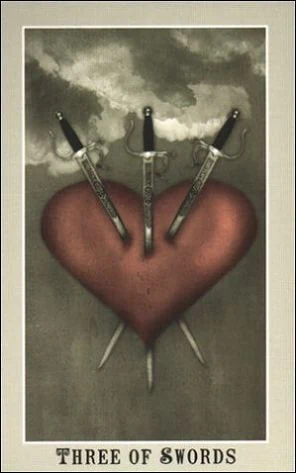
The Tower receives lightning above a falling figure; Five of Wands turns several reaching arms into crossed resistance; Five of Cups places a cloaked mourner before dark water; and Three of Swords gives pain a red centre. Read together, they separate the shock, struggle, mourning and truth inside one difficult story.


Who will feel at home with this deck?
This deck may suit readers drawn to photographic collage, Victorian or gothic atmosphere, muted palettes and emotionally direct symbolism. It is expressive for shadow work, relationships, creative blocks, grief, recovery and decisions where one overlooked detail changes the whole frame.
You may prefer another deck if you want bright colour on every card, close Rider–Waite–Smith staging, minimalist geometry or a light comic tone. Browse the full Minor Arcana before buying; the everyday cards reveal whether the deck’s silver world will remain readable beyond its dramatic Majors.
Card study
Three of Swords — a wound made impossible to ignore
A large red heart occupies nearly the whole frame. Three blades descend through it against turbulent grey clouds, and their cold metal makes the red look even more exposed. Nothing in the composition lets the eye evade the injury.
This is sorrow with a clear address. Upright, it can name heartbreak, division or a truth that hurts because it matters; in shadow, pain may be rehearsed until it becomes identity. Name the wound accurately, then let surrounding cards show what belongs to grief and what belongs to repair.
Resources, belonging and enough
The Pentacles in this deck often turn green, making material questions visibly alive. Two of Pentacles places the act of balancing near the body; Ten of Pentacles frames two figures and a dog beneath an arch of coins. Resources appear as motion, relationship and shelter rather than a simple pile to possess.
For money or work questions, identify what must be handled, who shares the structure, what restores capacity, and what needs protecting. A practical answer can still emerge from surreal collage when the final sentence names a real task, conversation or boundary.
Four-card story
Four ways to carry what matters
Two of Pentacles places balance literally above a woman’s lifted arm; Ten of Pentacles gathers two figures and a dog beneath an arch of green coins; The Star restores one measure at a time; and The High Priestess protects what is not ready to be spent. The sequence moves from handling resources to belonging, replenishment and wise reserve.


Buying the verified Schiffer edition
The exact-edition trail is unusually clear. Schiffer’s current publisher page credits artwork by Aunia Kahn and text by Russell J. Moon, lists 78 cards plus a 96-page book, and gives ISBN 9780764334382. Kahn’s own Silver Era Tarot page shows the matching pale box art and links to the same Amazon product identifier.
The Amazon button uses ASIN 0764334387 with the TarotFans affiliate tag. Check the ISBN, creator line, included book and seller before ordering; availability, condition and price can change.
Aurica’s golden rule for Silver Era Tarot
Find the one thing still carrying colour.
Let the grey field describe the atmosphere, but do not let it decide the whole reading. The coloured detail often marks the feeling, resource or truth that can move next.
Final thoughts
Silver Era Tarot has a distinctive visual discipline: photographic fragments, spacious monochrome and colour used as emphasis rather than decoration. The complete Gallery shows how consistently that method travels from the Major Arcana into all four suits.
I recommend it to readers who want recognisable tarot architecture with an art-photography voice of its own. Look slowly, name what the figure is doing, follow the living colour, and let the next practical gesture bring the image back into your life.
 View Silver Era Tarot on AmazonView Silver Era Tarot on Amazon
Silver Era Tarot FAQ
Who created Silver Era Tarot?
Artist Aunia Kahn created the deck’s photographic collage artwork, and Russell J. Moon wrote its companion text. Schiffer published the boxed set.
How many cards are in Silver Era Tarot?
It is a complete 78-card tarot: 22 Major Arcana and 56 Minor Arcana divided into Wands, Cups, Swords and Pentacles.
What comes in the Silver Era Tarot set?
Schiffer lists 78 cards and a 96-page illustrated companion book in a boxed set. The listed ISBN is 978-0-7643-3438-2.
Does Silver Era Tarot follow Rider–Waite–Smith?
The deck keeps familiar 78-card names and suit structure while replacing traditional scenes with contemporary black-and-white photographic collages and selective colour.
Is Silver Era Tarot suitable for beginners?
It can suit a visual beginner who knows the basic tarot structure and is willing to compare the image with the companion book. Start with one- and three-card readings before using a large spread.
Which Silver Era Tarot edition do the buying links reference?
They reference the Schiffer boxed set credited to Aunia Kahn and Russell J. Moon, ISBN 9780764334382. Check the ISBN, creator line, contents and seller before ordering because stock and price can change.


