Explore the Sherlock Holmes Tarot Cards
This carefully verified partial Gallery follows the deck’s printed sequence and preserves its renamed suits. Cards without a clean, reliable exact-edition source are omitted rather than guessed or padded. Choose a group to filter the continuous Gallery, or select any card to open the full-size Lightbox.
Showing the selected verified card group.

Aurica’s Quick Take
I love how this deck makes every spread feel like a lamplit room where one small detail has begun to glow. I notice the picture first, then let the card’s tarot role test my first impression, just as Holmes tests a beautiful theory against what is actually there.
Evidence asks what has truly appeared; Deduction challenges the story built around it; Analysis listens for feeling beneath reason; and Observation brings the question back to ordinary life. It is a delicious deck for tangled choices, creative puzzles and meaningful silences.
Let the clearest clue lead, welcome the next card’s challenge, and trust that patient attention can turn even a foggy path toward light.
A deck that reads like a case opened at midnight
Sherlock Holmes Tarot slips familiar tarot bones beneath gaslight, fog and the rustle of a case file. John Matthews reshapes the suits around the detective’s craft, while Wil Kinghan fills the cards with Victorian rooms, railway lines, moonlit searches and faces that seem to know more than they say.
The physical set adds The Giant Rat of Sumatra as a wild card beyond the standard tarot structure. This review keeps that unusual architecture visible, but the Gallery is deliberately partial: uncertain or marked source images were left out rather than presented as clean evidence. What remains is enough to hear the deck’s voice without pretending every clue has been recovered.
Artwork built from glances, rooms and hidden pressure
Kinghan’s collage-like realism moves between warm interiors and electric night colour. Hats, doors, windows, notebooks, lamps, tracks and measuring tools repeat like a trail of fingerprints. Faces often turn sideways or look past one another, which gives the deck a delicious sense that the important fact may be just beyond the edge.
I begin by noticing where a figure looks and what their hands are doing. Then I bring in the card’s traditional task and its renamed suit. That order matters: atmosphere opens the door, but visible action keeps the interpretation from vanishing into fog.
Card study
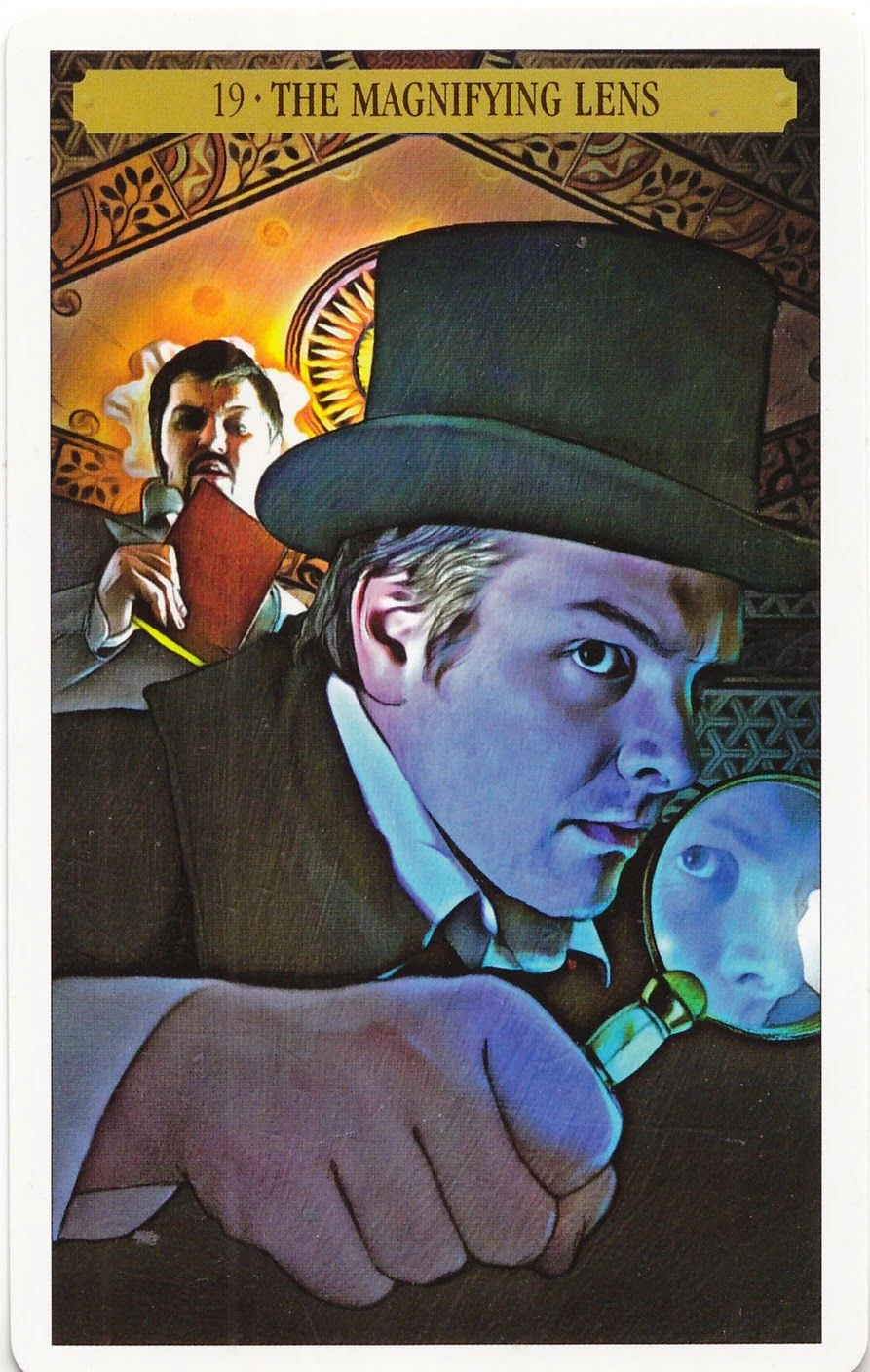
The Magnifying Lens — attention brought close
A blue-lit detective in a tall black hat leans into the foreground, one eye reflected in the round glass he holds. A clenched hand fills the lower frame, while a second man behind him grips a red notebook beneath warm patterned arches. The contrast between cool face, bright lens and amber room makes looking itself feel like the action.
This card takes the traditional Moon territory of uncertainty and turns it toward investigation. Upright, it can ask for patient observation, a closer question and respect for what remains half-seen. In shadow, scrutiny becomes suspicion and every reflection begins to look like proof. In a reading, name what the lens actually shows, then ask what evidence still sits outside its circle.
How Sherlock Holmes Tarot reads in practice
This deck is sharp, theatrical and surprisingly practical. It suits questions that need distinctions: fact from assumption, instinct from fear, loyalty from habit, strategy from avoidance. A three-card case file works beautifully: what I know, what I am inferring, and what deserves one more look.
Do not race to solve the whole spread. Describe one clue on each card, follow the direction of every gaze, and notice whether the scene is private, public or watched. Only then form a conclusion and let the final card suggest an action small enough to test.
Four-card case file
Four faces around the investigation
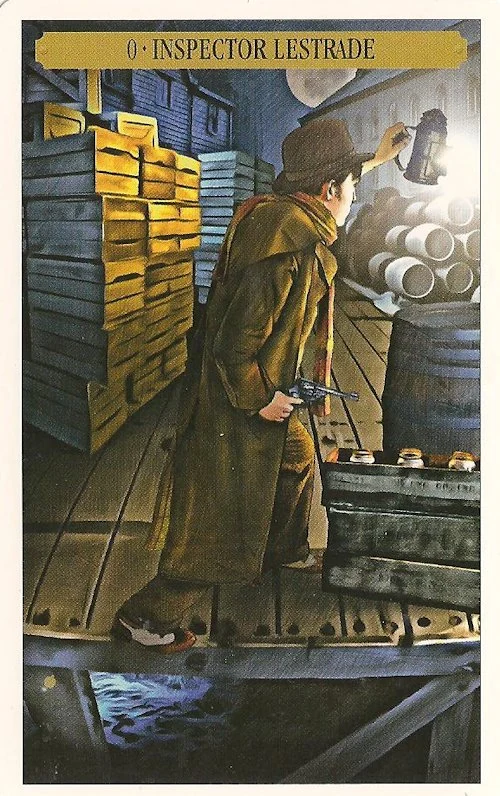
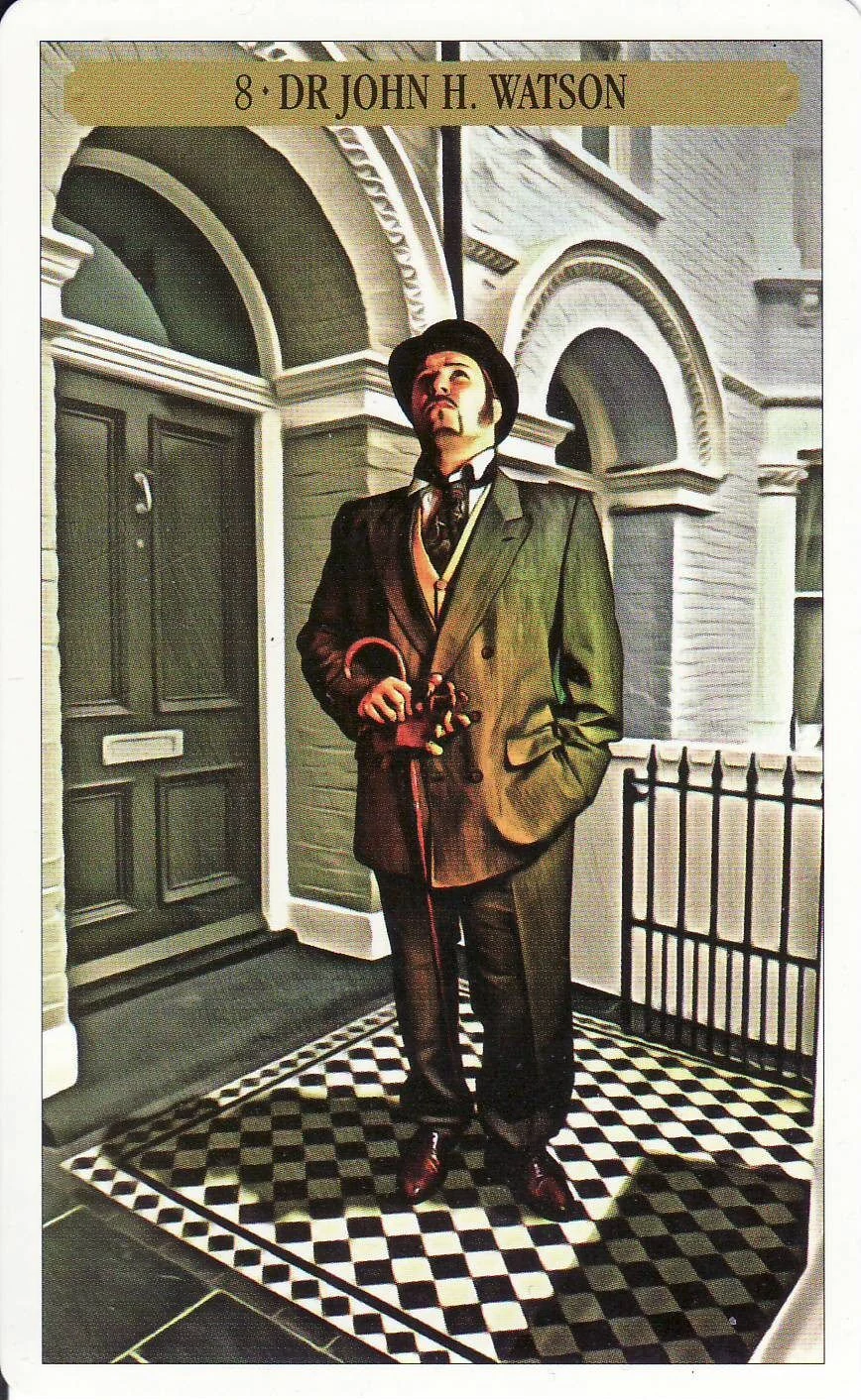
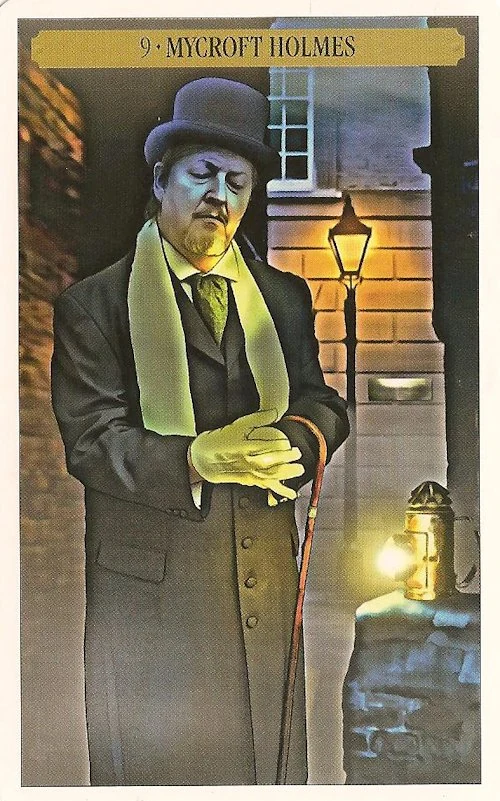
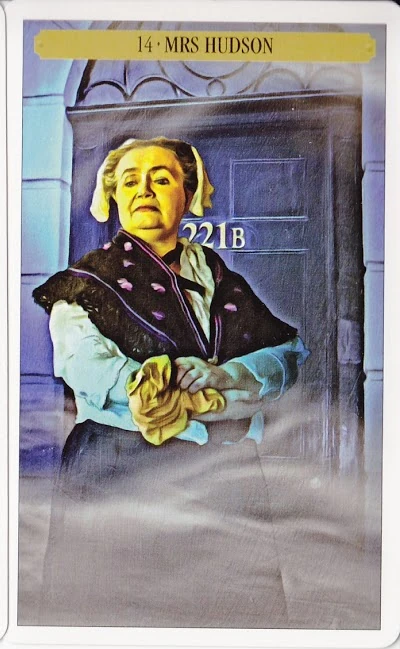
Inspector Lestrade works among stacked records; Dr John H. Watson stands on a black-and-white tiled threshold; Mycroft Holmes waits beneath streetlamps; and Mrs Hudson appears framed by the familiar domestic world. Together they show that insight is never only one brilliant mind: it is also procedure, loyalty, context and the person who keeps the room standing.
Beginner guidance and three useful questions
The familiar tarot structure offers a handrail, but the renamed suits and courts ask for a little patience. Keep a simple correspondence note nearby and learn through short readings. Holmes fans may recognise characters quickly; tarot beginners still need to learn why each role was chosen.
Gentle
What simple fact will help me move through today?
Deeper
Which assumption is colouring the evidence in front of me?
Demanding
Where am I protecting a clever story because the plainer truth asks more of me?

Card study
Professor Moriarty — temptation with a steady hand
Moriarty stands in a blue three-piece suit and black top hat, holding a small pale cup near his chest. Behind him, a huge barred window pours light into a stone hall where three dark figures struggle. His still posture and direct gaze sit sharply against their movement.
Placed in the deck’s Devil position, this image makes control look composed rather than wild. Upright, it may expose a binding bargain, manipulation or an appetite dressed as perfect manners. Its shadow can also show the fear of one’s own power. Ask who benefits from the arrangement, what keeps the struggle in the background, and which honest choice breaks the spell.
Evidence is not the same as certainty
The Evidence suit carries the fire and initiative of Wands, yet its detective language changes the flavour. An idea becomes something to gather, compare and test. Energy is useful, but excitement can also make a reader fall in love with the first explanation.
When Evidence dominates a spread, ask what can be observed directly and what still needs movement. A lantern, a journey or a working hand may show that truth is not passive; sometimes the clue appears only after you enter the room, make the call or examine the neglected detail.
Four-card case file
Four stages of gathering evidence
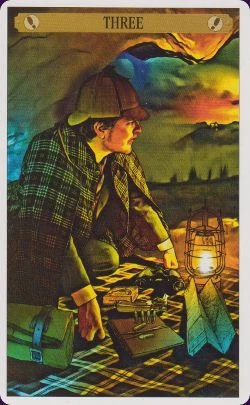
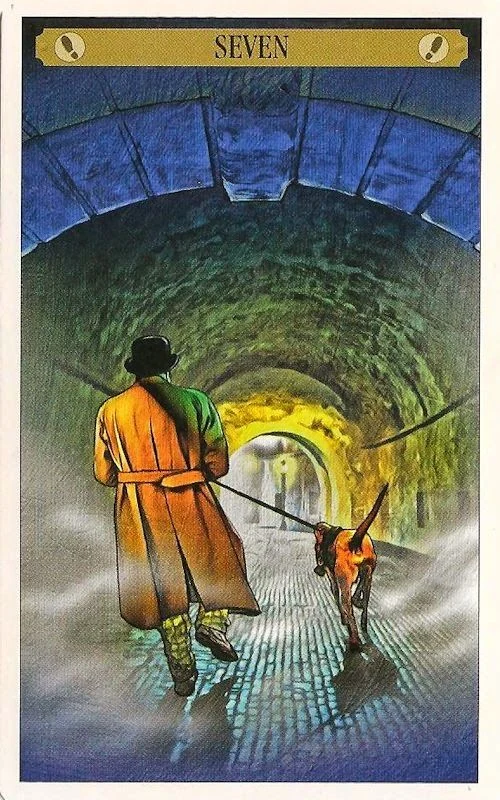
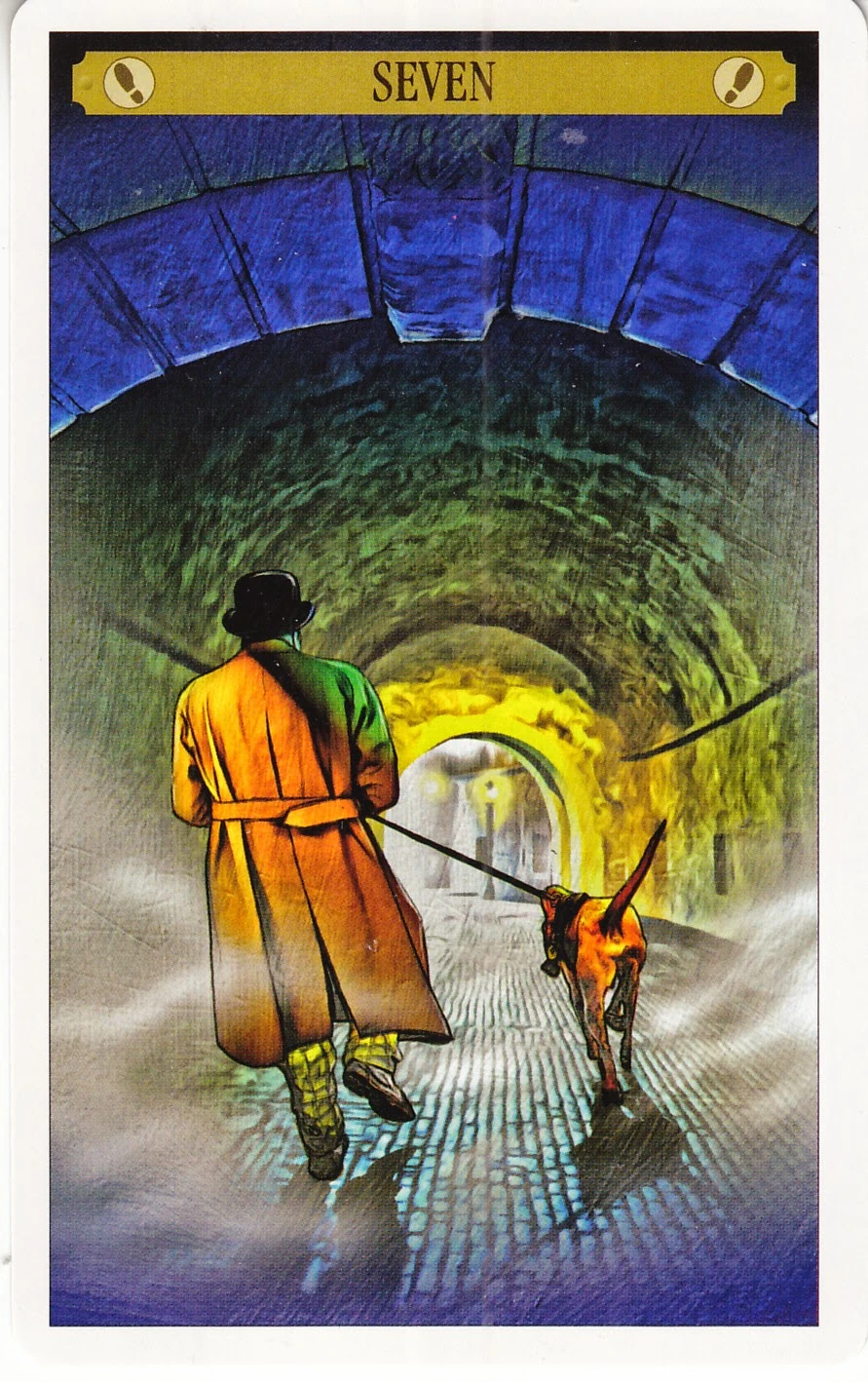
Three of Evidence lays tools across a checked cloth; Four sets people around a busy lamplit interior; Seven sends a figure and dog through a stone tunnel; and Eight follows a train along a curving track beneath heavy cloud. The case moves from preparation to collaboration, pursuit and momentum.


Relationships through loyalty, secrecy and shared purpose
In relationship readings, this deck notices alliances before romance. Who shares the investigation? Who controls access to information? Who stands beside another person when the scene becomes uncomfortable? Those questions can illuminate love, friendship, family and working partnerships without forcing every bond into one shape.
Let Cups’ emotional world speak through Analysis, but do not turn feeling into an interrogation. A guarded face may need safety rather than exposure. Read the surrounding cards for trust, reciprocity and timing before deciding whether a silence is tender, fearful or manipulative.

Card study
Nine of Evidence — the clue that waits under moonlight
Two men in coats and hats stand close together in a vivid green field beneath a large pale moon and a deep violet sky. One holds a magnifying glass toward low plants and a small patch of orange light; distant buildings glow faintly along the horizon. Their bodies bend toward the ground rather than toward the far view.
Evidence corresponds to Wands in this deck, so the Nine carries persistence and guarded effort into a night search. Upright, it can be the alertness that protects hard-won progress; in shadow, vigilance hardens into exhaustion. I would ask whether the reader needs one more careful look or permission to stop searching and trust what has already been found.
Who will enjoy this unusual tarot?
It may delight Sherlock Holmes readers, collectors of literary decks and tarot users who enjoy narrative, period atmosphere and renamed systems. It feels especially alive for journaling, research choices, tangled motives, boundaries, creative blocks and decisions where several explanations compete.
You may prefer another deck if you want a close scene-for-scene Rider–Waite–Smith clone, modern minimalist graphics or gentle imagery throughout. Spend time with the numbered cards as well as the famous characters; they reveal whether the detective language can keep speaking after novelty fades.
Four-card case file
Four turns of deduction
Ace of Deduction begins with a single clear proposition; Two brings competing possibilities into the same frame; Three puts the reasoning under pressure; and Seven asks what may be concealed, borrowed or strategically withheld. Read together, they remind me that cleverness needs both courage and a check against self-deception.


Buying guidance and the exact-edition gate
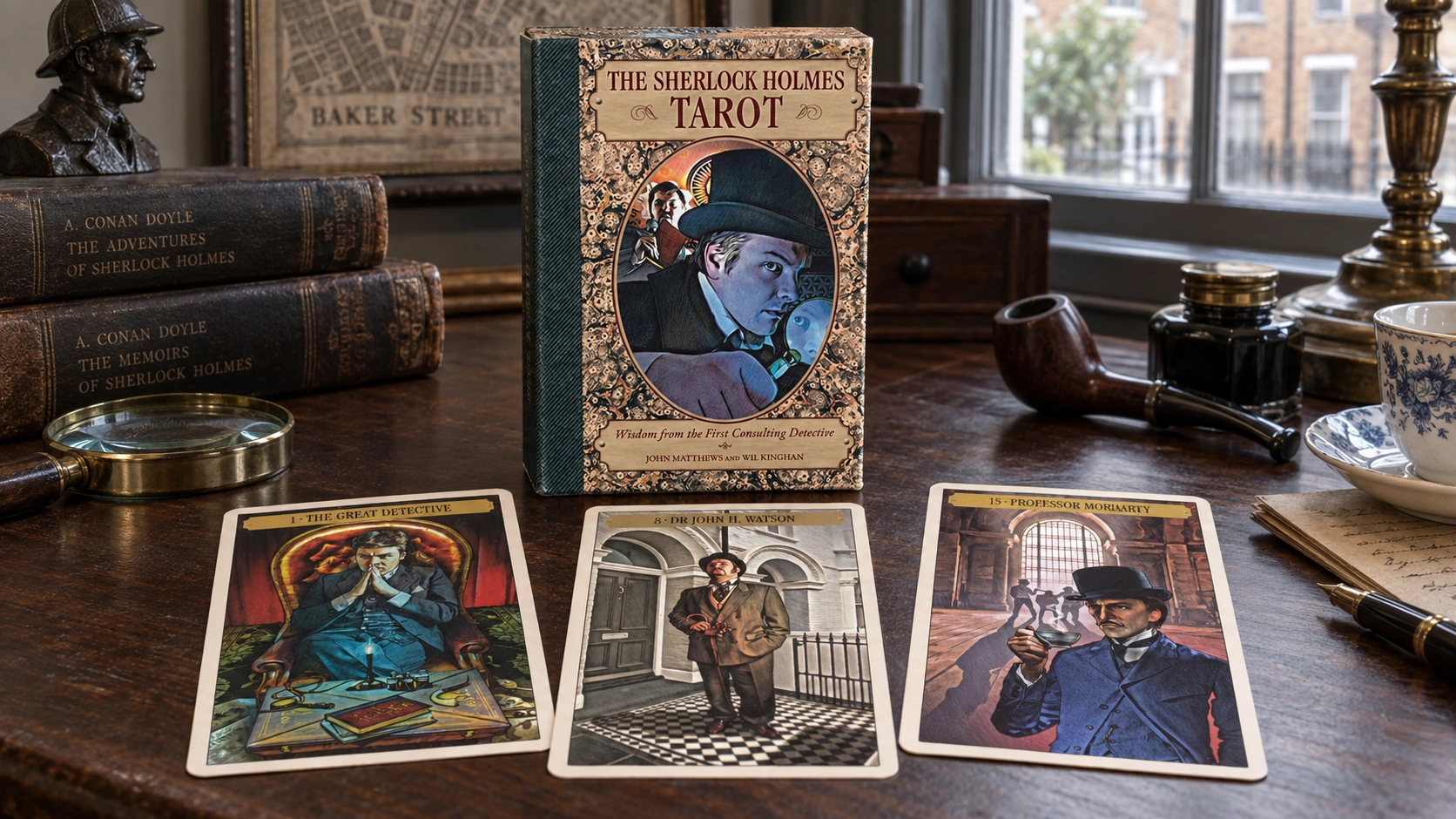
The reviewed set is credited to John Matthews and Wil Kinghan and identified by ISBN 9781859063705. The Amazon button opens that direct ISBN product page with the TarotFans affiliate tag. Price, stock, seller and condition can change, so compare those details before ordering, especially for used or imported copies.
The exact-edition product image for this review is grounded in the direct ISBN listing and the deck’s verified card fronts. The Gallery remains deliberately partial, and no unseen card back is presented or guessed.
Aurica’s golden rule for Sherlock Holmes Tarot
Observe first, infer second, and let the next card challenge your favourite theory.
A convincing story is not always the truest one. Give the quiet clue room to speak, and let curiosity become a lantern rather than a verdict.
Final Thoughts
Sherlock Holmes Tarot is clever without being a novelty trick. Its renamed suits make reading feel investigative, its characters give the Major Arcana dramatic weight, and its ordinary objects—a notebook, window, lamp or railway track—can turn a spread into a living scene.
I recommend it to a reader who enjoys looking twice and thinking with both intuition and evidence. You do not need every answer at once; follow the clearest clue with kindness, and the next honest step will reveal more of the path.
Sherlock Holmes Tarot FAQ
Who created Sherlock Holmes Tarot?
John Matthews wrote the deck and Wil Kinghan created its artwork. The published set is identified by ISBN 9781859063705.
How many cards are in the physical deck?
The set contains the standard seventy-eight-card tarot structure plus The Giant Rat of Sumatra wild card, making seventy-nine physical card fronts. This page intentionally shows only the clean exact-edition fronts that could be verified safely.
What do Evidence, Deduction, Analysis and Observation mean?
They are the deck’s renamed Minor Arcana suits. Evidence corresponds to Wands, Deduction to Swords, Analysis to Cups and Observation to Pentacles, while the court names become Baker Street Irregular, Peeler, Lady and Inspector.
Does Sherlock Holmes Tarot follow Rider–Waite–Smith?
It keeps the familiar tarot architecture and maps Holmes characters, places and cases onto it, but many scenes tell their meanings through the detective world rather than copying classic compositions.
Is Sherlock Holmes Tarot good for beginners?
It can suit a beginner who already knows the stories or enjoys learning by narrative. The renamed suits and courts add a small learning curve, so a guidebook, one-card draws and short spreads are the gentlest entry.
What should I check before buying this edition?
Match the title, the names John Matthews and Wil Kinghan, and ISBN 9781859063705. Confirm the current seller, language, box and book contents, condition, price and availability before ordering.