Explore the Naked Heart Tarot Cards
Browse the complete verified third-edition sequence in deck order. Filter by official deck section, or select any card for a larger carousel view.
Showing the selected card group.

Aurica’s Quick Take
The Naked Heart Tarot feels most alive to me when I stop treating its animals as substitutes for people. I let their bodies, habitats, and direction of gaze enter the reading. The familiar tarot structure gives me an anchor, while Jillian C. Wilde’s extra card and renamed courts leave room for instinct, tenderness, and wild honesty.
In The Universe, the bee and circular mandala carry the traditional World card’s completion without becoming still. I read the bee as purposeful participation: one cycle closes, but its sweetness belongs to a larger living system. Nearby cards tell me whether to celebrate the arrival or ask what lesson is ready to become useful.
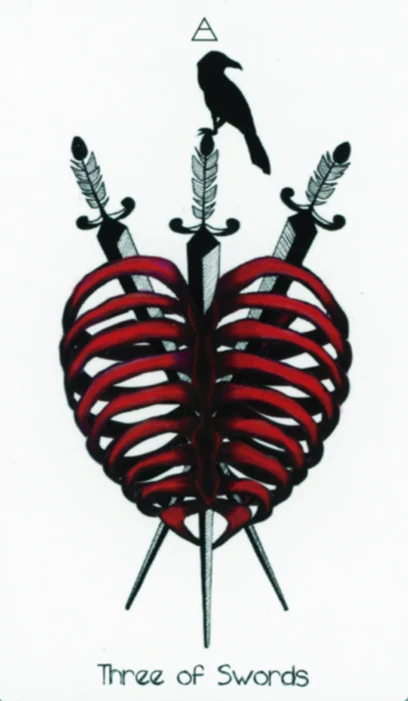
The Hermit slows the pace with its tortoise, mountain path, owl, and key. Retreat should eventually unlock something. Then Three of Swords, with its red ribcage and watchful raven, lets pain be named without turning it into spectacle. Cups draw me toward the feeling; Pentacles ask what support can become real.
I reach for this deck when a question needs honesty with breathing room. Its white space lets one bright creature, bone, wing, or flower speak clearly, while the spread shows whether that first impression is a warning, an invitation, or the beginning of repair. Every honest step joins a wider living pattern, and this deck makes that hope feel beautifully possible.
The Naked Heart Tarot by Jillian C. Wilde is an animal-led deck with plenty of white space, fine black linework, and small flashes of colour that land like a pulse. It follows the familiar tarot journey, then adds one extra Major Arcana card—The Naked Heart—for a complete 79-card gallery. The deck is expressive without becoming visually noisy, which makes it especially useful when you want symbols that speak quickly in a spread.
Deck at a glance
The Naked Heart Tarot in one look
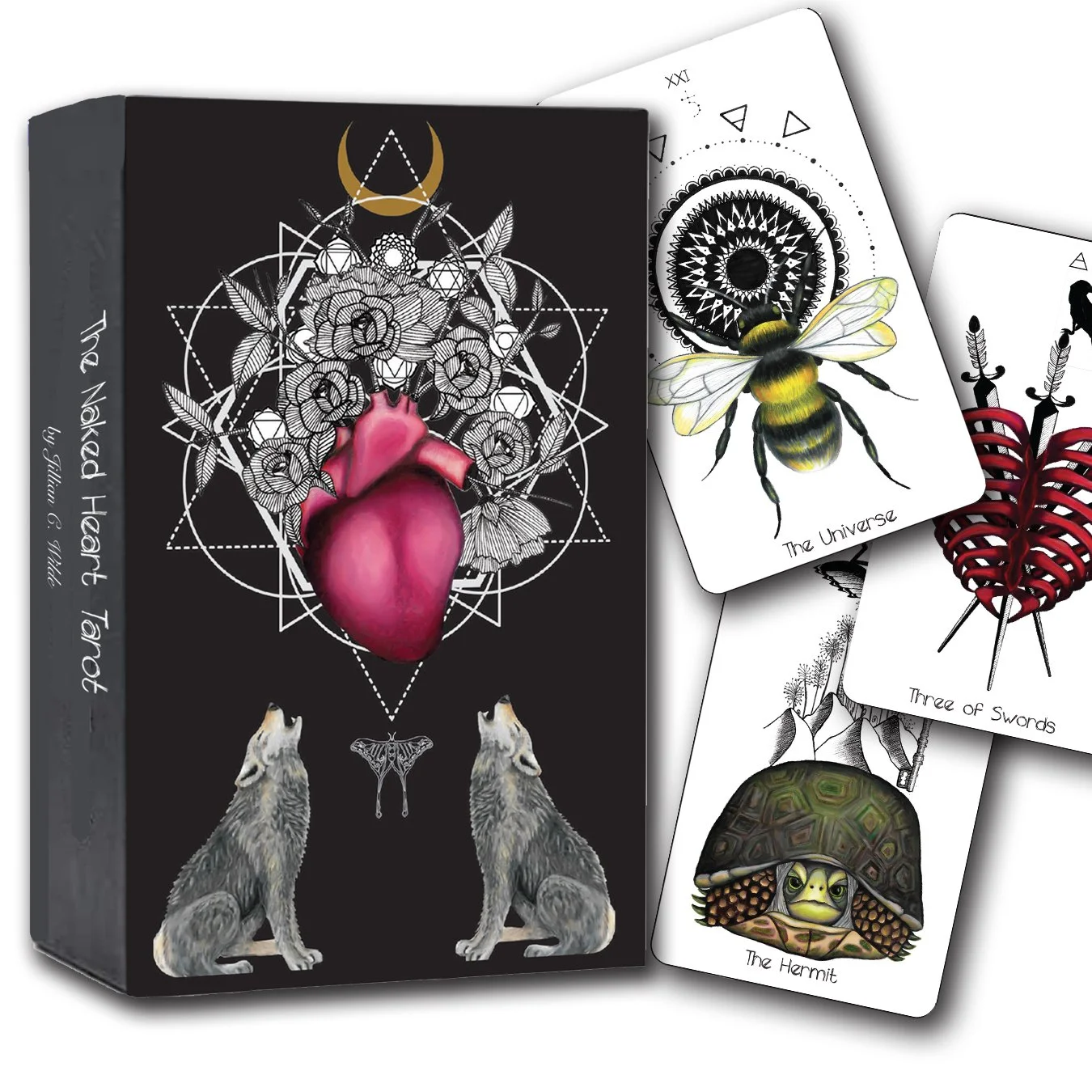
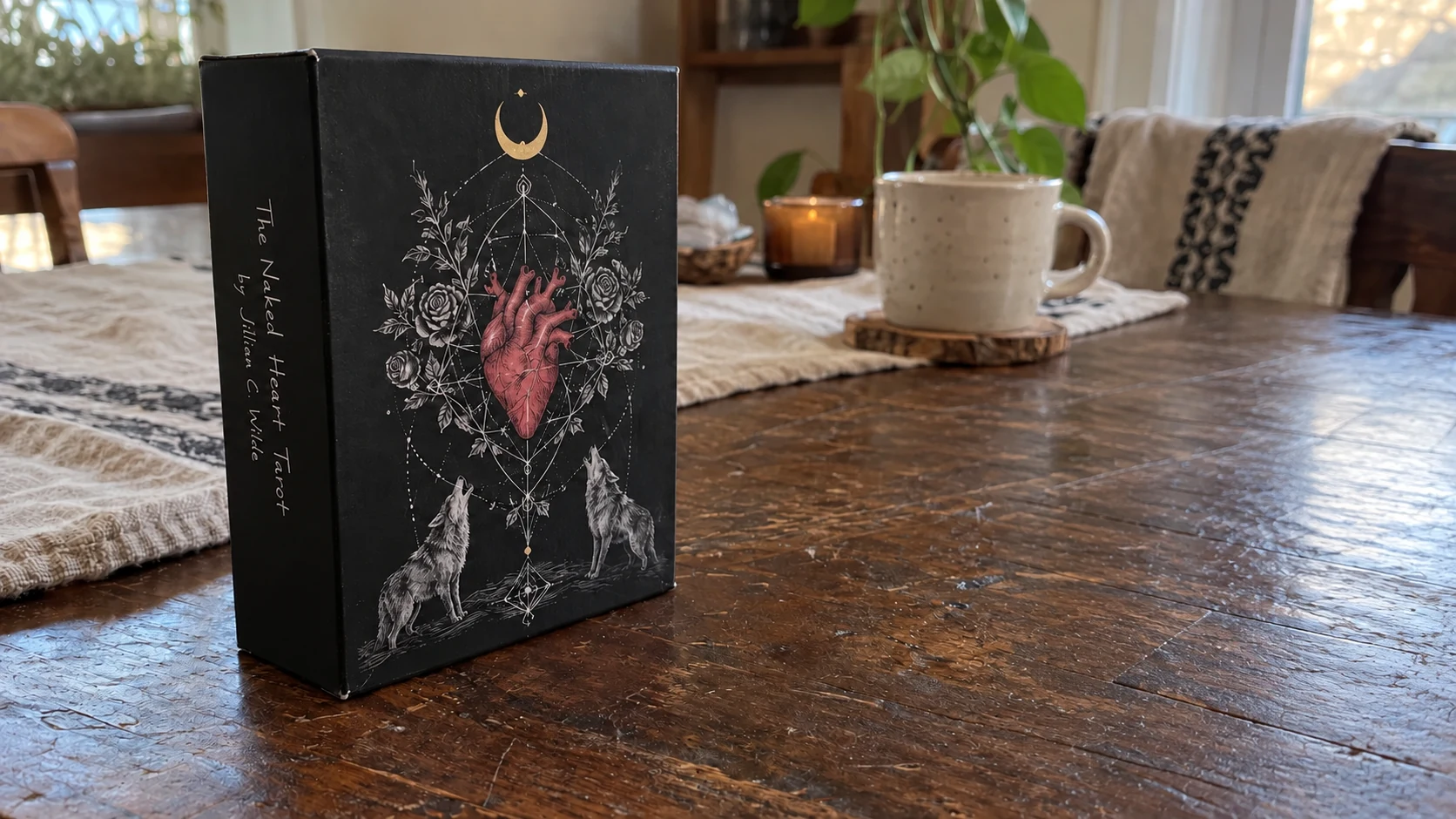
The black box places a red anatomical heart over white geometry, flowers, and two howling wolves. Inside, the cards keep the same contrast: borderless white fields, hand-drawn animals, elemental marks, and carefully chosen colour. The result feels modern and emotionally direct rather than decorative for its own sake.
- Creator: Jillian C. Wilde
- Cards: 79, including one extra Major
- Card size: 4.75 × 2.75 inches
- Stock: 350 GSM satin matte
- System: Major Arcana plus Wands, Cups, Swords and Pentacles
- Guidebook: 144 pages with six tarot spreads
What makes this animal tarot deck feel different?
The animals are not simple replacements for people. Wilde uses scale, posture, flight, shells, claws, feathers, and exposed anatomy to change how familiar cards feel. A tortoise slows The Hermit to a patient retreat. A bee makes The Universe feel complete because many small parts are working as one. A ribcage shaped like a heart gives the Three of Swords a physical ache before you have read a single keyword.


The white backgrounds also give nearby cards room to connect. Repeated circles can become a shared boundary; a run of birds can show thoughts gathering speed; a single red detail can reveal where the emotional heat sits. This is a deck that rewards looking across a spread before reading each card separately.
Three cards worth studying closely

The Universe: completion through connection
A large bee fills the lower half of the card. Behind it, a black-and-white circular pattern opens like a flower or mandala, while four elemental triangles sit around the outer ring. The traditional World or Universe meaning—completion, integration, and seeing the whole—is carried by an animal whose life depends on a wider system.
Beside the Eight of Pentacles, the bee can make completion feel earned through repeated work. Beside the Three of Cups, it may emphasise community. Beside The Hermit, it asks whether solitude is helping you return to the larger pattern or keeping you outside it.

The Hermit: carry your shelter with you
A tortoise sits low in the frame, its patterned shell forming a dark shelter. Above it are mountains, thin trees, a key, and an owl in flight. The familiar Hermit themes of withdrawal and inner guidance become practical here: step back, protect your energy, and move at a pace that lets wisdom catch up.
With the Four of Swords, the card can deepen the need for rest. With The Chariot, it may show a tension between speed and reflection. With the Ace of Wands, it suggests keeping a new spark private until it is strong enough to travel.
Three of Swords: pain you can finally name
Three swords pass through a red ribcage shaped like a heart, and a black raven perches above the central blade. The image keeps the card’s traditional themes of heartbreak, grief, and difficult truth, but it also makes the wound visible. What hurts is no longer vague.
Near Justice, the pain may come from a truth that needed to be spoken. Near the Six of Swords, it can show the hurt you are already leaving. Near the Queen-like Heart of Cups, it may ask for compassion without pretending that compassion erases the wound.
Structure, card stock, and guidebook
The deck contains the standard four suits of Wands, Cups, Swords, and Pentacles, but the court ranks use Innocence, Movement, Heart, and Spirit. That shift matters. Instead of immediately mapping a court card to a person, you can read it as a stage or quality of the element: the first curiosity of Innocence, the motion of Movement, the mature feeling of Heart, and the wider command of Spirit.


Wilde’s current Etsy listing specifies 350 GSM satin-matte stock, borderless graphics, a sturdy two-piece box with a pull ribbon, and a functional sacred-geometry crystal grid on the card backs. The card size is friendly to smaller hands, although a fresh satin deck may need several good shuffles before it loosens. The current third edition includes a 144-page guidebook with black-and-white card images and six spreads.
| Pros | Considerations |
|---|---|
|
|
A four-card Naked Heart reading
This spread uses the deck’s own visual language instead of forcing a complicated layout. Place the four cards in a gentle arc. Read the centre two first, then use the outside cards to show what is hidden and what helps.
The Honest Heart Spread
1. What I already knowThe quiet truth beneath the noise.2. What I am choosingThe value, bond, or path asking for commitment.3. What must be namedThe hurt or hard fact that cannot heal while hidden. 4. What keeps me openThe honest action that protects tenderness without closing it.
In this example, The High Priestess and The Lovers make the centre of the reading about a choice you already understand. The Three of Swords does not predict fresh pain; it identifies the truth that needs words. Because The Naked Heart is an extra card, read its visible symbols first rather than assuming a fixed textbook meaning: the exposed red heart suggests honesty, while flowers, geometry, and the crescent give that honesty a living frame.
How the deck handles change
A useful way to test any tarot deck is to place four stages of change together. Here, The Moon raises uncertainty; Strength asks for calm courage; Temperance blends what seemed separate; and The Universe closes the circle. The shared pale space lets each coloured detail act like a signal rather than a decoration.

When you use a sequence like this in a real reading, notice which animal faces inward, which looks away, and where the strongest colour sits. A nearby Sword can make the change more mental or verbal. Cups pull it toward feeling and relationship. Pentacles ask what will make the shift practical. Wands show the energy available to act.
Who is this deck best for?
This deck suits readers who enjoy animal symbolism but still want a recognisable tarot framework. Beginners can follow the numbered Major Arcana and familiar suit structure, while experienced readers have enough visual detail to build layered stories across a spread. It may be especially appealing if you like The Wild Unknown or Linestrider style of spacious illustration, but want more anatomy, colour accents, and a distinct extra card.
If you rely heavily on traditional human scenes, the animal cast and renamed courts may slow you down at first. That is not a flaw, but it does change the reading rhythm. Give yourself time to compare each image with its traditional meaning, then let posture, habitat, and nearby cards add the second layer.
Final Thoughts
The Naked Heart Tarot is at its best when you let one animal, bone, wing, flower, or patch of white space speak before you reach for a memorised meaning. Its familiar structure keeps readings grounded, while the renamed courts and extra card invite a gentler, more instinctive kind of attention.
If its creatures make you pause, trust that pause. With patient looking and honest questions, this deck can help a difficult feeling become a clear next step—and remind you that even the wildest heart can find its way home.
The Naked Heart Tarot FAQ
How many cards are in The Naked Heart Tarot?
There are 79 cards: the familiar 78-card tarot structure plus an additional Major Arcana card called The Naked Heart.
Who created The Naked Heart Tarot?
The deck was independently created, produced, and published by Jillian C. Wilde.
Is The Naked Heart Tarot good for beginners?
Yes, especially for visual learners. The deck keeps the main tarot sequence and four suits, although beginners should spend extra time with the renamed court cards: Innocence, Movement, Heart, and Spirit.
What do the card backs look like?
The backs use a dark, reversible-looking arrangement of mirrored moths and layered sacred geometry. The creator describes the design as a functional crystal grid and includes instructions with the deck.
Are the cards borderless?
The creator’s current listing describes borderless graphics on 4.75 × 2.75-inch cards with a satin-matte finish.
Why do some court cards have unusual names?
The courts are renamed Innocence, Movement, Heart, and Spirit. You can read them as different stages of each suit’s energy rather than forcing them into a fixed age, gender, or role.