Mayan Tarot Cards
Explore the verified exact-edition artwork in canonical deck order. This is a curated partial Gallery, not a claim of complete coverage. Choose an official group or open any card for a larger carousel view.

Aurica’s Quick Take
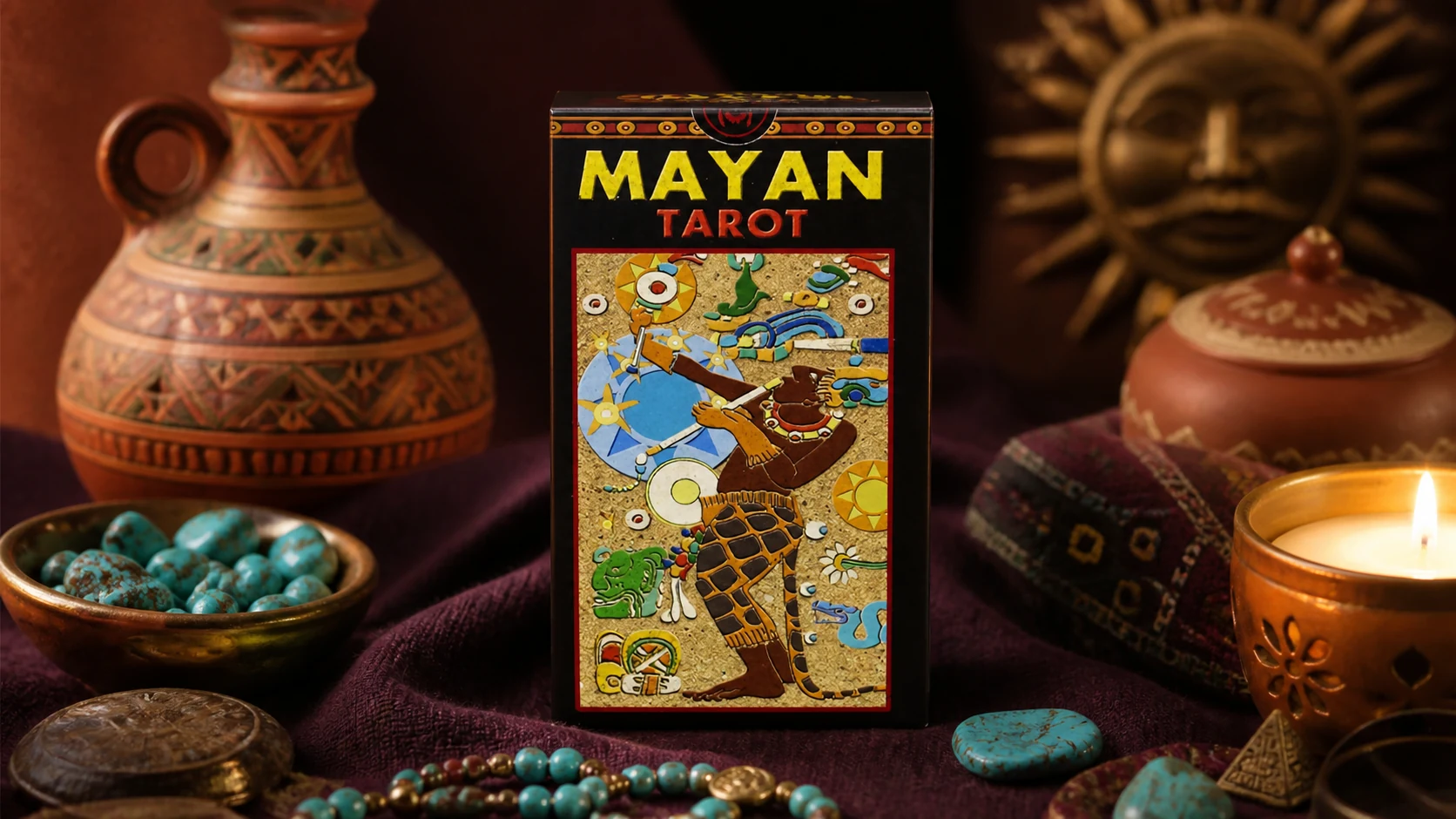
Mayan Tarot is Silvana Alasia’s 78-card Lo Scarabeo deck, first published in this edition in 2008. Its pictorial system recasts tarot through stylized Mesoamerican-inspired figures, glyph-like emblems, animals, architecture, and elemental color fields. It is not a historical reconstruction or a neutral Rider-Waite-Smith clone; it is an artist’s esoteric interpretation, and it reads best when you keep that distinction clear.
I would choose it if you want a visually coherent, symbol-dense deck that slows you down and rewards close looking. Beginners can use it, but readers who need familiar RWS scenes on every pip card will have a steeper learning curve.
When I meet the High Priestess here, her still blue-and-white figure feels like a quiet doorway set between curling green vines and warm stepped walls. I notice her calm before I chase every glyph; in a reading, that pause asks me to listen for what the question already knows beneath its noise.
The Fool, Magician and Lovers make that listening practical. The Fool opens a bright field of possibility, the Magician gathers scattered signs into deliberate action, and the Lovers bring the heart of the choice into view. I let the black frames hold each scene like a page in one painted manuscript, then watch which colour, gesture or repeated emblem answers the cards beside it.
I love how this deck rewards patience without dimming its fire. Give its symbols room to breathe, trust the detail that first catches your eye, and Mayan Tarot can turn a complicated question into a brave, vivid next step.
What Makes This Deck Different?
The Major Arcana retains the familiar 22-card sequence, while the four suits are expressed through torches, terracotta vessels, solar discs, and spears. The black frames, sandy grounds, saturated reds, turquoise blues, and profile figures make the deck feel like one continuous painted manuscript rather than 78 unrelated illustrations.
The strongest readings begin with what is visibly happening—direction of gaze, posture, animal presence, repeated circles, blades, flames, and vessels—before adding a memorized tarot keyword. That keeps the imagery active without pretending every motif has one fixed archaeological meaning.
Card study
The Fool: movement before certainty
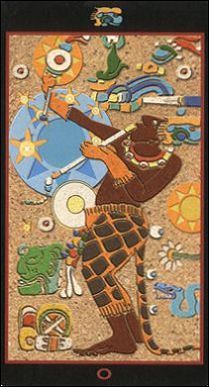
The Fool strides through a crowded field of creatures, discs, tools, and directional forms. The lifted leg and angled body create motion, while the many surrounding symbols make the space feel alive with possibility and distraction. In a reading, this Fool can signal genuine openness, but also the need to notice what enthusiasm is stepping past. Upright, it favors experiment and first-hand learning; in shadow, it asks whether novelty is replacing attention.
How the Mayan Tarot Reads in Practice
This is a medium-speed deck. The palette gives an immediate emotional temperature, but the scenes often need a second look before the practical message becomes clear. I would use it for identity, direction, creative work, spiritual practice, and pattern-focused readings rather than very literal timing questions.
For a three-card spread, try what is being shown / what is being concealed / what restores movement. Keep the guidebook nearby for the first several readings, then record the symbols that repeat across your own pulls.
Four-card moment
Authority, relationship, motion, and balance
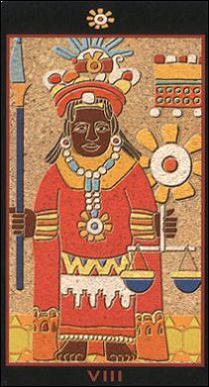
The Emperor, The Lovers, The Chariot, and Justice form a useful decision sequence: define the structure, name the bond or value at stake, choose a direction, then test the choice against balance and consequence. Together they show how this deck turns abstract archetypes into firm bodies, ritual objects, and directional geometry.


Is It Beginner-Friendly?
Yes—with a caveat. The card names and sequence provide a conventional tarot backbone, but the visual storytelling is not the familiar Pamela Colman Smith vocabulary. A new reader who enjoys comparing images and keeping notes can learn with it. Someone wanting instant scene-by-scene RWS recognition may be happier starting elsewhere and returning to this deck later.
- Easy prompt: What deserves my attention today?
- Medium prompt: Which repeated pattern is shaping this choice?
- Hard prompt: What story am I imposing on a symbol before I have actually observed it?
Card study
Strength: power held in relationship

Strength places a standing figure beside an orange feline, with hands, eyes, and circular emblems repeating through the scene. The visual tension is not simply domination; human and animal presences share the frame. In a reading, the card favors steadiness, embodied courage, and respect for instinct. Its shadow appears when control becomes performance or when raw reaction is mistaken for authority.
Art Style and Deck Personality
Alasia’s flat perspective, patterned clothing, emphatic outlines, and earth-and-jewel palette give the deck a ceremonial personality. Court cards feel especially formal, while the numbered minors are sparer and more emblematic. That contrast can be useful: Majors and courts speak through character and role; many pip cards speak through number, suit, rhythm, and arrangement.
The deck is serious without being visually grim. Humor and strangeness appear in animals, masks, gestures, and crowded compositions, but the overall tone remains deliberate.
Four-card moment
How the four suits change the question
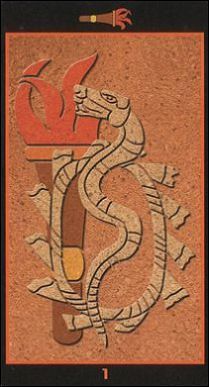
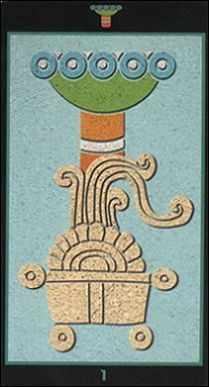
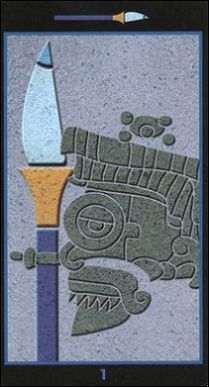
Ace of Wands, Ace of Cups, Ace of Pentacles, and Ace of Spears present four distinct beginnings: ignition, receptivity, material seed, and decisive edge. When two or more appear together, ask whether the new beginning needs energy, emotional capacity, practical form, or a clear boundary first.

Who Will Enjoy This Deck?
It suits collectors of Lo Scarabeo art decks, visual journalers, readers interested in comparative symbolism, and anyone who prefers a consistent invented world over contemporary everyday scenes. It also works well for readers who want court cards and Majors to feel stately rather than conversational.
Skip it if you need historically exact Maya iconography, scenic RWS pips, inclusive modern settings, or a deck that can be read fluently without study. The product is tarot art inspired by Mesoamerican visual culture; it should not be treated as an academic cultural source.
Card study
The Hanged Man: suspension as a crowded threshold
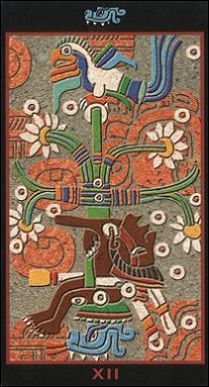
The Hanged Man is surrounded by interlocking beings, eyes, teeth, and curling forms, with the central body held in an inverted, compressed arrangement. The image makes suspension feel active rather than empty. In a reading, it can describe a pause full of competing signals: stop forcing resolution, observe which voice keeps returning, and let perspective reorganize before acting. In shadow, the same density can become paralysis by interpretation.
What to Know Before Buying
This is a standard 78-card tarot deck. The reviewed edition is associated with ISBN 9780738713861 and multilingual Lo Scarabeo presentation. Verify the listing photos and ISBN when buying used, because box designs and language packaging can vary by market.
Golden rule: describe the card before you explain it. With this deck, one accurately observed posture, animal, color, or repeated shape is more useful than a paragraph of borrowed symbolism.
Four-card moment
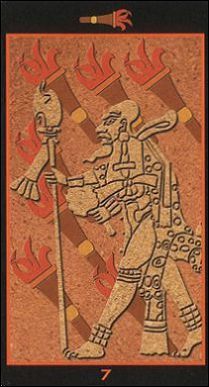
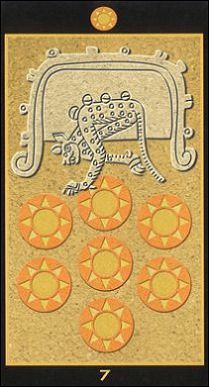
Sevens: pressure, testing, and pattern
Seven of Wands, Seven of Cups, Seven of Pentacles, and Seven of Spears show how a shared number changes across the suits. Fire tests resolve, water tests the arrangement of feeling and possibility, earth tests patience with results, and spears test strategy under pressure. Compare their spacing and repetition before deciding which kind of challenge is present.


Final Thoughts
Mayan Tarot is memorable because its visual language is so committed. The black frames, mineral colours and emblem-rich scenes ask you to slow down, notice what is actually visible, and let repeated gestures build the message.
Approach it as Silvana Alasia’s imaginative tarot world rather than a historical reconstruction, and it becomes a vivid companion for reflective questions, creative decisions and patient visual reading.
Mayan Tarot FAQ
What structure does the Mayan Tarot follow?
The Mayan Tarot follows the traditional Major and Minor Arcana structure while translating the familiar system into Silvana Alasia’s distinctive visual language.
Why is the Gallery a curated selection?
The Gallery respects the publisher’s online-review image allowance, so it presents a balanced selection rather than reproducing the entire deck.
Is the Mayan Tarot historically authentic?
It is an esoteric tarot artwork inspired by Mesoamerican visual material, not an archaeological handbook or a historically exact reconstruction. Treat the deck’s imagery as the artist’s interpretive system.
Does it follow Rider-Waite-Smith meanings?
It keeps the familiar 78-card tarot structure and recognizable archetypes, but its visual scenes and suit emblems differ. Traditional meanings help, while close observation is essential.
Is it good for beginners?
It can be, especially for visual learners willing to use the guidebook and journal repeated symbols. Readers wanting immediately familiar RWS scenes may find it intermediate rather than effortless.
Which readings suit it best?
It is strongest for identity, creative direction, spiritual practice, pattern recognition, and reflective decision-making. Its dense imagery is less suited to rigid yes-or-no or exact-timing questions.